AWS

Search documents
台积电2nm产能已被预订一空,科创半导体ETF(588170)和半导体设备ETF华夏(562590)直线拉升
Mei Ri Jing Ji Xin Wen· 2026-02-03 06:57
Group 1 - The Shanghai Stock Exchange's Sci-Tech Innovation Board semiconductor materials and equipment index rose by 1.96%, with notable gains from stocks such as Oulain New Materials (up 7.67%) and Xingfu Electronics (up 6.94%) [1] - The CSI semiconductor materials and equipment index increased by 2.22%, with Longchuan Technology rising by 6.19% and Huafeng Measurement Control by 5.96% [1] - The Sci-Tech semiconductor ETF (588170) saw a price increase of 2.00%, reaching 1.74 yuan, while the semiconductor equipment ETF (Huaxia, 562590) rose by 2.29%, with a latest price of 1.88 yuan [1] Group 2 - The Sci-Tech semiconductor ETF experienced a significant inflow of funds, totaling 6.16 billion yuan over four days, with a peak single-day inflow of 3.43 billion yuan [2] - In the last ten trading days, there were net inflows on eight days, accumulating to 2.08 billion yuan, with an average daily inflow of 20.81 million yuan [2] - TSMC's 2nm capacity has been fully booked by global tech giants, with AMD planning to produce 2nm CPUs starting in 2026, and Google and AWS expected to adopt this technology in 2027 [2] Group 3 - The Sci-Tech semiconductor ETF and its linked funds track the semiconductor materials and equipment index, focusing on companies in semiconductor equipment (60%) and materials (25%) [3] - The semiconductor equipment ETF (Huaxia) also emphasizes semiconductor equipment (63%) and materials (24%), targeting the upstream semiconductor sector [3] - The semiconductor equipment and materials industry is crucial for domestic substitution, benefiting from low domestic replacement rates and high ceilings for domestic alternatives [3]




AI人工智能ETF(512930)盘中成交1.82亿,台积电2nm产能已被预订一空
Xin Lang Cai Jing· 2026-02-03 06:08
Group 1 - The core viewpoint of the news highlights the performance of the AI sector, with the Zhongzheng AI Theme Index showing a slight increase of 0.04% and specific stocks like Chipone and Huaguan rising significantly [1] - The AI Artificial Intelligence ETF experienced a minor decline of 0.35%, with a latest price of 2.31 yuan and a trading volume of 1.82 billion yuan during the session [1] - TSMC's 2nm production capacity has been fully booked by global tech giants, with AMD planning to start production in 2026, while Google and AWS are expected to adopt this technology in 2027 [1] Group 2 - According to Dongfang Securities, the demand for high-performance storage devices is surging due to the rapid expansion of AI inference application scenarios, with Enterprise SSD prices expected to increase by 53-58% in Q1 2026, marking a historical high for quarterly growth [2] - Server DRAM contract prices are projected to rise by 90-95%, the highest increase on record, indicating a shift from structural to global storage shortages driven by AI [2] - The Zhongzheng AI Theme Index includes 50 listed companies involved in providing resources, technology, and application support for AI, reflecting the overall performance of AI-related securities [2] Group 3 - The AI Artificial Intelligence ETF closely tracks the Zhongzheng AI Theme Index, which is composed of companies that support AI development [3]
寒武纪一度跌近14%,官方发声!科创芯片ETF汇添富(588750)深V翻红,连续4日“吸金”超1.7亿元!涨价潮提振,存储龙头业绩大面积预喜
Sou Hu Cai Jing· 2026-02-03 05:36
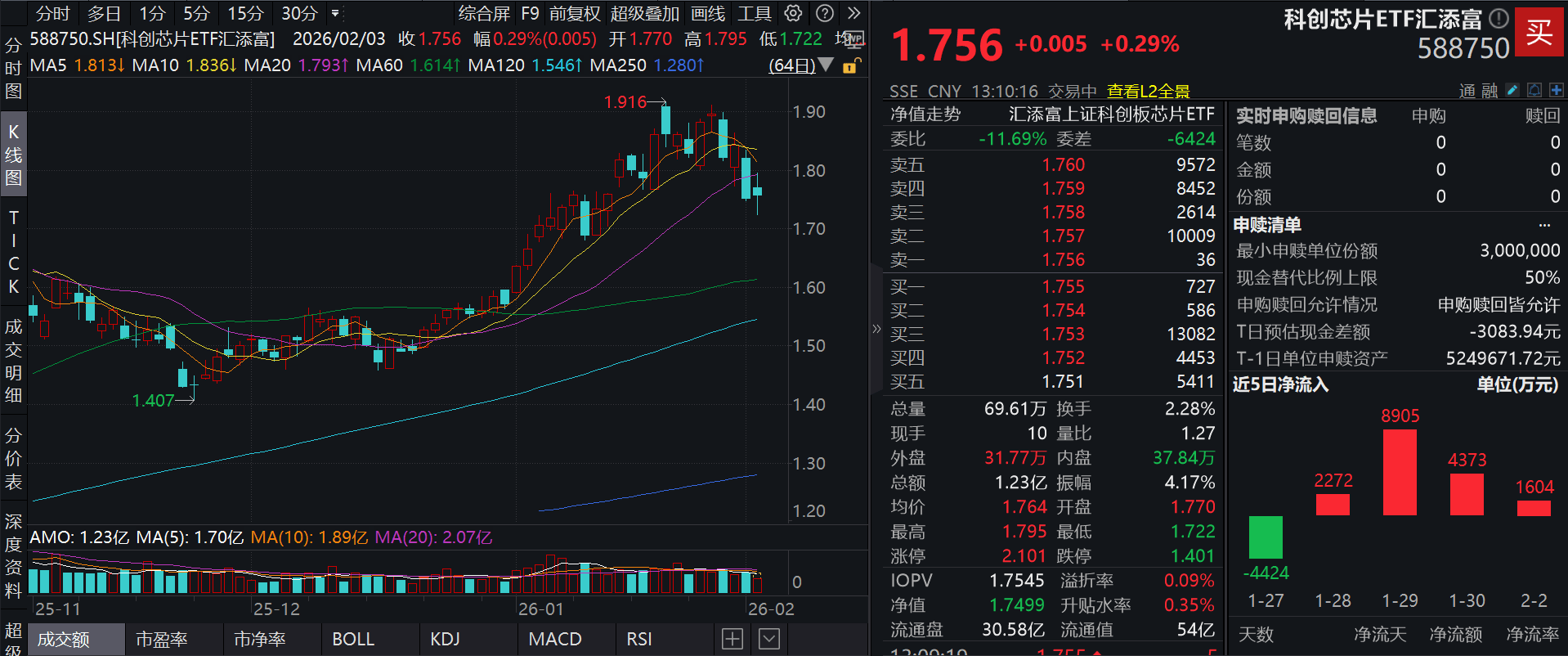
截至2026年2月3日 13:10,上证科创板芯片指数(000685)上涨0.21%,成分股华峰测控上涨6.95%,芯原股份上涨6.75%,联芸科技上涨4.24%,天岳先进上涨 4.22%,睿创微纳上涨3.94%。科创芯片ETF汇添富(588750)上涨0.29%,最新价报1.75元。拉长时间看,截至2026年2月2日,科创芯片ETF汇添富近1月累计 上涨11.46%。(以上所列股票仅为指数成份股,无特定推荐之意) 流动性方面,科创芯片ETF汇添富盘中换手2.28%,成交1.23亿元。拉长时间看,截至2月2日,科创芯片ETF汇添富近1月日均成交2.11亿元,居可比基金前 3。 TrendForce指出,存储芯片领域两大主要产品类别DRAM与NAND闪存现货价格累计上涨超过300%。2026年第一季AI与数据中心需求持续加剧全球存储器供 需失衡,原厂议价能力有增无减,预估NAND Flash合约价则从季增33-38%上调至55-60%,并且不排除仍有进一步上修空间。 Wind数据显示,受涨价潮提振,截至2月2日,41家存储概念公司中,25家披露业绩预告,其中16家预喜,多家公司在2025年第四季度业绩提升明显。 ...


高盛表示DRAM合约价格不跌反升;台积电2nm产能已被预订一空
Mei Ri Jing Ji Xin Wen· 2026-02-03 02:21
Market Performance - The Shanghai Composite Index fell by 2.48% to close at 4015.75 points, while the Shenzhen Component Index dropped by 2.69% to 14128.87 points, and the ChiNext Index decreased by 2.46% to 3264.11 points [1] - The Kweichow Moutai Semiconductor ETF (588170) declined by 5.49%, and the Huaxia Semiconductor Equipment ETF (562590) fell by 5.02% [1] - In contrast, the overnight U.S. market saw the Dow Jones Industrial Average rise by 1.05%, the Nasdaq Composite increase by 0.56%, and the S&P 500 gain 0.54% [1] Industry Insights - Goldman Sachs indicated that despite fluctuations in the spot market, DRAM contract prices are expected to rise significantly, with global storage supply-demand imbalance worsening in Q1, leading to increased forecasts for DRAM and NAND products [2] - TSMC's 2nm capacity has been fully booked by global tech giants, with AMD planning to produce 2nm CPUs starting in 2026, and Google and AWS expected to adopt this technology in Q3 and Q4 of 2027, respectively [2] - PRAM's recent institutional research highlighted that the overall capacity of NOR Flash is linked, with high-value large-capacity products experiencing early price increases due to supply shortages and demand stimulation, leading to a gradual price increase for medium and small-capacity products [2] Company Performance - According to Citic Securities, the global wafer foundry industry remains robust due to the rapid growth in AI computing demand, with TSMC's revenue expected to reach NT$1.05 trillion in Q4 2025, marking a 20.45% year-on-year increase and setting a quarterly record [3] - TSMC's annual revenue is projected to grow by 31.60% to NT$3.81 trillion, indicating significant growth potential compared to mainland China's wafer foundry companies [3] - The Kweichow Moutai Semiconductor ETF (588170) and its linked funds focus on semiconductor equipment and materials, benefiting from the AI revolution and domestic substitution trends in the semiconductor industry [3]
半导体早参丨高盛表示DRAM合约价格不跌反升;台积电2nm产能已被预订一空
Mei Ri Jing Ji Xin Wen· 2026-02-03 01:35
1、高盛表示,尽管现货市场出现波动,但DRAM的合约价格不仅未跌,反而迎来了更猛烈的上涨预 期。另有机构指出,Q1全球存储供需失衡加剧,全面上调DRAM、NAND产品Q1环比增幅。 2、台积电的2nm产能已被全球科技巨头的订单全部预订完毕。其中,AMD计划于2026年开始生产基于 2nm工艺的CPU,而谷歌和AWS据称分别计划于2027年第三季度和第四季度采用该工艺。此外,英伟达 计划于2028年推出其"Feynman AI"GPU,预计将采用台积电的A16工艺,该工艺采用背面供电设计。 2月2日,截至收盘,沪指跌2.48%,报收4015.75点;深成指跌2.69%,报收14128.87点;创业板指跌 2.46%,报收3264.11点。科创半导体ETF跌5.49%,半导体设备ETF华夏跌5.02%。 隔夜外盘:截至收盘,道琼斯工业平均指数涨1.05%;纳斯达克综合指数涨0.56%;标准普尔500种股票 指数涨0.54%。费城半导体指数涨1.70%,恩智浦半导体涨2.18%,美光科技涨5.51%,ARM涨1.49%, 应用材料涨1.89%,微芯科技涨2.85%。 行业资讯: 财通证券指出,在人工智能算力需求快速 ...
美股异动丨台积电涨幅扩大至2.5% 据称公司2nm产能已被预订一空
Ge Long Hui· 2026-02-02 15:43
入选了2026年格隆汇"全球视野"十大核心资产名单的台积电(TSM.US)涨幅扩大至2.5%。据悉,台积电 的2nm产能已被全球科技巨头的订单全部预订完毕。其中,AMD计划于2026年开始生产基于2nm工艺的 CPU,而谷歌和AWS据称分别计划于2027年第三季度和第四季度采用该工艺。此外,英伟达计划于 2028年推出其"Feynman AI"GPU,预计将采用台积电的A16工艺,该工艺采用背面供电设计。 ...
第三代特斯拉人形机器人即将亮相;白银跌超15%,三个交易日抹平一个月涨幅;黄金一度跌破4500美元,花旗:估值已达极端水平【美股盘前】
Mei Ri Jing Ji Xin Wen· 2026-02-02 12:32
每经记者|宋欣悦 每经编辑|陈柯名 高涵 ① 【三大期指齐跌】截至发稿,道指期货跌0.63%、标普500指数期货跌0.90%、纳指期货跌1.18%。 ② 【白银日内跌超15%,三个交易日抹平一个月涨幅】国际黄金和白银价格2日大幅下跌,其中黄金期货价格一度回落至每盎司4500美元下方,白银期货 价格一度跌至每盎司72.35美元。与1月29日创下的历史最高点相比,2日白银价格盘中低点的累计跌幅已达40%,金价累计跌幅约20%。现货白银日内跌超 15%报71.5美元/盎司,较历史高位回落50美元,仅三个交易日抹平一个月涨幅。 ③ 【中概股普跌,小鹏汽车跌5.5%】中概股盘前普跌。截至发稿,阿里巴巴跌2.7%,拼多多跌1.6%,网易跌2.5%,百度跌2.8%,京东跌2.0%,小鹏汽车 跌5.5%。 ④ 【台积电2nm产能已被预订一空】2月2日,据媒体报道,台积电的2nm产能已被全球科技巨头全部预订。其中,AMD计划于2026年开始生产基于2nm工 艺的CPU,而谷歌和AWS据称分别计划于2027年第三季度和第四季度采用该工艺。此外,英伟达计划于2028年推出其"Feynman AI"GPU,预计将采用台 积电的A16 ...


「美股盘前」第三代特斯拉人形机器人即将亮相;白银日内跌超15%,三个交易日抹平一个月涨幅;黄金一度跌破4500美元,花旗:估值已达极端水平;拟再融资50...
Mei Ri Jing Ji Xin Wen· 2026-02-02 10:28
① 【三大期指齐跌】截至发稿,道指期货跌0.63%、标普500指数期货跌0.90%、纳指期货跌1.18%。 ② 【白银日内跌超15%,三个交易日抹平一个月涨幅】国际黄金和白银价格2日大幅下跌,其中黄金期 货价格一度回落至每盎司4500美元下方,白银期货价格一度跌至每盎司72.35美元。与1月29日创下的历 史最高点相比,2日白银价格盘中低点的累计跌幅已达40%,金价累计跌幅约20%。现货白银日内跌超 15%报71.5美元/盎司,较历史高位回落50美元,仅三个交易日抹平一个月涨幅。 ⑧ 【计划再融资500亿美元"续命",甲骨文跌超5%】甲骨文盘前跌超5%。消息面上,周日,甲骨文宣 布今年拟筹资450亿至500亿美元,用以扩张AI数据中心,而此前多家投行已发出警告,称其可能最早 在2026年底耗尽现金。据媒体报道,由于对甲骨文融资能力的担忧,多家美国银行已停止向其数据中心 项目提供贷款。 ⑨ 【CoreWeave跌3.3%,近期遭多位公司高管及董事减持股票】CoreWeave跌3.3%。消息面上,近期多 位公司高管及董事减持股票,其中,公司首席执行官兼总裁Michael N Intrator于1月28日出售824 ...
智算产业竞争加剧:国产芯片与场景应用如何更好携手前行?
半导体行业观察· 2026-02-02 01:33
Core Insights - The rise of artificial intelligence (AI) is driving unprecedented growth in the semiconductor market, with AI semiconductors expected to account for nearly one-third of total sales by 2025 and over 50% by 2029 [1][2] Group 1: AI Chip Demand and Supply - A healthy collaboration between AI chip companies and clients is essential for mutual benefits and long-term stability, requiring high-performance, cost-effective, and reliable products from chip manufacturers [2] - Major players like Nvidia and AMD have emerged as winners in the AI wave due to their advanced hardware and software strategies [2] - Internet giants are becoming key buyers in the AI chip market, with startups like OpenAI also competing [2] Group 2: Capital Expenditure Trends - Capital expenditures for major data center operators such as Microsoft, Meta, Alphabet, and Amazon are projected to rise from approximately $350 billion in 2025 to over $470 billion [3] - In China, companies like ByteDance, Alibaba, and Tencent are expected to account for nearly 50% of AI capital expenditures by 2028 [3] - Tencent's founder emphasized that AI is currently the only area worth investing in for the company [3] Group 3: AI Chip Supply Challenges - Companies like xAI and OpenAI are exploring both third-party procurement and self-developed chips to secure supply, highlighting the importance of reliable AI chip suppliers [4] - The collaboration between Tencent and domestic AI chip company Suiyuan Technology serves as a model for the development of the domestic AI chip industry [4][6] Group 4: Suiyuan Technology's Development - Suiyuan Technology has developed a complete product system covering chips, acceleration cards, clusters, and software platforms, achieving significant milestones since its establishment [5] - The company is expected to reach breakeven by 2026, showcasing its strong capabilities compared to other domestic AI chip startups [5] - The partnership with Tencent has evolved from small-scale validations to deep strategic cooperation, providing support for various applications [5][6] Group 5: Customer Concentration Issues - Suiyuan Technology faces a high customer concentration risk, with significant revenue dependence on Tencent, which accounted for 71.84% of its sales in recent periods [8][9] - This concentration is common among domestic AI chip suppliers and reflects the industry's characteristics and current market conditions [8][9] - The high R&D costs in the AI chip industry necessitate close collaboration with major clients to adapt products to real-world applications [9] Group 6: Future Market Dynamics - The AI chip sector remains competitive, with companies like Nvidia investing in acquisitions to strengthen their market position [10] - Ensuring rapid hardware updates, continuous software optimization, and stable chip production capacity are critical for domestic AI chip companies to gain market recognition [10]


台积电2nm,被疯抢
半导体行业观察· 2026-02-02 01:33
Core Viewpoint - The global AI and HPC chip competition has officially entered the 2nm era, with TSMC initiating a "preparation mode" for advanced process technology [2] Group 1: 2nm Process Development - TSMC's 2nm (N2) process represents a significant shift from FinFET to GAAFET architecture, with strong demand from clients exceeding expectations [2] - Major clients for the 2nm process include Apple and Qualcomm, with general-purpose GPUs and ASICs expected to ramp up production starting next year [2][3] - TSMC's N2 family is projected to have a larger scale and longer lifecycle than the 3nm process, with mass production expected to ramp up in 2026 [3] Group 2: Advanced Packaging Technologies - TSMC is simultaneously upgrading its advanced packaging systems to meet the demands of AI chips, which are moving towards multi-chiplet and large package sizes [3] - The company is expected to increase its CoWoS monthly capacity by over 70% this year, while also validating next-generation technologies like CoWoP and CPO [3] - The ability to produce high-yield large system-level packages is critical for the semiconductor ecosystem's resilience [3]