台积电

Search documents
昨夜!全线暴跌!
证券时报· 2025-11-05 00:12
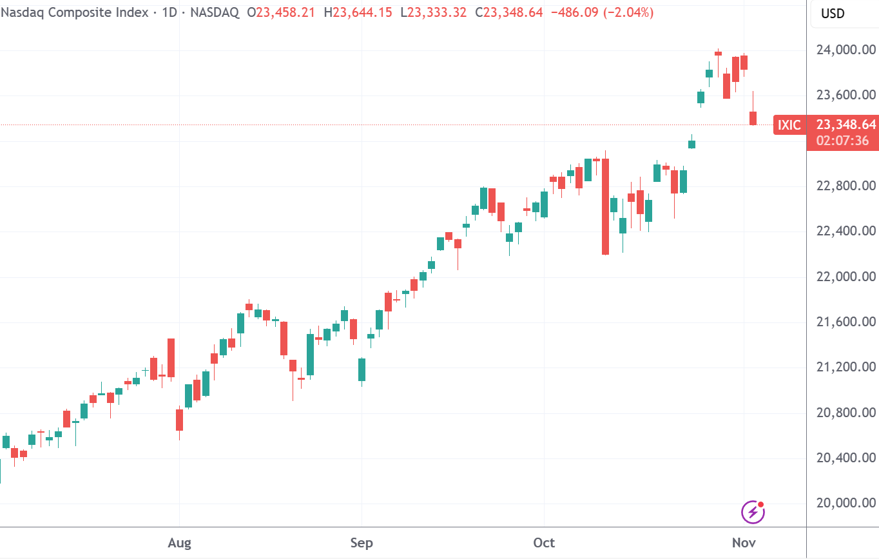
Market Overview - On November 4, US stock markets experienced a significant decline, with all three major indices closing lower. The Dow Jones Industrial Average fell by 0.53% to 47,085.24 points, the S&P 500 dropped by 1.17% to 6,771.55 points, and the Nasdaq Composite decreased by 2.04% to 23,348.64 points [4][5] - The Philadelphia Semiconductor Index saw a sharp decline of over 4%, negatively impacting the overall performance of US stocks [3][7] - Major technology stocks mostly fell, with Tesla down over 5%, Nvidia down nearly 4%, and Google down over 2%. Only Apple saw a slight increase of 0.43% [5][6] Sector Performance - The airline sector faced collective losses, with American Airlines and United Airlines both dropping over 5%, and Delta Airlines falling nearly 5% [6] - In the semiconductor sector, Micron Technology fell over 7%, Intel dropped more than 6%, and several other companies like ARM and Qualcomm also experienced declines of over 4% [7] Cryptocurrency Market - The cryptocurrency market saw a widespread decline, with Bitcoin briefly falling below the $100,000 mark. Over 47,000 traders faced liquidation within 24 hours [2][11] - As of the latest update, Bitcoin recovered slightly to above $101,000, while Ethereum's decline was around 8.7% [11][13] Economic Context - The US federal government has been in a shutdown for 35 days, matching the previous record set during Trump's presidency. This shutdown is expected to continue as attempts to pass a temporary funding bill have failed [15][16]








刚刚,全线崩跌!投资大佬“杀疯”,泡沫破了?
Zheng Quan Shi Bao· 2025-11-05 00:02
Core Viewpoint - Michael Burry, a well-known investor, is heavily shorting AI stocks like Nvidia and Palantir, raising concerns about potential market corrections and the sustainability of current valuations in the tech sector [1][2][6]. Group 1: Market Performance - The U.S. stock market experienced significant declines, with the Nasdaq dropping over 2%, the S&P 500 falling more than 1%, and the Dow Jones decreasing by 0.53% [1]. - Major tech stocks faced severe sell-offs, including Tesla down over 5%, Nvidia down nearly 4%, and Palantir down almost 8% [1]. Group 2: Burry's Short Position - Michael Burry's Scion Asset Management has a short position in Nvidia and Palantir, with a total nominal value of over $1 billion in put options, representing 80% of the firm's portfolio [2][3]. - The put options for Palantir are valued at approximately $912 million, while those for Nvidia are around $186 million [2]. Group 3: Stock Price Movements - Despite the recent downturn, both Palantir and Nvidia saw price increases after September 30, with Palantir rising 4.6% and Nvidia increasing 6.5% [3]. - Palantir reported a 63% year-over-year revenue growth in Q3, reaching $1.181 billion, and raised its revenue guidance for Q4 and 2025 [4]. Group 4: Company Background - Palantir specializes in big data analytics, primarily serving U.S. defense and financial sectors, and has launched an AI platform integrating large language models [4]. - The company's stock has surged over 152% year-to-date, with a market capitalization of approximately $452.5 billion [4]. Group 5: Market Sentiment and Warnings - Several Wall Street executives, including Goldman Sachs' CEO, have expressed concerns about high valuation levels in the U.S. stock market, predicting potential corrections of 10% to 20% in the next 12 to 24 months [2]. - Burry's warnings about market bubbles and the potential for significant losses highlight the risks associated with current market conditions [6][7].
全线崩跌!投资大佬“杀疯” 大举做空“AI大牛股” 泡沫破了?
Zheng Quan Shi Bao Wang· 2025-11-04 23:55
Core Viewpoint - Michael Burry, a well-known investor, is heavily shorting AI stocks like Nvidia and Palantir, indicating a bearish outlook on the market amid concerns of overvaluation and potential market corrections [1][3][5]. Group 1: Market Performance - The U.S. stock market experienced significant declines, with the Nasdaq dropping over 2%, the S&P 500 down more than 1%, and the Dow Jones falling 0.53% [1]. - Major tech stocks faced severe sell-offs, including Tesla down over 5%, Nvidia nearly 4%, and Palantir dropping close to 8% [1]. Group 2: Michael Burry's Position - Burry's Scion Asset Management has approximately 80% of its portfolio in put options on Nvidia and Palantir, with a total nominal value exceeding $10 billion [3]. - The put options for Palantir are valued at $9.12 billion (equivalent to 5 million shares), while those for Nvidia are valued at $1.86 billion [3]. - Despite the recent drop in stock prices, both Palantir and Nvidia have seen price increases since the reporting date, potentially leading to significant losses for Burry's short positions [3][6]. Group 3: Company Performance and Outlook - Palantir reported a strong Q3 with a 63% year-over-year revenue increase to $1.181 billion, surpassing market expectations [4]. - The company raised its revenue guidance for Q4 and 2025, projecting over 104% growth in U.S. commercial business revenue [4]. - Analysts express concerns that Palantir's stock price may be detached from its fundamentals, especially if the AI hype fades or customer growth slows [4]. Group 4: Broader Market Concerns - Several Wall Street executives, including Goldman Sachs' CEO, have warned about the current valuation levels of U.S. stocks, predicting a potential 10% to 20% correction in the next 12 to 24 months [2]. - Burry's recent warnings about market bubbles suggest a broader concern regarding the sustainability of the current market rally, particularly in AI stocks [5].
全线崩跌!投资大佬“杀疯”,泡沫破了?
Zheng Quan Shi Bao· 2025-11-04 23:52
Core Viewpoint - Michael Burry, a well-known investor, is heavily shorting AI stocks like Nvidia and Palantir, indicating a bearish outlook on the market, particularly in the tech sector, amidst concerns of overvaluation and potential market corrections [1][3][6]. Group 1: Market Performance - The U.S. stock market experienced significant declines, with the Nasdaq dropping over 2%, the S&P 500 down more than 1%, and the Dow Jones falling 0.53% [1]. - Major tech stocks faced severe sell-offs, including Tesla down over 5%, Nvidia down nearly 4%, and Palantir down nearly 8% [1]. Group 2: Burry's Short Positions - Michael Burry's Scion Asset Management has approximately 80% of its portfolio concentrated in short positions on Nvidia and Palantir, with a total nominal value of over $10 billion in put options [3]. - The put options for Palantir are valued at $912 million (equivalent to 5 million shares), while those for Nvidia are valued at $186 million [3]. Group 3: Company Performance and Valuation Concerns - Palantir reported a third-quarter revenue growth of 63% year-over-year, reaching $1.181 billion, significantly exceeding market expectations [4]. - Despite strong earnings, analysts express concerns about Palantir's stock price being detached from its fundamentals, especially if the AI hype fades [4]. - Nvidia has become the first company to surpass a market capitalization of $5 trillion, raising concerns about its valuation relative to broader economic indicators [6]. Group 4: Market Sentiment and Warnings - Several Wall Street executives, including Goldman Sachs' CEO, have warned of potential market corrections of 10% to 20% within the next 12 to 24 months due to high valuation levels [2]. - Burry's previous warnings about market bubbles and his recent social media activity suggest he believes the current AI stock frenzy may be unsustainable [6][7].
CoWoS产能缺口扩大 英伟达、AMD等客户争抢是主因
Jing Ji Ri Bao· 2025-11-04 23:48
Core Insights - Aletheia Capital's report highlights a significant underestimation of the demand for advanced packaging, particularly CoWoS, driven by emerging AI applications [1] - The report predicts a substantial capacity shortfall for TSMC's CoWoS technology, with a projected gap of 400,000 units in 2026 and 700,000 units in 2027, indicating a severe supply-demand imbalance [1] Group 1: Demand Drivers - The growth in GPU shipments and the rapid expansion of photomask sizes are identified as the two main drivers for CoWoS demand [1] - New devices such as server CPUs, high-end PCs, and gaming console chips are expected to adopt CoWoS technology starting in the second half of this year, with a significant acceleration anticipated by 2026 [1] Group 2: Beneficiaries - Aletheia names six Taiwanese companies—TSMC, ASE Technology Holding, Kyec, ChipMOS, Wistron NeWeb, and Hongjing Precision—as beneficiaries of the positive industry trend, recommending a "buy" for these stocks [1] - TSMC's CoWoS-dependent chips include products from Nvidia, AMD, Microsoft, and Broadcom, indicating a broad reliance on TSMC's advanced packaging capabilities [2] Group 3: Capacity Expansion Challenges - Despite TSMC's plans to quadruple CoWoS capacity between 2024 and 2027, this expansion is expected to fall short of the rapidly growing demand, prompting customers to seek assistance from packaging manufacturers [2] - Companies like ASE and Amkor are expected to play crucial roles in packaging for new products, with significant increases in CoWoS demand projected between 2025 and 2027 [2] Group 4: Testing and Outsourcing - Kyec is set to benefit from strong growth in testing services for Broadcom's AI ASICs starting in 2026, as well as from TSMC's outsourcing of wafer probing tests [2] - Wistron NeWeb is also expected to gain from TSMC's outsourcing strategy, as packaging manufacturers increasingly adopt Wistron NeWeb's solutions [2]
刚刚,全线崩跌!投资大佬"杀疯",泡沫破了?
券商中国· 2025-11-04 23:47
Core Viewpoint - The article discusses the significant short-selling activities by investor Michael Burry on AI stocks, particularly Palantir and Nvidia, amidst a broader market downturn, raising concerns about potential market bubbles and overvaluation in the tech sector [1][2][3][4][8]. Group 1: Market Performance - The U.S. stock market experienced a sharp decline, with the Nasdaq falling over 2%, the S&P 500 down more than 1%, and the Dow Jones decreasing by 0.53% [1]. - Major tech stocks faced heavy selling, including Tesla down over 5%, Nvidia down nearly 4%, and Palantir down nearly 8% [1]. Group 2: Michael Burry's Short Position - Michael Burry's Scion Asset Management has concentrated approximately 80% of its portfolio on short positions in Palantir and Nvidia, with a total nominal value of over $10 billion in put options [3][4]. - The nominal value of put options for Palantir is reported at $9.12 billion, while for Nvidia it is $1.86 billion [3]. Group 3: Company Performance and Valuation Concerns - Palantir reported a third-quarter revenue growth of 63% year-over-year, reaching $1.181 billion, and raised its guidance for future earnings significantly [4][5]. - Despite the strong earnings, analysts express concerns that Palantir's stock price may be detached from its fundamentals, especially given its year-to-date increase of over 152% [5]. Group 4: Broader Market Warnings - Several Wall Street executives, including Goldman Sachs' CEO David Solomon, have warned of potential market corrections of 10% to 20% within the next 12 to 24 months due to high valuation levels [2]. - Burry's previous warnings about market bubbles and his recent actions suggest a cautious outlook on the sustainability of the current market rally, particularly in AI stocks [7][8].

“大空头”点燃估值忧虑,纳指跌超2%,中概股难逃市场拖累
Feng Huang Wang· 2025-11-04 22:40
Market Overview - The S&P 500 index fell by 1.17% to 6771.55 points, the Nasdaq Composite dropped by 2.04% to 23348.64 points, and the Dow Jones Industrial Average decreased by 0.53% to 47085.24 points, reflecting concerns over high valuations in the U.S. stock market [1] Company Performance - Palantir, a leading AI stock, reported earnings that exceeded expectations and raised its guidance, yet its stock fell by 7.94%, highlighting its status as a representative of the "AI bubble" after a fourfold increase in the past year [2] - Nvidia's stock declined by 3.96%, while other major tech stocks like Apple and Microsoft saw mixed results, with Apple rising by 0.37% and Microsoft falling by 0.52% [8] - Chinese stocks also faced pressure, with the Nasdaq Golden Dragon China Index dropping by 2.05%, including Alibaba down by 2.02% and JD down by 2.93% [8] Economic Indicators - Goldman Sachs and Morgan Stanley executives expressed concerns about a potential 10% to 20% market pullback over the next 12 to 24 months, which has contributed to investor anxiety [6] - The retail investor sentiment index compiled by Goldman Sachs fell by 3.6%, indicating a significant drop in retail investor confidence [5] IPO and M&A Activity - Beta Technologies, an electric aircraft company, completed its IPO at $34 per share, raising over $1 billion, and saw its stock rise by 5.88% despite the overall market downturn [16] - Pfizer and Novo Nordisk are in a bidding war for Metsera, with Pfizer raising its offer to $8.1 billion and Novo Nordisk offering up to $10 billion, leading to a 20.5% increase in Metsera's stock [12] Corporate Developments - IBM announced plans to lay off thousands of employees in Q4, affecting a low single-digit percentage of its global workforce [15] - Amazon has issued a cease-and-desist order to AI startup Perplexity, demanding it stop using its AI browser for shopping on Amazon's platform [10] - Apple is reportedly preparing to enter the low-cost laptop market to attract consumers currently using Chromebooks and entry-level Windows laptops [11]
大举增持美股!QDII基金大动作
证券时报· 2025-11-04 11:46
在科技巨头讲出新的叙事逻辑下,公募QDII正逐步回补美股仓位。 近期,英伟达、微软、谷歌、三星在美股密集发布对AI医疗的投资后,包括张坤等明星基金经理所管公募 QDII大举增加美股仓位,也使不少基金在近期港股调整中降低了回撤风险,借助AI医疗新叙事在近期的强 势,不少前期表现落后的QDII基金业绩加速提升。 驱动QDII基金经理在第三季度末增持美股的核心原因,是近期美股AI医疗赛道开始展现高弹性。 Wind数据显示,以近三个月的弹性收益排名计算,以美股为核心仓位的QDII基金几乎主导了业绩前五名。其 中,易方达基金旗下的易方达全球成长精选基金近三个月的收益率为39%,华夏新时代基金的同期收益率为 36%,嘉实基金旗下的嘉实全球产业基金同期收益为31%,天弘基金旗下的全球高端制造基金同期为30%,创 金合信全球医药生物基金同期收益率约28%。 根据最近一个月的收益率,几乎没有港股仓位的QDII基金,曾是业绩排名的主要受益者。建信基金旗下的建 信新兴市场混合基金近一个月收益率约为11%,在最近一个月内排名QDII第一,而创金合信全球医药生物基金 在最近一个月的收益排名第二,期间业绩回报为10%。 QDII基金强力 ...

大举增持美股,QDII基金大动作
Zheng Quan Shi Bao· 2025-11-04 11:14
Group 1 - The core narrative shift among tech giants like Nvidia, Microsoft, Google, and Samsung is driving public QDII funds to increase their positions in US stocks, particularly in the AI healthcare sector [1][6] - Star fund managers, including Zhang Kun and Li Yaozhu, have significantly raised their US stock allocations, reducing their exposure to Hong Kong stocks amid recent market adjustments [3][4] - The performance of QDII funds has improved, with many previously underperforming funds seeing accelerated gains due to the strong performance of AI healthcare stocks [1][6] Group 2 - The report from GF Global Select Fund indicates that by the end of Q3, the fund's US stock allocation rose to 75%, while its Hong Kong stock allocation dropped to approximately 3.72% [3] - Similarly, the E Fund Global Growth Select Fund saw its US stock allocation increase to 52%, with only about 10% in Hong Kong stocks, focusing on major US tech companies [3] - The Chuangjin Hexin Global Pharmaceutical Fund completely liquidated its Hong Kong stock holdings, increasing its US stock allocation to 71% by the end of September [4] Group 3 - The core reason for the increase in US stock holdings among QDII fund managers is the high elasticity exhibited by the AI healthcare sector in the US market [6] - QDII funds focusing on US stocks have dominated performance rankings, with notable returns such as 39% for E Fund Global Growth Select Fund and 36% for Huaxia New Era Fund over the past three months [6] - Funds with minimal Hong Kong exposure, like the Jianxin Emerging Markets Mixed Fund, have also seen significant returns, ranking first with an 11% return in the last month [6] Group 4 - Recent developments in the US AI healthcare sector, including major collaborations and investments by companies like Nvidia and Microsoft, have significantly contributed to the performance of QDII funds [7] - For instance, the GRAIL company, which focuses on cancer early detection, has seen its stock price rise by 55% after receiving investments from major firms, benefiting funds like Chuangjin Hexin [7] Group 5 - Fund managers are optimistic about the growth potential of AI healthcare, viewing it as a key investment area amid the ongoing technological advancements in the sector [9][10] - The focus is shifting towards AI medical devices and applications with substantial market potential, as evidenced by adjustments in fund holdings [9][10] - The Silver Hua Healthcare Fund has also invested heavily in AI healthcare stocks, emphasizing the underestimated potential of AI technology in the pharmaceutical industry [10]
行业迎来多重利好,科创半导体ETF、科创半导体设备ETF涨超2%
Ge Long Hui A P P· 2025-11-04 05:13
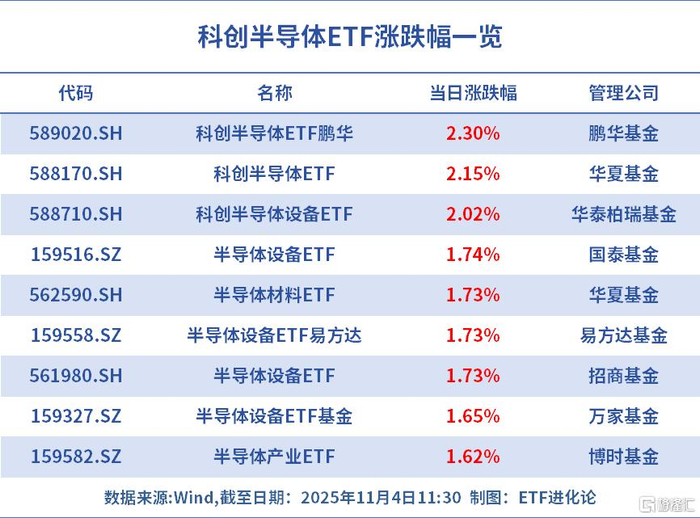
Market Overview - The A-share market experienced a collective decline in the morning session, with the Shanghai Composite Index down 0.19% at 3969.05 points, the Shenzhen Component Index down 1.27%, and the ChiNext Index down 1.51% [1] - The total trading volume in the Shanghai and Shenzhen markets was 123.11 billion yuan, a decrease of 16.74 billion yuan compared to the previous day, with over 3600 stocks declining [1] Semiconductor Sector Performance - The semiconductor sector showed positive performance, with the Kweichow Moutai Semiconductor ETF rising over 7%, and various semiconductor ETFs increasing by more than 2% [1][3] - The semiconductor equipment ETF tracks the CSI Semiconductor Materials and Equipment Index, with semiconductor equipment accounting for 61.4% and semiconductor materials for 21.9% [4] Investment Opportunities - Dongwu Securities highlighted the acceleration of new capacity expansion in storage fabs, indicating a historic development opportunity for domestic semiconductor equipment, with industry order growth expected to exceed 30% and potentially reach over 50% by 2026 [4] - Amazon signed a $38 billion agreement with OpenAI to provide computing power, which is expected to significantly boost the demand for AI-related infrastructure [5][6] Capital Expenditure Trends - North American cloud service providers reported a combined capital expenditure of $113.3 billion in Q3 2025, a 75% year-on-year increase, with a focus on AI infrastructure [6][7] - Companies like Google, Microsoft, and Meta are significantly increasing their capital expenditures for AI and data center infrastructure, indicating strong ongoing demand in the sector [6][7][8] Future Projections - Huawei's report predicts a tenfold increase in total computing power by 2035, emphasizing the transformative potential of general artificial intelligence [8] - The semiconductor industry is expected to benefit from a super cycle driven by AI, covering the entire supply chain from design to manufacturing and upstream equipment materials [8]