中信银行

Search documents
震荡市中“压舱石”:红利低波ETF(512890)近20个交易日吸金14.8亿 机构激辩“春躁”行情方向
Xin Lang Cai Jing· 2026-01-19 04:20
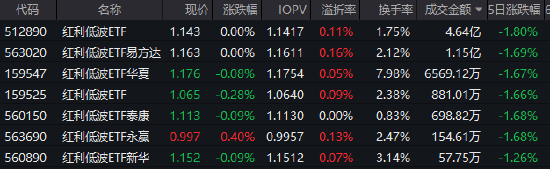
Core Viewpoint - The A-share market showed mixed performance with the Deep Composite Index and ChiNext Index turning negative after an initial rise, while the Dividend Low Volatility ETF (512890) remained flat at 1.143 yuan, leading its category in trading volume and turnover [1][7]. ETF Performance - The Dividend Low Volatility ETF (512890) reported a turnover rate of 1.75% and a trading volume of 4.64 billion yuan, maintaining its position as the top ETF in its category [1][8]. - The ETF's price remained unchanged at 1.143 yuan, with a 5-day decline of 1.80% [2][8]. Top Holdings - The top ten holdings of the Dividend Low Volatility ETF showed mixed performance, with notable movements including: - COFCO Sugar rising by 0.18% - Nanjing Bank declining by 0.57% - South Steel increasing by 2.85% [2][8]. - The specific holding proportions include: - COFCO Sugar: 3.47% - South Steel: 2.83% - Chengdu Bank: 2.82% [2][8]. Fund Flows - The Dividend Low Volatility ETF (512890) has seen significant net inflows, with 290 million yuan over the last 5 trading days, 1.48 billion yuan over the last 20 days, and 3.09 billion yuan over the last 60 days [2][8]. - As of January 16, 2026, the fund's circulation scale was 26.388 billion yuan [2][8]. Market Outlook - Recent macroeconomic data indicates a GDP growth of 5.0% for 2025, with the first, second, and third industries growing by 3.9%, 4.5%, and 5.4% respectively [4][10]. - Analysts suggest that the market may experience consolidation, influenced by complex overseas conditions and domestic regulatory guidance, with a shift towards focusing on individual stock fundamentals [10]. - The sentiment in the market is gradually returning to rationality, with expectations of a transition to a more volatile trading environment as earnings reports approach [5][10]. Fund Characteristics - The Dividend Low Volatility ETF (512890) was established on December 19, 2018, with a total return of 128.48% as of January 16, 2026, outperforming its benchmark [11]. - The fund is positioned as a stable investment tool in volatile markets, with options for investors to participate through regular investment plans [11].

银行业周报:结构性工具降息扩容,对公贷款有望支撑开门红-20260119
Yin He Zheng Quan· 2026-01-19 03:31
Investment Rating - The report maintains a "Recommended" rating for the banking sector, highlighting the continued dividend value of bank stocks and the positive outlook for the sector [39]. Core Insights - The expansion of structural monetary policy tools and interest rate cuts is expected to support banks in stabilizing their interest margins and enhance support for key areas of the real economy [5][39]. - The report anticipates a marginal improvement in corporate financing demand, with public loans expected to continue supporting the bank's credit growth in early 2026 [5][39]. - The report emphasizes the importance of monitoring the effectiveness of policies and the potential for further monetary easing, including a projected 50 basis points (BP) reduction in reserve requirements and a 10-20 BP cut in interest rates throughout the year [8][39]. Summary by Sections Latest Research Insights - The People's Bank of China (PBOC) has reduced the interest rates on various structural monetary policy tools by 25 BP, which is expected to enhance banks' credit allocation to key sectors [7][8]. - The PBOC's measures include increasing the quotas for re-lending to small and medium-sized enterprises and expanding support for technology innovation and green financing [7][8]. Market Performance - The banking sector underperformed the market, with a decline of 3.03% compared to a 0.57% drop in the CSI 300 index [5][15]. - The report notes that only three A-share banks saw an increase in stock prices, while the majority experienced declines [15]. Investment Recommendations - The report suggests focusing on banks that are likely to benefit from the structural monetary policy changes, recommending specific banks such as Industrial and Commercial Bank of China, Agricultural Bank of China, and Postal Savings Bank of China [39]. - The report highlights the ongoing dividend appeal of bank stocks, driven by factors such as low interest rates and substantial dividend payouts [39]. Financial Data - As of December, the total social financing (TSF) showed a year-on-year increase of 8.3%, with corporate loans demonstrating a notable increase, indicating a recovery in financing demand [9][10]. - The report projects that the total new RMB loans in January 2026 will be approximately 5.5-5.6 trillion yuan, with public loans expected to perform slightly better than the previous year [12][39].






华泰研究:结构性降息落地,融资逆周期调节
HTSC· 2026-01-19 03:10
Investment Rating - The report maintains an "Overweight" rating for the securities and banking sectors, while also suggesting a positive outlook for the insurance sector [10][40]. Core Insights - The report highlights a structural monetary policy shift with a focus on "increasing quantity and reducing price," indicating potential for further interest rate cuts and reserve requirement ratio reductions [12][41]. - The A-share market remains active, with an average daily trading volume of 3.47 trillion yuan and a financing balance exceeding 2.7 trillion yuan, marking a new high [12][28]. - The report emphasizes the importance of the recent increase in the minimum margin requirement for financing from 80% to 100%, which aims to stabilize market conditions and reduce leverage [14][18]. Securities Sector Summary - The securities sector is expected to benefit from improved market conditions, with a focus on high-quality brokerage firms such as CITIC Securities and Guotai Junan [3][27]. - The report notes that the recent increase in financing margin requirements is a regulatory measure to control leverage and stabilize market sentiment [14][15]. - CITIC Securities reported a 38% year-on-year increase in net profit for 2025, reflecting strong performance in brokerage and investment banking [27]. Insurance Sector Summary - The insurance sector is advised to focus on high-quality leading companies, as the market has recognized the strong performance of life insurance sales [39]. - The report indicates that the main drivers for insurance stock prices are currently on the asset side rather than the liability side, leading to some price corrections [12][39]. Banking Sector Summary - The banking sector is characterized by a stable performance, with major banks like Shanghai Bank and Nanjing Bank recommended for investment due to their solid fundamentals [3][40]. - The report highlights a decrease in social financing growth, primarily due to high government debt base effects, but notes an increase in corporate loans [42][43]. - The Central Bank's recent policies suggest room for further interest rate cuts, which could enhance the banking sector's profitability [41][40].






20家公司业绩快报抢先看
Zheng Quan Shi Bao Wang· 2026-01-19 01:58
Core Insights - The article discusses the performance forecasts and reports of 20 companies that released their earnings reports for the year 2025, highlighting the accuracy of earnings quick reports compared to earnings forecasts [1] Group 1: Revenue Performance - The highest revenue among the companies that released earnings quick reports is from CITIC Bank, achieving a revenue of 212.475 billion yuan, with a year-on-year decrease of 0.55% [1] - Following CITIC Bank, Shanghai Pudong Development Bank and Yangtze Power reported revenues of 173.964 billion yuan and 85.882 billion yuan, respectively [1] - Out of the 20 companies, 14 reported a year-on-year increase in revenue, with the highest growth rate recorded by Siyuan Electric, which achieved a revenue of 21.205 billion yuan, marking a growth of 37.18% [2] - CITIC Securities and Beiding Co. followed with revenue growth rates of 28.75% and 26.04%, respectively [2] Group 2: Profit Performance - All companies that released earnings quick reports reported profits, with five companies achieving net profits exceeding 10 billion yuan [2] - CITIC Bank led in net profit with 70.618 billion yuan, reflecting a year-on-year increase of 2.98% [2] - Shanghai Pudong Development Bank and Yangtze Power reported net profits of 50.017 billion yuan and 34.167 billion yuan, respectively [2] - Among the companies, 13 reported a year-on-year increase in net profit, with the highest growth seen in Quanyuan Spring, which achieved a net profit of 0.015 billion yuan, up by 147.89% [2] - Beiding Co. and Siyuan Electric also showed significant net profit growth rates of 59.05% and 54.35%, respectively [2]





银行股开年“速冻”,10天跌近 5%登顶跌幅榜
3 6 Ke· 2026-01-19 01:56
Core Viewpoint - The banking sector in A-shares has experienced a decline despite strong fundamentals, with the Shenwan Banking Index down nearly 5% year-to-date, contrasting with the positive performance of the broader market indices [1][4]. Group 1: Market Performance - As of January 16, the Shenwan Banking Index has dropped nearly 5%, leading the declines among Shenwan's primary sectors, resulting in a market capitalization loss exceeding 480 billion yuan [1][4]. - Notable declines include Shanghai Pudong Development Bank down over 11%, and other banks like Nanjing Bank and Agricultural Bank of China also experiencing declines exceeding 5% [1][6]. - The banking sector has seen seven out of ten trading days in decline since the start of 2026, with a total market value reduction of over 480 billion yuan [4]. Group 2: Financial Performance - Recent earnings reports from banks such as Shanghai Pudong Development Bank and CITIC Bank indicate a positive trend, with Shanghai Pudong's net profit for 2025 expected to grow by 10.52% year-on-year [1][3]. - Shanghai Pudong Development Bank reported an operating income of 173.964 billion yuan for 2025, a year-on-year increase of 1.88%, and its total assets surpassed 1 trillion yuan [3]. - Analysts expect the overall performance of listed banks to improve, with projected revenue growth of 1.2% and net profit growth of 1.8% for 2025 [3]. Group 3: Policy Environment - The People's Bank of China announced a 0.25 percentage point reduction in various structural monetary policy tool rates, which is expected to stabilize net interest margin expectations and enhance credit lending willingness [4]. - The reduction in policy rates is anticipated to lower the cost of funds for banks and stimulate credit growth in key areas, contributing to a more favorable operating environment for the banking sector [4]. Group 4: Investment Sentiment - Despite the current downturn, there is a belief among industry insiders that the banking sector holds long-term investment value due to its stable earnings expectations and high dividend yields [2][7]. - Institutional investors, particularly insurance funds, are expected to continue supporting high-dividend banking stocks, with an estimated influx of over 600 billion yuan into the market annually [7][8]. - Recent insider buying activities from bank executives and major shareholders signal confidence in the sector's value, with notable purchases reported from Chongqing Rural Commercial Bank and Nanjing Bank [8].

全国首单“北京城市更新”债券在北交所发行
Xin Lang Cai Jing· 2026-01-19 00:39
Core Viewpoint - Beijing Enterprises Group Co., Ltd. (Beijing Enterprises) has issued the first "Beijing Urban Renewal" bond in the Beijing Stock Exchange, with a scale of 1 billion yuan and a term of 3 years at a record low interest rate of 1.79% for corporate bonds in the same period nationwide [1]. Group 1 - The bond issuance is part of the urban renewal initiative aimed at promoting high-quality urban development and meeting the needs of the people for a better life [1]. - The issuance aligns with the guidelines from the Central Committee regarding the 15th Five-Year Plan, emphasizing the importance of urban renewal and the development of modern, resilient, and smart cities [1]. - Beijing Enterprises, as a major state-owned enterprise in Beijing, is actively involved in key urban renewal projects, including the renovation of old residential areas and the integration of urban renewal with elderly care services [1]. Group 2 - The company has formed the Beijing Urban Renewal Alliance with several central enterprises, municipal state-owned enterprises, and private companies to support the overall layout of urban renewal in the capital [1]. - The bond was underwritten by a leading investment bank, with participation from various financial institutions, indicating strong investor interest [1].

中信行长调任邮储,邮储银行VS中信银行
数说者· 2026-01-19 00:23
Core Viewpoint - The article analyzes the comparison between Postal Savings Bank of China (PSBC) and Citic Bank, particularly in light of the appointment of Lu Wei, the former president of Citic Bank, as the president of PSBC, and discusses the potential impact of this leadership change on PSBC's operations and strategy [2]. Group 1: Background and Structure - PSBC traces its origins back to 1919 with the establishment of postal savings, and it officially became a limited liability company in 2007, transitioning to a joint-stock company in 2012 [3]. - Citic Bank was established in 1987, evolving from the banking department of the former China International Trust Investment Corporation, and was renamed in 2005 [5]. - As of September 2025, PSBC's major shareholders include China Post Group (51.87%), the Ministry of Finance (15.77%), and China Mobile (6.70%) [4]. - Citic Bank's major shareholders include Citic Financial Holdings (64.75%) and the Ministry of Finance (21.30%) [6]. Group 2: Operational Scale and Network - By the end of 2024, PSBC had 7,899 branches across China, leveraging its extensive postal network, while Citic Bank had 1,470 branches in 153 cities [8]. - PSBC's branch network is significantly larger, especially in rural areas, while Citic Bank has international branches in Hong Kong and London [8]. Group 3: Subsidiaries and Business Focus - PSBC has three major subsidiaries focused on consumer finance, wealth management, and direct banking [9]. - Citic Bank operates seven major subsidiaries, including those in international finance and asset management, indicating a broader range of services [10]. Group 4: Financial Performance - As of the end of 2024, PSBC's total assets were CNY 17.08 trillion, compared to Citic Bank's CNY 9.53 trillion, indicating that PSBC's assets are approximately twice that of Citic Bank [13][14]. - In terms of net profit, PSBC reported CNY 864.79 billion in 2024, while Citic Bank reported CNY 685.76 billion, showing PSBC's profitability advantage [13]. - PSBC's non-performing loan ratio was 0.90% in 2024, lower than Citic Bank's 1.16%, indicating better asset quality [14][37]. Group 5: Income Structure and Cost Efficiency - PSBC's operating income heavily relies on net interest income, which constituted 82.04% of its revenue in 2024, while Citic Bank's was 68.66% [13][25]. - The cost-to-income ratio for PSBC was 64.23% in 2024, significantly higher than Citic Bank's 30%, primarily due to its unique cost structure related to deposit acquisition [47][50]. Group 6: Employee and Compensation Analysis - As of 2024, PSBC employed 197,600 people, significantly more than Citic Bank's 65,500 employees, leading to lower average compensation at PSBC (CNY 324,100) compared to Citic Bank (CNY 600,000) [12][54].
招行、中信、兴业密集落子:起底股份行AIC的生存哲学
Hua Er Jie Jian Wen· 2026-01-18 23:51
几乎同期,招商银行旗下的招银投资现身深蓝汽车的C轮融资名单,豪掷5亿元现金; 作为兴业银行旗下AIC,兴银投资则在开业45天内,密集扫货盛新锂能、金发科技、东阳光三家上市公 司的核心子公司,累计投放超60亿元。 随着兴业、招商、中信三家股份行AIC密集开业,"5+0"的国有行垄断格局宣告终结。 三家股份行急切的起手式,透露了一种与国有大行不同的生存哲学—— 它们已不甘做政府母基金身后的"金主",选择直接现身被投企业的股东名单中。 岁末年初,当一级市场的GP们还在为募资寒冬瑟瑟发抖,三张来自银行系的巨额支票,已经悄无声息 地划向了新能源与硬科技赛道。 2025年12月末,仅开业一周的中信银行旗下信银金投火速完成首单,一举拿下深圳港华顶信清洁能源 49%的股权; 三张新面孔 虽同持AIC牌照,但在首批落地的项目中,三家股份行已经拿出了不同的剧本。 在三家新晋AIC中,招商银行旗下的招银投资注册资本高达150亿元,比兴业和中信高出整整50%,这 多出的50亿是资本金,亦是招行在股权投资战场上的底气。 招银投资的首秀选择了深蓝汽车,在深蓝汽车刚刚完成的61.22亿元C轮融资中,招银投资拿下约2.42% 的股权,成为该 ...

结构性政策工具降息落地
Xiangcai Securities· 2026-01-18 13:25
Investment Rating - The industry rating is maintained at "Overweight" [7][36] Core Views - The recent structural policy tool interest rate cut aims to stabilize bank funding costs, with a reduction in various relending rates from 1.5% to 1.25% and an increase in the scope and amount of structural tools [6][33] - The total relending quota for supporting agriculture and small enterprises has been increased by 500 billion yuan, with a separate quota of 1 trillion yuan for private enterprises [33] - The relending quota for technological innovation and transformation has been raised by 400 billion yuan to 1.2 trillion yuan, expanding support to private SMEs with high R&D investments [33] - The balance of structural policy tools is expected to be 5.9 trillion yuan by March 2025, with the interest rate cut of 0.25% anticipated to impact commercial banks' funding costs by approximately 0.4 basis points [33] Summary by Sections Market Review - The banking index has decreased by 3.03% from January 12, 2025, to January 18, 2026, underperforming the CSI 300 index by 2.46 percentage points [11] - The performance of different bank categories shows large banks down by 2.20%, joint-stock banks down by 4.08%, city commercial banks down by 2.40%, and rural commercial banks down by 2.20% [11] Investment Recommendations - The report suggests focusing on state-owned banks with stable asset deployment and joint-stock and regional banks with growth potential amid economic recovery [9][36] - Recommended banks include Industrial and Commercial Bank of China, Bank of China, CITIC Bank, Jiangsu Bank, Shanghai Rural Commercial Bank, Chongqing Rural Commercial Bank, and Suzhou Bank [9][36]
金融行业周报(2026、01、18):央行宣布结构性降息,衍生品交易监管更规范-20260118
Western Securities· 2026-01-18 11:43
Investment Rating - The report does not explicitly state an overall investment rating for the financial industry, but it provides specific recommendations for various sectors and companies within the industry [3][21]. Core Insights - The financial industry experienced a decline this week, with the non-bank financial index down by 2.63%, underperforming the CSI 300 index by 2.06 percentage points. The banking sector saw a decline of 3.03%, also underperforming the CSI 300 index by 2.46 percentage points [1][9]. - The report highlights a structural interest rate cut by the central bank, which is expected to impact various financial sectors, particularly banks and insurance companies. The insurance sector is viewed as being in a critical window for performance and valuation recovery [3][21]. - Regulatory measures have been introduced to stabilize the derivatives market, which is expected to benefit well-capitalized and compliant brokerage firms [2][17]. Summary by Sections 1. Weekly Performance and Sector Insights - The non-bank financial index decreased by 2.63%, with the securities, insurance, and diversified financial indices down by 2.21%, 3.59%, and 1.83% respectively [1][9]. - The banking sector's performance was notably poor, with state-owned banks, joint-stock banks, city commercial banks, and rural commercial banks experiencing declines of 2.20%, 4.08%, 2.40%, and 2.20% respectively [1][9]. 2. Insurance Sector Insights - The insurance sector's index fell by 3.59%, underperforming the CSI 300 index by 3.02 percentage points. The report indicates that regulatory cooling measures have created short-term pressure on the insurance sector, but the long-term outlook remains positive due to asset growth and interest margin recovery [1][13][15]. - Key companies such as China Pacific Insurance, China Life, and New China Life are recommended for investment due to their strong fundamentals and recovery potential [3][16]. 3. Brokerage Sector Insights - The brokerage sector saw a decline of 2.21%, with the report emphasizing the potential benefits of new regulatory measures aimed at enhancing the derivatives market. The focus is on larger, well-capitalized firms that can navigate the evolving regulatory landscape [2][17]. - Recommendations include major brokerages like Guotai Junan and Huatai Securities, which are expected to benefit from the anticipated recovery in profitability and valuation [2][18]. 4. Banking Sector Insights - The banking sector's index fell by 3.03%, with the central bank's recent interest rate cut expected to support the sector's performance in the long run. The report suggests that banks may see a gradual recovery in net interest income and profitability [3][21][22]. - Specific banks such as Hangzhou Bank and Ningbo Bank are highlighted as potential investment opportunities, particularly those with previously undervalued positions [3][22].