华夏航空

Search documents
交通运输行业中期信用观察:稳健增长,温和前行
Zhong Cheng Xin Guo Ji· 2025-09-26 05:21
Investment Rating - The report indicates a stable investment outlook for the transportation industry, with a focus on the recovery and growth potential across various sub-sectors [5][6]. Core Insights - The aviation sector is experiencing a recovery in both passenger and cargo transport, with domestic passenger growth slowing but international routes rebounding to pre-pandemic levels [7][8]. - The airport industry shows a mixed performance, with growth in passenger throughput but a slowdown in growth rates, particularly influenced by the recovery of international flights [28][29]. - The toll road sector remains stable, with passenger transport slightly declining while freight transport continues to grow, supported by macroeconomic factors [41][42]. - The port industry is benefiting from stable domestic demand and growth in emerging markets, with expectations for continued growth in cargo throughput despite a slowdown in growth rates [5][6]. Aviation Industry - In the first half of 2025, China's aviation passenger market maintained good growth, with domestic passenger volume growth slowing and international routes recovering to 2019 levels [7][8]. - The total turnover of civil aviation transportation reached 783.50 billion ton-kilometers, a year-on-year increase of 11.45% [7]. - The international and regional passenger transport volume saw significant growth, with increases of 24.68% and 27.56% respectively compared to the previous year [8][12]. Airport Industry - In the first half of 2025, civil airports in China achieved a passenger throughput of 740 million, a year-on-year increase of 5.0%, and cargo throughput of 10.3 million tons, up 9.5% [29][30]. - Eastern region airports benefited from strong economic fundamentals and international flight recovery, with passenger throughput growth of 6.2% [29]. - The cargo throughput in the central region saw a significant increase of 28.5%, driven by national strategies and the development of high-end manufacturing [30]. Toll Road Industry - The toll road sector showed a slight decline in passenger volume by 1.24% to 5.761 billion passengers, while freight volume increased by 4.04% to 20.571 billion tons [41][42]. - The overall performance of the toll road industry remained stable, with expectations for continued growth in freight transport supported by domestic tourism and regional integration [41][45]. - The net profit of toll road operators increased by 3.80% due to diversified business development and reduced financial costs [46][54]. Port Industry - The national port cargo throughput and container throughput both saw year-on-year growth, supported by stable domestic demand and policy measures [5][6]. - The overall growth rate of port cargo throughput is expected to slow down, but the sector remains optimistic due to ongoing trade structure optimization [5][6]. - The port industry is projected to maintain growth, driven by the continuous improvement of trade relations and infrastructure development [5][6].
航空机场板块9月25日跌0.11%,中信海直领跌,主力资金净流出2.83亿元
Zheng Xing Xing Ye Ri Bao· 2025-09-25 08:37
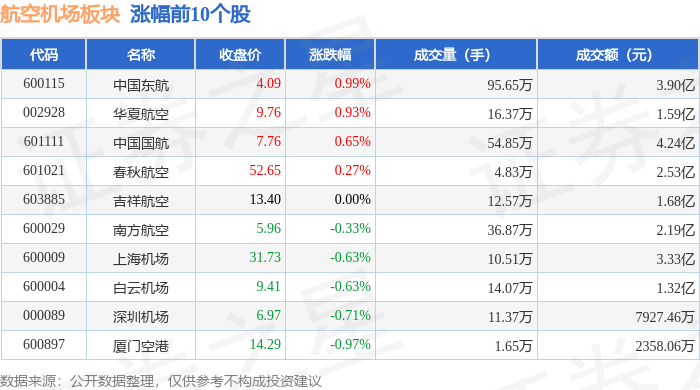
Market Overview - On September 25, the aviation and airport sector declined by 0.11% compared to the previous trading day, with CITIC Heli leading the drop [1] - The Shanghai Composite Index closed at 3853.3, down 0.01%, while the Shenzhen Component Index closed at 13445.9, up 0.67% [1] Stock Performance - Key stocks in the aviation and airport sector showed mixed performance, with China Eastern Airlines up by 0.99% to 4.09, and Xiamen Airport down by 0.97% to 14.29 [1][2] - The trading volume and turnover for major stocks were significant, with China Eastern Airlines recording a turnover of 390 million yuan [1] Capital Flow - The aviation and airport sector experienced a net outflow of 283 million yuan from institutional investors, while retail investors saw a net inflow of 103 million yuan [2] - The detailed capital flow indicated that Southern Airlines had a net inflow of 8.66 million yuan from institutional investors, while China National Airlines faced a net outflow of 51.88 million yuan [3]







西北民航“首乘服务”四周年,社会效益和经济效益实现“双丰收”
Zhong Guo Min Hang Wang· 2025-09-25 03:41
Core Viewpoint - The Northwest Civil Aviation has successfully implemented the "first flight service" initiative over the past four years, significantly enhancing both social and economic benefits in the region [1][2][4]. Group 1: Service Implementation and Impact - Since the launch of the first flight service in September 2021, over 200,000 first-time passengers have been served across 24 airports in Northwest China, receiving more than 5,900 commendations from travelers [1]. - The estimated sales of exclusive tickets for first-time passengers by airlines have exceeded 500 million yuan, indicating a substantial economic impact [1]. - The overall reputation of civil aviation services in the Northwest has improved significantly, reflecting the success of the first flight service initiative [1]. Group 2: Brand Development and Recognition - The "first flight service" brand has gained prominence, with various airlines and airports developing a series of related service products, such as "Saintly Care" at Yan'an Airport and "Easy First Flight" at Hanzhong Airport, which have won multiple awards in national and industry service competitions [2]. - The "Flying Oriole" team at Ningxia Airport was recognized as a "National Worker Pioneer," showcasing the recognition of first flight service initiatives [2]. Group 3: Service Expansion and Community Engagement - The scope of first flight services has expanded to include assistance at parking lots, bus stations, and high-speed rail stations, ensuring comprehensive support for first-time travelers [3]. - Initiatives like the "Flying Out of the Mountains" program invite local schoolchildren to experience air travel, promoting aviation awareness and dreams among the youth [3]. - The service now includes first-time transfers, intermodal travel, and international flights, broadening the support for new travelers [3]. Group 4: Regulatory Framework and Future Outlook - The establishment of a comprehensive service guarantee system is underway, with guidelines and industry standards being developed to enhance first flight services [4]. - The civil aviation sector is committed to optimizing service supply and increasing the willingness of the public to travel by air, contributing to the growth of China's aviation population and boosting air travel consumption [4]. - As China progresses towards its second centenary goal, the Northwest Civil Aviation aims to continue improving first flight services, ensuring a warm and smooth experience for new travelers [4].
航空机场板块9月24日跌0.24%,中国国航领跌,主力资金净流出4882.46万元
Zheng Xing Xing Ye Ri Bao· 2025-09-24 08:43
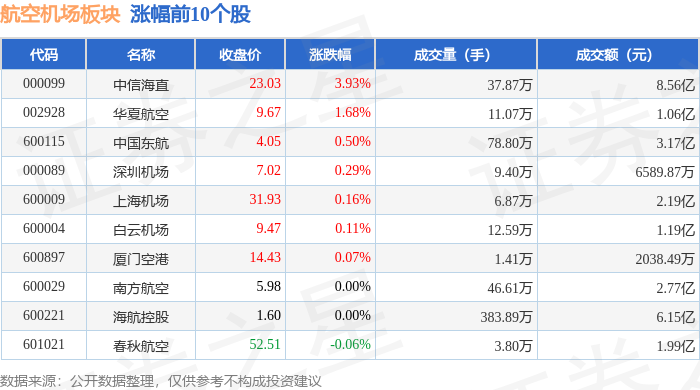
Market Overview - The aviation and airport sector experienced a decline of 0.24% on September 24, with China National Airlines leading the drop [1] - The Shanghai Composite Index closed at 3853.64, up 0.83%, while the Shenzhen Component Index closed at 13356.14, up 1.8% [1] Stock Performance - Notable stock performances included: - CITIC Hainan Airlines (000099) rose by 3.93% to close at 23.03, with a trading volume of 378,700 shares and a turnover of 856 million yuan [1] - China Eastern Airlines (600115) increased by 0.50% to 4.05, with a trading volume of 788,000 shares and a turnover of 317 million yuan [1] - China National Airlines (601111) fell by 1.28% to 7.71, with a trading volume of 631,400 shares and a turnover of 486 million yuan [2] Capital Flow Analysis - The aviation and airport sector saw a net outflow of 48.82 million yuan from institutional investors and 14.73 million yuan from retail investors, while retail investors had a net inflow of 63.56 million yuan [2] - Detailed capital flow for individual stocks showed: - CITIC Hainan Airlines had a net inflow of 81.88 million yuan from institutional investors [3] - China National Airlines experienced a net outflow of 5.92 million yuan from institutional investors [3] - Shenzhen Airport (000089) had a net inflow of 7.17 million yuan from retail investors [3]
航空机场板块9月22日跌0.27%,厦门空港领跌,主力资金净流出1.26亿元
Zheng Xing Xing Ye Ri Bao· 2025-09-22 08:47
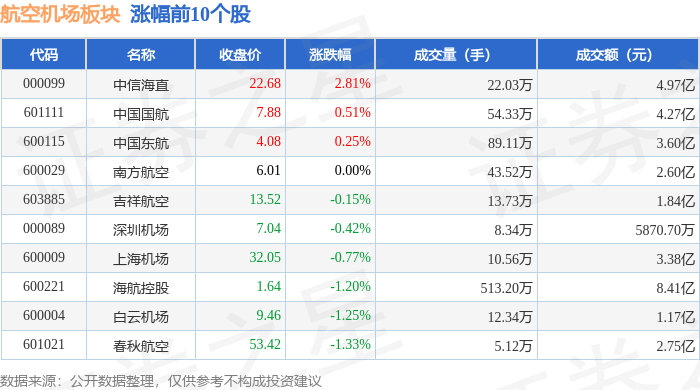
Market Overview - On September 22, the aviation and airport sector declined by 0.27%, with Xiamen Airport leading the drop [1] - The Shanghai Composite Index closed at 3828.58, up 0.22%, while the Shenzhen Component Index closed at 13157.97, up 0.67% [1] Stock Performance - Notable stock performances included: - CITIC Hainan Airlines (Code: 6600000) closed at 22.68, up 2.81% with a trading volume of 220,300 shares and a turnover of 497 million yuan [1] - China National Aviation (Code: 601111) closed at 7.88, up 0.51% with a trading volume of 543,300 shares [1] - Xiamen Airport (Code: 600897) closed at 14.46, down 1.57% with a trading volume of 16,800 shares and a turnover of 24.29 million yuan [2] Capital Flow - The aviation and airport sector experienced a net outflow of 126 million yuan from institutional investors, while retail investors saw a net inflow of 126 million yuan [2] - The capital flow for individual stocks showed: - CITIC Hainan Airlines had a net inflow of 39.99 million yuan from institutional investors [3] - Xiamen Airport had a net inflow of 4.81 million yuan from institutional investors [3] - China Eastern Airlines (Code: 600115) had a net inflow of 24.98 million yuan from institutional investors [3]



华夏航空(002928) - 关于归还用于暂时补充流动资金的部分闲置募集资金的公告
2025-09-22 08:00
证券代码:002928 证券简称:华夏航空 公告编号:2025-060 华夏航空股份有限公司 关于归还用于暂时补充流动资金的 金余额为 937,672,012.27 元。 三、备查文件 募集资金专户的银行收款回单。 特此公告。 部分闲置募集资金的公告 本公司及董事会全体成员保证信息披露的内容真实、准确、完整,没有 虚假记载、误导性陈述或重大遗漏。 一、部分闲置募集资金用于暂时补充流动资金的审议披露情况 华夏航空股份有限公司(以下简称"公司")于 2025 年 05 月 08 日召开第 三届董事会第十八次会议、第三届监事会第十七次会议,审议通过了《关于使 用部分闲置募集资金暂时补充流动资金的议案》,同意公司在保证募集资金投 资项目(以下简称"募投项目")的资金需求、不影响募投项目正常进行的前 提下,使用公司 2022 年度非公开发行 A 股股票的闲置募集资金不超过 139,000.00 万元暂时补充流动资金,使用期限自董事会审议通过之日起不超过 十二个月。具体内容详见公司于 2025 年 05 月 09 日披露于巨潮资讯网的《华夏 航空股份有限公司关于使用部分闲置募集资金暂时补充流动资金的公告》(公 告编号:2 ...
降息周期开启,周期有何投资机会?
2025-09-22 00:59
Summary of Key Points from Conference Call Records Industry or Company Involved - Focus on shipping, e-commerce, logistics, aviation, chemical, and non-ferrous metal industries Core Insights and Arguments Shipping Industry - The BDI index typically rises significantly during historical interest rate cut cycles, with current dry bulk freight rates at a low point. Recommendations include China Merchants Energy Shipping and Haitong Development [1][3] - Recent surge in cruise freight rates from over 30,000 to 96,000 RMB, driven by supply-demand reversal due to OPEC's production adjustments and reduced VLOC deliveries. Recommended companies include China Merchants Energy Shipping, which has dual advantages in cruise and dry bulk shipping [1][7] E-commerce and Logistics - Interest rate cuts are expected to benefit emerging market infrastructure and consumption, leading to increased capital inflow. Jitu Express is highlighted for its growth potential in Southeast Asia and Latin America [1][4][5] - The express delivery industry has seen price increases, with significant price hikes in August and September, covering 90% of national parcel volume. Companies like YTO Express, Shentong Express, and Jitu Express are recommended [1][9][10] Aviation Sector - The depreciation of the US dollar and appreciation of the RMB are favorable for the aviation sector, leading to significant exchange gains. Recommended stocks include Huaxia Airlines, Air China, China Eastern Airlines, China Southern Airlines, and Spring Airlines [1][6] Chemical Industry - The chemical industry is showing signs of bottoming out, with a narrowing decline in PPI. Key sub-sectors to watch include olefins (Baofeng Energy, Satellite Chemical), polyester, organic silicon (Xin'an Chemical, Sanyou Chemical, Dongyue Silicon), and agricultural chemicals (Yara International, Oriental Tower) [1][11][12][13] - The overall chemical industry is expected to improve due to liquidity easing and policy catalysts, with a current profit margin of 4.1%, historically low [1][13] Non-Ferrous Metals - The market remains bullish on the non-ferrous metals sector, with expectations for copper and gold to lead price increases. Recommended stocks include Zijin Mining, China Nonferrous Metal Mining, Jiangxi Copper H shares, and Shandong Gold H shares [2][15] Coal Industry - The coal sector has performed strongly, with prices rising nearly 4% due to futures increases and robust demand. Key companies to watch include Liugang Huaneng, Huayang Co., and China Shenhua [16][17] - The average daily sales of coal companies reached 7.22 million tons, with a healthy inventory level of 25.54 million tons, indicating a stable supply-demand situation [17] Other Important but Possibly Overlooked Content - The potential for further price increases in the express delivery sector as the Double Eleven shopping festival approaches, with optimistic performance expectations for listed companies [1][10] - The chemical sector's price adjustments and the impact of oil price fluctuations on various chemical products, highlighting the need to monitor policy changes [1][18]
交运行业2025Q3业绩前瞻:内需延续改善,外需维持韧性
Changjiang Securities· 2025-09-21 23:30
Investment Rating - The report maintains a "Positive" investment rating for the transportation industry [13] Core Insights - The transportation industry is expected to see improvements in profitability across various sub-sectors in Q3 2025, driven by domestic demand recovery and resilient international demand [2][6][7][8][9][10][11][12] Summary by Sub-Sector Aviation - The aviation sector is experiencing subdued demand but is benefiting from reduced costs, leading to an overall improvement in profitability for Q3 2025. The international flight recovery remains strong, and oil prices have significantly decreased [6][19][24] Airports - Domestic airport traffic is recovering, with international flights also increasing. Revenue is expected to improve steadily, with key airports benefiting from both domestic and international demand growth [2][6][24][26] Express Delivery - The "anti-involution" policy is driving price increases in the express delivery sector, leading to improved profitability for e-commerce deliveries. However, operational costs are temporarily pressuring profit margins [2][6][28][30] Logistics - The logistics sector is stabilizing, with major players expected to see profit growth due to improved supply chain performance and resilient cross-border logistics profitability [2][6][7][31] Maritime Transport - The maritime sector is witnessing a divergence in profitability among different shipping types. While container shipping faces challenges, oil tanker profits are improving due to favorable market conditions [2][6][8][33][37] Ports - Port operations are expected to see improved profitability in bulk cargo handling, while container throughput remains resilient despite external pressures [2][6][9][39] Highways - Highway traffic is relatively stable, with a slight increase in profitability anticipated for Q3 2025, supported by steady freight and passenger traffic [2][10][41] Railways - Railway passenger and freight volumes are showing mixed trends, with a focus on opportunities arising from high-speed rail transformations. Overall, passenger transport is expected to grow, while freight transport is improving [2][11][43][44]


交运周专题2025W38:快递单价涨幅超预期,油运运价延续上行
Changjiang Securities· 2025-09-21 23:30
Investment Rating - The report maintains a "Positive" investment rating for the transportation industry [8] Core Insights - The report highlights that the express delivery price increase exceeded expectations, and oil shipping rates continue to rise [5][6] - The passenger transport chain shows continuous improvement in load factors, with ticket prices turning positive year-on-year [5][17] - The logistics sector's unit price data surpassed expectations, indicating a favorable outlook for profitability amid a "de-involution" trend [7] Summary by Sections Passenger Transport - Domestic passenger volume increased by 11% year-on-year, while international passenger volume rose by 15% [5][17] - The domestic load factor improved by 5.0 percentage points year-on-year, and the international load factor increased by 4.6 percentage points [24] - Domestic ticket prices saw a slight decline of 1.5% year-on-year due to fuel surcharges, but the bare ticket price increased by 2.4% year-on-year, indicating a gradual recovery in revenue [24] Maritime Transport - Oil shipping rates continued to rise, with the average VLCC-TCE increasing by 15.3% to $90,000 per day [6][45] - The SCFI index for foreign trade container shipping fell by 14.3% to 1,198 points, indicating pressure on supply and demand [6][45] - The BDI index for bulk shipping rose by 3.6% to 2,203 points, driven by active demand from miners [6][45] Logistics - The volume of postal express deliveries reached 3.83 billion pieces, a year-on-year increase of 8.5% [7][51] - The average price for short-haul transport remained stable at 63 yuan per ton, with a daily average of 1,330 vehicles operating [7][51] - The unit price for major express companies showed significant increases, with YTO, Shentong, and Yunda reporting respective unit revenues of 2.15, 2.06, and 1.92 yuan, reflecting a positive trend in profitability [7][51]
「同样的飞机,多坐42人」,春秋航空是怎么赚钱的?
36氪· 2025-09-19 13:42
Core Viewpoint - Spring Airlines has achieved significant profitability in the competitive airline industry, primarily through its low-cost operating model and effective cost control strategies [4][6][10]. Financial Performance - In the first half of 2025, Spring Airlines reported a revenue of 10.304 billion yuan and a net profit of 1.169 billion yuan, making it the most profitable airline among A-share listed companies [5][9]. - Spring Airlines' net profit for 2024 reached a record high of 2.273 billion yuan, while the three major state-owned airlines reported losses exceeding 1 billion yuan each in the same period [9]. Operational Metrics - Spring Airlines led the industry with a 9.95% increase in available seat kilometers and a 93.87% passenger load factor in August 2025 [8][9]. - The airline operates a fleet of 134 Airbus A320 series aircraft with an average age of 7.76 years, covering major business and tourist cities in China and Southeast Asia [8]. Cost Control Strategies - The airline's unit cost was reported at 0.303 yuan per available seat kilometer, a 3.5% decrease from the previous year, compared to 0.44 yuan for China National Airlines [14]. - Spring Airlines employs a "two singles, two highs, and two lows" operational model to minimize costs and maximize efficiency [16]. Pricing Strategy - The airline's pricing strategy focuses on low fares, attracting price-sensitive travelers and maintaining high occupancy rates, with an average load factor of 90.52% in the first half of 2025 [12][13]. - Promotional activities have included extremely low fares, such as 9 yuan tickets for flights to Jeju Island, which further enhance customer attraction [12]. Revenue Diversification - Spring Airlines has separated ancillary services from ticket prices, allowing for additional revenue streams from services like baggage handling and in-flight meals, which contributed 1.03 billion yuan in 2024 [19][20]. - The airline's direct sales through its official website accounted for 99.7% of its sales channels, significantly reducing sales costs compared to industry averages [19]. Market Position and Future Outlook - The low-cost airline segment currently holds a 12.9% market share in China's domestic routes, indicating substantial growth potential as demand for affordable air travel increases [21].