荣耀

Search documents
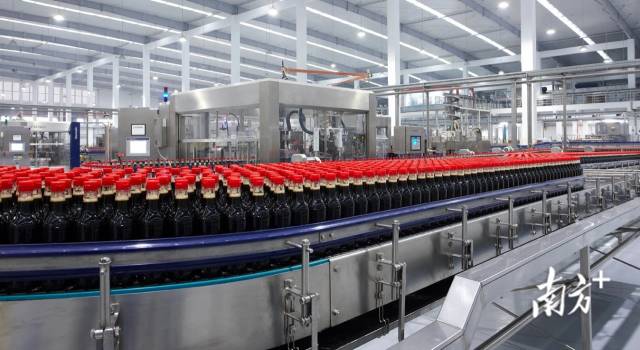
2025中国手机出货:苹果四季度第一,华为全年第一
Guan Cha Zhe Wang· 2026-01-14 05:44
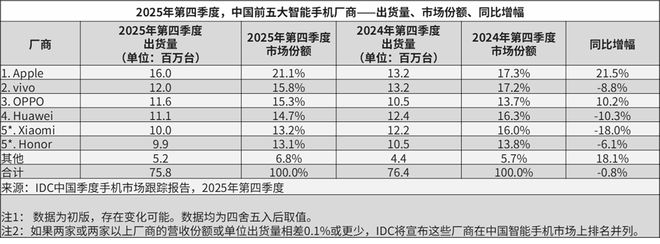
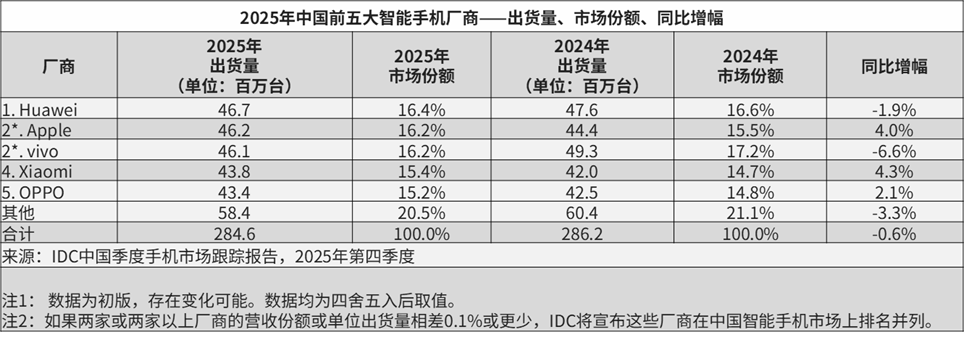
Core Insights - The Chinese smartphone market is projected to have a shipment volume of approximately 75.78 million units in Q4 2025, showing a slight year-on-year decline of 0.8%, with an annual total of about 285 million units, down 0.6% from the previous year [1][3] Q4 2025 Market Performance - Apple leads the Q4 2025 shipments with 16 million units, capturing a market share of 21.1%, marking a significant year-on-year increase of 21.5% [2] - Vivo ranks second with 12 million units shipped, holding a market share of 15.8, but experiencing a decline of 8.8% year-on-year [2] - OPPO follows closely with 11.6 million units, a year-on-year increase of 10.2%, and a market share of 15.3% [2] - Huawei's shipments are approximately 11.1 million units, down 10.3% year-on-year, with a market share of 14.7% [2] - Xiaomi and Honor are tied for fifth place, with Xiaomi shipping 10 million units (down 18%) and Honor shipping 9.9 million units (down 6.1%) [2] Annual Market Overview - For the entire year of 2025, Huawei tops the market with 46.7 million units shipped, a slight decline of 1.9%, and a market share of 16.4% [4] - Apple follows closely with 46.2 million units, reflecting a 4% increase year-on-year, and a market share of 16.2% [4] - Vivo's annual shipments are 46.1 million units, down 6.6% from the previous year, also sharing a market share of 16.2% with Apple [4] - Xiaomi and OPPO have annual shipments of 43.8 million and 43.4 million units, respectively, with Xiaomi showing a growth of 4.3% and OPPO a growth of 2.1% [4] Global Smartphone Market Insights - The global smartphone shipments reached 1.26 billion units in 2025, with Apple and Samsung leading the market shares at 19.7% and 19.1%, respectively [5][6] - Despite challenges such as storage chip shortages, the global market is driven by high-end model growth and consumer anticipation of price increases [5][6] - The average selling price is expected to continue rising, even as overall shipments face pressure [6]



消费电子ETF(561600)涨超1.3%,荣耀全球发货量首次突破7100万台
Xin Lang Cai Jing· 2026-01-14 05:40
Group 1 - The core viewpoint of the news highlights the strong performance of the consumer electronics sector, with the CSI Consumer Electronics Theme Index rising by 1.21% and notable gains in individual stocks such as Chipone Technology (up 5.89%) and Hengxuan Technology (up 5.72%) [1] - The IDC report indicates that Apple ranked first in China's smartphone market for Q4 2025, followed by Vivo, OPPO, Huawei, and a tie between Honor and Xiaomi in fifth place. Honor achieved a significant milestone with global shipments surpassing 71 million units, marking a year-on-year growth of approximately 55% in overseas shipments, the highest among the top ten global brands [1] - Open Source Securities notes that new AI terminals are rapidly evolving from general interaction to deep scene penetration, with Chinese brands leading innovation in AI glasses, including the launch of the world's first eSIM smart AR glasses by Thunderbird and the lightweight AI glasses "Rokid Style" [2] Group 2 - The CSI Consumer Electronics Theme Index consists of 50 listed companies involved in component production and brand design, reflecting the overall performance of the consumer electronics sector. As of December 31, 2025, the top ten weighted stocks in the index accounted for 54.35% of the total index weight [2] - The Consumer Electronics ETF closely tracks the CSI Consumer Electronics Theme Index, providing investors with exposure to the performance of the sector [3]
2025中国手机市场:苹果四季度第一,华为全年第一
Guan Cha Zhe Wang· 2026-01-14 05:38
Core Insights - The Chinese smartphone market is projected to see a slight decline in shipments, with approximately 75.78 million units expected in Q4 2025, representing a year-on-year decrease of 0.8% [1][2] - Apple leads in Q4 shipments with 16 million units, achieving a market share of 21.1%, while Huawei tops the annual rankings with 46.7 million units shipped [1][3] Q4 2025 Performance - Apple: 16 million units shipped, 21.1% market share, 21.5% increase year-on-year [2] - Vivo: 12 million units shipped, 15.8% market share, 8.8% decrease year-on-year [2] - OPPO: 11.6 million units shipped, 15.3% market share, 10.2% increase year-on-year [2] - Huawei: 11.1 million units shipped, 14.7% market share, 10.3% decrease year-on-year [2] - Xiaomi: 10 million units shipped, 13.2% market share, 18% decrease year-on-year [2] - Honor: 9.9 million units shipped, 13.1% market share, 6.1% decrease year-on-year [2] Annual Performance 2025 - Total shipments in China are estimated at 285 million units, down 0.6% from the previous year [3][4] - Huawei: 46.7 million units, 16.4% market share, 1.9% decrease year-on-year [4] - Apple: 46.2 million units, 16.2% market share, 4% increase year-on-year [4] - Vivo: 46.1 million units, 16.2% market share, 6.6% decrease year-on-year [4] - Xiaomi: 43.8 million units, 15.4% market share, 4.3% increase year-on-year [4] - OPPO: 43.4 million units, 15.2% market share, 2.1% increase year-on-year [4] Global Market Overview - Global smartphone shipments reached 1.26 billion units in 2025, with Apple (19.7% market share) and Samsung (19.1% market share) leading the market [5][6] - The global market is expected to face challenges in 2026 due to ongoing storage chip shortages, which may lead to a decline in shipments [6]

华为手机2025年重返中国市场第一
Mei Ri Jing Ji Xin Wen· 2026-01-14 04:45
Core Insights - The report by IDC indicates that in 2025, the top five smartphone brands in China by shipment volume will be Huawei, Apple, vivo, Xiaomi, and OPPO, with Honor falling out of the top five [1] - The total shipment volume for the Chinese smartphone market in 2025 is projected to be approximately 284.6 million units, reflecting a year-on-year decline of 0.6% [1][2] - The industry anticipates significant cost pressures for smartphone manufacturers due to expected substantial increases in storage prices, which may lead to a more pronounced decline in shipment volumes in 2026 [1] Brand Performance Summary - Huawei is expected to ship 46.7 million units in 2025, holding a market share of 16.4%, down from 47.6 million units and 16.6% market share in 2024, representing a decline of 1.9% [2] - Apple is projected to ship 46.2 million units, with a market share of 16.2%, an increase from 44.4 million units and 15.5% market share in 2024, showing a growth of 4.0% [2] - vivo's shipment is expected to be 46.1 million units, maintaining a market share of 16.2%, down from 49.3 million units and 17.2% market share in 2024, reflecting a decrease of 6.6% [2] - Xiaomi is forecasted to ship 43.8 million units, with a market share of 15.4%, up from 42.0 million units and 14.7% market share in 2024, indicating a growth of 4.3% [2] - OPPO is anticipated to ship 43.4 million units, holding a market share of 15.2%, slightly increasing from 42.5 million units and 14.8% market share in 2024, with a growth of 2.1% [2] - The "Others" category is expected to account for 58.4 million units, representing 20.5% of the market, down from 60.4 million units and 21.1% market share in 2024, showing a decline of 3.3% [2]
荣耀500 Pro MOLLY 20周年款定于1月19日发布
Feng Huang Wang· 2026-01-14 04:28
Core Viewpoint - Honor Mobile announced a collaboration with the trendy brand Pop Mart to launch the "Honor 500 Pro MOLLY 20th Anniversary Limited Edition Gift Box" [1] Group 1: Product Details - The product is set to be officially released on January 19 at 19:30 [1] - The gift box will include not only the phone itself but also accessories such as a protective case, pendant, and red envelopes [1] Group 2: Collaboration Purpose - The collaboration aims to achieve "inspirational resonance" through product design [1] - The gift box will incorporate elements of "fantasy and fun" [1]

荣耀与泡泡玛特合作推出MOLLY 20周年限定版礼盒
Bei Jing Shang Bao· 2026-01-14 03:57
Core Viewpoint - Honor Mobile has announced a collaboration with Pop Mart to launch the Honor 500 Pro MOLLY 20th Anniversary Limited Edition Gift Box, set to be officially released on January 19 at 19:30 [1] Group 1 - The collaboration centers around the 20th anniversary of Pop Mart's IP MOLLY, integrating fantasy and fun elements into the design of the limited edition gift box [1] - Specific product details will be revealed during the launch event [1]

【IPO追踪】引入高通等基石投资者,龙旗科技今起招股
Sou Hu Cai Jing· 2026-01-14 03:05
Core Viewpoint - The recent performance of the new stock market has been strong, with companies like Zhaoyi Innovation, Biran Technology, and Zhiyu experiencing significant post-listing gains. Longqi Technology is set to launch its IPO in Hong Kong, following this trend [2]. Group 1: IPO Details - Longqi Technology plans to globally issue approximately 52.26 million H-shares, with 10% allocated for public offering in Hong Kong and 90% for international offering. There is an option for an additional 7.84 million shares under an over-allotment option, representing a 15% over-allotment ratio based on the base offering size [2]. - The maximum offer price is set at HKD 31 per share, with expected net proceeds of approximately HKD 1.52 billion if the over-allotment option is not exercised. The funds will be allocated as follows: 40% for expanding production capacity, 20% for R&D, 10% for marketing and customer expansion, 20% for strategic investments or acquisitions, and 10% for working capital [2]. Group 2: Subscription Period and Fees - The subscription period for Longqi Technology is from January 14 to January 19, 2026, with the listing on the Hong Kong Stock Exchange expected on January 22. The minimum investment for one board lot of 100 shares is HKD 3,131.26 [3]. Group 3: Institutional Interest - Longqi Technology's IPO has attracted significant interest from various institutions, including Qualcomm, Jiangxi Guokong, and others, with a total subscription amounting to approximately USD 56.5 million (or about HKD 440 million) [4]. Group 4: Company Overview - Longqi Technology is a leading global provider of smart products and services, offering a full range of solutions from product research and design to manufacturing and support. Its diverse product portfolio includes smartphones, AI PCs, automotive electronics, tablets, smartwatches, and smart glasses, catering to various sectors such as consumer electronics and IoT [5]. - According to Frost & Sullivan, Longqi ranks second globally in the consumer electronics ODM segment with a market share of 22.4%, first in the smartphone ODM segment with a market share of 32.6%, and among the top three in the tablet ODM segment [5]. - The company's revenue for the years 2022 to 2024 and the first three quarters of 2025 are projected to be RMB 29.34 billion, RMB 27.19 billion, RMB 46.38 billion, and RMB 31.33 billion, respectively, with adjusted net profits of RMB 620 million, RMB 672 million, RMB 565 million, and RMB 604 million [5].

小米潘九堂:并非只有中国企业模仿,苹果也“买+抄”
Guan Cha Zhe Wang· 2026-01-14 02:52
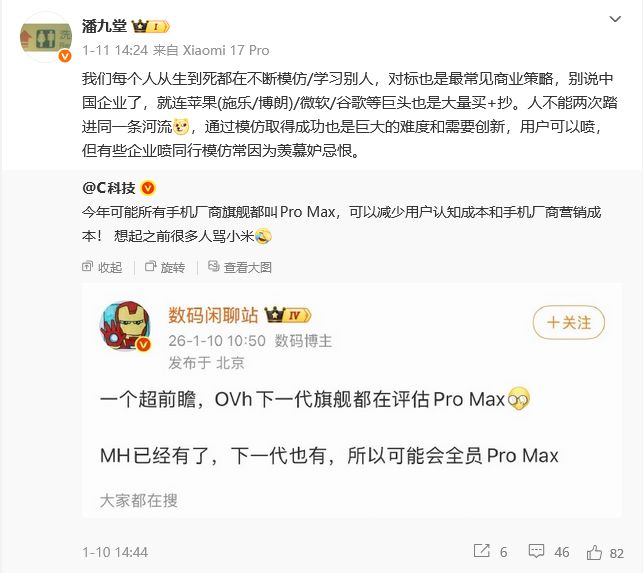
Core Viewpoint - The discussion around the naming convention "Pro Max" for flagship smartphones by Chinese manufacturers highlights the common practice of imitation in the tech industry, with Xiaomi's partner emphasizing that while imitation is a foundation for innovation, true success requires originality and adaptation [1][3]. Group 1: Industry Trends - Chinese smartphone manufacturers such as OPPO, vivo, and Honor are evaluating the "Pro Max" naming for their next flagship models, potentially leading to a unified naming strategy that could lower user recognition costs and marketing expenses [1]. - The trend of adopting similar naming conventions is not unique to Chinese companies; global giants like Apple, Microsoft, and Google also engage in imitation as a strategy for growth [1][3]. Group 2: Company Insights - Xiaomi's introduction of the "Pro Max" model in its 17 series and the Redmi K90 series has sparked significant discussion regarding naming strategies in the smartphone market [1]. - The company acknowledges that while it may draw inspiration from competitors, it aims to innovate rather than solely imitate, as seen in its approach to future products like range-extended vehicles [4].
开源证券:AI革命进入新阶段 重点关注AI硬件产业链相关
智通财经网· 2026-01-14 02:37
Core Viewpoint - AI remains the main theme of CES 2026, with a significant shift from software to physical world integration, empowering various AI terminals. The new wave of innovation driven by generative AI is just beginning, with traditional consumer electronics like AI smartphones and AI PCs expected to benefit from a consumer upgrade cycle, while AI glasses and embodied intelligent robots have transitioned from the "0 to 1" stage to the "1 to N" stage, indicating a potential for rapid growth in product shipments. The focus should be on the AI hardware supply chain [1] Group 1: AI Chips - Continuous iteration in chip architecture and manufacturing processes is enhancing AI inference efficiency and reducing costs. Major tech companies like NVIDIA, AMD, Intel, and Qualcomm showcased advancements at CES 2026, with NVIDIA announcing the full production of the Vera Rubin platform, which integrates six key chips and reduces AI inference costs by 90%. AMD's Helios platform, based on MI455X, boasts a tenfold performance increase and has gained recognition from leading clients like OpenAI. Intel introduced the Core Ultra3 series processors with over 70% superior integrated graphics performance compared to competitors, while Qualcomm launched the Snapdragon X2Plus platform to redefine Windows AI PC standards [2] Group 2: Traditional Consumer Electronics - AI smartphones and AI PCs are undergoing continuous innovation, with an emphasis on software AI interaction experiences. Lenovo introduced a rollable screen and foldable PC, enhancing AI PC capabilities through its "hybrid AI" strategy. Dell and HP upgraded their flagship AI PC products, significantly improving edge AI performance. YPlasma launched the world's first plasma cooling laptop, revolutionizing thermal management in consumer electronics. Samsung showcased a foldable OLED display solution for the next generation of foldable smartphones, while Honor presented the world's first robot phone, enhancing AI interaction through a gimbal camera [3] Group 3: New AI Terminals - New AI terminals are accelerating from general interaction to deep scene penetration. Chinese brands are leading innovation in AI glasses, with Thunderbird showcasing the world's first eSIM smart AR glasses, marking a shift to independent communication for AR devices. Rokid released the ultra-lightweight, screenless AI glasses "Rokid Style," focusing on voice-first interaction. XREAL and ROG jointly launched the R1 gaming glasses, supporting 240Hz refresh rates. AI large models are moving beyond software to empower emotional companionship, sports health, and pet care, indicating a personalized evolution in the AI terminal industry [4] Group 4: Automotive & Robotics - Physical AI models are accelerating the realization of intelligent driving, with companies like NVIDIA lowering the R&D threshold for L4 autonomous driving through the open-source Alpamayo system. Chinese automakers such as Geely and Great Wall are rapidly advancing full-stack intelligent driving solutions towards mass production. Innovations in mobility are diversifying, from Strutt's smart wheelchair enabling "human-machine co-driving" to Verge's solid-state battery electric motorcycle showcasing extreme performance. In the realm of embodied intelligence, NVIDIA is building an open ecosystem with the Jetson Thor chip and Isaac platform, while Boston Dynamics released the mass-produced Atlas humanoid robot, collaborating with Hyundai and DeepMind for large-scale industrial applications. LG introduced home robots CLOiD and the AXIUM actuator brand, covering the entire supply chain from core components to scene ecosystems. Chinese companies like Yuzhu and Zhiyuan are demonstrating rapid commercialization capabilities in industrial automation and home services, marking a new phase of large-scale application in the global robotics industry [5]
展十八般武艺!“广货行天下”春季行动明天启动
2 1 Shi Ji Jing Ji Bao Dao· 2026-01-14 01:45
Core Insights - Guangdong's manufacturing sector is showcasing its diverse capabilities, from smart home appliances to high-end mobile phones, fashion apparel, gourmet food, and modern agriculture, emphasizing innovation and quality development [1][2][6][9][21] Group 1: Food Industry - Guangdong's food industry is projected to achieve a revenue of 896.87 billion yuan in 2024, with soy sauce production accounting for over 60% of the national output and mooncake exports representing 90% of the total [2] - The food sector is characterized by a "smart brewing" approach, integrating traditional flavors with modern technology, leading to a "delicious revolution" driven by digitalization and biotechnology [2][3] - The province has established several billion-yuan sub-clusters in various food categories, including sauces, health foods, and traditional snacks, showcasing its strong industrial foundation [2] Group 2: Home Appliances - Guangdong's home appliance exports account for nearly 50% of the national total, with the Greater Bay Area's smart appliance industry representing about 30% of the global market [6][8] - The industry employs a "combination of strengths" strategy, integrating research, manufacturing, and branding while localizing production to penetrate global markets [6][8] - Major companies like Midea and Hisense are expanding their global footprint with numerous R&D centers and manufacturing bases, enhancing their competitiveness [6][8] Group 3: Agriculture - Guangdong's agricultural output is robust, with grain production capacity increasing from 12.38 million tons in 2021 to 12.98 million tons in 2025, achieving a record high in yield per unit area [9][10] - The province leads the nation in the production of lychees and pomelos, with the lychee industry alone generating over 9 billion yuan in value [12] - The agricultural sector is supported by a modernized marine ranching initiative, positioning Guangdong as a leader in fishery production and output [10][12] Group 4: Textile and Apparel - Guangdong's textile and apparel industry boasts the highest number of enterprises in the country, with 4,240 registered companies and a production output of 3.44 billion garments in 2024 [21][23] - The industry employs a "fast response and flexible attack" strategy, utilizing data-driven customization and intelligent production to enhance efficiency [21][23] - Significant advancements in digital transformation are evident, with companies adopting AI and big data to streamline operations and reduce production times [23][24] Group 5: Cultural and Tourism - Guangdong's cultural tourism sector is leveraging traditional customs and modern marketing strategies to attract visitors, particularly during the Spring Festival [17][19] - The "Please Come to Guangdong for the New Year" campaign aims to enhance the province's appeal as a travel destination through various cultural events and activities [19][20] - The integration of local culture, food, and entertainment is designed to create immersive experiences for tourists, showcasing Guangdong's rich heritage [17][21]