
海康威视

Search documents
OpenAI宣布推出首期OpenAI认证课程,AI人工智能ETF(512930)交投活跃
Xin Lang Cai Jing· 2025-12-10 02:02
消息面上,OpenAI当地时间12月9日宣布推出首期OpenAI认证课程,旨在提供实用的人工智能技 能:"人工智能基础课程"将通过与一批企业和公共服务合作伙伴的试点项目在ChatGPT平台推出;"教 师版ChatGPT基础课程"则已在Coursera平台上线。 AI人工智能ETF紧密跟踪中证人工智能主题指数,中证人工智能主题指数选取50只业务涉及为人工智能 提供基础资源、技术以及应用支持的上市公司证券作为指数样本,以反映人工智能主题上市公司证券的 整体表现。 数据显示,截至2025年11月28日,中证人工智能主题指数(930713)前十大权重股分别为中际旭创 (300308)、新易盛(300502)、寒武纪(688256)、中科曙光(603019)、澜起科技(688008)、科大讯飞 (002230)、海康威视(002415)、豪威集团(603501)、金山办公(688111)、浪潮信息(000977),前十大权重 股合计占比63.92%。 AI人工智能ETF(512930),场外联接(平安中证人工智能主题ETF发起式联接A:023384;平安中证人工 智能主题ETF发起式联接C:023385;平安中证人工智 ...
海康威视:移动机器人系列包括潜伏、移载、重载、叉取、料箱、复合机器人和智能组件等
Mei Ri Jing Ji Xin Wen· 2025-12-09 16:23
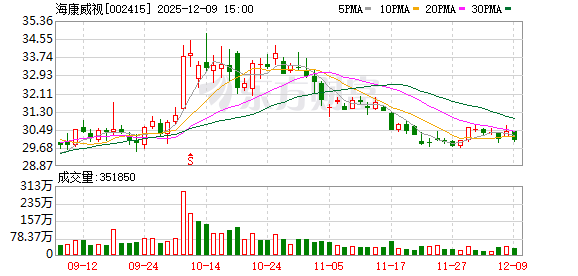
Group 1 - The company, Hikvision, is actively involved in the robotics sector, offering a range of intelligent robots, system platforms, and solutions [2] - The mobile robot series includes various types such as stealth, transfer, heavy-duty, fork, material box, composite robots, and intelligent components [2] - The articulated robot series consists of vertical and horizontal multi-joint robots, along with control systems and industrial software [2]


A股年内回购大数据出炉:超1500亿元,四成以上为注销
Zheng Quan Shi Bao· 2025-12-09 14:12
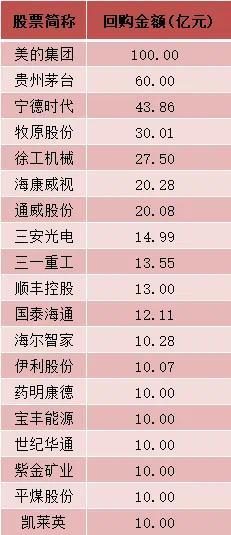
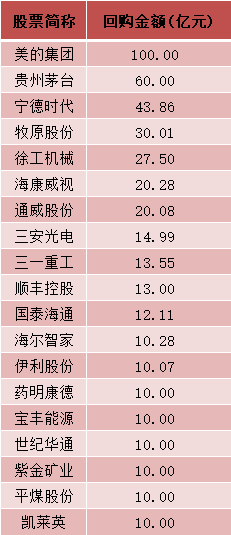
Core Viewpoint - The article highlights the increasing trend of stock buybacks among A-share listed companies, with over 40% of buyback plans aimed at complete or partial cancellation, indicating a shift towards "cancellation-type buybacks" as a common practice in the market [1][5]. Group 1: Buyback Trends and Amounts - As of December 9, over 1500 billion yuan has been spent on stock buybacks in 2023, with leading companies like Midea Group, Kweichow Moutai, and CATL leading the way [2][5]. - Midea Group's buyback reached 10 billion yuan, making it the only "billion-level" buyback in A-shares this year, with 70% of the repurchased shares intended for cancellation [2][5]. - A total of 1303 companies have announced 1502 stock buyback plans this year, with 637 plans aimed at cancellation, representing 42.41% of the total, an increase from 38.33% in 2024 [5]. Group 2: Motivations Behind Buybacks - Companies are responding to policy incentives and are likely to receive more tax benefits or financial support, which encourages the normalization of cancellation-type buybacks [1][4]. - The buyback activity is seen as a signal of confidence in future operations, especially when stock prices are perceived as undervalued, potentially leading to positive market reactions [4][6]. Group 3: Implications for Market and Company Value - The practice of stock buybacks is aimed at enhancing company value and market competitiveness amidst global economic uncertainties [6]. - Buybacks can improve earnings per share (EPS) and attract long-term capital, providing stable funding for company growth [6][7]. - Companies must balance shareholder returns with maintaining a robust capital structure to avoid excessive cash flow pressure while optimizing financial health [7].


超1500亿元 四成以上为注销!A股年内回购大数据,出炉→
Zheng Quan Shi Bao· 2025-12-09 12:32
Group 1 - The core viewpoint of the articles highlights the increasing trend of stock buybacks among A-share listed companies, driven by policy guidance, valuation recovery needs, and shareholder return optimization [1][4] - Over 40% of stock buyback plans announced this year are aimed at complete or partial cancellation, indicating a rise from 38.33% in 2024 [1][4] - The total amount of stock buybacks in A-shares has exceeded 150 billion yuan, with leading companies actively participating in these buybacks [2][4] Group 2 - Midea Group has completed a significant buyback of approximately 1.35 million shares, totaling around 10 billion yuan, marking it as the only "billion-level" buyback in A-shares this year [2][4] - Other notable companies include Kweichow Moutai and CATL, which have also engaged in substantial buybacks of 6 billion yuan and 4.386 billion yuan, respectively [2][3] - The trend of buyback cancellations is seen as a response to policies like the "New Nine Articles," which encourage companies to optimize their capital structures and enhance shareholder value [4][5] Group 3 - The buyback and cancellation strategy is viewed as a means to improve earnings per share (EPS) and attract long-term capital inflow, thereby enhancing company competitiveness [5][6] - Companies are advised to balance shareholder returns with maintaining a robust capital structure to avoid excessive cash flow pressure [6] - The overall sentiment is that buyback cancellations can stabilize the market and promote healthy development within the capital market [6]



年内A股回购总额突破1400亿元
Shen Zhen Shang Bao· 2025-12-09 11:37
Core Viewpoint - The A-share market is experiencing a significant increase in stock buybacks, driven by leading companies and supported by favorable policies, with a total buyback amount exceeding 140 billion yuan as of December 8, 2023 [2][3]. Group 1: Buyback Trends - A total of 1,464 A-share listed companies have initiated stock buybacks this year, with a cumulative buyback amount surpassing 140 billion yuan [2]. - Key industries such as power equipment, electronics, home appliances, and machinery have each seen buyback amounts exceeding 10 billion yuan [2]. - The People's Bank of China and financial regulators have introduced policies to support stock buybacks, including a loan program with an initial quota of 300 billion yuan, increasing to 800 billion yuan by May 2025 [2]. Group 2: Loan Support for Buybacks - Over 770 listed companies have disclosed receiving loan support for buybacks, with a total loan ceiling exceeding 157.19 billion yuan, including 98.50 billion yuan specifically for buybacks [3]. - Notable companies receiving significant loan amounts include China Three Gorges Renewables, Kweichow Moutai, and Haier Smart Home, with loan ceilings exceeding 10 billion yuan [3]. Group 3: Leading Companies in Buybacks - Nineteen companies have repurchased over 100 million shares this year, with the top five being BOE Technology Group, Innovation Materials, XCMG, China State Construction, and Liao Port, repurchasing 428 million, 362 million, 358 million, 290 million, and 279 million shares respectively [3]. - The top three companies by buyback amount are Midea Group, Kweichow Moutai, and CATL, with buyback amounts of 11.01 billion yuan, 6 billion yuan, and 4.39 billion yuan respectively [3]. Group 4: Impact of Buybacks - The current buyback trend is characterized by a significant increase in cancellation-type buybacks, with nearly 20% of companies explicitly stating their buybacks will be used for capital cancellation, a 3% increase from the previous year [5]. - Kweichow Moutai has completed a 6 billion yuan buyback for cancellation and announced a new buyback plan of 1.5 billion to 3 billion yuan, all intended for capital cancellation [5]. - The trend of leading companies engaging in buybacks is seen as a natural outcome of market resources concentrating towards top firms, which typically have stronger cash flow and risk resilience [4].

3900点收费站
Datayes· 2025-12-09 11:18
Core Viewpoint - The article discusses various sectors in the stock market, highlighting recent movements and potential investment opportunities, particularly in the PCB and AI-related industries, while also noting the challenges faced by the Hong Kong stock market. Group 1: Stock Market Movements - The Shanghai Composite Index fell by 0.37%, while the Shenzhen Component dropped by 0.39%, and the ChiNext Index rose by 0.61% on December 9, with a total trading volume of 19,178.70 billion yuan, a decrease of 1,338.75 billion yuan from the previous day [19] - Over 4,000 stocks declined, with 54 stocks hitting the daily limit up, indicating a mixed market sentiment [19] - The article mentions that the recent policies from central and local governments have kept the enthusiasm for Fujian-related stocks high, with several stocks reaching their daily limit up [19] Group 2: PCB Industry Insights - The import price of copper-clad laminates, a core material for PCBs, reached 46,500 USD per ton in November, a significant year-on-year increase of 69%, indicating strong domestic demand for high-performance materials [4] - The export price of PCBs also saw a year-on-year increase of 25%, reflecting an overall enhancement in the value of China's PCB industry chain [4] - There is a notable increase in the consumption of drill bits used for high-density PCBs, particularly for AI servers and ASIC chips, with consumption rates increasing by 6-10 times compared to traditional products [6] Group 3: AI and Technology Developments - The article highlights that leading companies like DingTai High-Tech are beginning to ramp up production of ASIC-related drill bits, which have seen significant price increases due to the demand for advanced materials [6] - Equipment manufacturers are actively developing new solutions for high-density materials, indicating a shift in technology to meet upcoming production demands [6] Group 4: Economic and Policy Context - The People's Bank of China reported an increase of 25.4 billion yuan in the pledged supplementary loan (PSL) in November, marking the first growth since January 2024, which may signal larger policy support to counteract weak domestic demand [10] - The article notes that the Hong Kong stock market has been underperforming, attributed to factors such as reduced southbound capital flows and concerns over interest rate hikes by the Bank of Japan [8]

海康威视:截至2025年9月末公司股东总数为387222户
Zheng Quan Ri Bao Wang· 2025-12-09 10:41
Group 1 - The core point of the article is that Hikvision (002415) reported a total of 387,222 shareholders as of the end of September 2025 according to its Q3 report [1]
外卖大战刚打完,大厂新一轮「烧钱抢市场」又来了
36氪· 2025-12-09 10:38
Core Insights - The article discusses the emerging competition in the AI glasses market, highlighting the aggressive strategies of major tech companies like Google, ByteDance, Vivo, Xiaomi, Tencent, and others in developing AI glasses products [4][10][12]. Group 1: Market Dynamics - Major companies are entering the AI glasses market, with Ideal's AI glasses priced at 1699 yuan, leading to rapid sell-out within two hours of launch [6][7]. - Google is reportedly in the POC stage for two AI glasses products, collaborating with Qualcomm, Samsung, and Foxconn for development [9]. - ByteDance is pursuing multiple AI glasses projects, with plans to release a light display version by Q4 next year and a non-display version by Q1 [12][12]. Group 2: Strategic Importance - For consumer electronics companies, AI glasses represent an extension of existing hardware experiences and a strategic defense move [14]. - For internet giants, AI glasses are seen as a necessary entry point to enhance their models and applications, with significant data implications [15][30]. Group 3: Data Collection and Competition - AI glasses are viewed as optimal devices for collecting real-world data, which is becoming increasingly valuable for AI development [22][25]. - The competition in the AI glasses market is fundamentally a data competition, as these devices will serve as data collection points for improving AI models [30]. Group 4: Hardware and Supply Chain - The entry of major players has lowered the hardware barriers, allowing for rapid development cycles and cost control in the AI glasses supply chain [48][52]. - The industry is witnessing a surge in AI glasses prototypes, with a typical timeline of three months for samples, six months for mass production, and nine months for shipping [51]. Group 5: Challenges and Risks - The AI glasses market is characterized by high competition, where any shortcomings in product quality can lead to significant failures [55]. - Previous product launches have faced challenges, such as Xiaomi's first-generation AI glasses experiencing a 40% return rate due to issues like Bluetooth connectivity and chip selection [56].


视频编解码领域标准必要专利及标准提案研究报告
中国信通院· 2025-12-09 08:32
Investment Rating - The report does not explicitly provide an investment rating for the industry Core Insights - The video codec technology is crucial for processing massive video data, driving the development of the digital visual industry [6] - The evolution of video codec standards is closely tied to patent management, influencing both the efficiency of technology dissemination and the healthy development of the industry ecosystem [6][7] - The report analyzes the global landscape of standard-essential patents (SEPs) and standard proposals in the video codec field, focusing on H.264/AVC, H.265/HEVC, and H.266/VVC standards [8] Summary by Sections Video Codec Standardization and Industry Development - The market has formed a diversified video codec standard ecosystem influenced by technological evolution, commercial competition, and geopolitical factors [16] - The three main standard camps are H.26x/MPEG-x, AVS, and AVx, each playing a significant role in the global video codec market [27] Video Codec Industry Application - Video codec technology impacts various sectors, including streaming services, video conferencing, digital TV broadcasting, and video surveillance [28] - H.26x/MPEG-x standards are widely used across all application scenarios, while AVS standards are primarily applied in China, and AVx standards are gaining traction in the streaming domain [35] Standard-Essential Patent Utilization - The video codec field has two main patent pool management organizations: Via Licensing Alliance and Access Advance, managing SEPs for H.264/AVC and H.265/HEVC standards [37] - The report highlights the increasing frequency of SEP licensing disputes, which are expanding beyond traditional device manufacturers to include content providers [49]
老工业城市怎样开“新花”——来自河北省石家庄市的调查
Jing Ji Ri Bao· 2025-12-09 06:00
Core Viewpoint - Shijiazhuang is transforming from an old industrial city to a modern industrial hub by focusing on high-quality development and building a modern industrial system, with five major industrial clusters each exceeding 100 billion yuan in revenue [1] Industrial Development - Shijiazhuang has identified five key industrial clusters: biomedicine, new-generation electronic information, advanced equipment manufacturing, modern food, and modern commercial logistics, aiming for each to exceed 100 billion yuan in revenue [3][5] - The city is enhancing traditional industries while developing emerging and future industries, supported by projects, innovation, and a favorable business environment [1][3] Electronic Information Industry - The Luquan Economic Development Zone is a hub for the electronic information industry, hosting major companies and research institutes, and forming six advantageous industrial chains in semiconductors, modern communication, and more [2] - Previously fragmented, the electronic information sector is now consolidating, with leading enterprises attracting high-end talent and driving growth [2] Biomedicine Sector - Shijiazhuang, known as "Pharmaceutical City," is home to major pharmaceutical companies but has faced challenges in core technology and high-value product development [2] - The biomedicine industry is projected to grow from 77.1 billion yuan in 2021 to 125.72 billion yuan by 2024, with an annual growth rate of 10.8% [5] Innovation and R&D - The city is focusing on innovation as a key driver, with significant investments in R&D, including 211.6 billion yuan in 2024, representing an intensity of 2.7% [8] - Shijiazhuang has established numerous partnerships with universities and research institutions to enhance innovation and technology transfer [9][10] Business Environment - The city is committed to creating a market-oriented, law-based, and international business environment, implementing various reforms to streamline processes and improve service efficiency [11][12] - Initiatives include a "companion team" service for project support and a digital platform for efficient government services [12] Talent Development - Shijiazhuang is implementing a talent strategy to attract and retain skilled professionals, with over 13,000 talent green cards issued and substantial housing support provided [15][16] - The city has seen a net inflow of residents for three consecutive years, with a significant increase in young talent [17]