DeepSeek

Search documents
华尔街见闻早餐FM-Radio|2026年1月10日
Sou Hu Cai Jing· 2026-01-10 00:01
Market Overview - The S&P 500 rose by 0.6%, reaching a new high, while the Nasdaq 100 increased by 1% [1] - Non-farm payroll data showed mixed results, reinforcing expectations that the Federal Reserve will maintain interest rates in January [1] - Intel's stock surged over 10% following a meeting between its CEO and Trump, while Oracle's shares rose nearly 5% [1] Currency and Commodities - The US dollar experienced a four-day increase, reaching a one-month high, with the USD/JPY pair surpassing 158 [2] - Bitcoin fell below $90,000 after a strong start to the week, while gold prices rose by 0.7%, surpassing $4,500 [3] - WTI crude oil saw fluctuations, initially rising by 2.3% before settling at a 0.6% increase [3] Chinese Market Developments - The A-share market saw a record trading volume exceeding 30 trillion, with the Shanghai Composite Index gaining 0.92% [4] - China's December CPI rose by 0.8% year-on-year, marking a 34-month high, driven by increased food prices [18] - The State Council's antitrust committee announced an investigation into the food delivery service industry's competitive practices [5] Company-Specific News - TSMC reported a 20% year-on-year increase in December revenue, driven by strong AI demand [28] - Minimax's stock surged 109% on its first day of trading in Hong Kong, raising approximately HKD 5.54 billion [25] - Intel's stock price increased by over 10% after a meeting between its CEO and Trump, with the government's investment in Intel doubling in value [34] Global Economic Indicators - The US non-farm payrolls increased by only 50,000 in December, below expectations, with the unemployment rate dropping to 4.4% [20] - The US consumer confidence index for January reached a four-month high, indicating stable inflation expectations [21] Strategic Moves - The US government is shifting its strategy regarding Venezuela, moving from military pressure to political engagement [23] - The potential merger talks between Rio Tinto and Glencore aim to create the world's largest mining company, driven by high copper prices [34]


华尔街见闻早餐FM-Radio | 2026年1月10日
Hua Er Jie Jian Wen· 2026-01-09 23:25
Market Overview - The U.S. Supreme Court has not yet announced its ruling on Trump's tariffs, with the next decision expected on January 14 [8] - Non-farm payroll data showed mixed results, with an increase of 50,000 jobs in December, below the expected 65,000, and the unemployment rate dropping to 4.4%, the lowest annual increase since 2020 [19] - The S&P 500 rose by 0.6%, reaching a new high, while the Nasdaq 100 increased by 1% [2] - The two-year U.S. Treasury yield rose by 4.39 basis points, reflecting market expectations for the Federal Reserve to maintain interest rates in January [2] Cryptocurrency and Commodities - Bitcoin fell below $90,000 after a strong start to the week, ending the week roughly flat [3] - Spot gold prices increased by 0.7%, surpassing $4,500, with a weekly gain of over 4% [3] - WTI crude oil saw a brief increase of 2.3% before settling at a 0.6% gain due to geopolitical tensions [3] Chinese Economic Indicators - China's December CPI rose by 0.8% year-on-year, marking a 34-month high, driven by increased food prices, particularly fresh vegetables, which rose by 18.2% [5][17] - The PPI has seen a continuous increase for three months, indicating rising industrial prices [17] - The Chinese Ministry of Finance announced the cancellation of VAT export rebates for 249 products, including solar energy products, starting in April [7][18] Company News - Intel's stock surged over 10% following a meeting between its CEO and Trump, with the U.S. government’s investment in Intel now valued at approximately $19.74 billion [33] - Minimax's debut on the Hong Kong stock market saw its shares soar by 109%, with significant backing from major investors like Alibaba and Tencent [11][23] - TSMC reported a 20.4% year-on-year increase in December revenue, driven by strong demand for AI chips and iPhone 17, alleviating market concerns about a potential bubble [28] Regulatory Developments - The State Council's Anti-Monopoly Committee announced an investigation into the food delivery service industry due to issues related to subsidies and pricing competition [6][18] - The U.S. is expected to release the results of its Section 232 tariff investigation, which could significantly impact the prices of silver, platinum, and palladium [19]

据报道,DeepSeek将于2月发布新一代旗舰AI模型,具备强大的编程能力
Hua Er Jie Jian Wen· 2026-01-09 13:19
市场有风险,投资需谨慎。本文不构成个人投资建议,也未考虑到个别用户特殊的投资目标、财务状况或需要。用户应考虑本文中的任何 意见、观点或结论是否符合其特定状况。据此投资,责任自负。 据报道,DeepSeek将于2月发布新一代旗舰AI模型,具备强大的编程能力。 风险提示及免责条款 ...

MiniMax上市大涨 市场更青睐靠用户挣钱的大模型公司
Jing Ji Guan Cha Wang· 2026-01-09 06:39
Core Insights - The first major AI model companies, Zhiyu (02513.HK) and MiniMax (00100.HK), went public on the Hong Kong Stock Exchange on January 8 and 9, 2026, following the ChatGPT-driven AI market boom [2] - On their debut, Zhiyu's stock rose by 3% initially, closing with a 13% increase, while MiniMax saw a peak increase of over 90%, with a market capitalization of nearly HKD 950 billion [2] Company Overview - Zhiyu, established in 2019, is recognized as a "national team" in AI, with investments from state-backed funds and major Chinese corporations [2] - MiniMax, founded in 2022, has backing from internet giants and venture capital firms, including Alibaba and Tencent [2] Financial Performance - Zhiyu reported cumulative revenue of CNY 685 million (approximately USD 100 million) over 3.5 years, while MiniMax's revenue was USD 86 million (approximately CNY 600 million) during the same period [3] - Both companies are currently operating at significant losses, with Zhiyu's net loss reaching CNY 2.358 billion (approximately USD 330 million) in the first half of 2025, and MiniMax's net loss at USD 512 million (approximately CNY 361 million) for the first nine months of 2025 [3] Business Models - Zhiyu primarily focuses on B2B services, generating 84% of its revenue from large state-owned enterprises, while MiniMax targets the C2C market, with 73% of its revenue coming from international markets [3] - MiniMax's C2C products include various AI applications, with significant user engagement, boasting over 200 million users across 200 countries [3] Revenue Sources - MiniMax's revenue is largely driven by user subscriptions for its products, such as the AI video application, which has competitive advantages in generating dynamic video content [4] - In the first three quarters of 2025, MiniMax's Talkie/Starry and Hai Luo AI products generated USD 18.75 million and USD 17.46 million in revenue, respectively [5] Cash Flow and Financial Stability - As of June 2025, Zhiyu had cash and cash equivalents of CNY 2.552 billion, with a monthly cash burn of nearly CNY 300 million, while MiniMax had approximately USD 1.05 billion (around CNY 736 million) in cash, providing a buffer for continued investment and expansion [5] Market Outlook - Industry experts predict increasing oligopolization in the domestic super-large model sector, with only a few companies likely to dominate, leaving less room for startups [5]

毫无征兆,DeepSeek R1爆更86页论文,这才是真正的Open
3 6 Ke· 2026-01-09 03:12
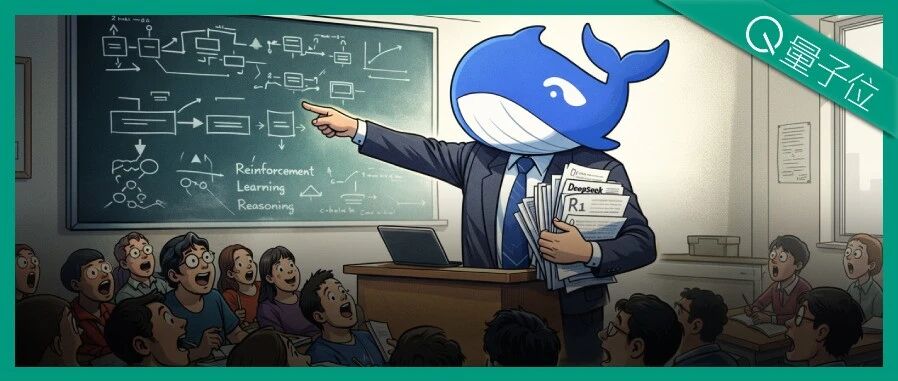
Core Insights - DeepSeek has significantly updated its R1 paper from 22 pages to 86 pages, demonstrating that open-source models can compete with closed-source ones and even teach them new methodologies [1][2][4] - The updated paper serves as a fully reproducible technical report for the open-source community, showcasing the advancements made in AI reasoning capabilities through reinforcement learning [2][4] Summary by Sections Paper Update and Content - The R1 paper now includes precise data specifications, detailing a dataset of 26,000 math problems and 17,000 code samples, along with the creation process [4] - Infrastructure details are provided, including a diagram of the vLLM/DualPipe setup [4] - The training cost is broken down, totaling approximately $294,000, with R1-Zero utilizing 198 hours of H800 GPU [4][24] - A retrospective on failed attempts is included, explaining why the Process Reward Model (PRM) did not succeed [4] - A comprehensive safety report of 10 pages outlines safety assessments and risk analyses [4] Performance Comparison - DeepSeek R1's performance is comparable to OpenAI's o1, even surpassing o1-mini, GPT-4o, and Claude 3.5 in several metrics [5][10] - In educational benchmarks like MMLU and GPQA Diamond, R1 outperforms previous models, particularly excelling in STEM-related questions due to reinforcement learning [10][12] - R1's performance in long-context question-answering tasks is notably strong, indicating excellent document understanding and analysis capabilities [10] Reinforcement Learning and Distillation - The paper discusses the effectiveness of distilling reasoning capabilities from larger models to smaller ones, confirming that learned reasoning can be transferred without re-exploring the reward space [20][22] - The training data distribution for reinforcement learning includes 26,000 math problems, 17,000 code samples, and 66,000 general knowledge tasks [19] Safety and Risk Assessment - DeepSeek R1's safety evaluation includes a risk control system that filters potential risk dialogues and assesses model responses against predefined keywords [31][32] - The model's performance in safety benchmarks is comparable to other advanced models, although it shows weaknesses in handling intellectual property issues [35][37] - A multi-language safety testing dataset has been developed, demonstrating R1's safety performance across 50 languages [42] Conclusion - The advancements made by DeepSeek R1 represent a significant milestone in open-source AI, showcasing competitive performance against proprietary models while maintaining lower operational costs [17][18]

清库存,DeepSeek突然补全R1技术报告,训练路径首次详细公开
3 6 Ke· 2026-01-09 03:12
Core Insights - DeepSeek has released an updated version of its research paper on the R1 model, adding 64 pages of technical details, significantly enhancing the original content [4][25] - The new version emphasizes the implementation details of the R1 model, showcasing a systematic approach to its training process [4][6] Summary by Sections Paper Update - The updated paper has expanded from 22 pages to 86 pages, providing a comprehensive view of the R1 model's training and operational details [4][25] - The new version includes a detailed breakdown of the training process, which is divided into four main steps: cold start, inference-oriented reinforcement learning (RL), rejection sampling and fine-tuning, and alignment-oriented RL [6][9] Training Process - The cold start phase utilizes thousands of CoT (Chain of Thought) data to perform supervised fine-tuning (SFT) [6] - The inference-oriented RL phase enhances model capabilities while introducing language consistency rewards to address mixed-language issues [6] - The rejection sampling and fine-tuning phase incorporates both reasoning and general data to improve the model's writing and reasoning abilities [6] - The alignment-oriented RL phase focuses on refining the model's usefulness and safety to align more closely with human preferences [6] Safety Measures - DeepSeek has implemented a risk control system to enhance the safety of the R1 model, which includes a dataset of 106,000 prompts to evaluate model responses based on predefined safety criteria [9][10] - The safety reward model employs a point-wise training method to distinguish between safe and unsafe responses, with training hyperparameters aligned with the usefulness reward model [9] - The risk control system operates through two main processes: potential risk dialogue filtering and model-based risk review [9][10] Performance Metrics - The introduction of the risk control system has led to a significant improvement in the model's safety performance, with R1 achieving benchmark scores comparable to leading models [14] - DeepSeek has developed an internal safety evaluation dataset categorized into four main categories and 28 subcategories, totaling 1,120 questions [19] Team Stability - The core contributors to the DeepSeek team have largely remained intact, with only five out of over 100 authors having left, indicating strong team retention in a competitive AI industry [21][24] - Notably, a previously departed author has returned to the team, highlighting a positive team dynamic compared to other companies in the sector [24]

牌桌被掀,中国模型换了一种赢法
3 6 Ke· 2026-01-08 13:43
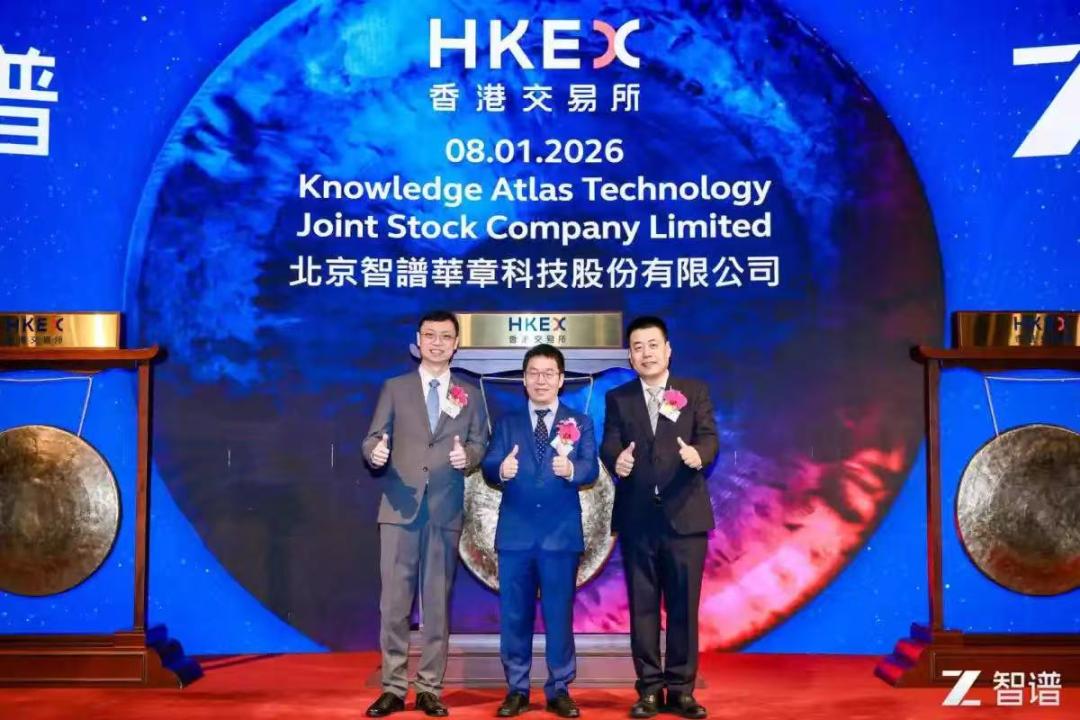
Core Insights - The core message of the news is the significant progress and recognition of Chinese AI companies, particularly in the large model sector, highlighted by the IPO of Zhiyu and MiniMax, marking a pivotal moment in the global AI landscape [1][4]. Group 1: IPO Significance - The IPO of Zhiyu and MiniMax serves as an optimistic signal for innovators, indicating that they will not be easily discarded by the times [4]. - The IPO is expected to raise approximately HKD 4.3 billion for Zhiyu, significantly enhancing its market valuation and international influence [27][28]. Group 2: Competitive Landscape - The emergence of DeepSeek has forced several companies within the "Six Little Tigers" to rapidly adjust their business strategies and teams to survive in a highly competitive environment [3][5]. - Despite initial setbacks, the "Six Little Tigers" have shown remarkable resilience and innovation, leading to significant advancements in model performance and market presence [6][8]. Group 3: Market Dynamics - The competitive landscape has shifted, with companies like Zhiyu and MiniMax gaining traction in international markets, evidenced by MiniMax's 73.1% overseas revenue share [14][15]. - The B-end market has matured, with companies realizing the importance of tailored services and industry knowledge, leading to a more robust commercial ecosystem [12][13]. Group 4: Financial Performance - Zhiyu's annual recurring revenue (ARR) surged from RMB 20 million to over RMB 500 million, reflecting a 25-fold increase within ten months [11]. - The financial reports indicate that both Zhiyu and MiniMax have incurred nearly RMB 11 billion in losses over the past three years, primarily due to substantial investments in model research and development [21][24]. Group 5: Long-term Vision - The industry consensus emphasizes the need for sustained innovation and investment, as the AI sector remains in its early stages, with significant long-term potential [23][24]. - IPOs in the AI sector are seen as a reward for long-term commitment and innovation, providing companies with a platform to further their technological advancements [29].
牌桌被掀,中国模型换了一种赢法
36氪· 2026-01-08 13:35
Core Viewpoint - The IPO of AI companies like Zhipu and MiniMax signifies a positive signal for innovation in the AI sector, indicating that innovators will not be easily discarded by the times [10][40][45] Group 1: IPO Significance - Zhipu officially listed on the Hong Kong Stock Exchange on January 8, 2026, becoming the "first stock of global large models" [3] - The IPO is seen as a badge of honor for companies in the AI sector, representing a milestone in their journey [10][45] - The expected fundraising scale for Zhipu is approximately HKD 4.3 billion, which is significantly more efficient than financing through primary markets [43] Group 2: Industry Dynamics - The AI industry has experienced rapid technological changes over the past three years, with companies facing intense scrutiny and competition [4][6] - The emergence of DeepSeek has forced several companies, including the "Six Little Tigers," to quickly adjust their business strategies and teams [6][12] - Despite initial setbacks, the "Six Little Tigers" have shown remarkable resilience and innovation, leading to a resurgence in their market presence [14][19] Group 3: Financial Performance - Zhipu and MiniMax have incurred nearly RMB 11 billion in losses over the past three years, with around 70% of expenditures allocated to model research and development [36] - Zhipu's annual recurring revenue (ARR) from its MaaS platform surged from RMB 20 million to over RMB 500 million, marking a 25-fold increase in just 10 months [19] - The revenue from localized deployments accounted for 84.8% of Zhipu's income in the first half of 2025, highlighting the importance of tailored services for enterprise clients [22] Group 4: Global Recognition - Chinese models are gaining international recognition, with MiniMax reporting that 73.1% of its revenue came from overseas by September 30, 2025 [27] - The competitive pricing of Chinese models, such as Zhipu's GLM-4.5, offers significant cost advantages compared to international counterparts [29][31] - The emergence of independent model developers is crucial for providing diverse model options and establishing a healthy commercial ecosystem [32] Group 5: Long-term Commitment - The AI sector's long-termism emphasizes the need for continuous innovation and investment, with companies like Zhipu and MiniMax embodying this spirit [39] - The IPO serves as a reward for those committed to climbing the AGI peak, reinforcing the notion that the journey of innovation is fraught with challenges but ultimately rewarding [45]

清库存!DeepSeek突然补全R1技术报告,训练路径首次详细公开
量子位· 2026-01-08 12:08
Core Insights - DeepSeek has released an updated version of its R1 paper, adding 64 pages of technical details, significantly enhancing the original content [2][5][56] - The new version emphasizes the implementation details and training processes of the R1 model, showcasing a systematic approach to its development [10][11][17] Summary by Sections Paper Updates - The updated paper has expanded from 22 pages to 86 pages, providing a wealth of new information that resembles a textbook [3][6] - The revisions include a comprehensive breakdown of the R1 training process, which is divided into four main steps: cold start, inference-guided reinforcement learning, rejection sampling and fine-tuning, and alignment-guided reinforcement learning [13][14][15][16] Model Performance and Safety - The R1 model has shown a significant increase in reasoning capabilities, with a reported 5 to 7 times increase in the occurrence of reflective vocabulary as training progresses [21][22] - DeepSeek has implemented a safety control system that includes a dataset of 106,000 prompts to evaluate and enhance the model's safety, using a point-wise training method for the safety reward model [26][29] - The introduction of the risk control system has led to a notable improvement in the model's safety performance, with R1 achieving benchmark scores comparable to leading models [32][33] Team Stability and Industry Context - The core team behind the R1 paper has remained stable, with 18 key contributors still part of DeepSeek, indicating a low turnover rate in contrast to industry trends [41][47] - The article contrasts DeepSeek's team retention with the challenges faced by other companies in the AI sector, highlighting a more cohesive internal culture [48][49]
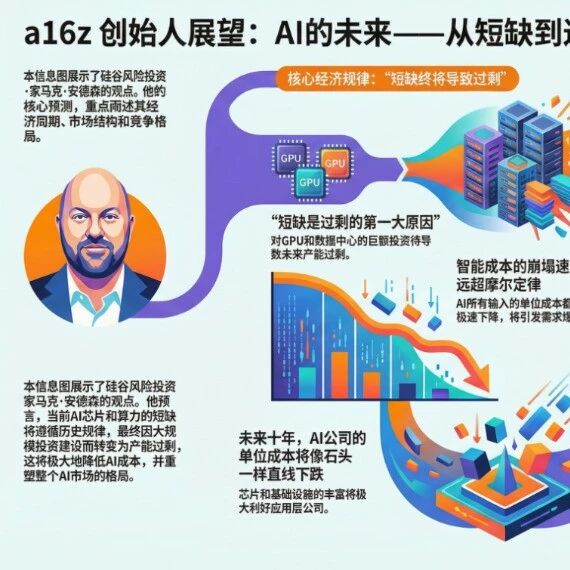
“短缺终将导致过剩”!a16z安德森2026年展望:AI芯片将迎来产能爆发与价格崩塌
硬AI· 2026-01-08 04:24
Core Insights - AI represents a technological revolution larger than the internet, comparable to electricity and microprocessors, and is still in its early stages [2][3][11] - The cost of AI is decreasing at a rate faster than Moore's Law, leading to explosive demand growth [4][41] - Historical patterns suggest that shortages in GPU and data center capacity will eventually lead to oversupply, further driving down AI costs [5][12][41] Group 1: AI Market Dynamics - The future AI market structure will resemble the computer industry, with a few "god-level models" at the top and numerous low-cost "small models" proliferating at the edges [6][19] - The competition between the US and China is intensifying, with Chinese companies like DeepSeek and Kimi making significant strides in open-source strategies and chip development [6][15][59] - AI applications are shifting from "pay-per-token" models to "value-based pricing," allowing startups to integrate and build their own models rather than merely acting as wrappers [7][17] Group 2: Public Perception and Regulatory Landscape - Public sentiment towards AI is mixed, with fears of job displacement coexisting with rapid adoption of AI technologies [8] - The EU's regulatory approach, focusing on leading in regulation rather than innovation, is hindering local AI development [8][60] - The US regulatory environment is shifting towards supporting innovation, with less interest in imposing strict regulations that could hinder competitiveness against China [14][64] Group 3: Economic Implications - The rapid decline in AI input costs is expected to create significant demand elasticity, leading to unprecedented growth in AI applications [41][42] - The economic landscape for AI companies is promising, with many experiencing unprecedented revenue growth as they effectively monetize their offerings [32][39] - The ongoing construction of data centers and GPU production is projected to lead to a significant reduction in AI operational costs over the next decade [41][50]