洋河股份

Search documents
新发展环境下禁酒政策调整对白酒行业影响分析
Lian He Zi Xin· 2025-12-30 11:16
Investment Rating - The report indicates a cautious outlook for the liquor industry, with expectations of continued pressure until mid-2026, followed by a potential recovery in the latter half of 2026 [32][33]. Core Insights - The new alcohol prohibition policy introduced in May 2025 has significantly impacted the liquor industry, particularly affecting sales and profits of listed companies, which experienced a year-on-year decline for the first time since 2015 [4][5][6]. - The shift in consumer behavior from government-related consumption to business and personal consumption has made the industry less sensitive to policy changes, although the recent prohibition has still caused notable disruptions [12][15]. - The liquor market is undergoing a structural transformation, with a focus on rational consumption and a shift towards mid-range and low-end products, as high-end consumption becomes less dominant [16][17]. Summary by Sections Policy Adjustment and Industry Operation - The new prohibition policy has led to a significant reduction in liquor consumption, particularly in the second and third quarters of 2025, resulting in a decline in sales and profits for the industry [5][6][7]. - The impact of the new policy is compounded by the cyclical nature of the industry, with the current downturn being attributed to both policy effects and the industry's operational cycle [9][11]. Market Structure Changes - The main consumption scenarios have shifted from government-led to diverse drivers, with personal and business consumption now accounting for approximately 95% of total demand [13][15]. - The price structure of the liquor market has also changed, with a notable increase in demand for mid-range and low-end products, reflecting a more pragmatic consumer approach [16][17]. External Factors - The slowing macroeconomic growth and declining labor population are expected to suppress the overall growth of the liquor industry [19][21]. - The changing demographics and consumption preferences among younger generations indicate a shift towards lower-alcohol products and a focus on health and quality of life [21][22]. Response Strategies of Mainstream Enterprises - Liquor companies are transitioning from passive responses to proactive strategies, including product structure optimization and digital channel enhancements to mitigate risks [26][29]. - The focus on cultural value reconstruction and international expansion is seen as a long-term strategy to overcome domestic market challenges [30][31]. Industry Development Trends - The liquor industry is expected to face significant pressure in the short term, with a potential turning point anticipated in the latter half of 2026 as policy impacts diminish and inventory levels normalize [32][33]. - Long-term projections suggest a gradual contraction in market size, with increased industry concentration likely benefiting leading enterprises [34].
因恒生银行私有化 相关恒生指数系列成份股变动
Zhi Tong Cai Jing· 2025-12-30 10:48
12月30日恒生指数公司发文,根据日期为2025年12月15日的计划文件,关于根据《公司条例》第673条 以协议安排方式将恒生银行(00011)私有化之建议,该计划须(其中包括)获得将于2026年1月8日举行的法 院会议及股东大会的批准。若该计划于上述会议获得批准,恒生银行股份预期将于联交所撤销上市,最 后交易日为2026年1月14日(星期三)。 若获得相关批准,并根据计划文件所载的现行时间表,恒生银行将于2026年1月14日收市后以当天收市 价从下列指数及其分类指数中剔除。变动将于2026年1月15日起生效。 | | 将从下列有成份股备选名单的指数剔除 | | 成份股替换 | | --- | --- | --- | --- | | | | 股份代号 | 公司 | | . | 恒生香港 35 | 1208.HK | 五矿资源有限公司 | | . | 恒生内地及香港可持续发展企业指数 | 1113.HK | 长江实业集团有限公司 | | . | 恒生可持续发展企业指数 | | | | . | 恒生沪深港通大湾区综合指数系列 | 301291.SZ | 广东明阳电气股份有限公司 | | . | 恒生泸深港通大湾区 ...


因恒生银行(00011)私有化 相关恒生指数系列成份股变动
智通财经网· 2025-12-30 10:48
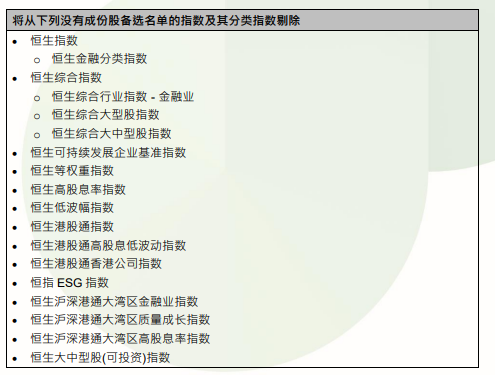
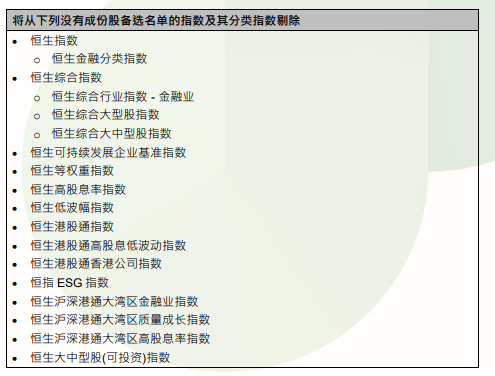
智通财经APP获悉,12月30日恒生指数公司发文,根据日期为2025年12月15日的计划文件,关于根据 《公司条例》第673条以协议安排方式将恒生银行(00011)私有化之建议,该计划须(其中包括)获得将于 2026年1月8日举行的法院会议及股东大会的批准。若该计划于上述会议获得批准,恒生银行股份预期将 于联交所撤销上市,最后交易日为2026年1月14日(星期三)。 若获得相关批准,并根据计划文件所载的现行时间表,恒生银行将于2026年1月14日收市后以当天收市 价从下列指数及其分类指数中剔除。变动将于2026年1月15日起生效。 | | 将从下列没有成份股备选名单的指数及其分类指数剔除 | | --- | --- | | . | 恒生指数 | | | 恒生金融分类指数 | | . | 恒生综合指数 | | | 恒生综合行业指数 - 金融业 0 | | | 恒生综合大型股指数 | | | 恒生综合大中型股指数 0 | | . | 恒生可持续发展企业基准指数 | | . | 恒生等权重指数 | | . | 恒生高股息率指数 | | . | 恒生低波幅指数 | | . | 恒生港股通指数 | | . | 恒生港股 ...
2025茅五泸掀价格保卫战,经销商收缩求生
3 6 Ke· 2025-12-30 10:30
Core Viewpoint - The Chinese liquor industry is undergoing a significant adjustment, with high-end liquor prices declining and companies shifting their strategies to stabilize prices and adapt to changing consumer behaviors [4][10][11]. Group 1: Market Dynamics - The demand for high-end liquor has decreased, with a shift from traditional gifting consumption to more personal consumption, leading to a reduction in sales of premium products [5][6]. - The price of 53-degree 500ml Flying Moutai has fluctuated significantly, dropping to around 1495 yuan per bottle, prompting the company to implement quantity control measures to stabilize market expectations [3][8]. - The overall liquor market is experiencing a price decline, with major brands like Wuliangye and Fenjiu also seeing price reductions compared to the previous year [9][10]. Group 2: Financial Performance - In the first three quarters of the year, the liquor sector's 19 listed companies reported a total revenue of 317.74 billion yuan, a year-on-year decrease of 5.85%, and a net profit of 122.68 billion yuan, down 6.90% [14]. - The average return on equity (ROE) for the sector fell to 19.77%, a decrease of 2.84 percentage points from the previous year, indicating pressure on profitability [14]. - The stock performance of the liquor sector has been weak, with a cumulative decline of 13.76% for the liquor index in 2025, resulting in a market capitalization reduction of approximately 404 billion yuan [14][15]. Group 3: Strategic Adjustments - Companies are focusing on reducing burdens on distributors and shifting marketing strategies to be more consumer-centric, moving away from traditional distribution methods [17][18]. - Major liquor companies are streamlining their distribution channels, with a net reduction of 1,701 distributors among 20 listed companies in the first half of 2025 [18]. - The concept of a "shared destiny" between manufacturers and distributors is being emphasized, with calls for shared pricing power and responsibilities to ensure sustainable partnerships [18].




中国必选消费品12月价格报告:白酒批价多数企稳,液态奶折扣显著增加
Haitong Securities International· 2025-12-30 08:54
Investment Rating - The report assigns an "Outperform" rating to multiple companies in the essential consumer goods sector, including Guizhou Moutai, Wuliangye, Luzhou Laojiao, and others, indicating a positive outlook for these stocks [1]. Core Insights - Wholesale prices of Baijiu have mostly stabilized, with specific brands showing varied price changes. For instance, the price of Feitian Moutai (case) is 1600 yuan, down by 50 yuan from last month, while the price of Wuliangye has increased by 20 yuan to 820 yuan [3][38]. - Discounts on liquid milk have significantly increased, while discounts on seasoning and soft drink products have narrowed compared to the end of November. The average discount rate for seasonings rose from 85.9% to 87.1%, and for soft drinks from 85.6% to 86.7% [5][17][35]. Summary by Sections Baijiu Pricing - The report details the wholesale prices of key Baijiu brands, noting that Feitian Moutai's prices have decreased by 640 yuan year-to-date compared to the previous year. Other brands like Wuliangye and Luzhou Laojiao have also shown price stability or slight increases [9][38]. Discount Trends - Discounts on liquid milk products have widened, with the average discount rate dropping from 66.0% to 62.8%. In contrast, discounts on convenience foods have decreased from 95.8% to 94.8% [19][21][36]. - The report highlights that infant formula and beer products have maintained stable discount rates, with slight changes observed [18][35]. Company Ratings - The report lists several companies rated as "Outperform," including Guizhou Moutai, Wuliangye, and others, indicating strong expected performance relative to the market [1].


17只白酒股下跌 贵州茅台1389.72元/股收盘
Bei Jing Shang Bao· 2025-12-30 07:44
Core Viewpoint - The liquor sector in China is experiencing a slight decline, with major brands showing mixed performance in stock prices, while analysts predict a gradual recovery in the industry by 2026 [1]. Industry Summary - The Shanghai Composite Index closed at 3965.12 points on December 30, with the liquor sector index at 2173.07 points, down 0.51% [1]. - A total of 17 liquor stocks declined, with notable drops in major brands such as Kweichow Moutai, Wuliangye, and Shanxi Fenjiu [1]. - Kweichow Moutai's stock closed at 1389.72 yuan per share, down 0.88% [1]. - Wuliangye closed at 107.36 yuan per share, down 0.65% [1]. - Shanxi Fenjiu closed at 173.05 yuan per share, down 1.11% [1]. - Luzhou Laojiao saw a slight increase, closing at 117.85 yuan per share, up 0.55% [1]. - Yanghe's stock closed at 61.19 yuan per share, down 0.46% [1]. Analyst Insights - Guosheng Securities highlighted that leading companies are actively optimizing supply, with expectations for sales recovery in the upcoming spring festival [1]. - The report anticipates that by 2025, the industry will fully release risks, and by 2026, there will be a dual improvement in supply and demand [1]. - Short-term outlook suggests a recovery in sales during the spring festival, while the medium to long-term perspective indicates a gradual improvement in the industry [1].
低度酒品类狂欢下,却赚了个寂寞
3 6 Ke· 2025-12-30 04:00
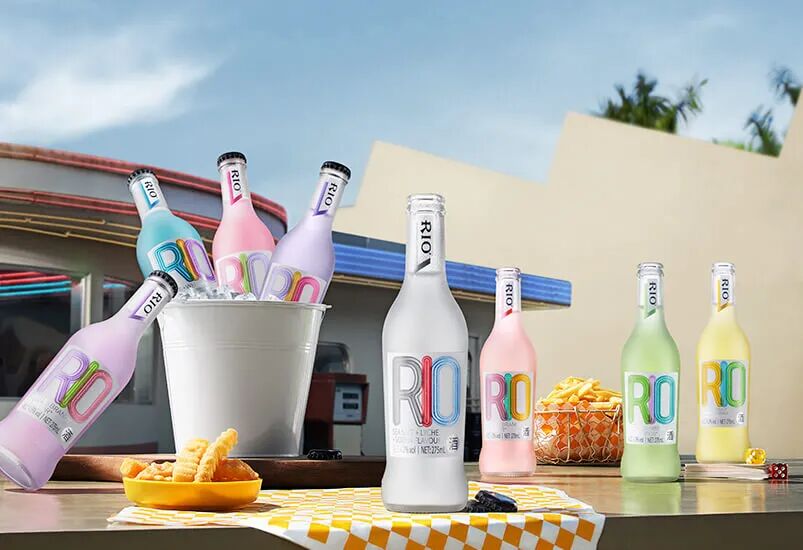
Core Insights - The low-alcohol beverage market in China has rapidly expanded, with market size projected to grow from 200 billion yuan in 2020 to over 570 billion yuan by 2024, and globally reaching 634.17 billion yuan in 2023, expected to exceed 740 billion yuan by 2025 [1][4][6] - The shift in consumer preferences from traditional high-alcohol beverages to low-alcohol options is driven by younger generations seeking healthier and more enjoyable drinking experiences [5][6][8] - The market is becoming increasingly competitive with new brands entering, including traditional liquor companies and retail chains launching their own low-alcohol products [5][9][12] Market Trends - The rise of low-alcohol beverages is characterized by a cultural shift from "drinking for social obligation" to "drinking for personal enjoyment," with 50% of consumption occurring at home and a 56% increase in outdoor activities like camping [5][6] - Young consumers aged 18-35 account for 68% of sales, with a significant portion being female [5][6] - Health concerns are a primary motivator for Gen Z consumers choosing low-alcohol options, as traditional high-alcohol spirits are viewed as outdated [6][8] Competitive Landscape - Established brands like RIO and emerging players such as Mei Jian and Bei Rui Tian Xin are competing for market share, with RIO facing challenges due to declining sales and brand fatigue [2][9][11] - Traditional liquor companies like Moutai and Wuliangye are diversifying into low-alcohol products, while retail chains like Hema and Haidilao are also launching their own offerings [5][9] - The market is characterized by a lack of standout brands, with many new entrants struggling to differentiate themselves in a crowded space [12] Consumer Behavior - Young consumers prefer low-alcohol products that are smooth and sweet, contrasting with the strong flavors of traditional spirits [8] - The use of social media has significantly increased the visibility and popularity of low-alcohol beverages, with discussions on platforms tripling in 2020 [4] - The trend towards low-alcohol beverages is not just a passing fad; it reflects a deeper cultural shift in drinking habits among younger generations [5][6]

省外收入微增0.06%,今世缘千亿扩张梦碎?
Xin Lang Cai Jing· 2025-12-30 03:38
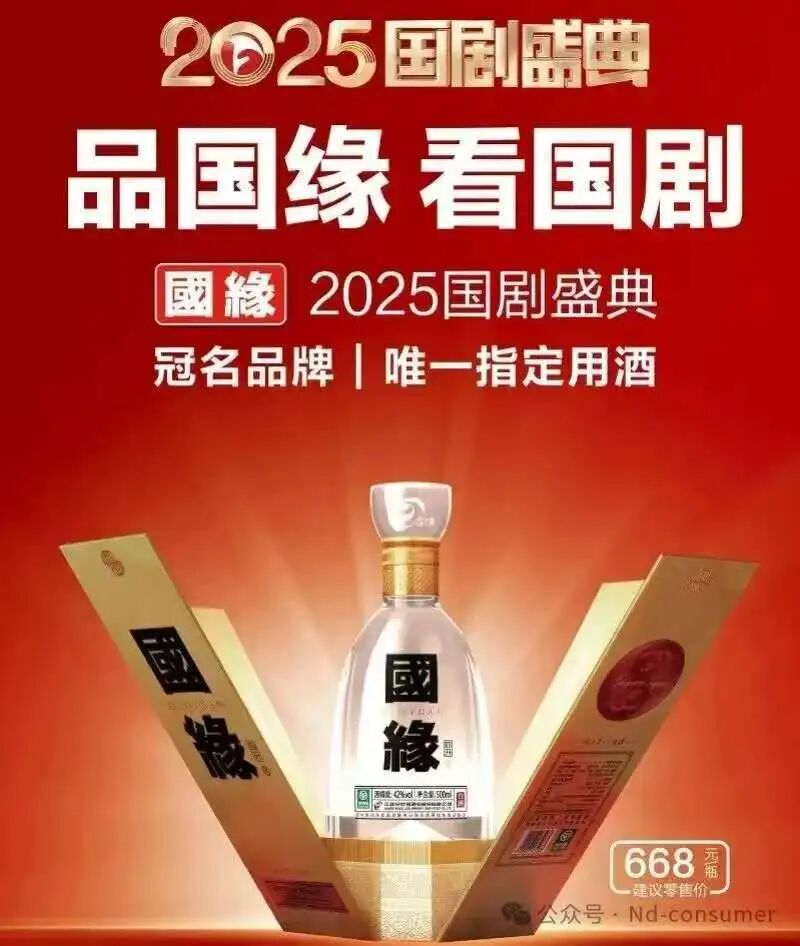
Core Insights - The company is facing a "high investment, low output" dilemma, with both revenue and net profit declining while external market growth stagnates [2][4][10] Group 1: Marketing Strategies - The company has accelerated its brand expansion efforts, engaging in intensive marketing activities across sports and cultural events, including becoming the official strategic partner of the Jiangsu Super League [2][8] - A strategic partnership with Anhui Satellite TV was established, securing the naming rights for the 2025 "National Drama Festival," aiming to enhance brand exposure and cultural recognition [3][8] Group 2: Financial Performance - For the first three quarters, the company reported a revenue of 8.88 billion yuan, a year-on-year decline of 10.7%, and a net profit of 2.55 billion yuan, down 17.4% [4][9] - In Q3 alone, revenue plummeted to 1.93 billion yuan, a staggering drop of 26.8%, with net profit nearly halving to 320 million yuan, a decrease of 48.7% [4][9] Group 3: Market Challenges - The company's revenue heavily relies on the domestic market, with 7.955 billion yuan from the province, accounting for 90% of total revenue, which saw a decline of 12.4% [4][9] - The external market growth is minimal, with only 804 million yuan in revenue, reflecting a mere 0.06% increase, indicating challenges in the company's national expansion strategy [4][10] Group 4: Industry Context - The broader industry is experiencing a "slight revenue increase, profit pressure" trend, with intense competition in the domestic market, prompting local companies to seek expansion into surrounding provinces [5][10] - The white liquor industry is characterized by strong regionality and channel dependency, making cross-regional expansion challenging and requiring significant long-term investment [10]

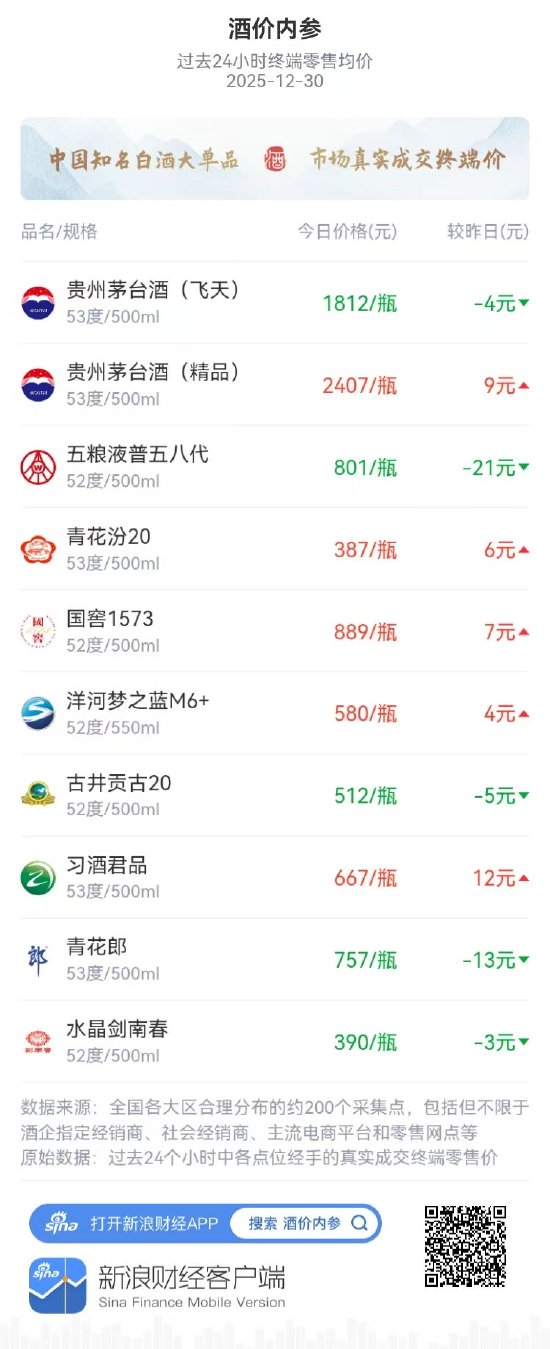
酒价内参12月30日价格发布,洋河梦之蓝M6+小涨4元
Xin Lang Cai Jing· 2025-12-30 02:10
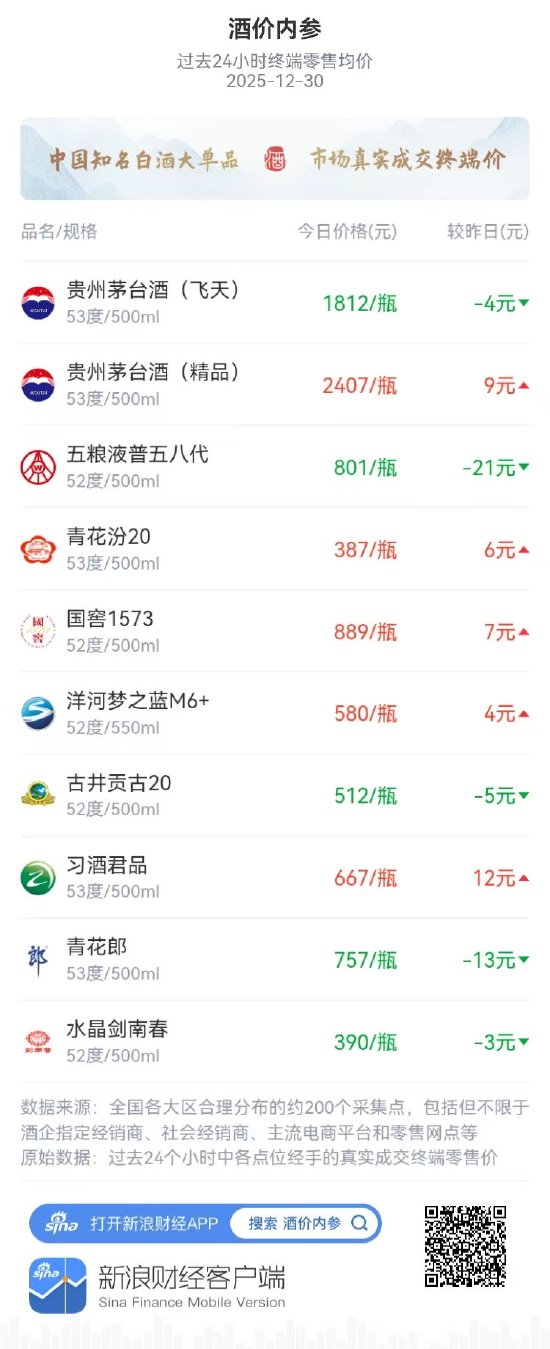
Core Viewpoint - The Chinese liquor market is experiencing a high-level consolidation with slight price adjustments, indicating a stable end to the year after significant fluctuations in mid-December [1] Price Trends - The average retail price of the top ten liquor products is 9,202 yuan, down 8 yuan from the previous day [1] - Notable price increases include: - Xijiu Junpin up 12 yuan/bottle - Guizhou Moutai (Premium) up 9 yuan/bottle, reaching 2,400 yuan/bottle - Guojiao 1573 up 7 yuan/bottle - Qinghua Fen 20 up 6 yuan/bottle - Yanghe Dream Blue M6+ up 4 yuan/bottle [1][3] - Significant price decreases include: - Wuliangye Pu 58th generation down 21 yuan/bottle, nearing the 800 yuan/bottle mark - Qinghua Lang down 13 yuan/bottle after a previous increase of 45 yuan/bottle over eight days - Gujing Gonggu 20 down 5 yuan/bottle - Feitian Moutai and Shuijing Jian'nan Chun down 4 yuan and 3 yuan/bottle respectively [1][4] Market Dynamics - The data is sourced from approximately 200 collection points across major regions, ensuring a comprehensive and objective representation of the liquor market [2] - Langjiu has announced a strategic push into Jiangsu, aiming to capture market share from Yanghe, which has seen a decline in influence [2] - The competition among major brands like Sichuan liquor, Guizhou liquor, and Anhui liquor in Jiangsu reflects a trend where smaller brands are losing market presence, necessitating larger brands to actively seek growth opportunities [2]
酒价内参12月30日价格发布,贵州茅台精品上涨9元站上2400元大关
Xin Lang Cai Jing· 2025-12-30 01:17
Core Insights - The core viewpoint of the article is that the Chinese liquor market, particularly for the top ten baijiu products, is experiencing a high-level consolidation with slight price adjustments, indicating a stable market as the year ends [1][6]. Price Trends - The average retail price for the top ten baijiu products is 9,202 yuan, down by 8 yuan from the previous day [1][6]. - Price fluctuations are noted, with some products increasing while others decrease, reflecting a typical year-end market sentiment characterized by capital and emotional speculation [7]. Product Performance - Notable price increases include: - Xijiu Junpin: up 12 yuan/bottle - Guizhou Moutai (Premium): up 9 yuan/bottle, reaching 2,400 yuan/bottle - Guojiao 1573: up 7 yuan/bottle - Qinghua Fen 20: up 6 yuan/bottle - Yanghe Dream Blue M6+: up 4 yuan/bottle [7][10]. - Significant price decreases include: - Wuliangye Pu 58th Generation: down 21 yuan/bottle, nearing the 800 yuan mark - Qinghua Lang: down 13 yuan/bottle after a previous increase of 45 yuan/bottle over eight days - Gujing Gonggu 20: down 5 yuan/bottle - Feitian Moutai and Shuijing Jianan Chun: down 4 yuan and 3 yuan/bottle respectively [7][10]. Market Dynamics - The data for "Liquor Price Reference" is sourced from approximately 200 collection points across major regions, including designated distributors, social distributors, mainstream e-commerce platforms, and retail outlets, aiming to provide objective and traceable market price data [2][6]. - In industry dynamics, Langjiu has announced a strategic focus on Jiangsu as a key development market, planning aggressive market penetration over the next three years, which poses a competitive threat to Yanghe, indicating a shift in market power among leading brands [3][8].