
中国海洋石油

Search documents
资金动向 | 北水爆买芯片股,连续10日抛售中国移动
Ge Long Hui· 2026-01-16 10:57
Group 1 - Southbound funds net bought Hong Kong stocks worth 93.58 million HKD on January 16, with notable purchases including SMIC (1.084 billion HKD), Xiaomi Group (867 million HKD), and Hua Hong Semiconductor (585 million HKD) [1] - Southbound funds have continuously net bought Tencent for 8 days, totaling 9.68457 billion HKD, and Alibaba for 5 days, totaling 4.42446 billion HKD; however, they have net sold China Mobile for 10 consecutive days, amounting to 8.06248 billion HKD [4] Group 2 - SMIC benefits from the recent easing of U.S. export regulations on Nvidia's H200 chips to China, with optimistic projections for the semiconductor industry driven by AI demand and price increases across various segments [6] - Xiaomi Group introduced a low-interest financing policy for its YU7 series, with a down payment starting at 49,900 HKD and monthly payments as low as 2,593 HKD [6] - Bubble Mart is expected to see growth driven by existing IP potential, with a positive outlook for visibility improvement by March, leading to potential revaluation [6] - Alibaba Health signed a strategic cooperation agreement with Jinsai Pharmaceutical to collaborate on various health sectors, including children's health and women's health [7] - China Mobile held a 2026 work meeting focusing on advancing market adaptation and developing three growth curves: communication, computing power, and intelligent services [7]


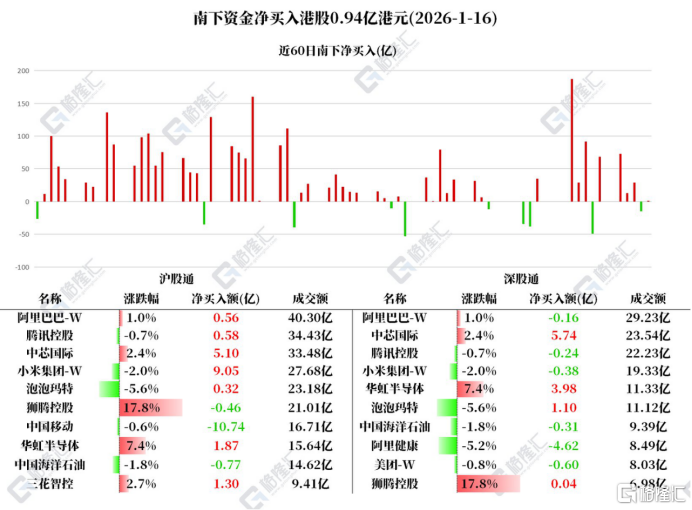
南向资金丨中芯国际获净买入10.84亿港元
Di Yi Cai Jing· 2026-01-16 09:58
Group 1 - The net buying of southbound funds amounted to 0.94 billion HKD, with the top three net purchases being SMIC, Xiaomi Group-W, and Hua Hong Semiconductor, which received net purchases of 10.84 billion HKD, 8.67 billion HKD, and 5.85 billion HKD respectively [1] - On the selling side, China Mobile, Alibaba Health, and CNOOC experienced net sales of 10.74 billion HKD, 4.62 billion HKD, and 1.08 billion HKD respectively [1]



北水动向|北水成交净买入0.94亿 芯片股再获加仓 北水抢筹中芯国际(00981)超10亿港元
智通财经网· 2026-01-16 09:48
Group 1: Market Overview - Northbound trading recorded a net buy of HKD 0.94 billion, with a net buy of HKD 10.06 billion from the Shanghai Stock Connect and a net sell of HKD 9.13 billion from the Shenzhen Stock Connect [1] - The most bought stocks included SMIC (00981), Xiaomi Group-W (01810), and Hua Hong Semiconductor (01347), while the most sold stocks were China Mobile (00941), Alibaba Health (00241), and CNOOC (00883) [1] Group 2: Stock Performance - Alibaba-W (09988) saw a net buy of HKD 395.9 million, while Lion Group (02562) and Alibaba Health (00241) experienced net sells of HKD 42 million and HKD 461 million respectively [6] - Tencent Holdings (00700) had a net buy of HKD 342.8 million, while China Mobile (00941) faced a significant net sell of HKD 10.74 billion [8] Group 3: Sector Insights - SMIC (00981) and Hua Hong Semiconductor (01347) received net buys of HKD 10.84 billion and HKD 5.85 billion respectively, driven by news of the U.S. easing export restrictions on Nvidia's H200 chips to China [4] - Xiaomi Group-W (01810) gained a net buy of HKD 8.67 billion, with the announcement of new purchasing incentives for its popular model, the Xiaomi YU7 [5] - Bubble Mart (09992) attracted a net buy of HKD 1.41 billion, with growth drivers identified for 2026, including monetization of existing IPs and new IP launches [5]
广东湛江:加快打造现代化沿海经济带
Zhong Guo Jing Ji Wang· 2026-01-16 08:13
Core Viewpoint - The "14th Five-Year Plan" period is a significant phase for Zhanjiang, focusing on high-quality development and modernization as a key coastal economic zone and provincial sub-center city [1] Economic Development - Zhanjiang's GDP is expected to reach 400 billion yuan by 2025, with industrial added value surpassing 100 billion yuan and a double-digit growth rate for industrial added value [1] - A total of 2,367 major provincial and municipal projects have been implemented over five years, with a cumulative investment of 440 billion yuan, ranking first in the eastern and northwestern regions of Guangdong [1] - The total output value of agriculture, forestry, animal husbandry, and fishery has exceeded 100 billion yuan for five consecutive years, with annual R&D expenditure growing by 24.9% [1] Industrial Development - Zhanjiang has established a preliminary "Four Greens and One Blue" industrial system, with green petrochemicals and modern agriculture both achieving annual output values exceeding 100 billion yuan [2] - Key projects such as BASF's integrated base and Baosteel's hydrogen-based steel plant have been completed, while the region leads the province in onshore wind and solar power grid connection [2] - The Zhanjiang Lingang Economic Zone has been recognized as a national zero-carbon park, and the Zhanjiang Economic Development Zone has been designated as a national hydrogen energy pilot area, with industrial added value growing at an annual rate of 33.5% [2] Transportation and Infrastructure - Zhanjiang has enhanced its role as a national logistics hub, with its port becoming the first deep-water port in South China capable of accommodating 400,000-ton vessels [3] - The completion of the Zhanjiang Wuchuan International Airport has led to an annual passenger throughput exceeding 3.1 million, and the Guangzhan high-speed railway has improved connectivity with the Guangdong-Hong Kong-Macao Greater Bay Area [3] - A series of road and bridge projects have been completed, making Zhanjiang's total road mileage the highest in the province [3] Environmental and Ecological Initiatives - Zhanjiang maintains excellent air quality and water quality in coastal areas, with over 93% of nearshore waters rated as good [3] - The city has launched the first national "blue carbon" trading project and has been recognized for its ecological initiatives, including the promotion of zero-carbon islands [3] - Zhanjiang's ecological assets, such as mangroves and the Chinese white dolphin, have become key ecological symbols for the city [3] Trade and Tourism - The Zhanjiang Comprehensive Bonded Zone has commenced operations, with international trade covering 182 countries and regions [4] - The "Fresh Zhanjiang" tourism brand has driven total tourism revenue to exceed 110 billion yuan, attracting over 100 million visitors [4] - Zhanjiang has been recognized as a high-quality outdoor sports destination, successfully hosting major sports events [4] Future Outlook - Looking ahead to the "15th Five-Year Plan," Zhanjiang aims to accelerate its development as a key coastal economic zone and provincial sub-center city, striving for new advantages and breakthroughs [4]
冲刺连续6天净流入,石油ETF鹏华(159697)早盘净申购1300万份
Sou Hu Cai Jing· 2026-01-16 04:16
Group 1 - The oil sector is experiencing a capital inflow, with the Penghua Oil ETF (159697) seeing a net subscription of 13 million units in the morning session, marking six consecutive days of net inflows [1] - Huatai Securities suggests that the tense situation in Iran may lead to a short-term decline in the country's crude oil production and exports, with potential supply gap risks if the situation escalates and disrupts transportation through the Strait of Hormuz [1] - Oil prices have returned to marginal cost levels, and the current conflict may lead to high volatility, with prices gradually bottoming out and recovering [1] Group 2 - As of January 16, 2026, the National Oil and Gas Index (399439) shows mixed performance among its constituent stocks, with Jerry Holdings leading at a 3.97% increase, followed by Heshun Petroleum at 3.53% and Hongtian Holdings at 2.87% [1] - The Penghua Oil ETF (159697) has recorded a total net inflow of 195 million yuan over the past five days, with a peak single-day net inflow of 89.68 million yuan, averaging 39.06 million yuan per day [1] - The National Oil and Gas Index reflects the price changes of publicly listed companies related to the oil and gas industry on the Shanghai and Shenzhen stock exchanges [1] Group 3 - The top ten weighted stocks in the National Oil and Gas Index (399439) as of December 31, 2025, include China National Petroleum, Sinopec, CNOOC, Jerry Holdings, Guanghui Energy, China Merchants Energy, New Hope Group, Jiufeng Energy, COSCO Shipping Energy, and Dazhong Public Utilities, collectively accounting for 67.11% of the index [2]
宝钢湛江钢铁年产值超600亿元
Zhong Guo Xin Wen Wang· 2026-01-16 00:44
Group 1 - The core viewpoint of the news is that Zhanjiang has made significant progress in industrial development and investment, positioning itself as a leader in the Guangdong province's economic landscape [1] - Over the past five years, Zhanjiang has implemented 2,367 major provincial and municipal projects, with a total investment of 440 billion yuan, ranking first in the eastern and western Guangdong region [1] - By 2025, Zhanjiang's industrial added value is expected to exceed 100 billion yuan [1] Group 2 - Zhanjiang has established a dominant industrial system characterized by "four greens and one blue," focusing on green steel, green petrochemicals, green energy, green food, and blue ocean economy [1] - The green steel industry, led by Baosteel Zhanjiang Iron & Steel Company, has an annual output value exceeding 60 billion yuan, making it the largest steel production base in Guangdong province [2] - The green petrochemical industry has developed a comprehensive industrial chain, achieving an annual output value exceeding 120 billion yuan, and is now among the top five petrochemical bases in the province [2] Group 3 - Key projects such as the BASF (Guangdong) integrated base and the Guangdong Lianjiang nuclear power project have been highlighted, with the BASF project alone having completed over 60 billion yuan in investment [1][2] - The first products from the BASF integrated base have started production, and several other significant projects have been completed and put into operation, including Baosteel's hydrogen-based vertical furnace and zero-carbon high-grade thin steel plate factory [1]

港股通净卖出15.15亿港元
Zheng Quan Shi Bao Wang· 2026-01-15 14:49
Market Overview - On January 15, the Hang Seng Index fell by 0.28%, closing at 26,923.62 points, with a total net sell of 1.515 billion HKD through the southbound trading channel [1] - The total trading volume for the southbound trading was 119.834 billion HKD, with a net sell of 1.515 billion HKD [1] Southbound Trading Details - In the Shanghai-Hong Kong Stock Connect, the trading volume was 74.697 billion HKD with a net buy of 1.930 billion HKD, while the Shenzhen-Hong Kong Stock Connect had a trading volume of 45.137 billion HKD with a net sell of 3.446 billion HKD [1] - The top traded stock in the Shanghai-Hong Kong Stock Connect was Alibaba-W, with a trading amount of 84.25 billion HKD and a net buy of 17.90 billion HKD, despite a closing price drop of 2.60% [1] - In the Shenzhen-Hong Kong Stock Connect, Alibaba-W also led with a trading amount of 44.51 billion HKD, followed by Tencent Holdings and Xiaomi Group-W with trading amounts of 17.26 billion HKD and 14.74 billion HKD respectively [2] Stock Performance - The stock with the highest net buy was China National Offshore Oil Corporation, with a net buy of 3.00 billion HKD and a closing price increase of 2.49% [2] - The stock with the highest net sell was Xiaomi Group-W, with a net sell of 4.91 billion HKD, while its closing price increased by 0.21% [2] - Other notable stocks included China Mobile, which had a net sell of 7.91 billion HKD and a closing price drop of 0.25% [1][2]





南向资金今日成交活跃股名单(1月15日)
Zheng Quan Shi Bao Wang· 2026-01-15 14:43
Core Viewpoint - On January 15, the Hang Seng Index fell by 0.28%, with southbound funds recording a total transaction amount of HKD 119.83 billion, resulting in a net sell of HKD 15.15 billion [1] Group 1: Southbound Fund Transactions - The total transaction amount for southbound funds was HKD 119.83 billion, with buy transactions at HKD 59.16 billion and sell transactions at HKD 60.68 billion, leading to a net sell of HKD 15.15 billion [1] - The southbound trading through Stock Connect (Shenzhen) had a total transaction amount of HKD 45.14 billion, with net sell of HKD 34.46 billion, while the trading through Stock Connect (Shanghai) had a total transaction amount of HKD 74.70 billion, resulting in a net buy of HKD 19.30 billion [1] Group 2: Active Stocks - Alibaba-W had the highest transaction amount among active stocks, totaling HKD 128.76 billion, with a net buy of HKD 19.76 billion, despite a closing price drop of 2.60% [1][2] - Tencent Holdings and SMIC followed with transaction amounts of HKD 50.96 billion and HKD 41.49 billion, respectively, with Tencent seeing a net buy of HKD 6.43 billion and SMIC a net buy of HKD 1.81 billion [1][2] - China Mobile experienced the largest net sell of HKD 7.91 billion, with a closing price decrease of 0.25%, while Xiaomi Group and CNOOC faced net sells of HKD 4.91 billion and HKD 3.66 billion, respectively [1][2] Group 3: Continuous Net Buying and Selling - Tencent Holdings and Alibaba-W were the only two stocks with continuous net buying for more than three days, with Tencent having a total net buy of HKD 96.50 billion over seven days and Alibaba-W with HKD 43.85 billion over four days [2] - China Mobile and Crystal International were the stocks with the highest continuous net selling, with total net sells of HKD 69.89 billion and HKD 7.61 billion, respectively [2]
山东墨龙:海外市场拓展再结硕果
Sou Hu Cai Jing· 2026-01-15 12:59
Core Viewpoint - Shandong Molong has established a strong presence in both domestic and international oil and gas markets, with significant orders and collaborations with major Chinese oil companies and successful expansion into over 50 countries [1] Group 1: Domestic Collaborations - The company’s products are widely used in various sectors including oil, natural gas, shale gas, coalbed methane, hydrogen energy, oil refining, engineering machinery manufacturing, and oilfield services [1] - Shandong Molong has collaborated with major domestic oil companies such as PetroChina, Sinopec, CNOOC, and Yanchang Petroleum [1] Group 2: International Expansion - The company has successfully expanded its business into over 50 countries across major oil-producing regions including Asia, Europe, America, Africa, and Oceania [1] - In November 2025, Shandong Molong participated in the Abu Dhabi International Petroleum Exhibition (ADIPEC) and secured product orders exceeding 40,000 tons in Middle Eastern countries, highlighting its successful international market expansion [1] Group 3: Business Performance - The company reports a strong order backlog and has achieved results in production operations, market expansion, equipment upgrades, product research and development, and key projects [1] - The continuous growth in overseas orders demonstrates Shandong Molong's robust competitiveness in the international market, providing strong support for the company's future rapid development [1]
市场洞察:从概念蓝图到油箱现实,航空可持续燃料即将进入爆发性增长元年
Tou Bao Yan Jiu Yuan· 2026-01-15 12:32
Investment Rating - The report does not explicitly state an investment rating for the sustainable aviation fuel (SAF) industry Core Insights - Sustainable aviation fuel (SAF) is crucial for the aviation industry's green transition, with a potential to reduce carbon emissions by nearly 80% over its lifecycle compared to traditional jet fuel [4] - The HEFA (Hydroprocessed Esters and Fatty Acids) route currently dominates the SAF market, accounting for 95% of the market share [4] - The global SAF market is expected to see significant growth, with demand projected to reach 18.35 million tons by 2030 and 72.62 million tons by 2035 [8][11] Summary by Sections Q1: Definition and Technology Pathways of Aviation Sustainable Fuel - SAF is derived from various sustainable resources, including waste oils, agricultural residues, and municipal solid waste [4] - The main production processes for SAF include FT (Fischer-Tropsch), HEFA, and ATJ (Alcohol-to-Jet) [4][5] Q2: Global Market Landscape and Growth Trends for Aviation Sustainable Fuel - The demand for SAF is primarily concentrated in Europe and North America, driven by regulatory policies [8] - The EU mandates a minimum of 2% SAF blending in aviation fuel by 2025, significantly increasing demand [9] - Global SAF production is expected to double in 2024, with a projected demand of over 2 million tons [8] Q3: Market Potential and Advantages of Aviation Sustainable Fuel in China - China has abundant resources for SAF production, including 235 million tons of municipal solid waste and 210 million tons of agricultural waste annually [19] - The Chinese SAF market is in its early stages, with pilot projects initiated by major airlines [20] Q4: Domestic Aviation Sustainable Fuel Enterprises and Project Tracking - The SAF industry in China includes a diverse range of participants, with state-owned enterprises leading the market [24] - Most SAF projects are in the early stages of development, focusing on various technological pathways [25] Q5: Competitive and Collaborative Relationships between Aviation Sustainable Fuel and Other Emerging Aviation Energies - SAF is compatible with existing aircraft and infrastructure, making it a more immediate solution compared to hydrogen and electric energy [27] - Hydrogen energy is limited to short-haul flights and requires specialized aircraft, while electric energy is constrained by battery density [28]