
联发科

Search documents
半导体行业双周报(2026、01、23-2026、02、05):存储芯片公司25Q4业绩表现亮眼-20260206
Dongguan Securities· 2026-02-06 05:14
2026 年 2 月 6 日 刘梦麟 SAC 执业证书编号: S0340521070002 电话:0769-22110619 邮箱: liumenglin@dgzq.com.cn 周 报 陈伟光 S0340520060001 电话:0769-22119430 邮箱: chenweiguang@dgzq.com.cn 资料来源:东莞证券研究所,iFind 相关报告 投资要点: 本报告的风险等级为中高风险。 本报告的信息均来自已公开信息,关于信息的准确性与完整性,建议投资者谨慎判断,据此入市,风险自担。 请务必阅读末页声明。 半导体行业 超配(维持) 半导体行业双周报(2026/01/23-2026/02/05) 行 业 存储芯片公司 25Q4 业绩表现亮眼 半导体行业指数近两周涨跌幅:截至2026年1月22日,申万半导体行业指数 近两周(2026/1/23-2026/2/5)累计下跌7.68%,跑输沪深300指数6.55个 百分点;2026年以来申万半导体行业指数累计上涨9.77%,跑赢沪深300指 数8.90个百分点。 SAC 执业证书编号: 半导体行业(申万)指数走势 行业新闻与公司动态:(1)铠侠:在AI ...
AI芯片厂商 集体被存储“卡住咽喉”
2 1 Shi Ji Jing Ji Bao Dao· 2026-02-06 02:45
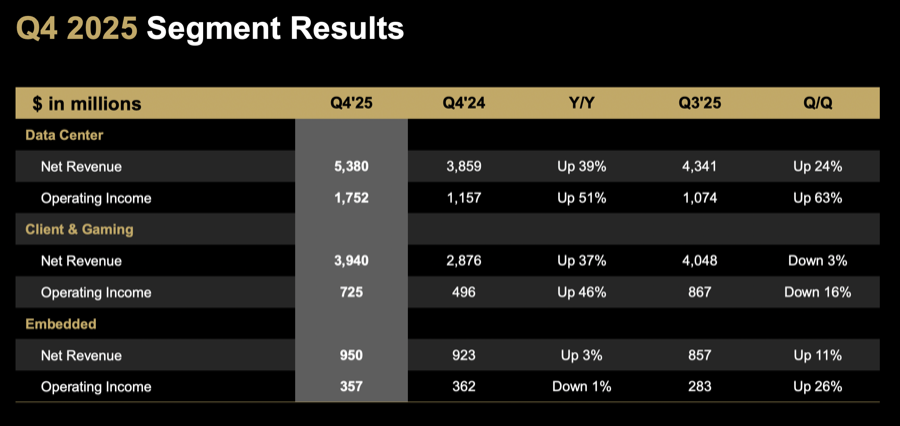
Core Insights - The rising prices of storage chips are significantly impacting the AI chip market, particularly affecting companies like Qualcomm and MediaTek, which are closely tied to the mobile sector [1][10] - Despite the challenges posed by storage price increases, major AI chip manufacturers reported record earnings, with AMD achieving a record revenue of $10.3 billion in Q4 FY2025, driven by strong demand in data centers and gaming [1][2][3] - Qualcomm's revenue for Q1 FY2026 reached $12.3 billion, a 5% year-over-year increase, with significant contributions from its semiconductor and technology licensing businesses [5][6] AMD Performance - AMD's data center revenue hit a record $5.4 billion in Q4 FY2025, up 39% year-over-year, driven by strong demand for EPYC processors and Instinct GPUs [3][4] - The data center segment's contribution to AMD's overall revenue surpassed 50% for the first time in the last quarter of the fiscal year [2] - CEO Lisa Su emphasized the importance of 2025 for AMD, highlighting the acceleration of high-performance processor adoption and the rapid expansion of AI business in data centers [1][2] Qualcomm Insights - Qualcomm's semiconductor business generated $10.6 billion, with mobile hardware and automotive sectors achieving record revenues [6][7] - The company noted that the mobile market is facing challenges due to storage supply constraints, particularly affecting high-end smartphone demand [10][11] - Qualcomm's CEO acknowledged that while the mobile sector is under pressure, growth in automotive and IoT markets may help mitigate the impact [11] Arm's Financials - Arm reported record revenue of $1.224 billion for Q3 FY2026, a 26% increase year-over-year, driven by higher royalty rates and increased usage of Arm-based chips in data centers [5][12] - The company is diversifying its revenue streams beyond mobile, with significant contributions from IoT and embedded markets [12][13] - Arm's CEO mentioned organizational changes to align with AI deployment strategies, focusing on three business units: mobile and IoT, automotive and robotics, and data center and networking [13][14] Market Challenges - The ongoing rise in storage chip prices is expected to impact the overall smartphone market, with companies like Qualcomm and MediaTek adjusting their strategies to cope with increased costs [10][11] - AMD anticipates a slight decline in the PC market size due to rising commodity prices, while still aiming to increase its share in the enterprise market [12] - MediaTek's CEO indicated that the overall demand for smartphones may be negatively affected by rising memory and BOM costs, prompting strategic adjustments in product offerings [11][12]


AI芯片厂商,集体被存储“卡住咽喉”
2 1 Shi Ji Jing Ji Bao Dao· 2026-02-06 02:44
Core Insights - The rising prices of storage chips are significantly impacting the AI chip market, particularly affecting companies like Qualcomm and MediaTek, which are closely tied to the mobile sector [1][6] - Major AI chip manufacturers, including AMD and Arm, have reported record earnings, but concerns about storage chip prices and their effects on future performance remain prevalent [2][3][4] Group 1: AMD Performance - AMD reported record revenue of $10.3 billion for Q4 FY2025, a 34% year-over-year increase, driven by strong demand in data center, client, and gaming segments [2] - The data center segment achieved a record revenue of $5.4 billion, up 39% year-over-year, primarily due to the demand for AMD EPYC processors and increased shipments of Instinct GPUs [2] - AMD's CEO highlighted the importance of the Chinese market, noting revenue from the MI308 product and pending approval for the MI325 product [3] Group 2: Arm Performance - Arm achieved record revenue of $1.224 billion for Q3 FY2026, a 26% year-over-year increase, with royalty revenue rising 27% and license revenue increasing by 25% [4] - The growth in Arm's revenue is attributed to higher royalty rates for chips and increased usage of Arm architecture in data centers [4] - Arm is expanding its product line to increase revenue outside the mobile sector, focusing on cloud, automotive, and IoT markets [10] Group 3: Qualcomm Performance - Qualcomm reported revenue of $12.3 billion for Q1 FY2026, a 5% year-over-year increase, with semiconductor revenue reaching $10.6 billion [5] - The automotive segment achieved record revenue of $1.1 billion, up 15% year-over-year, while IoT revenue was $1.7 billion, up 9% [5] - Qualcomm's CEO acknowledged challenges in the mobile market due to storage supply constraints but remains optimistic about high-end smartphone demand [6][7] Group 4: MediaTek Insights - MediaTek's CEO indicated that rising memory and BOM costs are expected to negatively impact overall smartphone demand in 2026 [8] - The CFO noted that flagship models are seeing higher chip content, leading to increased average selling prices, but overall shipment volumes may face pressure [8] - MediaTek is also focusing on strengthening its non-smartphone business, with increasing revenue from data centers [9] Group 5: Industry Challenges - The ongoing shortage and rising prices of storage chips, particularly DRAM, are expected to affect the mobile industry significantly, with companies adjusting production plans accordingly [6][7] - OEMs, especially in China, are cautiously reducing chip inventory, which may reflect in future earnings guidance [7] - The mobile market is anticipated to prioritize high-end products due to lower price sensitivity among consumers in that segment [7]

从“国产替代”到“市场主流”,本土企业稳居智能座舱芯片第一梯队
Zhong Guo Jing Ji Wang· 2026-02-06 01:35
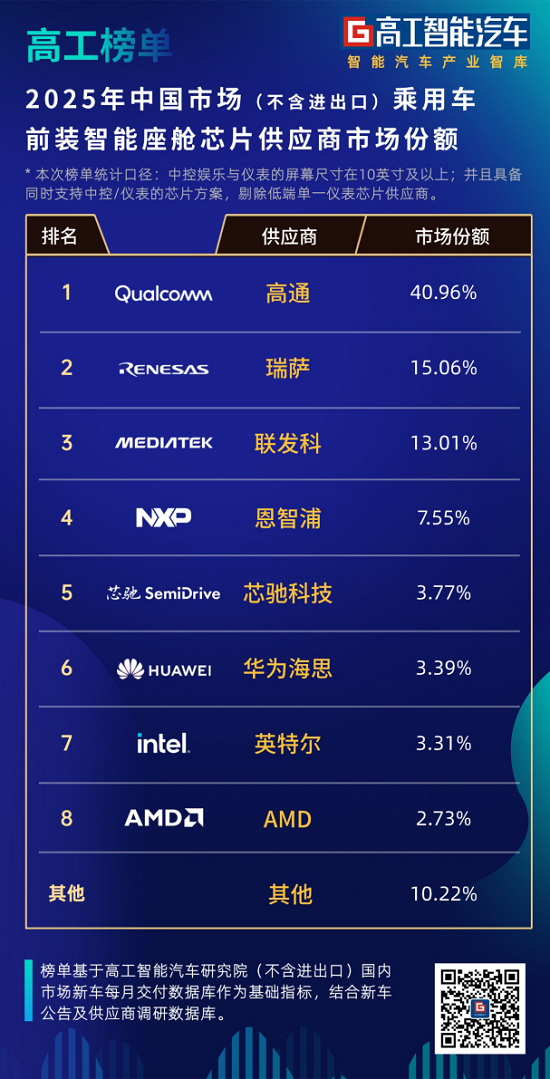
Core Insights - The Chinese domestic chip companies are expanding their market share in the automotive sector, transitioning from "domestic substitution" to becoming mainstream competitors alongside global giants [1][3]. Market Share Overview - Qualcomm leads the market with a share of 40.96%, followed by Renesas at 15.06%, MediaTek at 13.01%, and NXP at 7.55%. Chinese company SemiDrive ranks fifth with 3.77%, and Huawei follows closely with 3.39% [2][3]. Industry Trends - The penetration rate of smart cockpit chips in new passenger vehicles in China is projected to reach 76.62% by 2025, indicating a significant shift towards advanced automotive technology [3]. - The market landscape has evolved from a highly concentrated structure to a more diversified and balanced order, enhancing the presence of domestic companies [2][3]. Domestic Company Performance - SemiDrive has achieved a cumulative shipment of over 11 million chips across various smart cockpit applications, with over 150 models utilizing their technology [5]. - The performance of domestic chips has improved significantly, gaining widespread market recognition for their reliability and quality, overcoming initial trust barriers [3][5]. Strategic Implications - The global automotive industry is undergoing a major transformation, with China emerging as a hub for smart vehicle innovation. The ability to master advanced chip technology is becoming crucial for defining the next generation of smart vehicles [5][6]. - The restructuring of the Chinese automotive industry is extending beyond vehicle manufacturing to core components, software, and semiconductor technologies, which is essential for ensuring industry security and fostering high-quality development [6].
【高通(QCOM.O)】FY26Q1业绩符合预期, 内存短缺拖累下游需求——FY26Q1业绩点评(付天姿)
光大证券研究· 2026-02-05 23:08
Core Viewpoint - Qualcomm's FY26Q1 performance met expectations, but the guidance for FY26Q2 fell short due to adverse impacts from memory shortages and price increases affecting downstream demand [4]. Group 1: FY26Q1 Performance - Qualcomm achieved Non-GAAP revenue of $12.252 billion in FY26Q1, slightly above Bloomberg's consensus estimate of $12.196 billion, representing a year-on-year increase of 5% [4]. - The QCT business generated $10.613 billion in revenue, also up 5% year-on-year, while the QTL business reported $1.592 billion, a 4% increase [4]. - Non-GAAP net profit for FY26Q1 was $3.781 billion, exceeding the consensus estimate of $3.690 billion, with Non-GAAP EPS at $3.50, above the expected $3.407 [4]. Group 2: FY26Q2 Guidance - Qualcomm's guidance for FY26Q2 indicates Non-GAAP revenue between $10.2 billion and $11 billion, below the consensus estimate of $11.16 billion [4]. - The projected Non-GAAP diluted EPS for FY26Q2 is between $2.45 and $2.65, compared to the consensus estimate of $2.874 [4]. - The guidance shortfall is primarily attributed to the negative impact of memory shortages and price increases on downstream demand [4]. Group 3: QCT Mobile Business - In FY26Q1, the mobile business revenue was $7.824 billion, reflecting a 3% year-on-year growth, driven by increased shipments of Snapdragon chips [5]. - Qualcomm secured a 75% supply share for high-end smartphone chips for Samsung's upcoming series, and ByteDance's AI smartphone features Qualcomm's Snapdragon Elite chips [5]. - The company anticipates that the ongoing memory chip shortage will constrain the growth of its mobile business in the short term, with FY26Q2 mobile revenue expected to be around $6 billion [5]. Group 4: QCT IoT Business - The IoT business generated $1.688 billion in revenue in FY26Q1, a 9% year-on-year increase, mainly due to higher shipments in edge networking and consumer products [6]. - Qualcomm is expanding its presence in vertical applications, launching new products at CES 2026, including the Dragonwing Q-7790 and Q-8750 for various applications [6]. - The company introduced the Snapdragon X2 Plus chip, enhancing CPU single-core performance by 35% and NPU performance by 78%, with multiple PC products based on Snapdragon showcased at CES [7]. Group 5: QCT Automotive Business - The automotive business reported $1.101 billion in revenue for FY26Q1, a 15% year-on-year increase, driven by higher shipments of vehicles equipped with Qualcomm's smart cockpit technology [8]. - Qualcomm signed a long-term supply agreement with Volkswagen Group, expanding its supply to brands like Audi and Porsche [8]. - The company is collaborating with CARIAD and Bosch to develop autonomous driving systems, indicating progress in its smart driving initiatives [8].

全球内存陷入大缺货,高通、Arm齐发预警:芯片将挤压智能手机产能
Hua Er Jie Jian Wen· 2026-02-05 15:46
"从行业层面看,内存供应紧张和价格上涨,或将直接决定整个手机市场的整体规模上限。" 全球高带宽内存(HBM)短缺正从数据中心迅速向消费电子领域蔓延,智能手机行业已成为首要承压 环节。这场由人工智能基础设施需求激增引发的"内存危机",正在对全球电子产品供应链形成结构性冲 击。 全球最大智能手机芯片生产商高通与英国半导体设计企业Arm Holdings相继发出预警,指出HBM的持 续短缺将直接限制智能手机产量。作为全球最大的智能手机处理器供应商,高通首席执行官Cristiano Amon在财报电话会上表示: 据Amon透露,部分客户已表示将在今年削减手机生产计划。据报道,多家主流智能手机制造商正着手 下调其2026年出货目标,其中一家的调整幅度据称高达20%。 这场短缺被普遍视为中长期结构性挑战。英特尔首席执行官陈立武直言:"据我所知,短缺局面不会缓 解。"市场研究机构TrendForce进一步预测,今年生产的高端内存芯片中预计将有70%被数据中心吸纳, 消费电子领域的分配份额将持续受到挤压。 内存短缺的影响正在整个电子产品供应链持续传导与深化。芯片制造商联发科本周在分析师电话会议上 坦言,供应状况"正在动态演变 ...
谷歌“烧钱”攻AI吓跌自身股价,却点燃半导体生态链:英伟达、博通受益最大?
美股IPO· 2026-02-05 13:54
Core Viewpoint - Google is significantly increasing its capital expenditure to establish a leading position in the AI sector, with plans to invest $185 billion this year, exceeding analyst expectations of $119.5 billion [3]. Group 1: Financial Performance - Google's fourth-quarter revenue, excluding partner payouts, reached $97.23 billion, surpassing the average expectation of $95.2 billion [3]. - The anticipated total capital expenditure for 2026 will exceed the total capital expenditures of the past three years combined [3]. Group 2: AI Investment Impact - CEO Sundar Pichai emphasized the critical nature of AI investments, stating that they are driving revenue and growth, with search engine usage hitting historical highs [3]. - Despite the emphasis on AI, the announcement shocked Wall Street, leading to a more than 4% drop in Google's stock price [3]. Group 3: Beneficiaries in the Semiconductor Supply Chain - Nvidia and Broadcom are seen as major beneficiaries of Google's capital spending, with approximately 60% of the capital allocated to short-term assets, including TPUs and GPUs [4]. - Broadcom, as a key partner in designing and manufacturing Google's custom TPU chips, may see up to 80% of its AI computing sales linked to Google projects [4]. - Nvidia's stock rose over 2% following the announcement, as Google continues to offer a range of computing options, including Nvidia GPUs [4]. Group 4: Other Potential Beneficiaries - AMD is also recognized as a potential beneficiary due to its collaboration with Google in cloud computing and AI chips [5]. - Hardware manufacturers and component suppliers, such as Tianhong Technology, are expected to benefit from the capital expenditure wave, with Tianhong's stock rebounding over 6% after the announcement [6]. - Lumentum, a key supplier of optical interconnect components for data centers, may see increased demand due to the expansion of data center infrastructure [7].



谷歌(GOOGL.US)“烧钱”攻AI吓跌自身股价,却点燃半导体生态链:英伟达(NVDA.US)、博通(AVGO.US)受益最大?
Zhi Tong Cai Jing· 2026-02-05 13:37
Group 1: Google's Investment Strategy - Google is significantly increasing its capital expenditure to establish a leading position in the AI sector, with a planned spending of $185 billion this year, exceeding analysts' expectations of $119.5 billion [1] - The company's fourth-quarter sales, excluding partner revenue shares, reached $97.23 billion, surpassing the average forecast of $95.2 billion [1] - By 2026, Google's expected total capital expenditure will exceed the total capital spending of the past three years, indicating a strong commitment to AI and infrastructure investment [1] Group 2: Impact on Semiconductor Supply Chain - Approximately 60% of Google's capital expenditure will be allocated to short-term assets, including TPUs and GPUs, benefiting partner companies like Nvidia and Broadcom [2] - Broadcom is expected to be a major beneficiary, with Google projects potentially accounting for over 80% of its AI computing sales, leading to a stock price increase of over 5% in pre-market trading [2] - Nvidia's stock also rose by over 2% following the announcement, as Google continues to offer a range of computing options, including Nvidia GPUs alongside its own TPUs [2] Group 3: Other Beneficiaries in the Supply Chain - AMD is recognized as a potential beneficiary due to its collaboration with Google in cloud computing and AI chips [3] - Companies involved in hardware manufacturing and component supply, such as Tianhong Technology, have seen renewed market confidence, with stock prices rebounding over 6% in pre-market trading due to Google's investment plans [3] - Lumentum, a key supplier of optical interconnect components for data centers, may experience increased demand as data center infrastructure expands [3]
【太平洋科技-每日观点&资讯】(2026-02-06)
远峰电子· 2026-02-05 13:03
Market Overview - Major indices showed declines: Shanghai Composite Index (-0.64%), Shenzhen Component Index (-1.44%), STAR Market 50 (-1.44%), ChiNext Index (-1.55%), and North Exchange 50 (-2.03%) [1] - TMT sector led the gainers with SW Film and Animation Production (+3.70%), SW Brand Consumer Electronics (+2.10%), and SW Security Equipment (+0.86%) [1] - TMT sector faced losses with SW Communication Cables and Accessories (-5.86%), SW Other Electronics III (-3.27%), and SW Communication Network Equipment and Devices (-2.57%) [1] Domestic News - Tianhong Technology announced the delivery of the world's first 310×310mm panel-level packaging PLP PVD equipment, indicating a shift towards self-sufficiency in Taiwan's equipment supply chain [2] - MuChuang released a new 100G smart network security chip RSP-S30, which boasts a threefold increase in cryptographic acceleration capabilities compared to its predecessor [2] - Suzhou Qizhong's production line was temporarily halted due to a fire, leading to a projected 5-8% decrease in revenue growth for 2026 compared to initial forecasts [2] - MediaTek anticipates its mobile business revenue to exceed $10 billion in 2025, marking an 8% year-on-year increase, although it expects a significant decline in Q1 2026 due to rising storage chip costs [2] Overseas News - Qualcomm expects Q2 revenue between $10.2 billion and $11 billion, impacted by a global shortage of memory chips, affecting smartphone production plans [3] - Infineon announced price adjustments for certain products starting April 2026 due to ongoing supply constraints and rising raw material costs [3] - The global smartphone market revenue is projected to grow by 13% year-on-year in Q4 2025, reaching $143 billion, with average selling prices surpassing $400 for the first time [3] AI Insights - Shanghai AI Laboratory released the Intern-S1-Pro model with 1 trillion parameters, enhancing performance and computational efficiency [4] - ByteDance launched the "Doubao 4.0" AI model, which can adapt to 12 industry scenarios and features real-time learning capabilities [4] - A new open-source model, OpenScholar, developed by the University of Washington and the Allen Institute, matches human experts in citation accuracy [4] - Adobe's Firefly platform now offers unlimited AI image and video generation services to paid subscribers, enhancing creative efficiency [4] Industry Tracking - Tianbing Technology's satellite launch facility passed pre-acceptance review, aiming to double launch efficiency and reduce costs by over 30% [5] - Faraday Future introduced three series of EAI robots, including humanoid and quadruped models for various applications [5] - A Chinese team successfully opened the blood-brain barrier non-invasively for glioma patients, significantly improving drug concentration in tumor areas [5] - Asahi Kasei developed a new PFAS-free polyamide material for low-friction applications, maintaining stable performance under high load and temperature [5]

高通(QCOM):FY26Q1业绩符合预期,内存短缺拖累下游需求
EBSCN· 2026-02-05 11:09
Investment Rating - The report maintains a "Buy" rating for Qualcomm (QCOM.O) [6] Core Insights - Qualcomm's FY26Q1 performance met expectations, but the guidance for FY26Q2 fell short due to adverse impacts from memory shortages and price increases affecting downstream demand [1] - FY26Q1 Non-GAAP revenue was $12.252 billion, a 5% year-over-year increase, with Non-GAAP net profit at $3.781 billion [1] - The guidance for FY26Q2 is projected Non-GAAP revenue of $10.2 to $11 billion, below the consensus estimate of $11.16 billion [1] Summary by Sections QCT Mobile Business - FY26Q1 mobile business revenue was $7.824 billion, up 3% year-over-year, driven by increased shipments of Snapdragon chips [2] - Qualcomm secured a 75% supply share for high-end smartphone chips for Samsung's upcoming series [2] - The guidance for FY26Q2 mobile revenue is approximately $6 billion, with expectations of growth being constrained by memory chip shortages [2] QCT IoT Business - FY26Q1 IoT revenue reached $1.688 billion, a 9% year-over-year increase, primarily due to higher shipments in edge networking and consumer products [3] - The company continues to expand into vertical applications in edge networking and industrial IoT, with new products launched at CES 2026 [3] - The PC segment saw the release of the Snapdragon X2 Plus chip, enhancing performance significantly [3] QCT Automotive Business - FY26Q1 automotive revenue was $1.101 billion, a 15% year-over-year increase, attributed to higher shipments of vehicles equipped with Qualcomm's smart cockpit technology [4] - Qualcomm signed a long-term supply agreement with Volkswagen Group, expanding its supply to brands like Audi and Porsche [4] - The company is collaborating with CARIAD and Bosch to develop autonomous driving systems [4] Financial Forecast and Valuation - The report forecasts GAAP net profits of $11.5 billion, $12.5 billion, and $13 billion for FY2026, FY2027, and FY2028 respectively, with growth rates of 107.7%, 8.4%, and 4.2% [4] - The current price corresponds to FY2026-2028 P/E ratios of 14X, 13X, and 12X [4]