
合盛硅业

Search documents
新能源投资周报:消息趋于平淡,基本面权重上升-20250901
Guo Mao Qi Huo· 2025-09-01 05:26
1. Report Industry Investment Rating The report does not provide an overall industry investment rating. 2. Core Views of the Report - For industrial silicon and polysilicon, the supply side is expected to continue to resume production, and there are expectations of production cuts in downstream polysilicon. The pressure on the inventory side has not improved, so the futures prices are expected to be weak in the short - term. For polysilicon, the fundamentals show an increase in both supply and demand, with expectations of double production cuts later, and the terminal installation willingness continues to shrink. The price may fluctuate weakly in the short - term [9][10]. - For lithium carbonate, the supply - side disturbances are cooling down, and the demand schedule for September is relatively optimistic. However, the inventory transfer from upstream to downstream continues, and the return of goods from downstream weakens the transmission of increased demand. The fundamentals have limited support for the futures price, and it is expected to be mainly in a weak oscillation [83][84]. 3. Summary According to the Directory 3.1 Part One: Non - ferrous and New Energy Price Monitoring - **Non - ferrous Metals**: The report monitors the closing prices of various non - ferrous metals, including the dollar index, exchange rate CNH, copper (both Shanghai and London), aluminum, zinc, lead, nickel, tin, alumina, and stainless steel. For example, the dollar index is at 97.8477, with a daily decline of 0.02%, a weekly increase of 0.13%, and an annual decrease of 9.80%. Industrial silicon is at 8390 yuan/ton, with a daily decline of 2.10%, a weekly decline of 4.06%, and an annual decline of 23.62% [6]. - **New Energy Metals**: The price of industrial silicon is 8390 yuan/ton, with a daily decline of 2.10%, a weekly decline of 4.06%, and an annual decline of 23.62%. The price of lithium carbonate is 77180 yuan/ton, with a daily decline of 1.23%, a weekly decline of 2.25%, and an annual increase of 0.10% [6]. 3.2 Part Two: Industrial Silicon (SI) and Polysilicon (PS) 3.2.1 Industrial Silicon - **Supply Side**: The national weekly production is 9.00 tons, a 2.25% increase from the previous week. The number of operating furnaces is 281, an increase of 12 from the previous week. In the main production areas, Xinjiang's weekly production is 4.13 tons, a 2.23% increase, with 8 more operating furnaces; Inner Mongolia's weekly production is 1.05 tons, remaining the same, with 1 more operating furnace; Yunnan's weekly production is 1.32 tons, a 3.12% increase, with 2 more operating furnaces; Sichuan's weekly production is 1.29 tons, a 1.57% increase, with the same number of operating furnaces [9]. - **Demand Side**: For polysilicon, the weekly production is 2.99 tons, a 0.67% increase, the factory inventory is 23.30 tons, a 4.91% decrease, and the profit per ton is about 61.54 yuan, a 45 - yuan increase. For organic silicon, the DMC weekly production is 4.81 tons, a 4.37% decrease, the factory inventory is 4.93 tons, a 1.02% increase, and the gross profit per ton is - 1859.38 yuan, a 200 - yuan increase per ton [9]. - **Inventory Side**: The explicit inventory is 68.82 tons, a 0.34% decrease, with a 19.32% increase compared to the same period last year. The industry inventory is 43.59 tons, a 0.34% decrease. The market inventory is 17.45 tons, remaining the same, and the factory inventory is 26.14 tons, a 0.57% decrease. The warehouse - receipt inventory is 25.23 tons, a 0.34% decrease [9]. - **Cost and Profit**: The national average cost per ton is 9092 yuan, remaining the same, and the profit per ton is 123 yuan, a 12 - yuan decrease per ton. In the main production areas, the average profit per ton in Xinjiang, Yunnan, and Sichuan is 504, 131, and 200 yuan respectively, a decrease of 33, 0, and 5 yuan per ton compared to the previous week [9]. - **Investment View**: The supply side continues to resume production, there are expectations of production cuts in downstream polysilicon, and the inventory pressure has not improved. It is expected that the futures price will be weak in the short - term [9]. - **Trading Strategy**: Unilateral: Oscillation [9]. 3.2.2 Polysilicon - **Supply Side**: The national weekly production is 2.99 tons, a 0.67% increase. In the main production areas, Inner Mongolia, Xinjiang, Sichuan, and Yunnan have weekly productions of 1.09, 0.57, 0.29, and 0.40 tons respectively, with Xinjiang having a 0.88% increase [10]. - **Demand Side**: The weekly production of silicon wafers is 12.73GW, a 1.22% increase. The factory inventory is 18.05GW, a 3.68% increase. In July, the production of silicon wafers was 52.75GW, a 10.35% decrease compared to the previous month and a 0.60% decrease compared to the same period last year. In August, the scheduled production is 53.29GW, a 1.02% increase compared to the previous month and a 2.04% decrease compared to the same period last year [10]. - **Inventory Side**: The factory inventory is 23.30 tons, a 4.91% decrease, and the registered warehouse receipts are 20640 tons, a 5.20% increase [10]. - **Cost and Profit**: The national average cost per ton is 41368 yuan, a 0.21% decrease, and the profit per ton is 6109 yuan, a 2324 - yuan increase [10]. - **Investment View**: Fundamentally, both supply and demand increase, with expectations of double production cuts later. The terminal installation willingness continues to shrink, and there is no significant positive news in the short - term. The price may oscillate weakly, with support considered at the full - cost level [10]. - **Trading Strategy**: Unilateral: Oscillation [10]. 3.3 Part Three: Lithium Carbonate (LC) - **Supply Side**: The national weekly production is 1.90 tons, a 0.56% decrease. The production of lithium carbonate from spodumene is 12249 tons, a 0.57% increase; from lithium mica is 2500 tons, a 5.66% decrease; and from salt lakes is 2515 tons, a 1.45% decrease. In July, the production of lithium carbonate was 8.15 tons, a 4.41% increase compared to the previous month, a 26.00% increase compared to the same period last year, and 0.47% higher than the expected value. In August, the scheduled production is about 8.42 tons, a 3.27% increase compared to the previous month and a 37.29% increase compared to the same period last year [84]. - **Import Side**: In July, the import volume of lithium carbonate was 1.38 tons, a 21.77% decrease compared to the previous month and a 42.67% decrease compared to the same period last year. The import volume of spodumene concentrate was 57.61 tons, a 34.73% increase compared to the previous month and a 4.82% increase compared to the same period last year [84]. - **Demand Side**: For lithium - iron materials, the weekly production is 6.99 tons, a 1.03% decrease, and the factory inventory is 9.45 tons, a 0.91% increase. In July, the production was 29.07 tons, a 1.86% increase compared to the previous month, a 50.00% increase compared to the same period last year, and 1.07% lower than the expected value. In August, the scheduled production is 31.14 tons, a 7.12% increase compared to the previous month and a 47.24% increase compared to the same period last year. For ternary materials, the weekly production is 1.76 tons, a 0.17% increase, and the factory inventory is 1.78 tons, a 1.22% increase. In July, the production was 6.86 tons, a 5.75% increase compared to the previous month, a 16.70% increase compared to the same period last year, and 4.38% higher than the expected value. In August, the scheduled production is about 7.08 tons, a 3.07% increase compared to the previous month and a 14.34% increase compared to the same period last year. In July, the production of new energy vehicles was 124.30 million, a 1.95% decrease compared to the previous month and a 26.27% increase compared to the same period last year; the sales volume was 126.20 million, a 5.05% decrease compared to the previous month and a 27.41% increase compared to the same period last year. The penetration rate of new energy vehicles in July was 48.67%, a 2.91 - percentage - point increase compared to the previous month [84]. - **Inventory Side**: The social inventory (including warehouse receipts) is 14.11 tons, a 0.29% decrease. The inventory of lithium - salt factories is 4.33 tons, a 7.49% decrease, and the inventory of downstream sectors (cathode factories, battery factories, and traders) is 9.78 tons, a 3.28% increase. The cathode - factory inventory is 5.28 tons, a 2.51% increase, and the inventory of battery factories and traders is 4.50 tons, a 4.19% increase. The inventory center continues to shift from upstream to downstream, and the actual production consumption is small, mostly belonging to inventory transfer between different links. The warehouse - receipt inventory is 2.99 tons, a 22.89% increase [84]. - **Cost and Profit**: The cash production cost of lithium carbonate from purchased lithium mica is 80022 yuan/ton, a 5.71% decrease, and the production profit is - 3245 yuan/ton, a 250 - yuan decrease. The cash production cost of lithium carbonate from purchased spodumene is 76440 yuan/ton, a 4.92% decrease, and the production profit is 2418 yuan/ton, a 1195 - yuan decrease. The cash production cost of lithium carbonate from integrated production using lithium mica is 61721 yuan/ton, and from spodumene is 52787 yuan/ton [84]. - **Investment View**: The supply - side disturbances are cooling down, and the demand schedule for September is relatively optimistic. However, the inventory transfer from upstream to downstream continues, and the return of goods from downstream weakens the transmission of increased demand. The fundamentals have limited support for the futures price, and it is expected to be mainly in a weak oscillation [84]. - **Trading Strategy**: Unilateral: Oscillation [84].
合盛硅业深陷周期季度首亏6.57亿 碳化硅良率国内领先243只基金加仓
Chang Jiang Shang Bao· 2025-08-31 22:40
Core Viewpoint - The company, Hoshine Silicon Industry (合盛硅业), reported a rare operating loss due to a phase imbalance in supply and demand, marking its first loss since disclosing operational performance data [2][3][6]. Financial Performance - In the first half of 2025, Hoshine Silicon achieved revenue of 9.775 billion yuan, a year-on-year decrease of 26.34% [2][3]. - The net profit attributable to shareholders was -397 million yuan, a year-on-year decline of 140.6% [2][3]. - The company experienced a significant loss of 657 million yuan in the second quarter, contributing to the overall loss for the first half [2][5]. Historical Context - Historically, Hoshine Silicon's net profit has been positive from mid-2015 to mid-2024, with a peak of 3.545 billion yuan in mid-2022 [4]. - The company had previously faced fluctuations in performance but had never reported a loss until now [3][4]. Market Conditions - The loss was attributed to a phase imbalance in the supply and demand of industrial silicon and polysilicon, alongside declining market prices [2][6]. - The global economy showed weak recovery amid geopolitical tensions and trade frictions, impacting the industry [6]. Cash Flow and Financial Health - Hoshine Silicon reported a significant increase in operating cash flow, reaching 3.524 billion yuan, up 1987.93% from the previous year [8]. - The company's debt-to-asset ratio decreased to 62.83%, down 1 percentage point from the end of 2024 [8]. Competitive Position and Future Outlook - Despite the cyclical downturn, Hoshine Silicon maintained its leading position in industrial silicon and organic silicon markets [2][8]. - The company is focusing on high-value downstream product development and has made advancements in silicon carbide technology, achieving domestic leadership in product yield [9]. - As of the second quarter of 2025, 243 funds increased their holdings in Hoshine Silicon, indicating positive market sentiment towards its future prospects [2][9].


合盛硅业20250829
2025-08-31 16:21
Summary of the Conference Call for 合盛硅业 Company Overview - **Company**: 合盛硅业 (Hesheng Silicon Industry) - **Industry**: Silicon and Organic Silicon Production Key Points and Arguments Production and Sales Performance - In the first half of 2025, the company produced 660,000 tons of industrial silicon and sold 470,000 tons, with 180,000 tons for self-use [1][3] - The expected total production for industrial silicon in 2025 is 1.5 million tons, while organic silicon is projected to be between 1.5 to 1.6 million tons [1][4] - The company reported a loss of approximately 530 million yuan due to the suspension of its photovoltaic business, with 450 million yuan attributed to photovoltaic-related losses [3][12] Market Demand and Pricing Trends - Industrial silicon market demand is expected to recover in the second half of 2025, with prices likely to stabilize [1][5] - Organic silicon demand grew over 10% in the first half of 2025, with a projected growth of 5% to 10% in the second half, driven by emerging sectors like electronics and new energy vehicles [1][10] - The average unit sales cost for organic silicon was below 10,000 yuan, while the industry’s complete cost ranged from 12,000 to 13,000 yuan [1][8] Operational Insights - The company maintained an industrial silicon operating rate of 60% to 70%, compared to the industry average of 40% to 50% [1][9] - The company is currently undergoing maintenance and technical upgrades for its polysilicon-related facilities in Xinjiang, with other unfinished projects on hold [1][7] Future Outlook - The company anticipates a gradual recovery in prices for both industrial and organic silicon, with organic silicon prices expected to fluctuate around the industry’s complete cost line [5][6] - The company plans to adjust production flexibly based on supply-demand dynamics and macroeconomic factors to optimize operational efficiency [3][18] Competitive Positioning - The company believes it has a competitive advantage in cost control within the entire supply chain and is actively pursuing new product development and market expansion [23] Additional Insights - The company’s electricity costs are competitive, with an average tax-inclusive electricity price of 0.25 yuan per kWh, and a higher proportion of self-generated electricity [9][16] - The company has no new expansion plans in Yunnan for 2025, but it is considering future capacity planning based on industry conditions [21] Risks and Challenges - The photovoltaic sector has not fully recovered, impacting the demand for industrial silicon, while traditional sectors like real estate are growing slowly but remain significant in volume [10][11] This summary encapsulates the key insights from the conference call, highlighting the company's production capabilities, market dynamics, operational strategies, and future outlook within the silicon industry.
华鑫证券:给予合盛硅业买入评级
Zheng Quan Zhi Xing· 2025-08-31 01:28
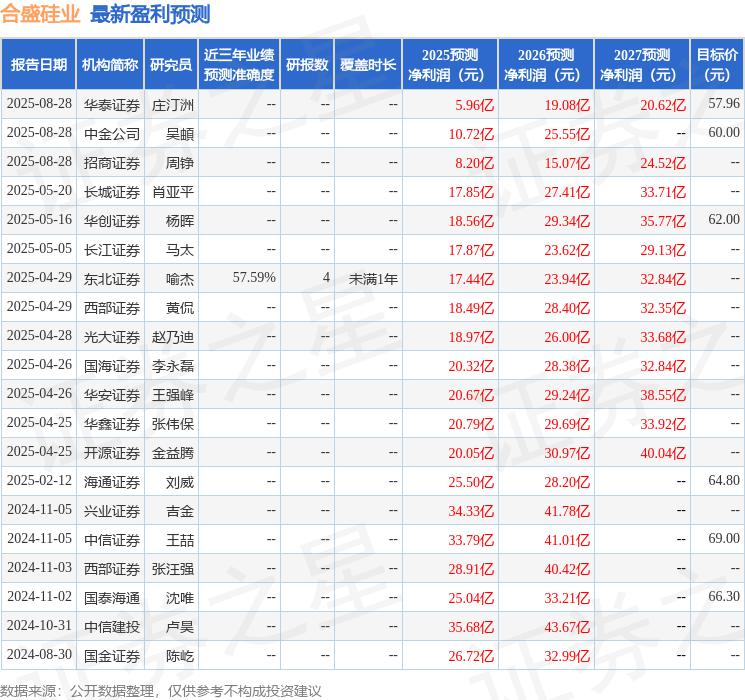
Core Viewpoint - The report highlights that Hoshine Silicon Industry's performance is under pressure due to the downturn in industrial silicon and organic silicon markets, leading to a significant decline in revenue and net profit [1][2][3] Company Performance - In the first half of 2025, Hoshine Silicon achieved revenue of 9.775 billion yuan, a year-on-year decrease of 26.34%, and a net profit attributable to shareholders of -397 million yuan, a year-on-year decline of 140.60% [2] - In Q2 2025, the company reported revenue of 4.548 billion yuan, down 42.11% year-on-year and 13.02% quarter-on-quarter, with a net profit of -657 million yuan, reflecting a year-on-year decline of 245.87% and a quarter-on-quarter decline of 352.93% [2] Industry Analysis - The decline in performance is attributed to falling sales prices of industrial silicon and organic silicon products, with the industrial silicon market experiencing a downward price trend due to supply-demand imbalances [3] - Domestic industrial silicon production in the first half of 2025 was 1.85 million tons, showing a year-on-year decrease, while the production of polysilicon was 597,000 tons, down 44.0% year-on-year [3] - The organic silicon industry saw a consensus on production cuts in Q1, but production increased in Q2, with total domestic DMC production exceeding 1.2 million tons, a nearly 20% year-on-year increase [3] Financial Metrics - The company's R&D expense ratio decreased due to lower material inputs, while net cash flow from operating activities increased by 1987.93% due to reduced production and inventory clearance [4] - The company is accelerating the upgrade of its R&D center, focusing on innovative manufacturing technologies and smart production models, aiming to enhance its competitive edge in the silicon-based materials sector [5] Profit Forecast - Due to the decline in product prices, the profit forecast for Hoshine Silicon has been slightly adjusted, with expected net profits for 2025, 2026, and 2027 at 1.024 billion yuan, 1.889 billion yuan, and 2.113 billion yuan respectively [6] - The current stock price corresponds to P/E ratios of 60.8, 33.0, and 29.5 for the respective years, with a maintained "buy" investment rating due to the company's leading position in the organic silicon and silicon carbide industries [6]
建信期货工业硅日报-20250829
Jian Xin Qi Huo· 2025-08-29 01:46
Report Information - Date: August 29, 2025 [2] - Report Type: Industrial Silicon Daily Report - Research Team: Energy and Chemical Research Team - Researchers: Li Jie, Ren Junchi, Peng Haozhou, Peng Jinglin, Liu Youran, Feng Zeren [3] Industry Investment Rating - Not provided Core Views - The industrial silicon futures price fluctuated. The Si2511 contract closed at 8,515 yuan/ton, down 2.85%, with a trading volume of 450,290 lots and an open interest of 281,839 lots, a net decrease of 7,286 lots [4]. - The spot price of industrial silicon opened low and moved high, fluctuating. The price of 553-grade silicon in Sichuan was 8,950 yuan/ton, and in Yunnan was 8,600 yuan/ton; the price of 421-grade silicon in Inner Mongolia was 9,500 yuan/ton, in Xinjiang was 9,300 yuan/ton, and in Sichuan was 9,700 yuan/ton [4]. - The supply and demand of industrial silicon both increased, maintaining a loose balance, with limited improvement in fundamentals. The high spot price loosened and declined. The weekly output in the third week of August increased to 88,100 tons, equivalent to a monthly output of over 370,000 tons. On the demand side, the production schedule of polysilicon in August will increase to 125,000 tons, while the demand from organic silicon and aluminum alloy remained stable. The export volume in July increased slightly to 70,000 tons. Without considering 97-grade silicon and recycled silicon, there is no inventory reduction drive in the industry. With policies in a vacuum period, short-term futures fluctuations gradually return to fundamental drivers. The spot price is mainly stable, but the high price has loosened, and the futures price will fluctuate widely [4]. Summary by Directory 1. Market Review and Outlook - **Market Performance**: The industrial silicon futures price fluctuated. The Si2511 contract closed at 8,515 yuan/ton, down 2.85%, with a trading volume of 450,290 lots and an open interest of 281,839 lots, a net decrease of 7,286 lots [4]. - **Spot Price**: The spot price of industrial silicon opened low and moved high, fluctuating. The price of 553-grade silicon in Sichuan was 8,950 yuan/ton, and in Yunnan was 8,600 yuan/ton; the price of 421-grade silicon in Inner Mongolia was 9,500 yuan/ton, in Xinjiang was 9,300 yuan/ton, and in Sichuan was 9,700 yuan/ton [4]. - **Future Outlook**: Supply and demand both increased, maintaining a loose balance, with limited improvement in fundamentals. The high spot price loosened and declined. The weekly output in the third week of August increased to 88,100 tons, equivalent to a monthly output of over 370,000 tons. On the demand side, the production schedule of polysilicon in August will increase to 125,000 tons, while the demand from organic silicon and aluminum alloy remained stable. The export volume in July increased slightly to 70,000 tons. Without considering 97-grade silicon and recycled silicon, there is no inventory reduction drive in the industry. With policies in a vacuum period, short-term futures fluctuations gradually return to fundamental drivers. The spot price is mainly stable, but the high price has loosened, and the futures price will fluctuate widely [4]. 2. Market News - On August 28, the futures warehouse receipt volume on the Guangzhou Futures Exchange was 50,656 lots, a net decrease of 53 lots from the previous trading day [5]. - According to customs data, China exported 74,000 tons of metallic silicon in July 2025, a month-on-month increase of 8.32% and a year-on-year increase of 36.75%. From January to July 2025, China exported a total of 414,700 tons of metallic silicon, a year-on-year decrease of 1.04% [5]. - On August 28, Hesheng Silicon Industry released its semi-annual report for 2025. The company's operating income was 9.78 billion yuan, a year-on-year decrease of 26.3%; the net profit attributable to the parent company was a loss of 397 million yuan, a year-on-year decrease of 140.6%; the non-recurring net profit attributable to the parent company was a loss of 533 million yuan, a year-on-year decrease of 159.3%; the net operating cash flow was 3.524 billion yuan, a year-on-year increase of 1,987.9%; the EPS (fully diluted) was -0.3359 yuan. In the second quarter, the company's operating income was 4.55 billion yuan, a year-on-year decrease of 42.1%; the net profit attributable to the parent company was a loss of 657 million yuan, a year-on-year decrease of 245.9%; the non-recurring net profit attributable to the parent company was a loss of 749 million yuan, a year-on-year decrease of 297.3%; the EPS was -0.5555 yuan [5]. - Data showed that the cumulative photovoltaic installed capacity from January to July 2025 reached 1,109.6 GW, and the newly installed capacity from January to July was 223.25 GW. In July, the newly installed capacity was 11 GW, a year-on-year decrease of 47.7%, hitting a new low in 2025 [5].
综合晨报:城市高质量发展方案推出-20250829
Dong Zheng Qi Huo· 2025-08-29 00:45
Report Industry Investment Ratings - The report does not explicitly provide an overall industry investment rating. However, individual investment suggestions are given for different sectors: - For股指期货, it is recommended to evenly allocate long positions in various stock index futures [15]. - For外汇 futures (US Dollar Index), the US dollar is expected to oscillate weakly [19]. - For US stock index futures, it is suggested to buy on dips after short - term corrections as the upward trend of US stocks has not reversed [22]. - For treasury bond futures, it is in a recent oscillatory trend, and when going long, one needs to pay attention to the absolute price, funds, and market sentiment [24]. - For other sectors such as commodities, specific investment suggestions are provided for each commodity, including buying on dips, selling on rallies, and waiting and seeing [26][28][29] Core Views - The A - share market has a V - shaped reversal with trading volume exceeding 3 trillion, but market divergence is increasing, and marginal changes need attention [2][14]. - The US labor market shows resilience with lower - than - expected initial jobless claims, and the market risk preference remains high. The Federal Reserve officials are releasing signals of interest rate cuts, which has an impact on the US stock and foreign exchange markets [17][20][21]. - In the commodity market, different commodities have different price trends and influencing factors. For example, copper prices are expected to oscillate at a high level due to the complex influence of macro and fundamental factors; the price of soybeans and related products is affected by factors such as export sales, reserve sales, and Sino - US relations [5][25][26] Summary by Directory 1. Financial News and Comments 1.1 Macro Strategy (Stock Index Futures) - The Chinese trade representative will visit the US. The "Opinions of the CPC Central Committee and the State Council on Promoting High - Quality Urban Development" is released. The A - share market has a V - shaped reversal with trading volume exceeding 3 trillion, but market divergence is increasing [13][14]. - Investment suggestion: Evenly allocate long positions in various stock index futures [15]. 1.2 Macro Strategy (Foreign Exchange Futures - US Dollar Index) - There are disputes over the dismissal of Federal Reserve Governor Lisa Cook. German Chancellor Merz says a meeting between Putin and Zelensky is unlikely. The US initial jobless claims last week were lower than expected [16][17]. - Investment suggestion: The US dollar is expected to oscillate weakly [19]. 1.3 Macro Strategy (US Stock Index Futures) - The US initial and continuing jobless claims last week were lower than expected. Federal Reserve Governor Waller supports a 25 - basis - point interest rate cut in the September meeting [20][21]. - Investment suggestion: Buy on dips after short - term corrections as the upward trend of US stocks has not reversed [22]. 1.4 Macro Strategy (Treasury Bond Futures) - The central bank conducted 4161 billion yuan of 7 - day reverse repurchase operations, with a net investment of 1631 billion yuan. The stock - bond seesaw effect has weakened recently, and the bond market is expected to be in an oscillatory trend [23]. - Investment suggestion: It is in a recent oscillatory trend, and when going long, one needs to pay attention to the absolute price, funds, and market sentiment [24]. 2. Commodity News and Comments 2.1 Agricultural Products (Soybean Meal) - The export sales of US new - crop soybeans were better than expected. China will auction 164,000 tons of imported soybeans on August 29. The soybean meal futures price is weaker than the overseas market [25][26]. - Investment suggestion: Affected by the expectation of improved Sino - US relations, soybean meal is weaker than the overseas market. The focus later is on China's purchase of US soybeans [26]. 2.2 Agricultural Products (Soybean Oil/Rapeseed Oil/Palm Oil) - The US soybean shipments to China were 0 tons in the week ending August 21. The oil market continued to oscillate at a high level and had a slight correction [27]. - Investment suggestion: The oil market still lacks clear guidance. It is recommended to go long on dips considering India's replenishment demand and the unfavorable inventory accumulation data of Malaysian palm oil in August [28]. 2.3 Agricultural Products (Corn Starch) - The corn consumption of starch sugar products increased slightly this week, while the corn starch consumption decreased. The industry's operating rate decreased slightly, and the inventory decreased slightly. The supply - demand situation is weak, and the CS11 - C11 spread is under pressure [29]. - Investment suggestion: The corn - starch price difference has fallen to a low level. It is necessary to pay attention to whether there are opportunities to widen the spread driven by factors such as the regional price difference of raw materials [29]. 2.4 Agricultural Products (Corn) - The corn inventory of major processing enterprises and the average inventory days of feed enterprises decreased. The spot market was cautious, while the futures rebounded. The short - term price decline rhythm may change [30][31][32]. - Investment suggestion: Short - term long positions entered earlier should be closed at an appropriate time. After the selling pressure is gradually realized, pay attention to whether there are new opportunities to go short on rallies [33]. 2.5 Black Metals (Rebar/Hot - Rolled Coil) - The inventory of five major steel products increased by 268,400 tons week - on - week. The supply - demand fundamentals of steel products still face pressure, but the industry policy has a positive impact on market sentiment [34][35]. - Investment suggestion: In the short term, a oscillatory approach should be adopted for steel prices [36]. 2.6 Black Metals (Steam Coal) - The price of low - calorie Indonesian coal has loosened, and the port coal price has fallen. The coal price is expected to be seasonally weak, but there is support below 650 yuan [37]. - Investment suggestion: The coal price is expected to be seasonally weak, but there is support below 650 yuan [37]. 2.7 Agricultural Products (Sugar) - The number of sugar - carrying ships waiting at Brazilian ports increased, and the estimated sugar production in Brazil was lowered. The international sugar price is expected to oscillate, and the outlook for the fourth - quarter external market is optimistic. The domestic sugar price is affected by factors such as imports and warehouse receipts [38][40][41]. - Investment suggestion: The Zhengzhou sugar futures price has fallen rapidly recently. The 1 - month contract can wait for opportunities to go long on dips, with a target price of around 5500 yuan or after the September contract is delivered [41]. 2.8 Black Metals (Iron Ore) - Rio Tinto adjusted its operation mode and executive committee. The iron ore price continued to oscillate, and the short - term supply - demand pressure was not large [42]. - Investment suggestion: Pay attention to the actual trading volume after the price increase. The iron ore market is expected to oscillate, and pay attention to positive spread trading opportunities [43]. 2.9 Agricultural Products (Red Dates) - The price of red dates in the Guangzhou Ruyifang market increased. The downstream arrivals decreased, and the spot price was firm but lacked upward momentum. The new - season production is uncertain [43][44]. - Investment suggestion: It is recommended to wait and see. Pay attention to the weather in the production area and the results of on - the - spot investigations [44]. 2.10 Non - Ferrous Metals (Lithium Carbonate) - KoBold Metals obtained seven lithium ore exploration licenses in the Democratic Republic of the Congo. The short - term supply - demand balance is affected by factors such as imports and production resumption, and there is support at the bottom [45]. - Investment suggestion: Pay attention to opportunities to go long on dips and positive spread trading opportunities [46]. 2.11 Non - Ferrous Metals (Polysilicon) - JinkoSolar's semi - annual report shows high - volume shipments but losses. The polysilicon price is stable, and the market is in a game about whether the upstream price increase can be transmitted downstream. The September production is uncertain [47][48]. - Investment suggestion: The downside space of the futures price is more definite, and the upside space depends on factors such as component bidding prices and production cuts. Unilaterally, a bullish view on dips can be maintained, and for arbitrage, pay attention to the 11 - 12 reverse spread opportunity at around - 2000 yuan/ton [49]. 2.12 Non - Ferrous Metals (Industrial Silicon) - Hesheng Silicon Industry's semi - annual report shows a loss. The production and inventory of industrial silicon are affected by the resumption of production of large factories in Xinjiang. The short - term price is expected to operate in the range of 8200 - 9500 yuan/ton [50][51]. - Investment suggestion: Pay attention to the resumption of production progress of large factories in Xinjiang. The short - term price may operate in the range of 8200 - 9500 yuan/ton, and pay attention to range - trading opportunities [51]. 2.13 Non - Ferrous Metals (Copper) - Yunnan Copper produced 779,400 tons of cathode copper in the first half of the year. Jiangxi Copper's semi - annual profit increased. The Snow Lake copper - gold mine in Canada resumed operation. The copper price is affected by macro and fundamental factors and is expected to oscillate at a high level [52][53][54]. - Investment suggestion: Unilaterally, it is recommended to go long on dips. For arbitrage, it is recommended to wait and see [56]. 2.14 Non - Ferrous Metals (Nickel) - The Indonesian Nickel Mining Association focuses on illegal mining in the nickel industry. The nickel price is affected by factors such as raw material prices and supply - demand fundamentals. The short - term price is expected to have band - trading opportunities, and medium - term short - selling opportunities can be considered [57][58][59]. - Investment suggestion: Short - term band - trading opportunities can be paid attention to, and medium - term short - selling opportunities on rallies can be considered. The downside space depends on factors such as the decline of raw material prices and downstream restocking [59]. 2.15 Energy Chemicals (Liquefied Petroleum Gas) - The weekly commercial volume of liquefied petroleum gas in China increased, and the inventory situation was mixed. The market is expected to oscillate in the short term [60][61]. - Investment suggestion: The market is expected to oscillate in the short term [63]. 2.16 Energy Chemicals (Carbon Emissions) - The CEA closing price decreased on August 28. The carbon market trading volume has not increased significantly, and the price is expected to oscillate weakly in the short term [64]. - Investment suggestion: The CEA price is expected to oscillate weakly in the short term [65]. 2.17 Energy Chemicals (Natural Gas) - The US natural gas inventory increased less than expected. The natural gas price has support at the current level, and the export demand is strong. The market is expected to oscillate in the short term [66]. - Investment suggestion: The NYMEX natural gas price is expected to oscillate in the short term [67]. 2.18 Energy Chemicals (Caustic Soda) - The price of high - concentration caustic soda in Shandong increased locally. The supply is relatively sufficient, and the demand is stable. The market is affected by factors such as transportation and inventory [68][69]. - Investment suggestion: Be cautious when chasing high prices [69]. 2.19 Energy Chemicals (Pulp) - The import pulp spot market was mostly stable. The pulp market is in a weak fundamental situation and is expected to oscillate weakly [70][71]. - Investment suggestion: The pulp market is expected to oscillate weakly [71]. 2.20 Energy Chemicals (PVC) - The domestic PVC powder market price decreased slightly. The market is affected by factors such as futures prices and downstream demand. It is expected to oscillate [72][73]. - Investment suggestion: The market is expected to oscillate [73]. 2.21 Energy Chemicals (Styrene) - The weekly output of styrene decreased slightly. The port inventory is accumulating, and the supply pressure is large. The market is affected by factors such as policies and oil prices [74][75]. - Investment suggestion: Pay attention to internal and external policy variables [75]. 2.22 Energy Chemicals (Bottle Chips) - The export price of bottle chips decreased, and the major manufacturers will maintain a minimum 20% production cut in September. The inventory is decreasing, and the supply - demand contradiction is alleviated [76][78]. - Investment suggestion: Pay attention to whether new production capacity can be put into operation as scheduled in September. The absolute price follows the fluctuation of polyester raw materials [78]. 2.23 Energy Chemicals (PTA) - The terminal operating rate in the Jiangsu and Zhejiang regions decreased locally. The supply - demand situation of PTA has improved marginally, and it is recommended to go long on dips in the short term [79][80][81]. - Investment suggestion: The short - term unilateral price will oscillate and adjust. It is recommended to go long on dips in a rolling manner [82]. 2.24 Energy Chemicals (Soda Ash) - The inventory of domestic soda ash manufacturers decreased. The soda ash price is in a weak and stable oscillation. It is recommended to sell on rallies and pay attention to supply - side disturbances [83]. - Investment suggestion: Sell on rallies and pay attention to supply - side disturbances [83]. 2.25 Energy Chemicals (Float Glass) - The price of float glass in the Shahe market decreased slightly. The glass price was affected by the equity market. The supply - demand contradiction has not been resolved, and it is recommended to be cautious in unilateral operations and focus on arbitrage [84][85]. - Investment suggestion: Be cautious in unilateral operations and focus on arbitrage. Pay attention to the spread - widening strategy of going long on glass and short on soda ash [85]. 2.26 Shipping Index (Container Freight Rate) - The cargo and container throughput of major ports from January to July increased year - on - year. The spot freight rate is weak, and the supply pressure is high. The freight rate is expected to continue to decline [86][87]. - Investment suggestion: The 10 - contract has broken through the 1300 support, and the next test is the 1250 support level [87].

合盛硅业2025年中报简析:净利润同比下降140.6%,短期债务压力上升
Zheng Quan Zhi Xing· 2025-08-28 22:59
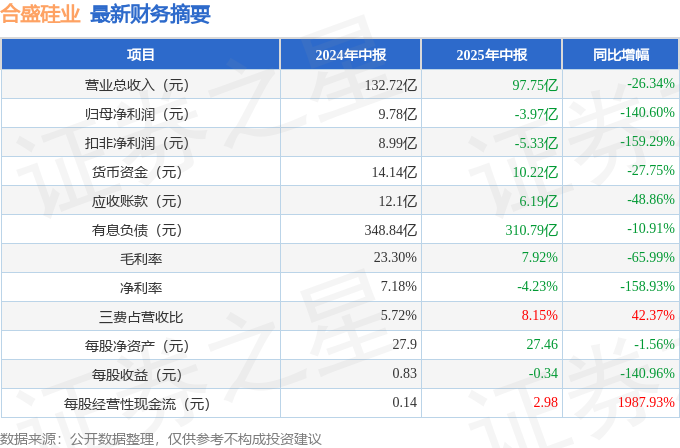
Core Viewpoint - 合盛硅业's financial performance for the first half of 2025 shows significant declines in revenue and profit, indicating increased short-term debt pressure and a challenging operational environment [1][3]. Financial Performance - The total revenue for the first half of 2025 was 9.775 billion yuan, a decrease of 26.34% compared to 2024 [1]. - The net profit attributable to shareholders was -397 million yuan, representing a decline of 140.6% year-on-year [1]. - In Q2 2025, total revenue was 4.548 billion yuan, down 42.11% year-on-year, with a net profit of -657 million yuan, a drop of 245.87% [1]. - The gross margin fell to 7.92%, down 65.99% from the previous year, while the net margin was -4.23%, a decrease of 158.93% [1]. - Total expenses (selling, administrative, and financial) amounted to 796 million yuan, accounting for 8.15% of revenue, an increase of 42.37% year-on-year [1]. Cash Flow and Debt Situation - The current ratio reached 0.3, indicating rising short-term debt pressure [1]. - Cash and cash equivalents decreased to 1.022 billion yuan, down 27.75% year-on-year [1]. - Accounts receivable dropped to 619 million yuan, a decline of 48.86% [1]. - The company’s interest-bearing liabilities were 31.079 billion yuan, a decrease of 10.91% [1]. Investment Metrics - The return on invested capital (ROIC) for the previous year was 3.99%, indicating weak capital returns [3]. - The historical median ROIC since the company’s listing is 10.89%, suggesting better investment returns in the past [3]. - The average operating cash flow over the past three years relative to current liabilities is only 5.38%, raising concerns about liquidity [3]. Fund Holdings - The largest fund holding in 合盛硅业 is 大成景禄灵活配置混合A, with 159,400 shares, which has reduced its position [4]. - Other funds have also adjusted their holdings, with some increasing their positions while others have decreased or maintained their holdings [4].
合盛硅业20250828
2025-08-28 15:15
Summary of the Conference Call Company and Industry Overview - The conference call pertains to the polysilicon and silicon industry, specifically focusing on 合盛硅业 (Hesheng Silicon Industry) and its operations in industrial silicon and organic silicon production [2][4][10]. Key Points and Arguments 1. **Market Conditions**: The industrial silicon supply and demand have both decreased due to a decline in polysilicon demand and cyclical fluctuations in organic silicon, leading to price pressures [2][4]. 2. **Production Rates**: The company maintains an industrial silicon operating rate of 60%-70%, with significant year-on-year growth in organic silicon production [2][5]. 3. **Future Production Targets**: For the first half of 2025, the company expects to produce 660,000 tons of industrial silicon and 730,000 tons of organic silicon, with annual targets of 1.5 million tons for both [2][7]. 4. **Profit Margins**: The overall gross margin for the second quarter was close to zero, with industrial silicon margins at approximately 15%-16% and organic silicon margins at 17%-18%, showing year-on-year improvement despite price declines due to tariffs [2][11]. 5. **Price Expectations**: Industrial silicon prices are expected to rise slightly to the range of 9,000-10,000 RMB/ton in the fourth quarter, although there are risks of extreme price increases due to policy and weather uncertainties [2][14]. 6. **Impact of Drought**: The ongoing drought in the southwest region has affected industrial silicon prices and operating rates, with the southwest operating rate below 40% [5][14]. 7. **Investment Plans**: The company plans to invest approximately 7-8 billion RMB, contingent on refinancing strategies, including bond financing [3][24]. 8. **Cost Increases**: The cost of silicon ore increased by 27% due to a reliance on self-supply, with over 80% of ore sourced internally [2][16]. 9. **Sales Performance**: In the first half of 2025, the company achieved a sales volume of 730,000 tons, with a target of 1.5 million tons for the year [9][10]. 10. **Organic Silicon Market Outlook**: The organic silicon market is expected to see a recovery in production and sales in the second half of the year, following significant maintenance and upgrades in the first half [13][12]. Additional Important Information - **Solar Business Impact**: The company incurred approximately 500 million RMB in depreciation and 400 million RMB in losses due to the suspension of its solar business, with sales of components amounting to around 400 million RMB [2][15]. - **Cash Flow and Financing**: The company is exploring market-based refinancing options to meet significant funding needs for projects, including coal utilization initiatives [28][24]. - **Silicon Carbide Development**: The silicon carbide business is in the R&D phase, with expected sales revenue between 50 million to 100 million RMB this year [21]. - **Electricity Costs**: The self-supplied electricity price is approximately 0.18 RMB/kWh, while the external purchase price is around 0.31 RMB/kWh, affecting overall production costs [27]. This summary encapsulates the critical insights from the conference call, highlighting the company's operational status, market conditions, and future expectations in the polysilicon and silicon industry.
机构风向标 | 合盛硅业(603260)2025年二季度已披露前十大机构累计持仓占比51.63%
Xin Lang Cai Jing· 2025-08-28 10:28
Group 1 - Core viewpoint: 合盛硅业 (603260.SH) reported its 2025 semi-annual results, indicating strong institutional investor interest with 24 institutions holding a total of 611 million shares, representing 51.66% of the total share capital [1] - The top ten institutional investors collectively hold 51.63% of the shares, with a 0.64 percentage point increase from the previous quarter [1] - Major institutional investors include 宁波合盛集团有限公司, 富達實業公司, and several funds from 中国工商银行 and 华泰 [1] Group 2 - In the public fund sector, two funds increased their holdings, including 华泰柏瑞沪深300ETF and 易方达沪深300ETF, with an increase rate of 0.10% [2] - Ten new public funds disclosed their holdings this period, including 鹏华沪深300ETF and 平安中证A500ETF [2] - One foreign fund, 香港中央结算有限公司, increased its holdings by 0.35% compared to the previous period [2]
合盛硅业(603260):Q2盈利承压下行,工业硅景气待复苏
HTSC· 2025-08-28 08:33
证券研究报告 合盛硅业 (603260 CH) Q2 盈利承压下行,工业硅景气待复苏 2025 年 8 月 28 日│中国内地 化学原料 合盛硅业于 8 月 27 日发布 25H1 半年度报告:上半年实现营收 97.8 亿元, 同比-26%,归母净利润-4.0 亿元,同比-141%,扣非净利润-5.3 亿元,同 比-159%;其中 Q2 实现归母净利润-6.7 亿元,同比-246%/环比-353%,扣 Q2 工业硅量价承压较大,硅橡胶销量环比减少 工业硅方面,受下游需求端的多晶硅/有机硅开工下降以及行业高库存影响, Q2 销量同比-47%/环比-17%至 21.5 万吨,营收同比-66%/环比-35%至 15.7 亿元,H1 工业硅毛利率同比-15pct 至 14.6%。有机硅方面,二季度行业整 体实施减产稳价,Q2 硅橡胶销量同比-15%/环比-6%至 16.3 万吨,硅橡胶 营收同比-23%/环比-11%至 18.3 亿元,原料工业硅、氯甲烷价格下跌支撑 毛利率维稳,H1 有机硅毛利率同比+1pct 至 17.4%。公司 25H1 计提存货 减值损失 1.68 亿元。子公司西部合盛/中部合盛/东部合盛/新 ...