TCL电子

Search documents
25W24周观点:美国对部分钢制家电品类加征50%关税-20250615
Huafu Securities· 2025-06-15 09:58
Investment Rating - The report maintains an "Outperform" rating for the home appliance sector [7]. Core Insights - The U.S. has imposed a 50% import tariff on certain steel-based home appliances, effective June 23, which includes washing machines, dishwashers, refrigerators, ovens, dryers, freezers, kitchen garbage disposers, and welding racks. This tariff applies globally, with the exception of the UK, which faces a 25% additional tax. Companies using domestically sourced steel can benefit from exemptions [3][11][17]. - The tariff aims to protect the U.S. steel industry, potentially benefiting companies with domestic production capabilities, such as Haier, while having a limited impact on overall global production capacity in the short term [3][17]. Summary by Sections 1. Tariff Impact - The tariff will be assessed based on the value of steel components in appliances rather than the total product price, affecting products with higher steel content more significantly. For example, refrigerators may see an estimated total tariff of about 65% due to various tariffs combined [11][12][13]. 2. Market Trends - The home appliance sector experienced a decline of 1.4% this week, with specific segments like white goods and kitchen appliances seeing drops of 0.8% and 2.8%, respectively. Meanwhile, raw material prices for copper and aluminum changed by -1.4% and +2.2% respectively [4][24]. 3. Investment Recommendations - The report suggests focusing on several areas for investment: 1. Major appliances benefiting from trade-in programs, recommending companies like Midea Group, Haier, Gree Electric, Hisense, and TCL [18]. 2. The pet industry, which is expected to remain resilient, with recommendations for companies like Guibao Pet and Zhongchong Co [18]. 3. Small appliances and branded apparel, which may see a rebound in demand, with a focus on leading brands like Bear Electric and Supor [18]. 4. Electric two-wheelers, which are expected to improve in domestic sales, with recommendations for companies like Ninebot and Yadea [18]. 4. Global Manufacturing Dynamics - The report highlights that Chinese manufacturers maintain a significant advantage in global production, particularly in major appliances and tools, with recommendations for Midea, Haier, and others [19][23]. 5. Company Performance - The report tracks the performance of key companies in the home appliance sector, noting that Haier has substantial domestic production capacity in the U.S., which may mitigate the impact of tariffs compared to competitors with lower U.S. exposure [13][17].
每经品牌100指数成分股“换血”,科技、消费“纳新”助力稳增长
Mei Ri Jing Ji Xin Wen· 2025-06-15 06:33
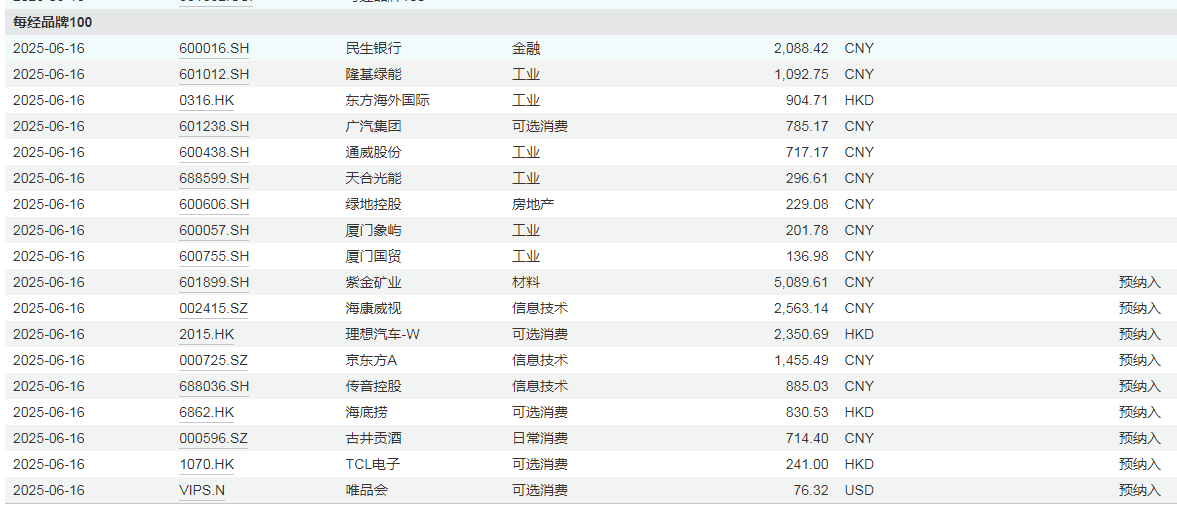
Core Viewpoint - The recent adjustment of the "Everyday Brand 100 Index" reflects a significant shift in its constituent stocks, with nine new companies being added, which is expected to support the index's continued growth [1][6]. Group 1: Index Performance - The "Everyday Brand 100 Index" has shown strong performance, achieving a 17.37% increase from May 9, 2024, to May 7, 2025, outperforming major A-share indices such as the Shanghai Composite Index and the Shenzhen Component Index [2]. - The index has consistently reached new highs, indicating strong investment elasticity and resilience against risks [2]. Group 2: Valuation Metrics - As of June 13, the index's price-to-earnings (P/E) ratio stands at 11.5 times, and the price-to-book (P/B) ratio is 1.25 times, which is competitive compared to benchmark indices like the Shanghai 50 and CSI 100 [3]. - The index's valuation is notably lower than the Hang Seng Technology Index, which has a P/E ratio of 20 times, highlighting its valuation advantage [3]. Group 3: Brand Value Performance - The total brand value of the top 100 Chinese listed companies reached 20.46 trillion CNY, marking a year-on-year increase of 14.9% [4]. - Notably, 24 Chinese companies made it to the global brand value top 100 list, with a combined brand value of 17,775.29 billion USD, reflecting a 28.4% increase from the previous year [4]. Group 4: New Constituent Stocks - The nine new companies added to the index include Zijin Mining, Hikvision, Li Auto, BOE Technology Group, Transsion Holdings, Haidilao, Gujing Distillery, TCL Electronics, and Vipshop, primarily from the consumer, information technology, and mineral resources sectors [6]. - The average revenue and net profit of the new constituent stocks are 398.19 billion CNY and 43.49 billion CNY, respectively, with revenue showing a year-on-year decline of 2.73% and net profit increasing by 8.95% [6]. Group 5: Financial Performance - The average revenue of the constituent stocks is 30.03 times that of the A-share market, and the average net profit is 42.10 times higher, indicating strong competitive and profitability capabilities [8]. - The return on assets (ROA) and return on equity (ROE) for the constituent stocks are 5.96% and 13.61%, respectively, both significantly higher than the A-share market averages [8].


如何看待白电龙头打造高管“IP”?
Changjiang Securities· 2025-06-12 15:22
Investment Rating - The industry investment rating is "Positive" and maintained [9] Core Viewpoints - The home appliance industry is witnessing a strategic upgrade with the creation of executive "IP" by leading companies like Haier and Midea, enhancing direct interaction with consumers through social media platforms [2][4][26] - This approach allows for a restructured market research process in product design, providing consumers with a greater sense of participation and improving brand recognition through the personal charisma of executives [2][4][26] Summary by Sections Executive "IP" Development - Haier and Midea are actively developing executive "IP" to enhance brand influence, with executives engaging on social media platforms to connect with consumers [4][16] - The strategy aims to create a more relatable corporate image, allowing consumers to better understand the company's culture and values [4][26] Capturing Consumer Demand - In the current market, home appliance companies face higher demands for product innovation and consumer engagement, with social media providing a platform for direct communication [5][27] - The example of Haier's three-tub washing machine illustrates how consumer feedback can lead to rapid product development, achieving over 88,000 pre-orders within a week of launch [5][30] Brand Image and Trust - The creation of executive "IP" enhances brand image and fosters emotional connections with consumers, breaking down barriers between executives and the public [6][38] - Executives' personal engagement on social media can significantly boost brand recognition and consumer trust, as seen with Haier's CEO gaining popularity through relatable content [6][38] Investment Recommendations - In light of potential uncertainties, the report suggests focusing on companies with lower exposure to U.S. tariffs and strong domestic sales supported by government subsidies, such as Gree Electric, Hisense Home Appliances, and Midea Group [7][41] - Companies with significant domestic production capacity and compliance with trade agreements are also highlighted as strong investment opportunities [7][41]




如何看显示技术迭代对黑电格局和盈利的影响?
Changjiang Securities· 2025-06-10 01:00
Investment Rating - The report maintains a "Positive" investment rating for the home appliance industry, specifically recommending "Buy" for Hisense Visual and TCL Electronics [9]. Core Insights - The report highlights the impact of display technology iterations on the black electrical landscape and profitability, emphasizing that Chinese companies are well-positioned to enhance their profitability and global market share during the current Mini LED technology upgrade [3][6][7]. Summary by Sections Previous Display Technology Changes - The evolution of black electrical display technology is summarized as "CRT → Rear Projection → PDP → LCD (LED Backlight) → OLED → Mini/Micro-LED." Historically, Japanese companies dominated the global black electrical industry until the late 1990s, when Korean companies like Samsung and LG began to invest heavily in LCD technology, ultimately surpassing Japanese firms by 2006 [5][27][32]. Current Mini LED Upgrade Outlook - Mini LED is identified as the next major display technology, with global shipments expected to reach 6.2 million units in 2024, a 100% increase year-on-year, capturing 2.9% of the market share. In China, Mini LED TV sales are projected to reach 5.56 million units, accounting for 18.0% of the overall TV market [6][7]. Investment Recommendations - The report suggests capitalizing on structural upgrades and profitability improvements among leading black electrical companies. It notes that the ongoing shift of panel production capacity to China, combined with continuous investment in Mini LED technology by companies like TCL and Hisense, supports the sustainable enhancement of profitability and market share for Chinese black electrical enterprises [7][9].
TCL电子20250609
2025-06-09 15:30
Summary of TCL Electronics Conference Call Company Overview - **Company**: TCL Electronics - **Industry**: Consumer Electronics, specifically Television Manufacturing Key Points and Arguments Sales Performance - **Domestic Market Growth**: TCL's main brand TV sales grew by 15%-20% in Q1 2025, contributing to an overall domestic market growth of 10.8% [2][3][12] - **Mini LED Sales**: Domestic Mini LED TV shipments increased by 300%, with a market share rising from 4% to 18% in Q1 2025. The annual target for Mini LED sales is set at 1.5 million units, aiming for a market share of 20%-25% [2][3][25] - **Overseas Market Growth**: Overall overseas sales grew by 11.6%, with Europe seeing a 16% increase and emerging markets growing by 20%-25%. North America experienced a slight decline of 4% [2][4][13] Market Dynamics - **North America**: The North American market generated approximately $10 billion in revenue in 2024, accounting for 10% of total revenue, but has not yet achieved profitability. The company aims to turn this around by improving product and channel structures [2][8][13] - **Tariff Management**: TCL has strategically positioned its manufacturing in countries like Vietnam and Mexico to mitigate tariff impacts, ensuring supply chain stability [6][32][33] Product Strategy - **Focus on High-End Products**: TCL is concentrating on high-end Mini LED products with over 1,000 zones, which are expected to maintain a gross margin advantage of over 10% compared to standard LCD TVs [2][25][37] - **Consumer Preferences**: The impact of national subsidy policies on Mini LED sales is limited, as consumers prioritize picture quality improvements over subsidies [5][9][30] Financial Outlook - **Profitability Goals**: TCL aims to achieve profitability in the North American market by 2025 through improved channel structures and product offerings [2][13][21] - **Gross Margin Trends**: The average gross margin for TCL's main brand is around 23%-25%, significantly higher than the 15%-18% margin for the Thunderbird brand [16][29] Competitive Landscape - **Market Positioning**: TCL's pricing strategy positions its products approximately 30% lower than comparable Samsung models, with an average TV price of $400 compared to Samsung's $800 [26] - **Mini LED Technology**: The Mini LED technology is gaining traction in overseas markets, with a significant increase in market share, particularly in Europe and North America [23][24] Future Growth Drivers - **Mini LED Expansion**: The company plans to leverage Mini LED technology as a key growth driver, with a global sales target of 3.5 million units in 2025, split between 2 million units overseas and 1.5 million units domestically [22][23] - **European Market Focus**: TCL is targeting ten key European countries for market share growth, with a current market share of about 10% and significant room for improvement [17][20] Risks and Challenges - **Tariff Fluctuations**: Ongoing changes in tariffs, particularly in North America, pose a risk to profitability and market performance [6][36] - **Market Competition**: The competitive landscape, especially against established brands like Samsung and LG, requires continuous innovation and strategic marketing efforts [15][26] Additional Important Information - **Shareholder Dynamics**: The second-largest shareholder's stake has decreased to approximately 3.5%, with minimal impact on stock performance [11] - **Independent Director Appointment**: The appointment of a new independent director with a strong background in overseas mergers and acquisitions aligns with the company's strategic needs [10]
分布式光伏有多火?农村“屋顶”遭疯抢,村民销冠,一个月就赚十万!
Ge Long Hui· 2025-06-09 01:47
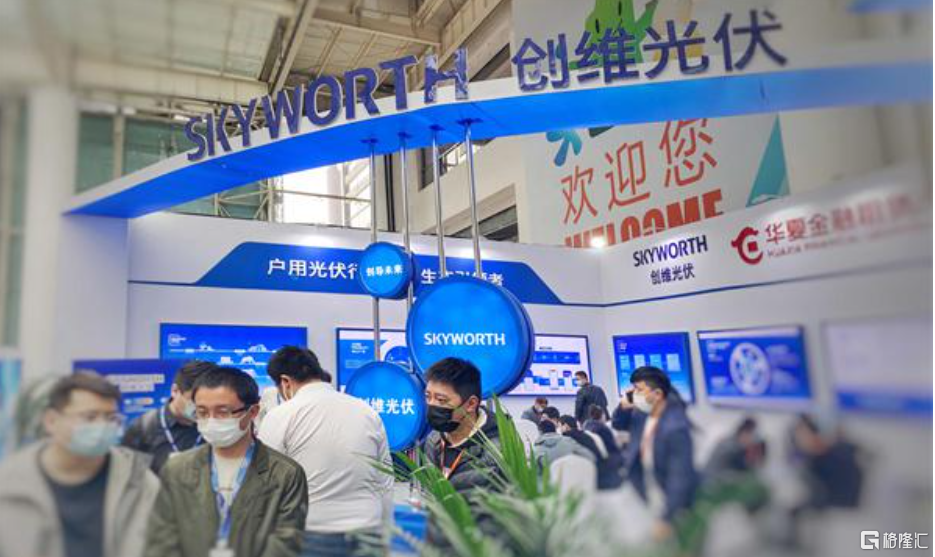
Core Insights - The distributed photovoltaic (PV) industry is experiencing intense competition as various sectors, including home appliances and real estate, enter the market, disrupting previous business models and profit margins [1][3][4] Industry Overview - The distributed PV sector has seen a surge in participants, with companies like Skyworth, Haier, and TCL joining the fray, leading to a more competitive landscape [1][3] - The net profit margin for distributed PV stations is currently around 20%, with some companies like Xinneng Technology reporting as high as 29.54% due to rising industrial electricity prices [4][6] - However, the market is expected to become increasingly saturated, potentially leading to a "red ocean" scenario for competition [4][6] Market Dynamics - The competition is characterized by aggressive marketing strategies and flexible partnership models, as seen during the recent Jinan International Solar Exhibition [6][18] - The acquisition of "roof resources" has become a critical competitive factor, with companies needing to invest in channels to reach rural and lower-tier markets [6][11] Company Performance - Skyworth Group reported a revenue of 53.491 billion yuan in 2022, with a significant growth of 191% in its renewable energy segment, despite an overall decline in net profit [9][14] - The distributed PV segment of Skyworth has become a key growth area, with over 200,000 installed units across more than ten provinces [9][14] - The company's profit margin in the distributed PV sector is projected to be around 3%, significantly lower than other segments [16] Competitive Landscape - Major players in the distributed PV market include Zhengtai Aneng, Trina Solar, and Skyworth, with Zhengtai leading in user numbers and development scale [12][14] - The entry of home appliance companies into the PV market has changed traditional business models, with a focus on leveraging existing distribution channels and customer relationships [11][14] - The market is witnessing a shift towards rental models and financing solutions, which are impacting traditional EPC (Engineering, Procurement, and Construction) businesses negatively [17][18] Future Outlook - The distributed PV market is expected to double in size, with significant growth projected for 2023, despite challenges faced by traditional players [17][18] - The industry is still in its early stages, and the long-term viability of new business models and management practices remains to be seen [19]
618电视价格战白热化:32吋电视低至400元,头部企业毛利率不足20%
Sou Hu Cai Jing· 2025-06-06 10:06
Core Viewpoint - The television market is experiencing a price war, particularly in the 32-inch segment, with prices dropping to around 500 yuan, but there are notable differences between online and offline sales channels [2][3][11]. Group 1: Market Trends - The online television market is expected to see significant growth during the 618 shopping festival, with sales projected to reach 5.44 billion yuan, a 22% increase year-on-year [3]. - The average price of televisions online is expected to rise to 3,664 yuan, a 14% increase, while offline prices are projected to be 7,194 yuan, up 7.5% [3]. - The 32-inch television segment is seeing intense competition, with many manufacturers launching models priced around 400-500 yuan [16][22]. Group 2: Price Dynamics - Several brands have introduced 32-inch televisions at low prices, such as Philips at 424 yuan and TCL at 509 yuan after subsidies [4][5]. - The price drop in the 32-inch segment is attributed to a combination of national subsidies and a focus on inventory clearance strategies by manufacturers [11][14]. - The cost structure of televisions shows that panel prices significantly influence retail prices, with panel costs accounting for 52% of total costs [12]. Group 3: Consumer Behavior - Offline consumers tend to prioritize picture quality and the ability to see the product in person, contrasting with online consumers who focus more on price [9][10]. - There is a growing trend towards larger televisions, with consumers increasingly opting for high-end products rather than just low-priced options [23][24]. Group 4: Company Performance - Companies like TCL and Hisense have reported revenue growth despite low profit margins, with TCL's revenue reaching 99.32 billion HKD, a 25.7% increase [19]. - Konka, however, has faced significant losses, with a revenue decline of 37.73% and a net loss of 3.296 billion yuan, attributed to intensified market competition [21]. - The overall profitability of television manufacturers remains low, with many operating at margins below 20% [17][18].

【港股收评】三大股指收涨!电子烟、核电概念表现强劲
Jin Rong Jie· 2025-06-04 09:08
Group 1: Market Overview - The Hong Kong stock market indices collectively rose, with the Hang Seng Index up by 0.6%, the Hang Seng China Enterprises Index up by 0.67%, and the Hang Seng Tech Index up by 0.57% [1] - The electronic cigarette sector saw significant gains, with Smoore International rising by 12.87%, China Tobacco Hong Kong by 8.75%, and China Boton by 5.84% [1] Group 2: Regulatory Impact - China's upgraded electronic cigarette regulatory framework mandates that all production licenses will indicate approved production capacity, effective from June [1] - The stricter regulations are expected to eliminate non-compliant products, benefiting compliant companies by enhancing their market share and profitability [1] Group 3: Sector Performance - The nuclear power sector experienced substantial increases, with China National Nuclear Power rising by 11.91%, China General Nuclear Power by 28.31%, and China General Nuclear Power New Energy by 3.51% [1] - In the pharmaceutical sector, notable gains were observed in biopharmaceuticals and innovative drug concepts, with Innovent Biologics up by 14.14% and Zai Lab by 12.22% [2] - Coal stocks also saw upward movement, with Jinma Energy increasing by 24.14% and China Qinfa by 4.17% [2] Group 4: Brokerage and Other Sectors - Brokerage stocks showed positive performance, with Zhongtai Futures up by 6% and Everbright Securities by 4.72% [3] - Various consumer sectors, including film, baby products, dairy, sports, and food, experienced varying degrees of increase [4] Group 5: Declining Sectors - The home appliance sector faced declines, with TCL Electronics down by 2.9% and Midea Group by 2.58% [5] - Telecommunications and 5G concept stocks collectively weakened, with China Telecom down by 1.89% and China Unicom by 2.16% [5]
中国黑电的全球突破
2025-06-04 01:50
Summary of Key Points from the Conference Call Industry Overview - The conference call discusses the Chinese black electrical appliances (black goods) industry, particularly focusing on the television sector, highlighting the global breakthroughs of leading companies like Hisense and TCL [1][2][3]. Core Insights and Arguments - **Market Share Growth**: Chinese television brands, such as Hisense and TCL, have significantly increased their global market share, particularly in the high-end market, competing closely with Samsung and LG [2][3][19]. - **Panel Production Shift**: By 2024, China's market share in global LCD TV panel production is projected to reach 66.5%, with BOE and Huaxing Optoelectronics accounting for 45.5% of this share [1][8]. - **Profitability Improvement**: Leading companies have improved their profitability through product structure upgrades, economies of scale, and effective inventory management, resulting in reduced gross margin volatility [1][9]. - **Technological Advancements**: The Mini LED technology is identified as a key trend for upgrading the television industry, particularly suitable for large-sized TVs, with significant cost reductions driving high-end market growth [1][15][16]. - **Industry Transition**: The panel industry is shifting from strong cycles to weaker fluctuations, with leading companies adopting production control and transitioning to larger, high-value products to stabilize costs and optimize profit structures [10][11]. Additional Important Content - **Historical Context**: The average return on equity for the black goods sector was only 6.5% from 2010 to 2020, significantly lower than white goods and consumer electronics, which were 23.5% and 14.4%, respectively [4]. - **Brand Recognition**: Chinese brands are enhancing their global recognition through sports marketing, with Hisense sponsoring major events like the UEFA European Championship and the FIFA World Cup [3][27]. - **Competitive Landscape**: The global black goods market is becoming more concentrated, with the CR4 (concentration ratio of the top four firms) expected to reach 56% by 2024, up from 46% in 2016 [19]. - **Emerging Markets**: New markets in Latin America, the Middle East, and Asia-Pacific present significant growth opportunities, with TCL and Hisense rapidly increasing their market shares in these regions [23][26]. - **Challenges in Mature Markets**: In North America and Europe, Chinese brands face challenges such as high channel concentration and competition from established brands, necessitating strategic adjustments to improve market penetration [24][25]. Conclusion - The Chinese black goods industry, particularly in the television segment, is poised for significant growth driven by technological advancements, strategic market positioning, and enhanced brand recognition. The shift in global production dynamics and the focus on high-end products present substantial opportunities for leading companies like Hisense and TCL to further expand their market presence and improve profitability [31].
港股早评:三大指数高开,金价强势大涨重回3400美元,科技股黄金股强势 ,稳定币概念分化!腾讯、小米涨超1%,招金矿业涨近4%
Ge Long Hui· 2025-06-03 03:40
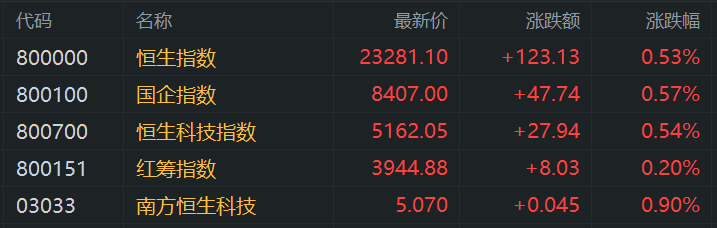
Market Performance - The three major U.S. stock indices closed higher, with most popular Chinese concept stocks also rising [1] - Hong Kong's three major indices opened higher, with the Hang Seng Index up 0.53%, the Hang Seng China Enterprises Index up 0.57%, and the Hang Seng Tech Index up 0.54% [1] Sector Performance - Large technology stocks collectively rose, with NetEase increasing nearly 3%, Tencent and Xiaomi rising over 1%, and Kuaishou, Baidu, and JD.com also showing gains [1] - Gold prices surged back to $3,400, leading to a strong performance in gold stocks, with Zhaojin Mining up nearly 4%, Tongguan Gold up 3.5%, and Zijin Mining, Shandong Gold, and Chifeng Jilong Gold all rising [1] - Biopharmaceutical, heavy machinery, and film and entertainment stocks also saw increases [1] - Stablecoin concept stocks showed mixed performance, with Yika down over 5% and Lianyi Rong Technology continuing to rise by 3.55% [1] - Consumer electronics and steel stocks generally declined, with TCL Electronics dropping over 2% [1] Index Data - Hang Seng Index: 23,281.10, up 123.13, or 0.53% [1] - Hang Seng China Enterprises Index: 8,407.00, up 47.74, or 0.57% [1] - Hang Seng Tech Index: 5,162.05, up 27.94, or 0.54% [1] - Red Chip Index: 3,944.88, up 8.03, or 0.20% [1] - Southern Hang Seng Tech: 5.070, up 0.045, or 0.90% [1]