
菲利华

Search documents
国防军工行业2025半年报总结:基本面逻辑确定,行业景气度向好
Shenwan Hongyuan Securities· 2025-09-11 11:13
Investment Rating - The report maintains a "Positive" outlook on the defense and military industry for the first half of 2025 [3]. Core Viewpoints - The defense industry is experiencing a recovery in overall performance, with revenue and profit showing positive year-on-year growth [2][5]. - The report emphasizes the importance of focusing on the next-generation equipment and the rapid development of unmanned and counter-unmanned weaponry starting in 2025 [4][5]. - The industry is expected to benefit from increased global military trade and a favorable domestic demand environment, leading to a sustained growth trajectory [6]. Summary by Sections 1. Overall Industry Conditions - The military industry shows a recovery in its economic climate, with revenue and profit increasing year-on-year [18]. - In the first half of 2025, the military industry achieved revenue of 304.9 billion yuan, reflecting an 11.39% increase year-on-year, while net profit attributable to shareholders rose by 5.03% to 20.9 billion yuan [23][27]. 2. Revenue and Profit - Revenue performance varies across different segments, with the aviation sector contributing the most to both revenue and net profit in the first half of 2025, accounting for 45% and 54% respectively [44][49]. - The maritime equipment sector showed significant growth, with a revenue increase of 132.0% year-on-year [50]. 3. Profitability Indicators - The overall profitability of the military industry has faced short-term pressure, with gross margin decreasing from 21.60% to 19.27% and net margin from 8.78% to 6.85% from the first half of 2021 to the first half of 2025 [28][31]. - The report indicates that profitability is expected to improve as product prices stabilize and economies of scale are realized [28]. 4. Operational Indicators - Operational indicators have shown stable growth, with inventory increasing by 13.43% year-on-year to 349.3 billion yuan, and contract liabilities rising by 21.48% to 224 billion yuan [32][36]. - The report highlights that the growth in operational metrics reflects a robust demand from downstream sectors, ensuring a positive outlook for future performance [32]. 5. Key Companies to Watch - The report identifies several key companies to focus on, including AVIC Shenyang Aircraft Corporation, AVIC Chengdu Aircraft Industry Group, and others in both high-end and new-type combat capabilities [4][5].


航空装备板块9月11日涨2.26%,迈信林领涨,主力资金净流出3.54亿元
Zheng Xing Xing Ye Ri Bao· 2025-09-11 08:50
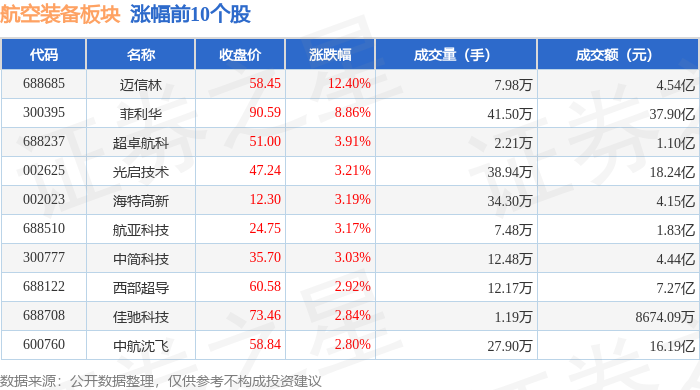
Core Insights - The aviation equipment sector experienced a significant increase of 2.26% on September 11, with Mai Xinlin leading the gains [1] - The Shanghai Composite Index closed at 3875.31, up 1.65%, while the Shenzhen Component Index closed at 12979.89, up 3.36% [1] Sector Performance - Mai Xinlin (688685) saw a closing price of 58.45, with a remarkable increase of 12.40% and a trading volume of 79,800 shares, amounting to a transaction value of 454 million [1] - Other notable performers included: - Feili Hua (300395) with a closing price of 90.59, up 8.86%, trading 415,000 shares for a total of 3.79 billion [1] - Chaozhuo Hangke (688237) at 51.00, up 3.91%, with a transaction value of 110 million [1] - Guangqi Technology (002625) at 47.24, up 3.21%, with a transaction value of 1.82 billion [1] Fund Flow Analysis - The aviation equipment sector experienced a net outflow of 354 million from institutional investors and 244 million from speculative funds, while retail investors contributed a net inflow of 597 million [1] - Specific stock fund flows included: - Guangqi Technology (002625) with a net inflow of 91.29 million from institutional investors, but a net outflow of 33.93 million from speculative funds [2] - Li Jun Shares (002651) had a net inflow of 55.45 million from institutional investors, with a net outflow of 20.93 million from speculative funds [2] - Hai Te Gao Xin (002023) saw a net inflow of 28.31 million from institutional investors, while speculative funds had a net outflow of 18.02 million [2]




指数持续走强!中证A500ETF天弘(159360)涨1.77%,创业板ETF天弘(159977)涨超4%,机构:A股持续向好的核心逻辑并未改变
2 1 Shi Ji Jing Ji Bao Dao· 2025-09-11 06:07
Group 1 - The ChiNext Index showed strong performance with an intraday increase of 4.6% on September 11, indicating a bullish market trend [1] - The Tianhong ChiNext ETF (159977) rose by 4.18% with a trading volume exceeding 200 million, highlighting significant investor interest in high-growth stocks [1] - Key stocks within the ChiNext ETF, such as Shenghong Technology and Zhongji Xuchuang, experienced gains exceeding 10%, reflecting strong market sentiment [1] Group 2 - The Tianhong CSI A500 ETF (159360) increased by 1.77% with a trading volume over 88 million, indicating active trading and investor engagement [1] - The CSI A500 Index, which the Tianhong ETF tracks, consists of 500 large-cap, liquid stocks across various industries, providing a broad representation of the market [1] - Recent low funding rates and a generally loose monetary environment have contributed to increased trading volumes in the A-share market, surpassing 2 trillion for several consecutive days [1] Group 3 - Dongguan Securities noted that the A-share market has experienced high-level fluctuations due to profit-taking after five months of gains, but the core logic for continued market growth remains intact [2] - Tianfeng Securities highlighted the gradual commercialization of AI in China, with internet companies reporting substantial returns on AI investments, suggesting a rapid iteration cycle for AI applications [2]




行情一到,证券就躁!创业板指突破3000点!深市最大的证券ETF(159841)直线飙升涨超3%,创业板ETF天弘(159977)涨超4%
Xin Lang Cai Jing· 2025-09-11 05:34
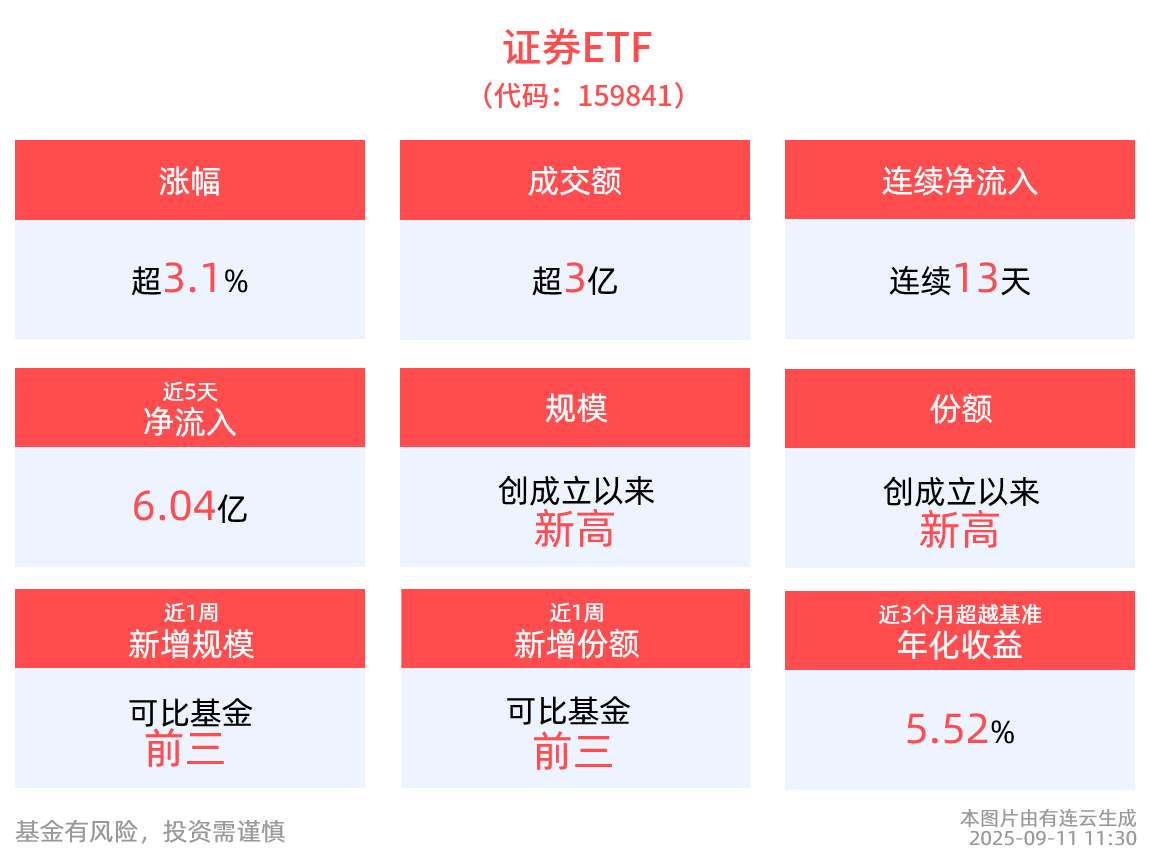
Market Performance - The A-share market showed strong performance with the ChiNext Index rising over 4%, surpassing the 3000-point mark [2] - The Securities ETF (159841) increased by 3.19% with a turnover of 340 million yuan, indicating robust trading activity [2] Fund Flows - The Securities ETF (159841) experienced continuous net inflows over the past 13 days, accumulating a total of 2.096 billion yuan [5] - The ETF's latest scale reached 7.936 billion yuan, with a record high of 703.7 million shares [4] Sector Highlights - Key stocks in the Securities ETF saw significant gains, with Guohai Securities up 10.09% and Pacific Securities up 7.08% [2] - The ETF is heavily weighted towards top-tier brokerages, with nearly 60% of its holdings in the top ten firms, while also including mid-sized brokerages for high growth potential [5] Investment Trends - There is a notable increase in overseas "long money" investing in Chinese assets, with domestic stock funds attracting a net inflow of 6.55 billion USD in the past month [7] - The market is witnessing a trend of brokerages increasing their margin financing limits, reflecting a growing confidence in the market [7] Regulatory Environment - Regulatory encouragement for industry consolidation is evident, with mergers and acquisitions seen as effective strategies for enhancing competitiveness and resource optimization in the brokerage sector [8] - Policies aimed at stabilizing growth and boosting the capital market are expected to continue influencing the sector's trajectory positively [8]
潜江 “芯” 崛起:从基础化工到半导体材料的蝶变之路
2 1 Shi Ji Jing Ji Bao Dao· 2025-09-11 03:46
Core Viewpoint - Qianjiang is positioning itself as a new hub for semiconductor materials, demonstrating a strong commitment and clear path towards developing high-tech industries [1] Group 1: Industry Development - During the 14th Five-Year Plan, Qianjiang is constructing a three-in-one development system comprising an industrial ecosystem, technological innovation chain, and green circular chain to lead the industry towards high-end, intelligent, and green transformation [1] - The successful hosting of the "Central and Western Semiconductor Materials Industry Development Matching Conference" in Qianjiang attracted representatives from various semiconductor industry associations and leading enterprises, indicating a strategic focus on regional collaboration and innovation [1][2] - Qianjiang is recognized as a key supporting demonstration base within Hubei Province's trillion-yuan "Optoelectronic Information" industrial cluster, becoming a new engine for semiconductor materials development in Central and Western China [1][2] Group 2: Resource and Infrastructure - Qianjiang has a solid industrial foundation with abundant resources, including over 200 million tons of oil reserves, 790 billion tons of rock salt, and approximately 3.09 million tons of lithium resources, which support its transition to semiconductor materials [2] - The city has established a comprehensive circular chemical system covering various sectors, including petrochemicals and fine chemicals, which provides a robust support for upgrading to electronic-grade chemicals and semiconductor materials [2] - The park features modern infrastructure, including a comprehensive utility corridor, specialized wastewater treatment facilities, and a solid waste treatment center, ensuring a conducive environment for industry growth [3] Group 3: Business Environment and Policy Support - Qianjiang's complete industrial chain supply is a major attraction, with stable annual supplies of 800 million cubic meters of hydrogen and 25,000 tons of caustic soda, among other key materials [3] - The local government has designated Qianjiang as the only "Optoelectronic Information" industrial supporting demonstration base in the Wuhan metropolitan area, providing significant policy support and investment through the Yangtze (Qianjiang) Industrial Fund [3] - The city promotes a "zero fee" policy for industrial projects and offers comprehensive lifecycle services, fostering a business-friendly environment that encourages enterprise development [3] Group 4: Industry Growth and Future Plans - Qianjiang aims to establish itself as a "Central and Western Semiconductor Materials Industry Base," focusing on attracting projects related to polishing materials, photoresists, and electronic specialty gases [6] - The city is accelerating the construction of an electronic semiconductor materials analysis and testing center and is closely monitoring 32 projects in the optoelectronic information industry, which are expected to generate a total output value of 21.5 billion yuan upon full production [6] - Qianjiang is actively promoting the transformation of traditional chemicals into high-end fine chemicals, aiming to cluster semiconductor materials industries and develop new productive forces tailored to local conditions [6]



中银晨会聚焦-20250911
Bank of China Securities· 2025-09-11 01:12
Key Points - The report highlights a focus on the macroeconomic environment, noting that the August CPI growth rate was lower than expected, while the PPI growth rate met expectations, indicating structural changes in consumer prices and the impact of policies on supply-demand dynamics [2][5][6] - The report discusses the recent trends in the A-share merger and acquisition market, indicating a decrease in overall activity but with a diverse range of participants and sectors involved [8] - The Shanghai real estate market is analyzed, revealing a high proportion of older properties, with 82% of existing residential communities being over 20 years old, which poses challenges for the market [9][10][11] Macroeconomic Analysis - August CPI remained flat month-on-month but decreased by 0.4% year-on-year, with core CPI increasing by 0.9% year-on-year, indicating a structural divergence in consumer prices [5][6] - The report notes that food prices have a significant downward impact on CPI, while non-food prices have shown a consistent increase, contributing to the overall CPI growth [6][7] Mergers and Acquisitions - The report states that there were 68 disclosed M&A events during the period, with a total transaction value of 519 billion RMB, reflecting a decline in both the number and value of major M&A activities [8] - Key sectors for M&A activity included real estate management, machinery, and semiconductor products, indicating a trend towards horizontal integration and strategic cooperation among private and local state-owned enterprises [8] Real Estate Market Insights - The report identifies that as of May 2025, Shanghai had 27,500 existing residential communities, with 64% of the 9.62 million existing homes being over 20 years old, highlighting the aging housing stock [9][10] - The analysis of the Shanghai housing market indicates a cyclical evolution, with significant price fluctuations and regulatory impacts over the past three decades, leading to a current phase of stabilization and structural differentiation [10][11] Future Development Plans - The report outlines the "CAZ" (Central Activity Zone) and "One River, One River" initiatives as key future development directions for Shanghai, aiming to enhance urban functionality and livability [12][13] - The CAZ is projected to cover 75 square kilometers, contributing 25% of the city's GDP, while the "One River" initiative focuses on ecological and cultural improvements along the Huangpu and Suzhou Rivers [12][13] Sales and Pricing Trends - New home sales in Shanghai showed a positive year-on-year growth of 5% in the first five months of 2025, reversing a downward trend from previous years, while second-hand home sales also experienced significant growth [14][15] - The report notes that the average price of new homes reached 92,119 RMB per square meter, while second-hand home prices faced downward pressure, indicating a divergence in market performance [17][19] Inventory and Supply Dynamics - The report highlights that the overall inventory in Shanghai has increased, with a total of 39.06 million square meters of new and second-hand home inventory, but the average de-stocking period remains healthy at 14.9 months [21][22] - New home inventory pressure is concentrated in the outer ring areas, while second-hand home inventory pressure is more pronounced in the inner ring, reflecting differing supply-demand dynamics [22][23]
航空装备板块9月10日涨1.08%,菲利华领涨,主力资金净流出3.28亿元
Zheng Xing Xing Ye Ri Bao· 2025-09-10 08:37
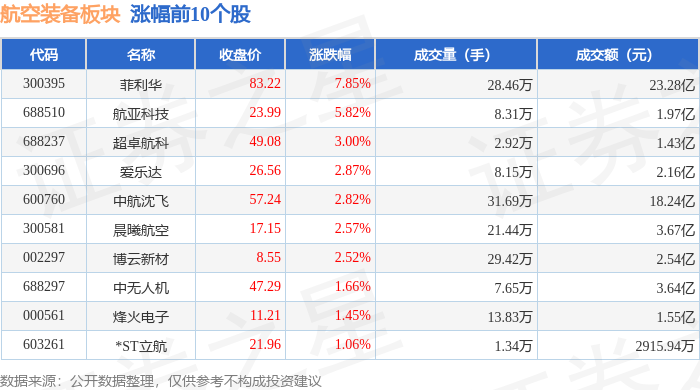
Core Viewpoint - The aviation equipment sector experienced a rise of 1.08% on September 10, with notable gains from companies like Feilihua, which led the sector's performance [1]. Group 1: Market Performance - The Shanghai Composite Index closed at 3812.22, up 0.13%, while the Shenzhen Component Index closed at 12557.68, up 0.38% [1]. - Feilihua's stock price increased by 7.85% to 83.22, with a trading volume of 284,600 shares and a transaction value of 2.328 billion yuan [1]. - Other notable performers included Hangya Technology, which rose by 5.82%, and Chaozhuo Aerospace Technology, which increased by 3.00% [1]. Group 2: Capital Flow - The aviation equipment sector saw a net outflow of 328 million yuan from institutional investors, while retail investors contributed a net inflow of 316 million yuan [2]. - The table of capital flow indicates that Feilihua had a net inflow of 293 million yuan from institutional investors, despite a net outflow from retail investors [3]. - Other companies like Boyun New Materials and Zhonghang Ji载 also experienced varying degrees of net inflow and outflow from different investor categories [3].
军工新质生产力利好频出,菲利华、海格通信领涨!国防军工ETF(512810)回暖涨逾1%
Xin Lang Ji Jin· 2025-09-10 06:26
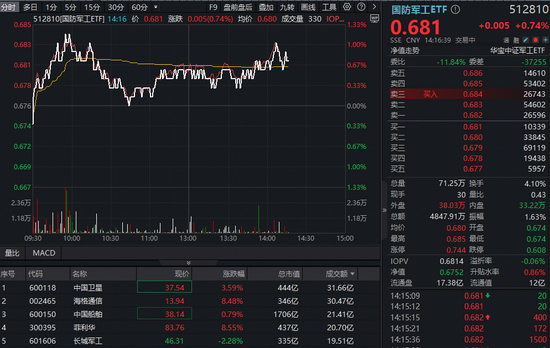
Group 1 - The defense and military industry sector is experiencing a rebound, with stocks like Philihua and Haige Communication rising over 8%, and several others increasing by more than 3% [1] - The defense military ETF (512810) showed signs of stabilization, with a peak increase of over 1% during trading and a transaction volume exceeding 48 million yuan [1] Group 2 - Positive developments in the defense and military sector include China Mobile applying for satellite mobile communication business licenses, which will support the legal foundation for direct satellite mobile services [3] - In the large aircraft sector, Cambodia's national airline signed a memorandum of understanding with COMAC to purchase 20 C909 aircraft, with 10 confirmed orders and 10 intended orders [3] Group 3 - Analysts from Shenwan Hongyuan expect the adjustment of funds in the defense and military sector to be nearing its end, recommending increased attention to this sector [4] - Guojin Securities emphasizes that the defense and military sector is essential for a major country's rise and is a typical long-term core asset, with 2025 being a critical year for achieving planned goals and new growth points [4] - The defense military ETF (512810) covers various hot topics, including commercial aerospace, low-altitude economy, large aircraft, deep-sea technology, military AI, and controllable nuclear fusion, serving as an efficient tool for investing in core assets of the defense and military sector [4]

菲利华:副总经理刘俊龙先生累计减持81500股
Zheng Quan Ri Bao· 2025-09-08 14:07
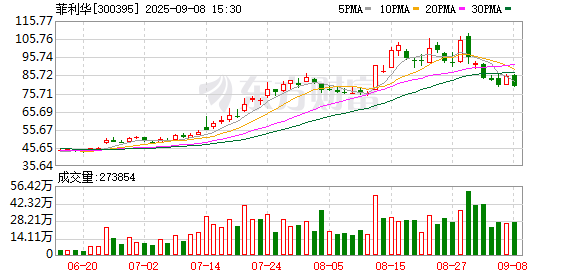
Core Viewpoint - On September 8, the company announced that its Vice President, Liu Junlong, completed a share reduction plan, selling a total of 81,500 shares through centralized bidding [2] Group 1 - The share reduction plan was executed as scheduled, indicating adherence to the company's outlined timeline [2] - The method of share reduction was through centralized bidding, which is a common practice in the market [2]
菲利华(300395) - 关于高级管理人员股份减持计划时间届满暨减持股份结果的公告
2025-09-08 09:26
证券代码:300395 证券简称:菲利华 公告编号:2025-49 本公司副总经理刘俊龙先生保证向本公司提供的信息内容真实、准确、完 整,没有虚假记载、误导性陈述或重大遗漏。 本公司及董事会全体成员保证公告内容与信息披露义务人提供的信息一 致。 湖北菲利华石英玻璃股份有限公司(以下简称"公司")于2025 年5 月15 日在巨潮 资讯网(www.cninfo.com.cn)披露了《关于高级管理人员减持股份预披露公告》(公告编 号:2025-24)。公司副总经理刘俊龙先生计划在自减持计划公告发布之日起15 个交易 日后的三个月内以集中竞价方式减持本公司股份不超过81,750 股(占剔除本公司回购专用 证券账户中的股份数量后总股本比例0.0157%)。 近日,公司收到副总经理刘俊龙先生出具的《关于股份减持计划时间届满的告知函》, 截至本公告披露日,刘俊龙先生减持计划时间届满,通过集中竞价交易方式累计减持公司 股份81,500 股。现将减持计划实施情况公告如下: | | | | | | 减持数量占剔 除公司回购专 | | --- | --- | --- | --- | --- | --- | | 股东名 减持 | ...