海螺水泥

Search documents
破局与重构——建筑材料行业上市公司中期报告投研分析
Sou Hu Cai Jing· 2025-10-27 05:44
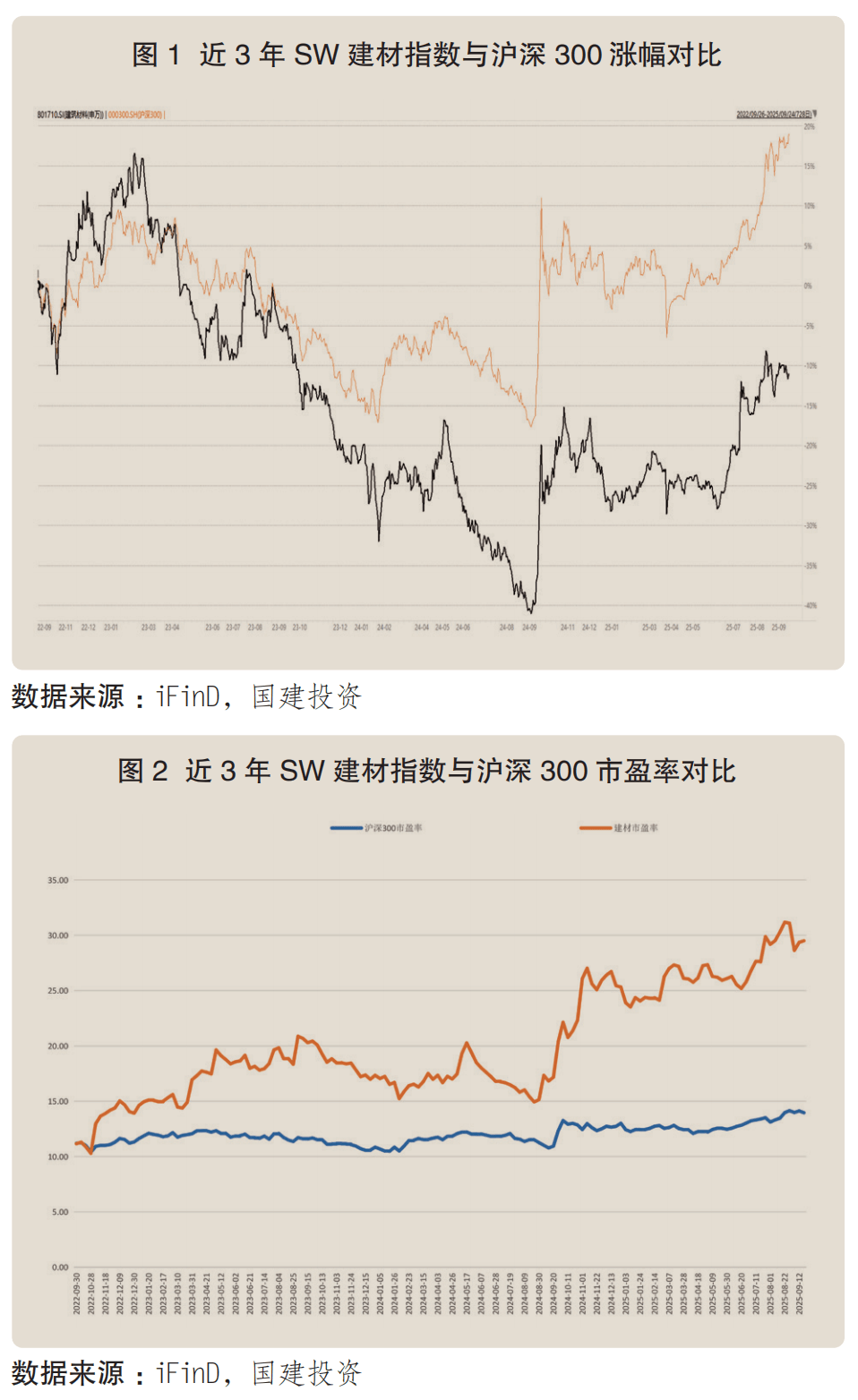
Core Insights - The construction materials sector is experiencing significant structural differentiation, with varying performance across sub-industries, driven by factors such as real estate adjustments and demand contraction [1][2][6][19]. Overall Industry Performance - Since 2022, the SW construction materials index has underperformed compared to the CSI 300 due to adjustments in the real estate supply chain and demand shrinkage [2]. - In the first half of 2025, the total market capitalization of listed companies in the SW construction materials sector reached 862.68 billion yuan, with operating revenue of 690.43 billion yuan, a year-on-year decline of 4.92%, and a net profit attributable to shareholders of 21.69 billion yuan, a year-on-year increase of 43.58% [2]. Sub-Industry Analysis Cement Manufacturing - The cement manufacturing sector is in a severe downturn, with a three-year CAGR of -28.35% for total revenue and -77.85% for net profit, indicating a significant mismatch between high supply and weak demand [10][11]. - The national cement capacity utilization rate was only 55.8% in the first half of 2025, well below the 75% threshold for reasonable operation [10]. Cement Products - The cement products sector shows a contrasting performance with a three-year CAGR of -15.58% for revenue and -152.26% for net profit, but a gross margin of 25.67% and a high inventory turnover rate of 7.99 times [12]. - The sector benefits from new infrastructure and major engineering investments, supporting demand for cement products [12][13]. Glass Fiber Manufacturing - Glass fiber manufacturing is the only sub-industry showing positive growth across all dimensions, with a three-year CAGR of 18.72% for revenue and 23.47% for net profit [14]. - The growth is driven by expanding downstream demand in sectors like wind power and photovoltaics, supported by favorable industrial policies [14]. Glass Manufacturing - The glass manufacturing sector has reported an overall loss for the first time, with a three-year CAGR of -10.23% for revenue and -35.87% for net profit, facing challenges from overcapacity and strict environmental regulations [15]. Refractory Materials - The refractory materials sector remains relatively stable, with a three-year CAGR of -1.87% for revenue and -15.62% for net profit, benefiting from rigid demand in high-energy-consuming industries [16]. Pipe Materials - The pipe materials sector is driven by infrastructure investments, with a three-year CAGR of -5.67% for revenue and -12.35% for net profit, but a gross margin of 22.45% [17]. Other Construction Materials - The other construction materials sector, covering gypsum boards, artificial boards, and decorative materials, shows strong anti-cyclical properties due to its low correlation with real estate [18]. Investment Value and Strategy - The report suggests focusing on three core investment tracks: high-growth manufacturing represented by glass fiber, high-turnover engineering products like cement products, and comprehensive service transformations in waterproofing and decoration [19][20]. - Emphasis is placed on selecting industry leaders with strong cash flow and balance sheet quality, advocating for a diversified cross-sector allocation to mitigate cyclical risks [20]. Future Outlook - The construction materials industry is expected to shift from quantity competition to quality competition, with increasing concentration as a trend [22]. - New infrastructure investments and green building initiatives are projected to become significant growth drivers, with a planned investment of 1.5 trillion yuan in new infrastructure by 2025 [22].

建材、建筑及基建公募REITs周报(10月18日-10月24日):十五五首提航天强国,上海发布促进建筑业高质量发展行动方案-20251027
EBSCN· 2025-10-27 05:20
Investment Rating - The report maintains an "Overweight" rating for the construction and engineering sector and a "Buy" rating for non-metallic building materials [5]. Core Insights - The report highlights the acceleration of the commercial aerospace industry development, with the recent successful launch of the Long March 6A rocket, which deployed 18 satellites, enhancing communication capabilities [1]. - Shanghai's action plan aims to promote high-quality development in the construction industry, focusing on optimizing competition, expanding development space, and improving the industry ecosystem [2][3]. - The report notes a decline in cement demand during the traditional peak season, with a cumulative cement production of 1.259 billion tons in the first three quarters of 2025, down 5.2% year-on-year, and a September production of 154 million tons, down 8.6% year-on-year [3]. Summary by Sections Commercial Aerospace - The central government has prioritized the construction of a "strong aerospace nation," which is expected to accelerate the development of the commercial aerospace industry [1]. Construction Industry Development - Shanghai's action plan includes measures to optimize competition by encouraging business integration and supporting the formation of construction groups with full industry chain capabilities [2]. - The plan also aims to expand development space through new real estate models and urban renewal projects, while enhancing operational capabilities in energy and environmental sectors [2][3]. - The report emphasizes the need for a robust industry ecosystem, including payment guarantees and a quality-based regulatory framework [2]. Cement Industry - The report indicates that the cement industry is experiencing a weak recovery, with production and shipment rates showing a decline due to funding shortages and adverse weather conditions [3]. - It anticipates that supply reductions will drive price trends and improve industry profitability, with expectations for accelerated capacity replacement [3]. Investment Recommendations - The report suggests focusing on companies in the new materials sector, such as China Jushi and Guoen Co., and in the infrastructure and real estate chain, including China State Construction and Conch Cement [4].
严控产能!建材行业稳增长进行时
Zheng Quan Shi Bao· 2025-10-27 04:54
Core Viewpoint - The construction materials industry is facing significant challenges due to declining prices and increased losses, prompting the government to implement a "Stabilization Growth Work Plan" for 2025-2026 aimed at improving profitability and promoting green and digital development [1][3]. Industry Overview - The construction materials sector is crucial for national economic growth, but it has been impacted by falling prices in cement and glass, leading to an expanded loss margin and structural market issues [1]. - The Ministry of Industry and Information Technology and five other departments have issued a plan to enhance profitability and promote green materials, targeting over 300 billion yuan in revenue from green construction materials by 2026 [1]. Market Conditions - In 2024, the domestic cement industry's profit is projected to be 26.6 billion yuan, a nearly 90% decline from the historical peak of 186.7 billion yuan in 2019 [3]. - Cement production from January to September 2025 was 1.259 billion tons, a year-on-year decrease of 5.2% [3]. - The price of P.O 42.5 bulk cement hit a yearly low of 267.11 yuan per ton in mid-August 2025, reflecting a downward trend in cement prices [3]. Capacity Control Measures - The industry is actively responding to the "anti-involution" policy by increasing the number of shutdown days for production lines and eliminating inefficient capacity [4]. - As of September 2025, the total capacity of suspended cement clinker was approximately 118,000 tons per day, an increase from 99,600 tons per day in the same period of 2024 [4]. - The cement industry has seen a significant increase in concentration, with the top ten companies' clinker capacity concentration rising from 56.5% to over 65% [5]. Diversification and Innovation - Companies are diversifying by expanding into related industries such as aggregates and concrete, and through investments in new sectors to mitigate risks and foster growth [8]. - Conch Cement is actively investing in the photovoltaic industry and has established a distributed photovoltaic power station with a capacity of approximately 38 megawatts [11]. Green and Low-Carbon Development - The industry is increasingly adopting energy-saving and carbon-reducing technologies, with 65% of the glass production capacity now using natural gas as an energy source [11]. - The cement sector is implementing carbon capture and utilization technologies, optimizing energy consumption, and enhancing digital management to reduce carbon emissions [11]. - The government is supporting green production through subsidies, tax reductions, and green finance, encouraging companies to innovate and reduce resource consumption [12].
严控产能!建材行业稳增长进行时
证券时报· 2025-10-27 04:14
Core Viewpoint - The construction materials industry in China is facing significant challenges due to declining prices and demand, leading to increased losses and structural issues. The government has introduced a growth stabilization plan for 2025-2026 to enhance profitability and promote green and digital development in the sector [5][6]. Group 1: Industry Challenges - The construction materials industry is a crucial foundation for the national economy, but recent years have seen a decline in prices for key products like cement and glass, resulting in an expanded loss margin and highlighted structural problems [3]. - In 2024, the domestic cement industry's profit is projected to be 26.6 billion yuan, a nearly 90% drop from the historical high of 186.7 billion yuan in 2019. The demand has reverted to levels seen before 2010, necessitating a restructuring of competitive order [7]. - From January to September 2025, domestic cement production was 1.259 billion tons, a year-on-year decrease of 5.2%, with prices continuing to decline [7]. Group 2: Government Initiatives - The Ministry of Industry and Information Technology and five other departments issued the "Construction Materials Industry Stabilization Growth Work Plan (2025-2026)," aiming for a significant improvement in profitability and a target of over 300 billion yuan in revenue from green building materials by 2026 [5]. - The plan emphasizes strict capacity control, nurturing emerging markets, and accelerating green production to transition towards high-quality, low-carbon development [5][8]. Group 3: Capacity Control Measures - To address the sluggish market, the industry is implementing strict capacity control measures. For instance, Conch Cement has increased the number of days its production lines are idled and has eliminated 16 production lines, accounting for over 22% of the total capacity eliminated in the industry [8][9]. - By the end of 2025, it is expected that 10% of the total cement capacity will be eliminated, with the concentration of capacity among the top ten companies rising from 56.5% to over 65% [9]. Group 4: Innovation and Market Development - Companies are diversifying their operations to mitigate risks and foster new growth points. For example, Conch New Materials is acquiring a 51% stake in a plastic products company to enhance synergy and expand into new markets [11]. - The cement industry is increasingly exploring horizontal expansions into aggregates and vertical extensions into concrete, leveraging synergies for competitive advantage [12]. Group 5: Green and Low-Carbon Initiatives - The industry is advancing towards green and low-carbon production through technological innovations, such as the transition to natural gas in glass production, which has reached 65% of total capacity [15]. - The cement sector is adopting carbon capture technologies and optimizing energy consumption, with the proportion of green and smart factories increasing to over 68% [15][16].

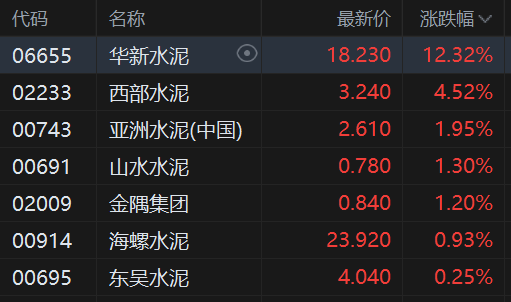
港股异动丨水泥股拉升 华新水泥绩后大涨超12%领衔 西部水泥涨4.5%
Ge Long Hui· 2025-10-27 03:03
Group 1 - The core point of the article highlights a significant rise in Hong Kong cement stocks, particularly Huanxin Cement, which surged over 12% following its earnings announcement [1] - Huanxin Cement reported a net profit of 900 million yuan for Q3, representing a year-on-year increase of 120.73%, and a total net profit of 2 billion yuan for the first three quarters, up 76.01% year-on-year [1] - The company plans to distribute a dividend of 0.34 yuan per share for the first three quarters on December 24, 2025, supported by rising domestic cement prices and reduced production costs [1] Group 2 - Other cement stocks also experienced gains, with Western Cement rising 4.5%, Asia Cement increasing by 2%, and several others, including Shanshui Cement and Jinyu Group, seeing over 1% growth [1] - According to a report by Shenwan Hongyuan, Q3 is traditionally a slow season for the cement industry, and cement prices are expected to peak and then decline in 2025 [1] - The ongoing expansion of overseas operations is showing progress, with Huanxin Cement and Western Cement continuing to increase production capacity, and profitability in African cement operations is expected to remain high and improve [1]


严控产能,绿色发展 建材行业提质增效进行时
Zheng Quan Shi Bao· 2025-10-26 17:41
Core Viewpoint - The construction materials industry in China is facing significant challenges due to declining prices and increased losses, prompting the government to implement a growth stabilization plan aimed at enhancing profitability and promoting green and digital development by 2026 [1][2]. Industry Overview - The construction materials sector is crucial for national economic growth, but recent years have seen a downturn in prices for key products like cement and glass, leading to an expanded loss margin and structural market issues [1]. - The Ministry of Industry and Information Technology, along with five other departments, has issued a plan targeting a significant increase in the profitability of the construction materials industry over the next two years, with a goal of exceeding 300 billion yuan in revenue from green building materials by 2026 [1]. Market Conditions - In 2024, the total profit for the domestic cement industry is projected to be 26.6 billion yuan, a decline of approximately 90% compared to the historical peak of 186.7 billion yuan in 2019 [1]. - Cement production from January to September 2025 was only 1.259 billion tons, reflecting a year-on-year decrease of 5.2% due to reduced demand from real estate and infrastructure investments [1]. Price Trends - The price of cement has been on a downward trend since 2025, with the price of P.O 42.5 bulk cement hitting a yearly low of 267.11 yuan per ton in mid-August [2]. - The glass industry has also experienced a decline in prices, with the price of float glass reaching a historical low in September 2024, followed by a slight rebound before falling again in 2025 [2]. Capacity Control Measures - The cement industry is actively responding to market challenges by implementing strict capacity controls, with a significant increase in kiln shutdown days and the elimination of inefficient production lines [2][3]. - As of September 2025, the company has shut down 16 production lines, accounting for over 22% of the total capacity eliminated in the industry [2]. Diversification and Innovation - Companies are diversifying their operations by expanding into new markets and industries, such as aluminum and eco-friendly home products, to mitigate reliance on traditional construction materials [5][6]. - The cement industry is also exploring horizontal and vertical expansions into related sectors, leveraging synergies to enhance competitive advantages [6]. Green and Low-Carbon Development - The industry is increasingly focusing on green and low-carbon production methods, with many companies adopting natural gas as a fuel source, which is expected to improve product quality [8]. - The implementation of carbon capture technologies and digital management systems is helping to significantly reduce energy consumption and carbon emissions in cement production [8]. Policy Support - The government is providing support through subsidies, tax reductions, and green finance initiatives to encourage construction material companies to expand their green production capabilities and phase out outdated capacities [9].
9月基建投资环比回落,“十五五”管网新增投资有望超5万亿
Guotou Securities· 2025-10-26 13:38
Investment Rating - The industry investment rating is "Outperform the Market" [4] Core Viewpoints - Infrastructure investment in September showed a month-on-month decline, but the new investment demand for underground pipeline networks during the 14th Five-Year Plan is expected to exceed 5 trillion yuan [3][19] - The overall infrastructure investment has maintained steady growth since the beginning of the year, but the growth rate has been declining month-on-month. Q4 is typically a peak construction season, and infrastructure investment is expected to accelerate [2][17] - The 14th Five-Year Plan emphasizes expanding domestic demand and effective investment, with a focus on underground pipeline construction as a key direction [3][19] Summary by Sections Industry Dynamics Analysis - In the first three quarters, the GDP reached 101.50 trillion yuan, with a year-on-year growth of 5.2%. Fixed asset investment (excluding rural households) was 37.15 trillion yuan, down 0.55% year-on-year [1][16] - Infrastructure investment grew by 1.1% year-on-year, while real estate development investment fell by 13.9% [1][16] Market Performance - The construction industry rose by 2.91%, outperforming the Shanghai Composite Index [20][21] - The top five stocks in the industry saw significant gains, with Huylv Ecology up 32.77% [21] Company Announcements - Major contracts were awarded, including a project by Anhui Construction with a total bid of 10.295 billion yuan [31] - China State Construction reported a new contract amount of 3.29 trillion yuan in the first nine months, a year-on-year increase of 1.4% [32] Industry News - The Ministry of Industry and Information Technology emphasized the need for high-quality development in the cement industry, aiming for a revenue target of over 300 billion yuan for green building materials by 2026 [33][34] - The Fourth Plenary Session of the 20th Central Committee highlighted the importance of expanding domestic demand and effective investment [34]
建筑建材行业周报:高质量发展、扩大内需、反内卷仍是十五五关键词-20251026
Western Securities· 2025-10-26 12:39
Investment Rating - The report does not explicitly state an investment rating for the construction and decoration industry. Core Insights - High-quality development, expanding domestic demand, and comprehensive rectification of "involution" competition are key themes for the 14th Five-Year Plan. The report emphasizes the importance of a strong domestic market as a strategic support for modernization in China. It suggests that construction companies will adopt a mindset focused on cash flow and profitability rather than just revenue growth [1][2]. - As of September 2025, fixed asset investment decreased by 0.5% year-on-year, while infrastructure investment (excluding electricity) increased by 1.1%. Real estate investment saw a significant decline of 13.9% year-on-year, and manufacturing investment grew by 4.0% [1][2]. - The report indicates that infrastructure investment is expected to remain stable during the 14th Five-Year Plan period despite current challenges [2]. Market Performance - During the week of October 20-24, 2025, the construction index rose by 2.91%, and the building materials index increased by 1.60%, while the Shanghai Composite Index rose by 2.88%. Year-to-date, the construction index has increased by 9.76%, ranking 19th out of 30 industries, and the building materials index has risen by 18.69%, ranking 12th [3][8]. - The report highlights that the market is becoming more active, particularly for low-growth, low-valuation, and low-holding construction and building materials sectors, especially heavyweight stocks [3][8]. Special Bonds and Funding Status - As of October 24, 2025, a total of 1,123.61 billion yuan in new local government special bonds were issued during the week, a week-on-week increase of 459.27%. The cumulative issuance for the year reached 38,096.76 billion yuan, a year-on-year increase of 0.22% [2][19]. - The report notes that the funding availability rate for construction sites was 59.62%, with non-residential projects at 61.06% and residential projects at 52.76% [24]. Cement Industry Data - The national average cement price as of October 23, 2025, was 263.5 yuan per ton, reflecting a week-on-week increase of 0.8% but a year-on-year decrease of 17.8%. The report anticipates that cement prices will continue to fluctuate [35][39]. - Cement production from January to September 2025 totaled 1.259 billion tons, a year-on-year decrease of 5.2%, with September's production down 8.6% compared to the previous year [49][55]. Key Company Orders and Valuation - The report suggests focusing on major construction blue-chip stocks such as China Railway, China Communications Construction, and China State Construction, as well as companies involved in overseas projects and those benefiting from domestic demand [3][8]. - The current price-to-earnings ratios for the construction and building materials sectors are 9.46 and 21.72, respectively, indicating that the construction sector is at a historically low valuation level [3][14].
建筑材料行业周报:基本面仍显疲软,期待更多地产政策-20251026
GOLDEN SUN SECURITIES· 2025-10-26 11:28
Investment Rating - The report maintains an "Overweight" rating for the construction materials sector [4] Core Views - The construction materials sector is experiencing weak fundamentals, with expectations for more supportive real estate policies [1] - The recent Central Committee meeting emphasized the importance of building a strong domestic market and enhancing effective investment, which could positively impact the construction materials sector [2] - The report highlights the potential for recovery in municipal engineering projects and the positive changes in supply-side dynamics for cement and glass industries [2] Summary by Sections Market Overview - From October 20 to October 24, 2025, the construction materials sector (SW) rose by 0.40%, with cement and glass manufacturing declining by 0.72% and 0.89%, respectively, while fiberglass manufacturing increased by 3.37% [1][12] - The net inflow of funds into the construction materials sector was +415 million yuan during this period [1] Cement Industry Tracking - As of October 24, 2025, the national cement price index was 343.65 yuan/ton, with a week-on-week increase of 0.13% [17] - The total cement output for the week was 2.616 million tons, up 3.46% from the previous week [17] - The capacity utilization rate for cement clinker kilns was 63.75%, reflecting a week-on-week increase of 9.39 percentage points [17] Glass Industry Tracking - The average price of float glass as of October 23, 2025, was 1243.68 yuan/ton, down 4.40% from the previous week [5] - The inventory of raw glass in 13 provinces increased by 2.9 million heavy boxes week-on-week, indicating a growing supply [5] Fiberglass Industry Tracking - The price of non-alkali fiberglass remained stable, with demand showing slight improvement [6] - The average price of electronic fiberglass was stable, with high-end products experiencing tight supply [6] Carbon Fiber Industry Tracking - The carbon fiber market price remained stable, with a production volume of 1857 tons and an operating rate of 61.69% [7] - The industry continues to face challenges with a negative gross margin, indicating ongoing losses for many companies [7] Key Stocks - Recommended stocks include: - Beixin Building Materials (Buy) [8] - Weixing New Materials (Overweight) [8] - Sankeshu (Buy) [8] - China Jushi (Buy) [8] - Yinlong Co. (Buy) [8] - Puren Co. (Buy) [8]
十五五再提管网改造,内需投资确定性增强
HUAXI Securities· 2025-10-26 09:12
Investment Rating - The industry rating is "Recommended" [4] Core Views - The "14th Five-Year Plan" emphasizes urban renewal and underground pipeline renovation, with an expected investment demand exceeding 5 trillion yuan for over 700,000 kilometers of pipeline construction [6] - The report highlights the impact of renewed tariff conflicts and the acceleration of industry self-discipline, recommending companies with strong pricing power and cost advantages in the cement and waterproof sectors [6] - The report notes that the special electronic fabric sector is experiencing high demand, with companies like China Jushi and China National Materials Technology benefiting from this trend [7] Summary by Sections Investment Suggestions - Recommended companies benefiting from urban pipeline renovation include Qinglong Pipe Industry, Donghong Co., and China Liansu [6] - In the cement sector, companies like Huaxin Cement and Conch Cement are recommended due to their cost and scale advantages amid tariff conflicts [6] - The waterproof industry is seeing frequent price increases, with recommendations for Oriental Yuhong and Keshun Co. [6] - In the photovoltaic glass sector, companies such as Qibin Group, Fuyao Glass, and Xinyi Solar are recommended due to price increases [6] - The report suggests strong resilience in operations for companies like Sanhe Tree and high dividend yield firms like Rabbit Baby and Weixing New Materials [6] - The fire alarm leader Qingniao Fire is recommended due to its upcoming commercialization of fire-fighting robots [7] - The report highlights the strong performance of special electronic fabrics, recommending China Jushi and China National Materials Technology [9] Market Trends - The national cement market price increased by 0.4% week-on-week, with price rises in regions like Guizhou and Jiangsu [22][23] - The average price of float glass decreased by 4.40% to 1243.68 yuan/ton, indicating a shift from an upward trend to a decline [64] - The photovoltaic glass market remains stable, with mainstream order prices for 2.0mm coated panels at around 13 yuan/square meter [72]