陕西煤业

Search documents
煤炭月度供需数据点评:10月:火电增速逆势向上,煤价上涨超预期-20251118
Shanxi Securities· 2025-11-18 05:42
Investment Rating - The report maintains an investment rating of "Leading the Market" for the coal industry, indicating an expected price increase exceeding the benchmark index by more than 10% [6][39]. Core Insights - In October, thermal power demand increased against the trend, leading to an unexpected rise in coal prices. The supply of raw coal showed a marginal decrease, with cumulative production from January to October reaching 3.973 billion tons, a year-on-year increase of 1.5%, but with a declining growth rate [5][6]. - The report highlights that while fixed asset investment decreased by 1.7% year-on-year in the first ten months of 2025, thermal power demand saw a notable increase of 7.3% in October, contrasting with declines in other sectors such as real estate [5][6]. - Coal imports showed a downward trend, with cumulative imports from January to October at 388 million tons, a year-on-year decrease of 11%. In October alone, imports were 41.74 million tons, down 9.76% year-on-year [5][6]. - The report emphasizes that coal prices in October rose unexpectedly, driven by increased demand from downstream power plants and a reduction in inventory at ports. The report suggests that if coal prices continue to rise significantly, it may attract policy attention [6][7]. Summary by Sections Supply - From January to October 2025, raw coal supply showed a marginal decrease, with October production at 407 million tons, down 2.3% year-on-year and 1.16% month-on-month [5][6]. Demand - The demand for thermal power increased by 7.3% in October, while cumulative demand for fixed asset investment showed a decline of 1.7% year-on-year. Other sectors like real estate and cement experienced significant declines [5][6]. Imports - Coal imports decreased, with a cumulative total of 388 million tons from January to October, reflecting an 11% year-on-year drop. October imports were 41.74 million tons, down 9.76% year-on-year [5][6]. Prices - Coal prices saw an unexpected rise in October, with various types of coal showing different price trends. The report notes that the price increase is supported by strong demand and reduced supply expectations [6][7]. Investment Recommendations - The report suggests a positive outlook for the coal sector in the fourth quarter, with specific stocks recommended for investment based on their performance and market conditions [6][7].
中证现金流ETF(159235)跌1.27%,半日成交额5434.18万元
Xin Lang Cai Jing· 2025-11-18 03:40
Core Viewpoint - The China Securities Cash Flow ETF (159235) experienced a decline of 1.27% as of the midday close on November 18, with a trading volume of 54.34 million yuan [1] Group 1: ETF Performance - The China Securities Cash Flow ETF (159235) closed at 1.245 yuan, with a year-to-date return of 26.19% since its inception on April 23, 2025 [1] - The ETF has shown a return of 6.62% over the past month [1] Group 2: Major Holdings Performance - Major holdings in the ETF include: - China National Offshore Oil Corporation (CNOOC) down 0.69% - Midea Group down 0.21% - Gree Electric Appliances up 0.17% - Wuliangye Yibin up 0.37% - COSCO Shipping Holdings down 0.66% - Luoyang Molybdenum down 2.55% - TCL Technology down 1.62% - China Aluminum Corporation down 3.05% - SF Express down 0.40% - Shaanxi Coal and Chemical Industry down 1.91% [1]
自由现金流ETF中证全指(561080)跌1.28%,半日成交额152.47万元
Xin Lang Cai Jing· 2025-11-18 03:40
来源:新浪基金∞工作室 风险提示:市场有风险,投资需谨慎。本文为AI大模型自动发布,任何在本文出现的信息(包括但不 限于个股、评论、预测、图表、指标、理论、任何形式的表述等)均只作为参考,不构成个人投资建 议。 自由现金流ETF中证全指(561080)业绩比较基准为中证全指自由现金流指数收益率,管理人为华安基 金管理有限公司,基金经理为许之彦、王超,成立(2025-04-23)以来回报为24.70%,近一个月回报为 6.35%。 11月18日,截止午间收盘,自由现金流ETF中证全指(561080)跌1.28%,报1.231元,成交额152.47万 元。自由现金流ETF中证全指(561080)重仓股方面,中国海油截止午盘跌0.69%,美的集团跌0.21%, 格力电器涨0.17%,五粮液涨0.37%,中远海控跌0.66%,洛阳钼业跌2.55%,TCL科技跌1.62%,中国铝 业跌3.05%,顺丰控股跌0.40%,陕西煤业跌1.91%。 ...
东吴证券:煤炭供需弱均衡导致煤价震荡运行 高股息投资逻辑持续
Zhi Tong Cai Jing· 2025-11-18 02:41
Group 1 - The core viewpoint of the report is that coal prices are expected to bottom out in Q2 2025, leading to improved performance for coal companies starting from Q3 2025, with stable coal prices benefiting leading companies [1] - The report suggests focusing on companies like Guanghui Energy (600256) due to its production growth from the "Xinjiang coal transportation" logic and performance elasticity from rising thermal coal prices [1] - Other companies recommended for attention include Haohua Energy (601101), Yanzhou Coal Mining (600188), and Shaanxi Coal and Chemical Industry (601225) [1] Group 2 - Since mid-2023, the coal supply and demand have entered a weak equilibrium state due to slowing economic growth, with normal coal prices fluctuating between 670-870 RMB/ton, and a reasonable expectation around 770 RMB/ton [1] - Xinjiang coal has become a significant elastic supply region, with large-scale open-pit coal mines providing important supply flexibility [1] - When coal prices fall below 700 RMB/ton, coal mines face losses and may exit production, while prices above 800 RMB/ton lead to significant production releases due to improved profitability [1] Group 3 - The report indicates that Indonesian coal production has significant elasticity, as it consists of open-pit mines, and low-calorific coal is prioritized for elimination during market downturns, making it an important supplementary source for China's coal supply [2] - It is projected that China's coal imports will decrease by 5-6 million tons in 2025, with a similar decline expected in Indonesia's total export volume [2] - The most significant impact on coal prices from 2024 to 2025 will come from temporary railway freight discounts, particularly in Xinjiang, where a 20-30% discount will reduce transportation costs by 100-150 RMB/ton, ultimately affecting coastal coal price fluctuations [2]

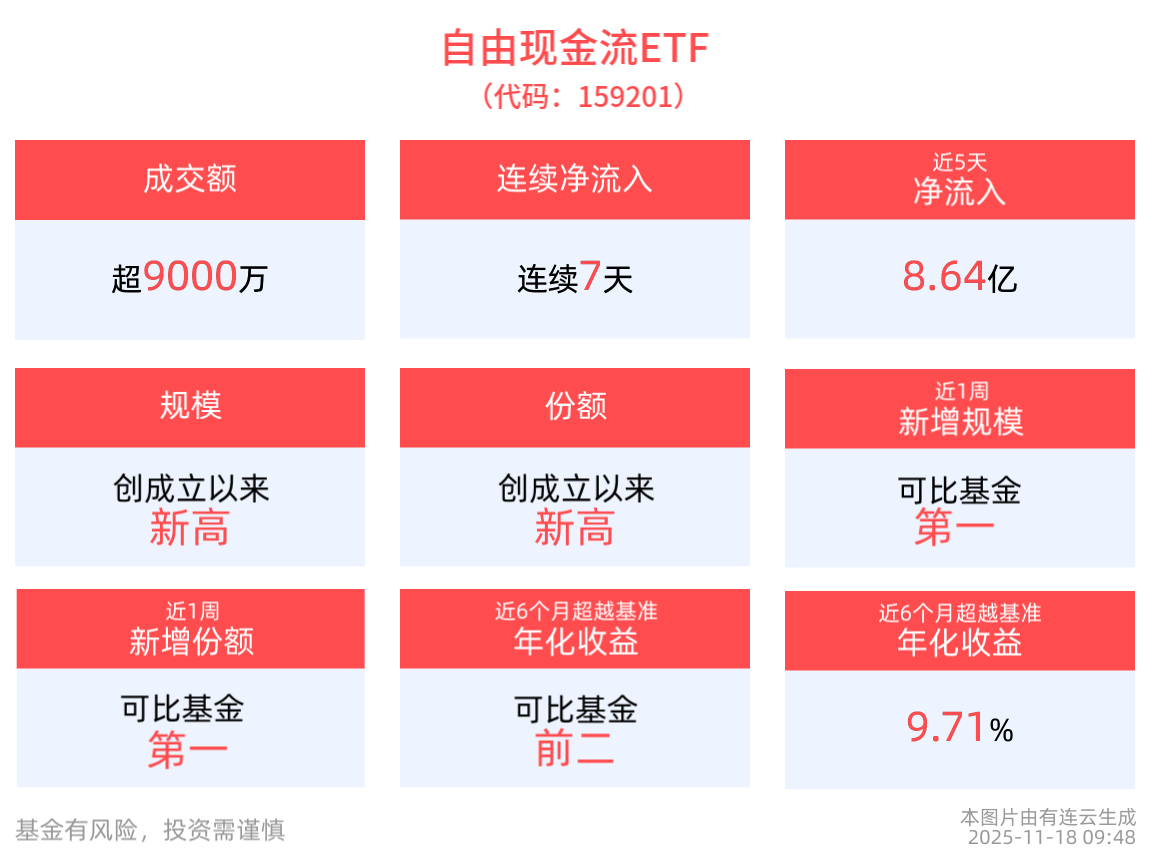
自由现金流ETF(159201)连续7天净流入,合计“吸金”10.63亿元
Sou Hu Cai Jing· 2025-11-18 02:18
Core Insights - The Guozheng Free Cash Flow Index has decreased by 1.04% as of November 18, 2025, with mixed performance among constituent stocks [1] - The Free Cash Flow ETF (159201) has seen a decline of 0.99%, currently priced at 1.2 yuan [1] - The Free Cash Flow ETF has achieved a record high in both share count (5.519 billion shares) and total scale (6.656 billion yuan) [1] Performance Metrics - The Free Cash Flow ETF has recorded a net value increase of 23.26% over the past six months [4] - The ETF's highest monthly return since inception is 7%, with the longest consecutive monthly gain being 6 months and a maximum gain of 22.69% [4] - The ETF has an 87.5% monthly profit percentage and an 82.82% monthly profit probability, with a 100% probability of profit over a six-month holding period [4] Fund Flow and Liquidity - The Free Cash Flow ETF has seen a net inflow of 1.063 billion yuan over the past week, with a peak single-day inflow of 240 million yuan [1] - The average daily net inflow for the ETF is 152 million yuan [1] - The ETF's financing net purchase amount for the month is 6.2215 million yuan, with a current financing balance of 161 million yuan [4] Fee Structure - The management fee for the Free Cash Flow ETF is 0.15%, and the custody fee is 0.05% [5] Top Holdings - As of October 31, 2025, the top ten weighted stocks in the Guozheng Free Cash Flow Index account for 54.79% of the index, including China National Offshore Oil Corporation, SAIC Motor, and Wuliangye [5][7]

【省人力资源社会保障厅】陕西试点“首席技师+一评两证”人才评价新模式
Shan Xi Ri Bao· 2025-11-17 23:03
Core Viewpoint - The implementation of the "New Eight-Level Worker" vocational skill grading system in Shaanxi Province aims to enhance the development of skilled talents through policy-driven initiatives and new evaluation models [1][2]. Group 1: Policy Initiatives - The Shaanxi Provincial Human Resources and Social Security Department, along with eight other departments, has issued 13 measures to promote skill-based enterprises, emphasizing the implementation of the "New Eight-Level Worker" vocational skill grading system [1][2]. - The new policy supports the selection of qualified enterprises as vocational skill evaluation institutions, allowing them to conduct independent evaluations based on their main business [1]. Group 2: New Evaluation Model - Shaanxi Coal Group is piloting a new talent evaluation model called "Chief Technician + One Assessment, Two Certificates," which allows individuals to obtain both a skill level certificate and a professional title certificate simultaneously [2]. - This model aims to break down barriers in the development of skilled talents and aligns with both the vocational skill grading system and the professional technical title system [2]. Group 3: Recognition and Benefits - As of November 6, 17 individuals from Shaanxi Coal Group have been proposed for recognition as Chief Technicians, and 20 as Special Technicians, with the policy ensuring that those in Special Technician positions receive benefits comparable to senior professional titles [2]. - The new skill grading evaluation system facilitates the integration of high-skilled talents and professional technical talents, allowing over 1,000 individuals in Shaanxi to achieve dual recognition in professional titles and vocational qualifications [2]. Group 4: Direct Recognition of Skills - The policy allows for the direct recognition of skilled talents who solve significant technical challenges, bypassing traditional restrictions related to education, experience, age, and ratios [3]. - Shaanxi will also focus on key industries to conduct skill competitions, providing better treatment for those who excel in vocational skill grading and professional title promotions [3].

——煤炭行业周报(2025.11.8-2025.11.14):安监、环保检查下,产量预期偏紧,取暖季煤价预计上涨-20251117
Shenwan Hongyuan Securities· 2025-11-17 12:02
Investment Rating - The report maintains a positive outlook on the coal industry, suggesting a "Buy" rating for specific stocks based on their performance relative to the market [3][29]. Core Insights - The report highlights that the coal prices are expected to rise due to supply constraints and seasonal demand, particularly in the context of winter heating needs [3][4]. - It emphasizes the impact of environmental regulations and safety inspections on coal production, which are likely to tighten supply further [3][7]. - The report identifies several companies as potential investment opportunities, including Jin控煤业, 华阳股份, and 山煤国际, based on their price elasticity and valuation [3][4]. Summary by Sections 1. Recent Industry Policies and Dynamics - The report discusses the initiation of the third round of central ecological environment protection inspections, which will affect major coal-producing regions and companies [7]. - It mentions the State Energy Administration's guidance on integrating coal with renewable energy, focusing on low-carbon transitions and new energy developments in mining areas [7]. 2. Price Trends of Coal - The report notes fluctuations in domestic coal prices, with specific increases in certain regions, such as a rise of 10 CNY/ton in Dazhou and Ordos [8]. - The overall coal price index in the Bohai Rim region has increased by 4 CNY/ton, indicating a general upward trend in coal prices [8]. 3. International Oil Prices - Brent crude oil prices have risen by 1.19% to 64.39 USD/barrel, which may influence coal prices due to the relationship between oil and coal markets [14]. 4. Port Inventory Trends - The report indicates an increase in coal inventory at the Bohai Rim ports, with a total of 24.3 million tons, reflecting a 2.56% rise week-on-week [18]. 5. Domestic and International Freight Rates - Domestic coastal shipping rates have increased slightly, with an average of 51.52 CNY/ton, while international shipping rates from Australia to China have also seen a rise [23]. 6. Key Company Valuation Table - The report provides a detailed valuation table for key companies in the coal sector, highlighting their stock prices, market capitalization, and earnings projections [28].





煤炭行业周报:安监、环保检查下,产量预期偏紧,取暖季煤价预计上涨-20251117
Shenwan Hongyuan Securities· 2025-11-17 10:12
Investment Rating - The report maintains a positive outlook on the coal industry, indicating an "Overweight" rating for the sector [3]. Core Insights - The report highlights that due to safety and environmental inspections, coal production is expected to tighten, leading to an anticipated increase in coal prices during the heating season [3]. - The report provides specific price data for thermal coal and coking coal, noting price increases and supply constraints in key production areas [3][10][11]. - The report suggests that the demand for thermal coal is expected to rebound during the peak season, recommending specific companies for investment based on their price elasticity and valuation [3]. Summary by Sections Recent Industry Policies and Dynamics - The report discusses the initiation of central ecological and environmental inspections across several provinces and major state-owned enterprises, which may impact coal production [9]. - It mentions the release of guidelines by the National Energy Administration aimed at integrating coal with new energy sources, emphasizing low-carbon transitions [9]. Price Trends - Thermal coal prices have shown mixed trends, with some regions experiencing price increases while others have seen declines [10]. - Coking coal prices have generally increased, with specific price points provided for various regions [13]. Supply and Demand Dynamics - The report notes an increase in daily coal inflow and outflow at the Bohai Rim ports, indicating a tightening supply situation [22]. - It highlights a decrease in power plant inventories and an increase in daily consumption rates, suggesting a growing demand for coal [5][22]. International Oil Prices - The report indicates a rise in Brent crude oil prices, which may influence coal pricing dynamics [17]. Shipping Costs - Domestic and international shipping costs have increased, which could affect overall coal pricing and supply chain logistics [28]. Company Valuation Table - The report includes a valuation table for key companies in the coal sector, providing insights into their market capitalization, earnings per share, and price-to-earnings ratios [33].
2026年煤炭行业投资策略:资源民族主义觉醒,高估的煤炭供给
Shenwan Hongyuan Securities· 2025-11-17 09:41
Investment Strategy Overview - The report highlights the resurgence of resource nationalism driven by de-globalization, emphasizing coal's strategic importance for national energy security. Major coal-producing countries like Indonesia, Mongolia, and the USA are tightening control over coal resources, integrating them into national strategies to bolster energy independence and support domestic industrial and power needs [3][4][5]. Supply Side Analysis - The coal industry is undergoing a significant restructuring, with safety and environmental regulations leading to a more rational supply order. The release of production capacity is expected to be steady but cautious, promoting high-quality development in the coal sector [3][4]. - Domestic supply costs are rising, and coal imports are tightening marginally due to increased scrutiny and regulations [4][32]. Demand Side Analysis - The report anticipates a stable and slight increase in overall coal demand, driven by the rigid growth in electricity consumption and the irreplaceable role of coal in peak regulation and energy security. The expected price range for thermal coal in 2026 is projected to be between 750-800 RMB per ton [3][4][29]. - The resilience of coal power generation is highlighted, particularly in the context of fluctuating renewable energy output, indicating that coal will continue to play a crucial role in the energy mix [3][4]. Investment Recommendations - The report recommends investing in stable, high-dividend companies such as China Shenhua, Shaanxi Coal and Chemical Industry, and China Coal Energy. It also suggests paying attention to companies with price elasticity like Jinkong Coal Industry, Huayang Co., Tebian Electric Apparatus, and Shanxi Coal International [3][4]. - Growth-oriented companies in coal-electricity joint ventures, such as Xinji Energy, are also recommended for consideration [3][4]. Regional Insights - Indonesia's coal production is expected to decline in 2025 due to new resource tax regulations, which will increase export costs and support domestic coal prices [11][12]. - Mongolia's coal production and sales are affected by ongoing political instability, impacting the stability of coal imports [17][18]. - The USA is implementing favorable policies to revitalize its coal industry, including reducing royalty rates and increasing federal land available for coal exploration [21][22]. Future Capacity and Production Trends - Future coal production capacity is expected to be limited, with only about 67 million tons of new capacity projected over the next three years. The focus is shifting towards regions like Xinjiang, which has significant coal reserves and favorable mining conditions [61][67]. - The report notes that the overall coal production in China is unlikely to see significant growth in 2026 due to ongoing safety inspections and regulatory measures [51][53].



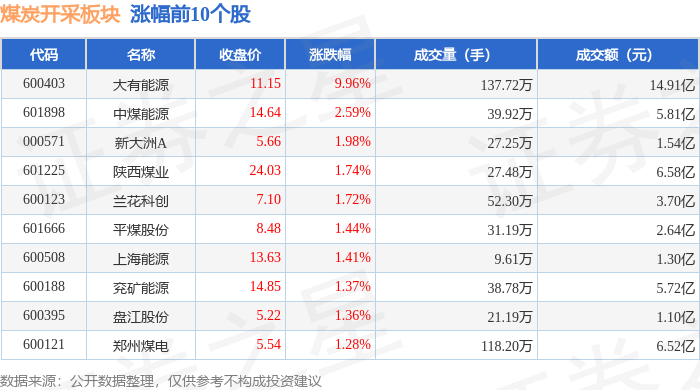
煤炭开采板块11月17日涨1.07%,大有能源领涨,主力资金净流出4.86亿元
Zheng Xing Xing Ye Ri Bao· 2025-11-17 09:00
Core Insights - The coal mining sector experienced a rise of 1.07% on November 17, with Dayou Energy leading the gains [1] - The Shanghai Composite Index closed at 3972.03, down 0.46%, while the Shenzhen Component Index closed at 13202.0, down 0.11% [1] Coal Mining Sector Performance - Dayou Energy (600403) closed at 11.15, up 9.96% with a trading volume of 1.3772 million shares and a transaction value of 1.491 billion [1] - Other notable performers included: - Zhongmei Energy (601225) at 24.03, up 1.74% [1] - Shanxi Coal (000571) at 5.66, up 1.98% [1] - The sector saw a net outflow of 486 million from main funds, while retail investors contributed a net inflow of 359 million [2][3] Fund Flow Analysis - Main funds showed a net outflow in several companies, including: - Electric Power Investment Energy (002128) with a net outflow of 114 million [3] - Shanxi Jiao Coal (000983) with a net outflow of 20.07 million [3] - Retail investors showed positive net inflows in companies like: - Zhengzhou Coal Electricity (600121) with a net inflow of 1.309 million [3] - New Dazhou A (000571) with a net inflow of 1.243 million [3]