国泰基金

Search documents
ETF,大爆发!
Zhong Guo Ji Jin Bao· 2025-12-26 05:39
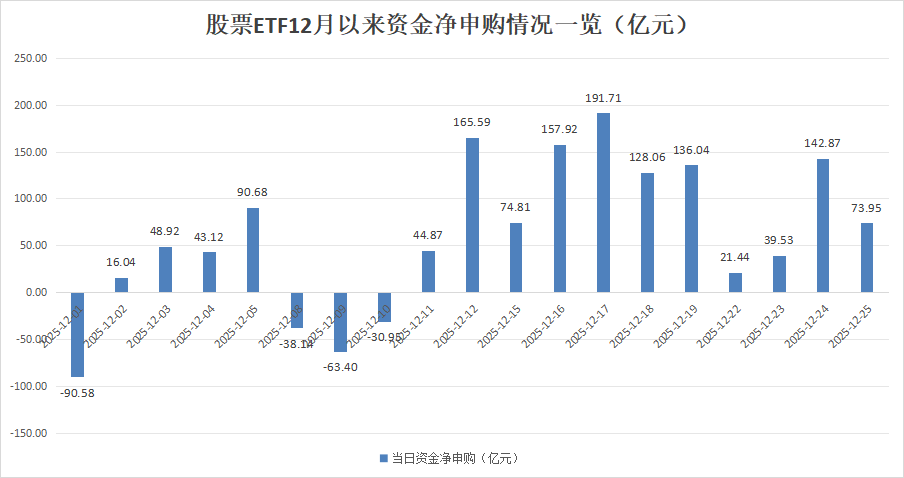
Core Insights - The competition for scale in the ETF market is intensifying, with the China Securities A500 ETF attracting nearly 95 billion yuan in inflows since December, contributing to a total market ETF scale approaching 6 trillion yuan [1][6] Group 1: Market Performance - On December 25, the stock ETF market saw a net inflow of over 7.3 billion yuan, with total inflows exceeding 110 billion yuan since the beginning of December [2] - The total scale of all stock ETFs (including cross-border ETFs) reached 4.74 trillion yuan as of December 25, with an increase of 3.127 billion units in total shares [2] Group 2: Fund Flows - Broad-based ETFs and bond ETFs led the net inflows, with 9.189 billion yuan and 8.814 billion yuan respectively, while thematic industry ETFs experienced a net outflow of 2.063 billion yuan [4] - The A500 ETF from major fund companies like Huatai-PB, Huaxia, and Southern saw net inflows exceeding 10 billion yuan each, with total net inflows for the A500 ETF reaching approximately 94.757 billion yuan since December [7] Group 3: Specific Fund Performance - The A500 ETF and the Sci-Tech 50 ETF from Huaxia Fund were among the top performers, with net inflows of 1.449 billion yuan and 0.697 billion yuan respectively, bringing their latest scales to 39.106 billion yuan and 76.493 billion yuan [5] - Several Sci-Tech bond ETFs also saw significant inflows, with inflows of 3.474 billion yuan and 2.050 billion yuan for Yin Hua and Huitianfu respectively on December 25 [7]

打响规模争夺战!中证A500ETF 12月以来“吸金”近950亿元
Xin Lang Cai Jing· 2025-12-26 05:38
Core Insights - The stock ETF market is experiencing significant inflows, driven by competition for the scale of the CSI A500 ETF, pushing the total ETF market size close to 6 trillion yuan [1][9] - On December 25, the total net inflow for the stock ETF market exceeded 7.3 billion yuan, with over 110 billion yuan in net inflows for December [2][10] - The CSI A500 ETF has been a major contributor to these inflows, with nearly 95 billion yuan in net inflows since the beginning of December [5][14] Market Performance - As of December 25, the total scale of 1,282 stock ETFs (including cross-border ETFs) reached 4.74 trillion yuan, with a total increase of 3.127 billion units in market share [2][10] - The market saw a net inflow of 7.395 billion yuan on December 25, coinciding with a seven-day rise in the Shanghai Composite Index, nearing the 4,000-point mark [2][10] ETF Inflows and Outflows - Broad-based ETFs and bond ETFs led the inflows, with net inflows of 9.189 billion yuan and 8.814 billion yuan respectively, while thematic industry ETFs saw a net outflow of 2.063 billion yuan [4][12] - Specific ETFs tracking the AAA Sci-Tech Bond Index saw the highest single-day net inflow of 8.471 billion yuan on December 25, while those tracking the Robotics Index experienced a net outflow of 796 million yuan [4][12] Major Fund Contributions - Major fund companies like E Fund and Huaxia have seen significant inflows in their ETFs, with E Fund's ETFs reaching a total scale of 847.64 billion yuan, increasing by 2.06 billion yuan on the previous day [4][12] - Huaxia's A500 ETF and Sci-Tech 50 ETF were among the top inflows, with net inflows of 1.449 billion yuan and 697 million yuan respectively [5][13] Notable ETF Performance - The top inflowing ETFs on December 25 included the Sci-Tech Bond ETF from Yin Hua with a net inflow of 3.474 billion yuan and the A500 ETF from Huatai with a net inflow of 1.520 billion yuan [6][15] - Conversely, the top outflowing ETFs included the Chip ETF with a net outflow of 227 million yuan and the Bank ETF with a net outflow of 284 million yuan [7][16]
ETF午评 | 迷你港股ETF继续上涨,恒生ETF港股通涨7%
Ge Long Hui· 2025-12-26 04:18
Market Performance - The Shanghai Composite Index experienced a slight decline of 0.19% in the morning session, while the ChiNext Index fell by 0.15%. In contrast, the Shenzhen Component Index rose by 0.17% [1] - The total market turnover reached 1.4648 trillion yuan, an increase of 252.9 billion yuan compared to the previous day's trading volume [1] Sector Performance - The AI industry chain saw a collective pullback, with CPO, liquid cooling, and high-speed copper concepts leading the declines. Technology sectors such as robotics and photolithography machines also underwent a general correction [1] - Conversely, the lithium battery industry chain surged, with the non-ferrous metals sector accelerating. Companies like Luoyang Molybdenum and Zijin Mining reached historical highs [1] - The commercial aerospace concept began to show signs of differentiation [1] ETF Performance - Mini-sized Hong Kong stock ETFs continued to rise, with GF Fund's Hang Seng ETF and Cathay Fund's Hong Kong Stock Connect 50 ETF increasing by 7.11% and 2.84%, respectively. Their latest premium/discount rates are 16.96% and 12.35% [1] - The non-ferrous metals sector remained strong, with Southern Fund's Non-Ferrous Metals ETF, Huatai-PineBridge Fund's Non-Ferrous 50 ETF, and Yinhua Fund's Non-Ferrous Metals ETF all rising by 3% [1] - The photovoltaic sector also showed strength, with Harvest Fund's New Energy ETF and Bosera Fund's New Energy Theme ETF both increasing by 2% [1] - The semiconductor sector declined, with chip equipment ETFs and semiconductor equipment ETFs falling by 1.6%. The CPO sector also saw a pullback, with communication ETFs and 5G communication ETFs dropping by 1.6% and 1.43%, respectively [1]
224只ETF获融资净买入 华夏上证科创板50ETF居首
Zheng Quan Shi Bao Wang· 2025-12-26 02:32
Core Viewpoint - As of December 25, the total margin balance for ETFs in the Shanghai and Shenzhen markets decreased to 119.42 billion yuan, reflecting a reduction of 7.893 billion yuan from the previous trading day [1] Group 1: ETF Margin Balance - The ETF financing balance stands at 112.007 billion yuan, down by 7.881 billion yuan from the previous trading day [1] - The ETF margin short balance is recorded at 7.413 billion yuan, showing a decrease of 0.12 billion yuan compared to the previous trading day [1] Group 2: Net Inflows - On December 25, 224 ETFs experienced net financing inflows, with the Huaxia SSE Sci-Tech Innovation Board 50 ETF leading with a net inflow of 157 million yuan [1] - Other ETFs with significant net inflows include the E Fund CSI Hong Kong Securities Investment Theme ETF, the Harvest SSE Sci-Tech Innovation Board Chip ETF, the E Fund SSE Sci-Tech Innovation Board 50 ETF, the Guotai CSI All-Share Communication Equipment ETF, and the Yongying National Standard Commercial Satellite Communication Industry ETF [1]
东百集团股价涨5.02%,国泰基金旗下1只基金位居十大流通股东,持有180万股浮盈赚取189万元
Xin Lang Cai Jing· 2025-12-26 02:29
Group 1 - The core viewpoint of the news is that Dongbai Group's stock has increased by 5.02%, reaching a price of 21.96 yuan per share, with a trading volume of 1.728 billion yuan and a turnover rate of 9.24%, resulting in a total market capitalization of 19.102 billion yuan [1] - Dongbai Group, established on October 31, 1981, and listed on November 22, 1993, is primarily engaged in the retail industry, with its revenue composition being 85.56% from commercial retail, 9.52% from warehousing and logistics, 4.44% from hotel and catering, and 0.48% from commercial real estate [1] Group 2 - Among the top ten circulating shareholders of Dongbai Group, a fund under Guotai Fund, Guotai Ju Xin Value Advantage Flexible Allocation Mixed A (000362), has entered the list in the third quarter, holding 1.8 million shares, which accounts for 0.21% of the circulating shares, with an estimated floating profit of approximately 1.89 million yuan [2] - Guotai Ju Xin Value Advantage Flexible Allocation Mixed A (000362) was established on December 17, 2013, with a latest scale of 1.543 billion yuan, achieving a year-to-date return of 34.51% and a one-year return of 31.87%, ranking 2582 out of 8087 and 2731 out of 8074 respectively [2] Group 3 - The fund manager of Guotai Ju Xin Value Advantage Flexible Allocation Mixed A (000362) is Cheng Zhou, who has a cumulative tenure of 17 years and 272 days, managing a total fund asset size of 7.788 billion yuan, with the best fund return during his tenure being 366.48% and the worst being -37% [3]

12月以来超千亿资金涌入权益类ETF
Sou Hu Cai Jing· 2025-12-26 02:21
Core Viewpoint - The pace of capital inflow into the market has significantly accelerated as the year comes to a close, with a notable peak in net subscriptions for equity ETFs observed in December [1] Group 1: Capital Inflow - As of December 24, net subscriptions for equity ETFs reached 106.37 billion yuan, marking a recent high in capital inflow [1] - Several ETFs saw net subscriptions exceeding 10 billion yuan, indicating strong investor interest [1] Group 2: Notable ETFs - The Southern A500 ETF led with a net subscription of 22.65 billion yuan, followed by Huatai-PB A500 ETF with 19.67 billion yuan, and Huaxia A500 ETF with 16.28 billion yuan [1] - Other ETFs, including Guotai A500 ETF and E Fund A500 ETF, also surpassed 10 billion yuan in net subscriptions [1] Group 3: Thematic ETFs - In addition to broad-based ETFs, several industry-themed ETFs attracted significant capital, with Yongying Satellite ETF and Huatai-PB Dividend ETF each exceeding 2 billion yuan in net subscriptions [1] - Hong Kong stock technology-themed ETFs gained attention, with the GF Hong Kong Stock Technology ETF seeing over 3 billion yuan in net subscriptions, while Tianhong Hang Seng Technology ETF, Huaxia Hang Seng Technology ETF, and E Fund Hang Seng Technology ETF each surpassed 2 billion yuan [1]
中证A500ETF总规模突破2900亿元
Zheng Quan Ri Bao· 2025-12-25 16:16
Group 1 - The core viewpoint of the news is that the China Securities A500 ETF has seen significant inflows, with a net inflow of 886.54 billion yuan in December, leading the market among broad-based ETFs [1][2] - The total scale of the ETFs tracking the China Securities A500 Index has surpassed 290 billion yuan, indicating strong market interest and investment [1][3] - The inflow of funds is concentrated in a few leading ETFs, with the top six funds capturing nearly all of the net inflows since the beginning of December [1][2] Group 2 - Factors driving the inflow include expectations of a year-end market rally and a favorable liquidity environment due to easing monetary policies [2][3] - Long-term funds are increasingly entering the market, with insurance funds lowering stock investment risk factors, providing potential incremental capital [2][3] - The low cost structure of some A500 ETFs, with management fees of 0.15% and custody fees of 0.05%, attracts both individual and institutional long-term investors [2][3] Group 3 - A total of 33 public fund institutions have launched 40 A500 ETFs, with a combined scale of 2905.84 billion yuan, reflecting a competitive landscape [3][4] - The unique index construction and positioning of the A500 Index allow it to better reflect China's economic trends and align with the overall A-share market performance [3][4] - Public fund institutions view the A500 ETF as a strategic product, investing significant resources in promotion and marketing to capture market share [3][4] Group 4 - The competition among A500 ETFs is intense, with eight products exceeding 10 billion yuan in scale, led by Huatai-PB A500 ETF at 467.71 billion yuan [4] - Differentiated marketing strategies are emerging, with leading institutions leveraging brand and channel advantages, while smaller institutions focus on niche markets and product innovation [4] - Smaller institutions are encouraged to enhance customer loyalty through improved service experiences and targeted strategies rather than competing solely on resources [4]
个人养老金缴存倒计时,金融机构出招冲刺
Sou Hu Cai Jing· 2025-12-25 14:59
Core Insights - The personal pension system in China began pilot programs in select cities at the end of 2022 and is set for nationwide rollout by the end of December 2024, with over 150 million accounts opened to date [1][2] Group 1: Personal Pension Contributions - As the year-end approaches, financial institutions are intensifying marketing efforts to boost personal pension contributions, which are a key part of China's multi-tiered pension system [2] - The tax benefits associated with personal pensions, including pre-tax deductions on contributions and low tax rates upon withdrawal, are encouraging residents to optimize their personal tax and enhance retirement savings [2] Group 2: Bank Marketing Strategies - Banks are implementing tiered rewards and differentiated products to attract customers for personal pension contributions, moving from broad marketing to more refined operations [3][4] - Various banks are offering unique incentives, such as cash rewards for account opening and contributions, with examples including Citic Bank's promotional activities and Industrial and Commercial Bank of China's multiple reward schemes [4][5][6] Group 3: Industry Trends and Customer Engagement - The focus of bank marketing has shifted from merely acquiring new accounts to enhancing customer engagement and activity, addressing the issue of inactive accounts post-opening [8] - Banks are innovating in deposit methods and creating a comprehensive pension financial ecosystem, including features like automatic deductions and integrating non-financial services to encourage ongoing contributions [8] Group 4: Investment Performance and Product Offerings - Over 98% of personal pension fund products have achieved positive returns, with an average yield exceeding 15%, highlighting the strong performance of available investment options [10][11] - The types of investable products include savings, funds, insurance, and wealth management products, with funds offering a wider range of options and higher potential returns [10][12] Group 5: Investment Strategy Recommendations - Investment strategies for personal pensions should vary by age and risk tolerance, with younger individuals advised to allocate a higher percentage to growth-oriented funds, while older individuals should prioritize safety and stability [12]

低利率遇见高股息,红利基金凭什么成为最稳“现金牛”?
Mei Ri Jing Ji Xin Wen· 2025-12-25 14:51
Core Insights - The investment strategy of dividend investing is regaining prominence as a stable investment approach in 2025, contrasting with previous years focused on growth and resilience [1] - Dividend funds are highlighted as a key investment tool for 2025, offering steady returns and enhancing overall yield through dividends [1] Group 1: Dividend Fund Performance - Since the beginning of 2025, public funds have distributed over 220 billion yuan in dividends, with a total of 3,492 funds implementing dividend distributions, marking a year-on-year increase of approximately 13.5% [2] - Leading fund companies like E Fund and Huaxia Fund have demonstrated significant dividend capabilities, each surpassing 10 billion yuan in annual dividends [2] - Equity funds are increasingly contributing to the total dividend pool, with their share rising as bond funds' contribution declines, indicating a shift in investor preference [2][3] Group 2: Specific Fund Highlights - The top five funds in terms of dividend payouts in 2025 are all ETFs, with the Huatai-PB CSI 300 ETF leading at 8.39 billion yuan [3] - Funds with a high frequency of dividends, particularly those focused on dividend strategies, have shown strong performance, with some funds achieving over 10 distributions in 2025 [3] - The highest-performing dividend fund in 2025 is E Fund Kexiang, with a return of 66.37%, significantly outperforming others in the same category [3] Group 3: Fee Structure and Growth - Dividend funds are characterized by lower management and custody fees compared to actively managed equity funds, making them more attractive in a low-fee environment [4] - As of mid-2025, the asset management scale of dividend funds reached approximately 240 billion yuan, reflecting a significant increase driven by low fees and improved dividend mechanisms [5] - The growth of dividend funds is attributed to a combination of low-fee environments, enhanced dividend mechanisms, and rising demand for stable returns amid market uncertainties [5] Group 4: Future Outlook - Industry experts believe that dividend funds will continue to be a favored asset class due to ongoing policy support for dividend distributions from both funds and listed companies [6] - Key areas of focus for 2026 include traditional industry leaders with stable earnings and clear dividend policies, as well as emerging dividend stocks with strong payout intentions [7] - The long-term value of Hong Kong dividend assets is also highlighted, particularly for investors seeking cash flow returns in a low-interest-rate environment [7]
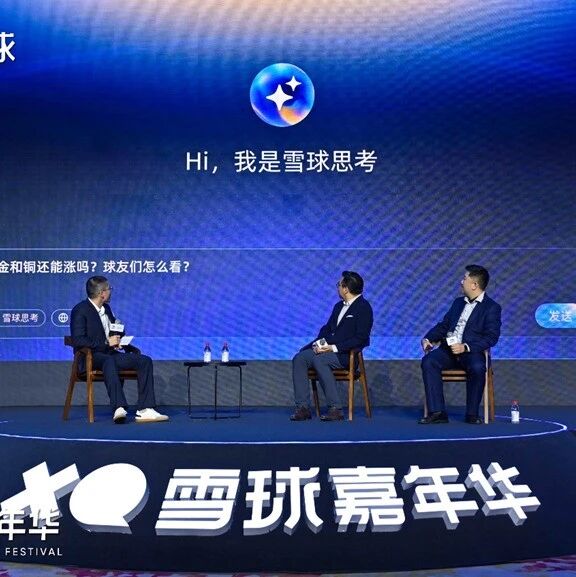
从这些关键词中寻找确定性:科技、长期主义、多元配置|2025雪球嘉年华
中国基金报· 2025-12-25 13:47
Core Insights - The 2025 Xueqiu Carnival held in Shanghai focused on macroeconomic outlook, industry investment opportunities, and asset allocation strategies, emphasizing "long-termism" and "asset allocation" as key themes for investors preparing for 2026 [2][4][11] Macroeconomic Trends - China's economic positioning and potential were highlighted, with ICBC International's chief economist Cheng Shi noting that China's economic advantages are systemic and comprehensive, acting as a "fast variable" and "stabilizer" in the global economy. He emphasized that Chinese assets are entering a value reassessment phase [4][6] - Cheng summarized two core viewpoints: the ongoing "East rises, West declines" trend in global asset allocation and the importance of integrating investments in both material and human capital to grasp future investment opportunities [4][6] Investment Strategies - Liu Gang from CICC pointed out that the Chinese market's excess liquidity continues to chase "scarce return assets." He noted that 2025 will exhibit many counterintuitive market characteristics, including diverse asset performance and significant asset rotation, particularly in Hong Kong stocks [6][11] - Liu suggested that credit expansion is a key explanatory factor for current market phenomena and provided guidance for 2026 investment directions, recommending alignment with credit expansion trends [6][11] Thematic Investments - The rise of quantitative strategies and index funds, especially ETFs, was emphasized as crucial for investors to build portfolios and achieve returns. The ETF market in China is expected to enter a golden development period over the next decade [11][33] - The focus on AI and dividend sectors for 2026 was recommended as a complementary strategy [7][11] Sector-Specific Insights - The technology and pharmaceutical sectors were highlighted as key areas of interest, with AI driving significant changes. The pharmaceutical industry is expected to see innovations, particularly in drug development processes [22][23][24] - The semiconductor industry remains a focal point, with ongoing demand driven by AI applications and the need for advanced chips. The investment logic in this sector is expected to continue evolving [28][30] Market Dynamics - The discussion around AI's impact on various sectors, including the potential for human-like robots to enter a critical industrialization phase by 2026, was prevalent. The anticipated growth in robot production and application scenarios was noted as a significant investment opportunity [30][31] - The importance of understanding market cycles and constructing risk-aware portfolios was emphasized, with strategies focusing on both undervalued assets and sectors with high certainty of returns [38][39]