极氪

Search documents
“京东新车”预计定价在10万至12万之间,为广汽埃安换电车型;多款新车订单火爆超预期,极氪或面临供应链压力丨汽车交通日报
创业邦· 2025-10-15 11:00
Group 1 - The core viewpoint of the article highlights significant developments in the automotive industry, including new vehicle launches, investment plans, and sales growth in electric vehicles [2][4]. Group 2 - "JD New Car" is expected to be priced between 100,000 to 120,000 yuan, a collaboration between JD Auto, CATL's Times Electric, and GAC Group for a battery-swapping model [2]. - Zeekr's new model, Zeekr 001, has seen explosive order growth, surpassing 10,000 units, leading to potential supply chain pressures, particularly in battery supply [2]. - Hyundai Motor's Indian subsidiary plans to invest 450 billion rupees by the fiscal year 2030 to strengthen its market position, focusing on electric and luxury vehicles [2]. - Global sales of pure electric and plug-in hybrid vehicles surged by 26% in September, reaching a record 2.1 million units, driven by strong demand in China and a pre-tax credit rush in the U.S. [4].


东兴证券晨报-20251015
Dongxing Securities· 2025-10-15 09:31
Economic News - The Minister of Industry and Information Technology of China met with Apple's CEO to discuss Apple's business development in China and cooperation in the electronic information sector, emphasizing China's commitment to high-level opening-up and creating a favorable business environment for foreign companies [2] - In September 2025, China's CPI decreased by 0.3% year-on-year, primarily due to a drop in food prices, which fell by 4.4%, impacting CPI significantly [2] - The Bay Area Semiconductor Industry Ecological Expo showcased new domestic EDA design software with a 30% performance improvement over industry benchmarks and a 40% reduction in hardware development cycle [2] - A new high-precision, scalable analog matrix computing chip was developed, achieving a computational throughput and energy efficiency improvement of 100 to 1000 times over current top digital processors [2] - China's oil drilling has reached depths exceeding 10,000 meters, marking a significant advancement in deep earth energy exploration [2] - JD.com announced a collaboration with CATL and GAC Group to develop a new vehicle, leveraging JD's data and channel advantages [2] - SenseTime and Cambricon signed a strategic cooperation agreement to enhance AI infrastructure and explore international markets [2] - Global smartphone shipments increased by 3% in Q3 2025, with Samsung leading the market with a 19% share, followed by Apple at 18% [3] Company Insights - The banking sector has seen a positive relative return after adjustments, with the Shenwan Banking Index rising by 0.28% [5] - The banking sector's PB valuation stands at 0.67x, indicating a favorable position compared to historical levels [5] - Key banks such as Qilu Bank and Agricultural Bank of China reported significant stock price increases, reflecting market confidence [5] - The banking sector is expected to benefit from upcoming mid-term dividends, enhancing the attractiveness of bank stocks for long-term investors [6] - The net interest income for banks is projected to improve, with a stabilization of net interest margins anticipated in Q3 [6] - The average dividend yield for listed banks has increased to 4.4%, making them more appealing to long-term investors [7] - The report suggests a focus on quality mid-sized banks with performance potential and state-owned banks with stable profitability for long-term investments [8] Industry Analysis - The report highlights the importance of the rocket engine components and testing services in the commercial space industry, particularly referencing SpaceX's Falcon 1 rocket development [10] - The Merlin 1A engine is identified as a critical component, with the combustion chamber being a key area of focus for material and manufacturing technology [10] - The report emphasizes the significance of extensive testing in achieving high success rates for rocket launches, with SpaceX achieving a 97.76% success rate [14] - Investment opportunities are identified in companies supplying rocket engine components and those providing testing services for commercial rockets [15]





从无图到轻图,大模型时代图商的新角逐
自动驾驶之心· 2025-10-15 02:05
Core Insights - The article discusses the evolution of intelligent driving maps, highlighting the transition from high-precision maps to lightweight maps in response to the growing demand for advanced driver-assistance systems (ADAS) [4][5][12]. Group 1: Evolution of Intelligent Driving Maps - The development of intelligent driving maps has gone through three stages: the sweet period of high-precision maps (2018-2021), the aggressive phase of "no map driving" post-2021, and the current rational phase focusing on lightweight maps as of 2024 [7][9][12]. - The shift to lightweight maps is driven by the need for safety, continuity, and comfort in driving experiences, as traditional high-precision maps are not feasible for widespread use across various terrains [10][12][15]. Group 2: Market Dynamics and Competition - Tencent has emerged as a leader in the intelligent driving map market, holding a 49.01% market share in the urban NOA intelligent driving map segment for new energy passenger vehicles, while Gaode follows closely with 47.9% [5][18]. - The market for intelligent driving maps is expected to grow significantly, with projections estimating it will reach 5.4 billion yuan by 2025 and 11.7 billion yuan by 2030 [27]. Group 3: Technological Innovations - Tencent's transition to lightweight high-precision maps (HD Air) began in 2022, allowing for faster updates and lower costs, which has positioned it favorably against traditional map providers [19][20]. - The introduction of cloud services for map data delivery enhances the flexibility and responsiveness of map updates, allowing for real-time adjustments based on driving conditions [22][24]. Group 4: Future Trends - The integration of AI large models is expected to further transform the landscape of intelligent driving maps, moving beyond traditional databases to models that incorporate geographical and environmental data [29][31]. - The competition in the intelligent driving map sector is ongoing, with companies needing to adapt to new paradigms to maintain or gain market share [26][31].


AI落地再掀“云战争”火山引擎瞄准MaaS赛道
Shang Hai Zheng Quan Bao· 2025-10-14 18:30
Core Insights - The cloud service industry is experiencing intense competition, referred to as the "cloud war," with various companies focusing on different aspects of the market [1] - ByteDance's Volcano Engine is strategically targeting the enterprise-level MaaS (Model as a Service) sector, emphasizing specific business scenarios [1][2] - The collaboration between Volcano Engine and companies like Seres and Zeekr highlights the growing demand for intelligent data solutions in the automotive industry [1] Group 1: Market Dynamics - The cloud service landscape includes IaaS, PaaS, and MaaS, with each serving different needs, akin to different types of housing [1] - By 2025, the total call volume of public cloud services for large models in China is projected to reach 536.7 trillion tokens, with Volcano Engine's MaaS platform capturing a market share of 49.2% [2] - The focus of Volcano Engine is on selling tokens rather than computing power, which is a strategic differentiation from other cloud service providers [2] Group 2: Future Growth Potential - The generative AI software market in China is expected to reach a scale of 48.24 billion yuan by 2028, indicating significant growth potential [3] - Both C-end and B-end markets present vast opportunities for expansion, with multimodal models and agent applications identified as key growth drivers [3]
AI落地再掀“云战争” 火山引擎瞄准MaaS赛道
Shang Hai Zheng Quan Bao· 2025-10-14 18:21
Core Insights - The cloud service industry is experiencing intense competition, with major players like ByteDance's Volcano Engine and Alibaba Cloud focusing on different aspects of the market [1][2] - ByteDance's Volcano Engine is strategically targeting the enterprise-level MaaS (Model as a Service) sector, emphasizing specific business scenarios [1][2] - The collaboration between Volcano Engine and various automotive companies highlights the growing demand for digital transformation in the automotive industry [1] Summary by Sections Industry Competition - The cloud service market is characterized by a "cloud war," with different companies adopting unique strategies to capture market share [1] - Major cloud service models include IaaS, PaaS, and MaaS, with each serving different customer needs [1] Company Strategies - ByteDance's Volcano Engine focuses on providing a superior user experience through its MaaS offerings, contrasting with Alibaba Cloud's broader service model [2] - The market share of Volcano Engine's Ark (MaaS) platform reached 49.2% in the first half of 2025, indicating its strong position in the market [2] Market Potential - IDC forecasts that the generative AI software market in China will reach 48.24 billion yuan by 2028, suggesting significant growth potential in both consumer and business sectors [3]
新能源汽车购置税明年退坡 车企及消费者抢搭红利“末班车”
Zheng Quan Shi Bao· 2025-10-14 17:34
Core Viewpoint - The transition from a full exemption of vehicle purchase tax to a 50% reduction starting January 1, 2026, marks a significant shift in China's new energy vehicle (NEV) market, impacting consumer purchasing decisions and costs [1][2][3] Policy Changes - The new policy requires NEVs to meet specific technical standards to qualify for tax exemptions, emphasizing battery capacity and hybrid system upgrades [2][3] - The maximum tax exemption for NEVs will decrease from 30,000 yuan to 15,000 yuan, with a reduction in the exemption rate from 60% to 30% for vehicles priced at 500,000 yuan [3] Market Dynamics - Automakers are accelerating new model launches to capitalize on the remaining tax benefits, with over 70 new models introduced in September [4] - The market is experiencing a surge in demand for NEVs, with retail sales reaching 1.296 million units in September, a year-on-year increase of 15.5% [5] Competitive Landscape - The focus of competition is shifting towards technology, brand, service, and user experience, indicating a longer-term quality competition in the NEV sector [1][2] - Companies are adopting strategies such as tax difference subsidies to mitigate the impact of the tax changes on consumer purchasing decisions [6] Consumer Behavior - Consumers are increasingly aware of the impending tax cost increases, leading to a rush in orders during the last months of the tax exemption period [7] - The market is witnessing a differentiation in promotional strategies, with NEVs focusing on "new car benefits" while traditional fuel vehicles are offering significant cash discounts [7][8] Industry Outlook - The gradual exit of tax incentives is seen as a necessary evolution for the NEV industry, pushing it towards maturity and self-sustainability [3][8] - Future market success will depend on the true product strength, cost control, and adaptability of automakers [9]
沈方俊加盟极氪出任公关总监
Zhong Guo Qi Che Bao Wang· 2025-10-14 06:52
10月13日消息,前阿里系的沈方俊已加盟极氪,担任极氪公关总监一职。沈方俊今年5月离开淘宝 公关部,此前去向未明。在加入阿里之前,他曾担任海尔集团新媒体总监,还是中国企业蓝V联盟发起 人。在阿里任职期间,他主导策划了"中国锦鲤""淘宝直播间卖火箭卫星"等多个知名案例。此次沈方俊 加盟极氪,有望凭借其丰富的经验,为极氪的公关工作带来新的思路和活力,助力极氪在市场竞争中取 得更好的成绩。 ...
BBA在华销量失守 加速布局纯电赛道
2 1 Shi Ji Jing Ji Bao Dao· 2025-10-13 23:17
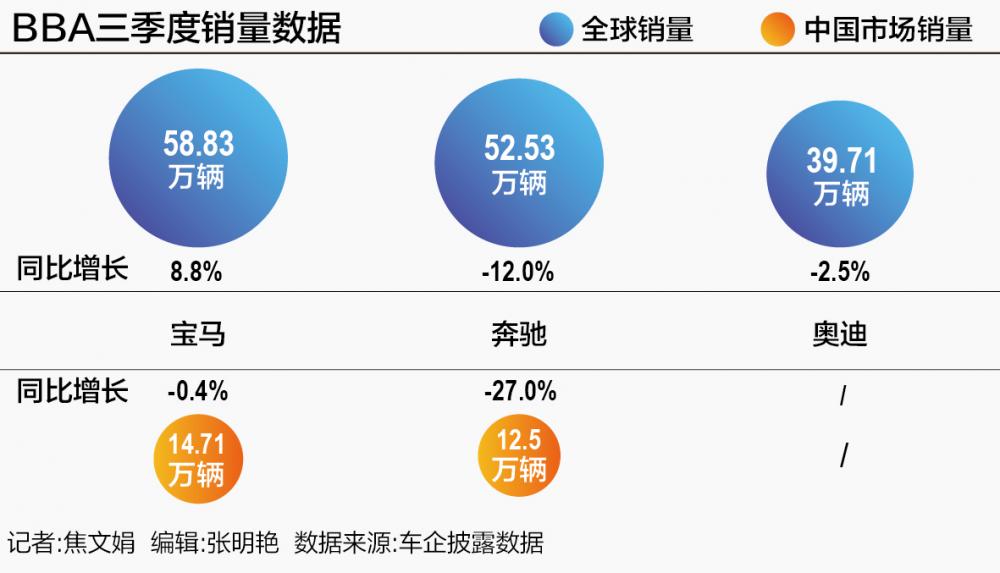
Group 1: Market Dynamics - The luxury car market is undergoing a significant adjustment, with BBA (BMW, Mercedes-Benz, Audi) showing a differentiated trend: BMW is leading, Mercedes-Benz is under pressure, and Audi is catching up [1] - BMW is the only company among BBA to achieve positive sales growth, with global deliveries reaching 588,300 units in Q3, up 8.8% year-on-year, and a total of 1,795,900 units in the first three quarters, up 2.4% [1] - In contrast, Mercedes-Benz's Q3 global sales fell to 525,300 units, down 12% year-on-year, with a total of 1,601,600 units in the first three quarters, down 9% [1][3] - Audi's Q3 global sales were 397,100 units, a decrease of 2.5%, with a total of 1,191,100 units in the first three quarters, down 4.8% [1] Group 2: Challenges in the Chinese Market - The Chinese market poses a significant challenge for BBA, with BMW's Q3 deliveries in China slightly declining by 0.4% to 147,100 units, and a cumulative drop of 11.2% to 464,000 units in the first three quarters [3] - Mercedes-Benz faced a more severe decline, with Q3 deliveries in China plummeting 27% to 125,000 units, and a total drop of 18% to 418,000 units in the first three quarters [3] - Audi's sales in China showed signs of recovery, with its joint venture reporting a 13.5% increase in sales to 58,000 units in the first three quarters [3] Group 3: Pricing and Competitive Pressure - The pricing structure of BBA is under pressure, particularly in the 200,000 to 400,000 RMB price range, where local brands are challenging entry-level models [4] - In the 200,000 to 300,000 RMB segment, brands like Zeekr and Tesla are eroding BBA's market share with better performance and value [4] - BMW has revised its profit forecast for 2025, expecting a pre-tax profit "slightly below" last year's 10.97 billion euros (approximately 90.98 billion RMB) due to increased tariff costs and support for local dealers [4][5] Group 4: Electrification Strategies - BBA's electrification strategies are diverging, with BMW leading, Mercedes-Benz aggressively pushing forward, and Audi taking a more pragmatic approach [6] - BMW's electric vehicle sales reached 323,000 units in the first three quarters, up 10% year-on-year [7] - Mercedes-Benz is launching a significant product offensive, with plans to introduce at least 40 new models by the end of 2027, including the new electric GLC targeting the Chinese luxury electric SUV market [8] - Audi is adjusting its electric strategy, focusing on a balanced approach between long-term electric goals and flexible product offerings, with new models like the Q6L e-tron [9] Group 5: Current Market Trends - The hybrid market remains a crucial support for BBA, with BMW's hybrid vehicle sales growing 8% to 152,000 units in Q3 [9] - The pure electric market is outpacing hybrids in China, with a year-on-year growth of 32.4% in September, indicating a shift in consumer preference [9] - As BBA collectively intensifies its focus on electric products, a competitive battle for market share in the future landscape is unfolding in China [9]
BBA失守中国市场,奔驰三季度交付量大跌27%
21世纪经济报道· 2025-10-13 14:21
Core Viewpoint - The luxury car market is undergoing a significant adjustment, with BBA (BMW, Mercedes-Benz, Audi) showing a differentiated performance: BMW is leading, Mercedes-Benz is under pressure, and Audi is catching up [1]. Group 1: Sales Performance - BMW is the only company among BBA to achieve positive sales growth, with global deliveries reaching 588,300 units in Q3, a year-on-year increase of 8.8%, and a total of 1,795,900 units for the first three quarters, up 2.4% [1]. - Mercedes-Benz's Q3 global sales were 525,300 units, down 12% year-on-year and 4% quarter-on-quarter, with a total of 1,601,600 units for the first three quarters, a decrease of 9% [1]. - Audi's Q3 global sales were 397,100 units, a decline of 2.5% year-on-year, with a total of 1,191,100 units for the first three quarters, down 4.8% [1]. Group 2: Market Challenges - The Chinese market has become a common challenge for BBA, with BMW's Q3 deliveries in China slightly decreasing by 0.4% to 147,100 units, and a cumulative decline of 11.2% to 464,900 units for the first three quarters [3][4]. - Mercedes-Benz faced a significant drop in China, with Q3 deliveries plummeting 27% to 125,000 units and a total decline of 18% to 418,000 units for the first three quarters, marking it as the largest market decline for the brand [5]. - Audi's sales in China showed signs of recovery through its joint ventures, with a 13.5% increase in sales for the first three quarters [5]. Group 3: Pricing and Competition - The pricing structure of BBA is under pressure, particularly in the 200,000 to 400,000 RMB price range, where domestic brands are challenging BBA's entry-level models [6]. - In the 200,000 to 300,000 RMB segment, brands like Zeekr and Tesla are offering better performance or value, while in the higher segments, NIO and Li Auto are competing for core customers [6]. - BMW has adjusted its profit forecast for 2025, expecting a pre-tax profit "slightly lower" than last year's 10.97 billion euros (approximately 90.98 billion RMB) due to higher-than-expected tariff costs and financial support for local dealers [6]. Group 4: Electrification Strategies - BBA's electrification paths are diverging, with BMW leading, Mercedes-Benz aggressively pushing, and Audi taking a pragmatic approach [8]. - BMW's electric vehicle deliveries reached 323,000 units in the first three quarters, a year-on-year increase of 10% [8]. - Mercedes-Benz is launching a major product offensive with its new electric GLC targeting the luxury electric SUV market in China, while also building a cooperative ecosystem for intelligent driving [8][9]. - Audi is adjusting its electric strategy, focusing on a balanced approach between long-term electric goals and flexible product offerings, with plans for new electric models [11]. Group 5: Market Trends - The hybrid market remains a crucial support, with BMW's hybrid vehicle sales increasing by 8% to 152,000 units in Q3, while Mercedes-Benz delivered 96,000 hybrid vehicles, up 10% [8]. - The pure electric market is growing rapidly, with a year-on-year increase of 32.4% in September, surpassing hybrid and extended-range vehicles [8].

从技术狂欢到企业落地,智能编程的全球破局战
AI前线· 2025-10-13 13:54
Core Insights - The article emphasizes that intelligent programming is rapidly evolving from simple code completion to an era of AI autonomous development, driven by advancements in technology and changing industry dynamics [2][5][10]. Industry Overview - Historically, the "development tools" sector has not been among the most profitable in the software industry, but this is changing as 60% of global developers now utilize AI to build tools [3][10]. - The shift towards intelligent programming is marked by a transition from basic functionalities to complex software development needs, with companies like Alibaba leading the charge [5][10]. Technological Advancements - Intelligent programming is moving beyond code completion to address real software construction challenges, focusing on three core capabilities: deepening value-driven scenarios, achieving productivity transformation through Spec-driven development, and enhancing context engineering [5][6][7][9]. - Alibaba's Qoder emphasizes the importance of engineering knowledge and code documentation, which are critical for effective collaboration and knowledge sharing among developers [6]. Productivity Transformation - The transition to AI autonomous programming allows developers to delegate tasks to AI, significantly increasing productivity—up to 10 times—by enabling AI to work independently for extended periods [7][8]. - Developers can now manage multiple tasks simultaneously, akin to leading an AI development team, which enhances overall efficiency [8]. Context Engineering - As software systems grow in complexity, the ability of AI to accurately understand context becomes crucial. Alibaba's approach combines vectorized retrieval and memory extraction to improve context processing capabilities [9][10]. - This context engineering is particularly vital in complex scenarios, such as modifying legacy systems, where understanding historical code and business rules is essential [9]. Market Dynamics - The penetration of intelligent programming tools is accelerating, with a notable difference in usage depth among developers. Some utilize AI for simple tasks, while others have achieved full-scale autonomous development [10]. - The future of intelligent programming is envisioned as a connector between the digital and physical worlds, facilitating code generation for smart devices and applications [10][22]. Enterprise Implementation Challenges - Despite the potential of intelligent programming, enterprises face challenges such as adapting to complex scenarios, ensuring security compliance, and improving knowledge transfer and asset reuse [11][14]. - Companies are encouraged to create clear engineering specifications and documentation to enhance AI's understanding of historical assets and business logic [15]. Case Studies - Successful implementations, such as that of China Pacific Insurance, demonstrate significant productivity gains through intelligent programming tools, with code generation rates reaching 41.26% [12]. - Hisense Group's comprehensive evaluation of AI coding tools highlights the importance of balancing cost, quality, and security in tool selection [13]. Competitive Landscape - Domestic AI programming tools are increasingly competitive with international counterparts, with Alibaba's Qwen3-Coder model surpassing others in capabilities [16][17]. - The strategy of combining model development with data advantages and ecosystem collaboration is crucial for domestic firms to thrive in the global market [17][19]. Future Outlook - The demand for intelligent programming is evolving from a mere efficiency tool to a vital partner in productivity, reflecting a deeper desire for digital transformation within enterprises [21]. - The ultimate goal of intelligent programming is to eliminate barriers to innovation, positioning code production as a catalyst for business growth [22].