泸州老窖

Search documents
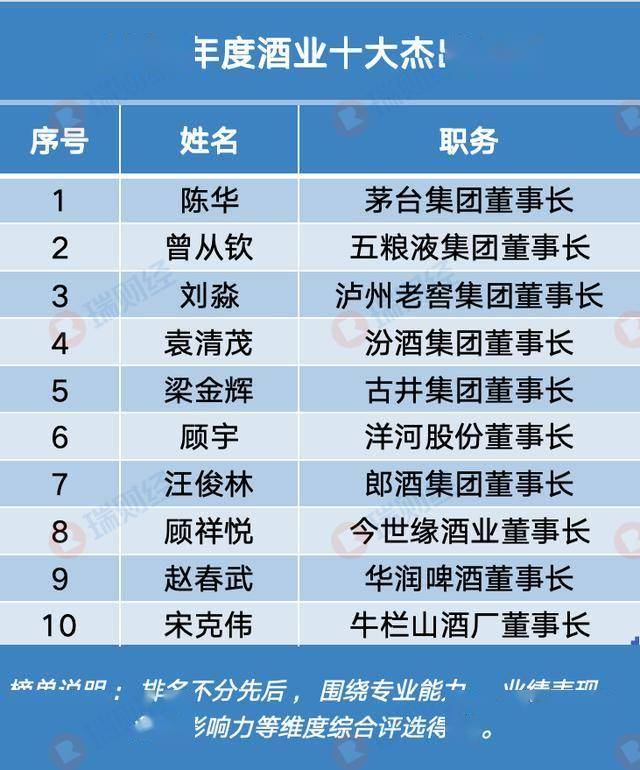
古井集团董事长梁金辉入选“2025年度酒业十大杰出人物”
Sou Hu Cai Jing· 2026-01-16 02:10
Group 1 - The "Top Ten Outstanding Figures in the Liquor Industry for 2025" list was announced by Rui Finance, with Liang Jinhui, Chairman of Gujing Group, being selected [2] - The selection criteria for the list included professional ability, performance, and industry influence [2] - Liang Jinhui has a background in business management and has held various leadership positions within Gujing Group, contributing to its growth and innovation [3] Group 2 - In 2025, under Liang Jinhui's leadership, the group aims to achieve breakthroughs in product innovation, flexible channel strategies, and deeper international expansion [3]


泸州老窖等新设投资合伙企业,出资额3.83亿
Sou Hu Cai Jing· 2026-01-16 01:50
Group 1 - Shenzhen Jin Jun Run Wan No. 2 Investment Partnership (Limited Partnership) was recently established with a registered capital of 383 million yuan [1][2] - The business scope includes investment activities with self-owned funds, enterprise management, enterprise management consulting, and financial consulting [1][2] - The partnership is co-funded by Sichuan Jin Jue Investment Co., Ltd., a subsidiary of Luzhou Laojiao Group Co., Ltd. [1] Group 2 - The executing partner is Jin Hui Hong Hu (Shenzhen) Enterprise Management Co., Ltd., and the company is currently in a state of existence [2][4] - The partnership is classified under the national standard industry of investment and asset management (L7212) [2] - The registered office is located in Nanshan District, Shenzhen, Guangdong Province [2]

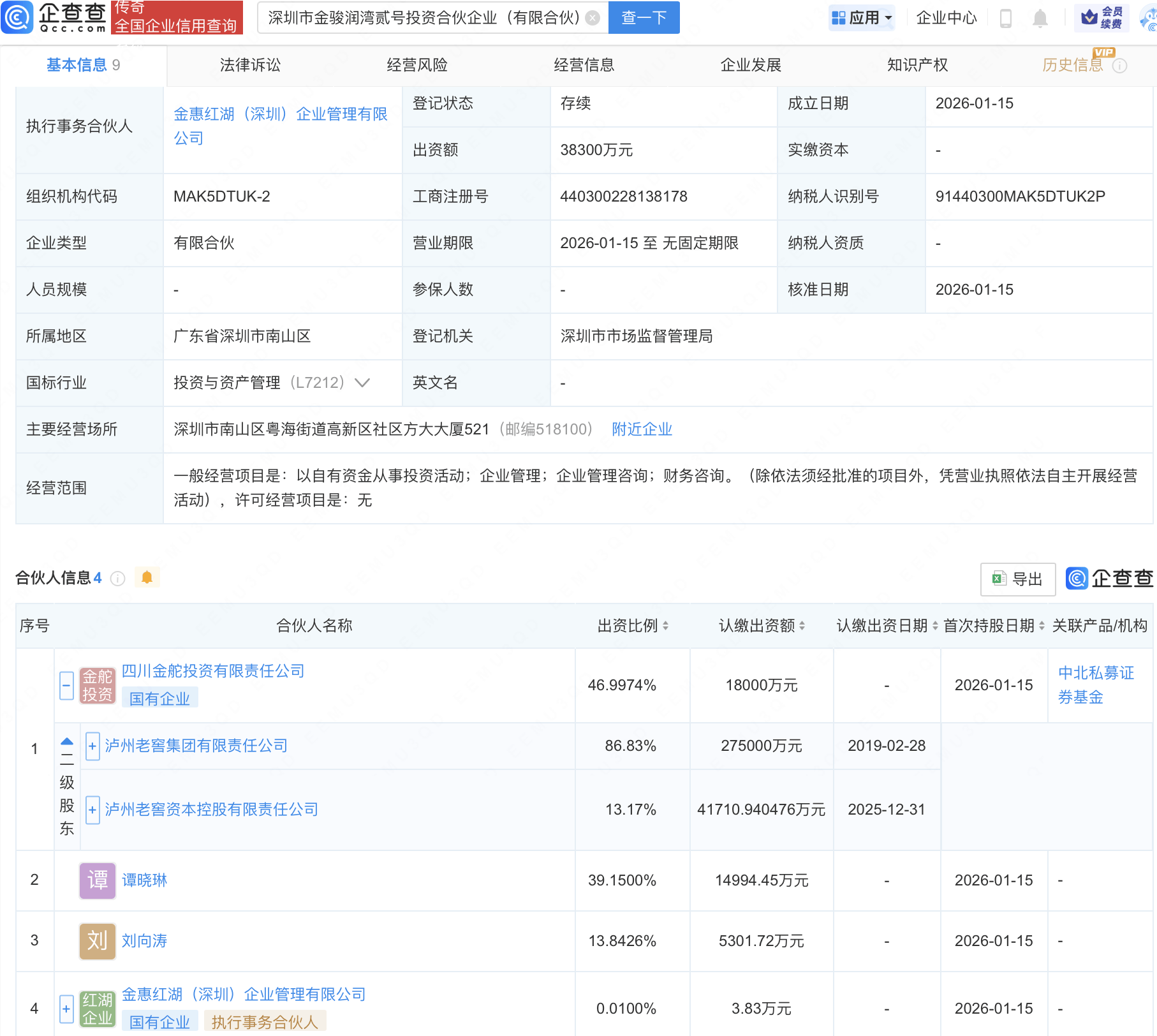
酒价内参1月16日价格发布 青花汾20上涨5元
Xin Lang Cai Jing· 2026-01-16 01:24
Core Insights - The core viewpoint of the article highlights a significant decline in the retail prices of major Chinese liquor brands, indicating ongoing inventory adjustments within the industry [1][7]. Price Trends - The average retail price of the top ten liquor products in China fell to 8,895 yuan on January 16, a decrease of 46 yuan from the previous day, marking the lowest price level in nearly two months [1][7]. - Among the ten products, seven experienced price drops while three saw increases, with key products collectively contributing to the decline in average prices [1][7]. Specific Product Price Changes - Leading the price declines were Qinghua Lang and Xijiu Junpin, which fell by 12 yuan and 11 yuan per bottle, respectively [1][7]. - Wuliangye Pu Wu Eight Generation decreased by 8 yuan, while Feitian Moutai dropped by 7 yuan, influenced by the iMoutai platform's pricing strategies and inventory adjustments [1][7]. - Other notable declines included Yanghe Dream Blue M6+ and Guojiao 1573, which fell by 6 yuan and 5 yuan, respectively [1][7]. - In contrast, Qinghua Fen 20 saw an increase of 5 yuan, while Gujing Gonggu 20 and Shuijing Jian Nan Chun rose by 1 yuan each [1][7]. Market Dynamics - The decline in prices is attributed to differentiated consumer demand and price adjustments by leading brands, reflecting the ongoing inventory reduction process in the liquor industry [1][7]. - The iMoutai platform's recent sales of Moutai products at competitive prices have had a magnetic effect on the market, contributing to the observed price changes [2][8]. Sales and Marketing Strategies - Moutai has been leveraging digital marketing through the iMoutai platform, which has seen significant engagement, including the rapid sell-out of new product releases [3][9]. - The platform's popularity surged, reaching the top of the Apple App Store's shopping category, with over 2.7 million new users added within nine days of launching a new product [3][9]. - Moutai's board has approved a market-oriented operational strategy, enhancing its sales model to include a dynamic pricing adjustment mechanism based on market conditions [3][9].




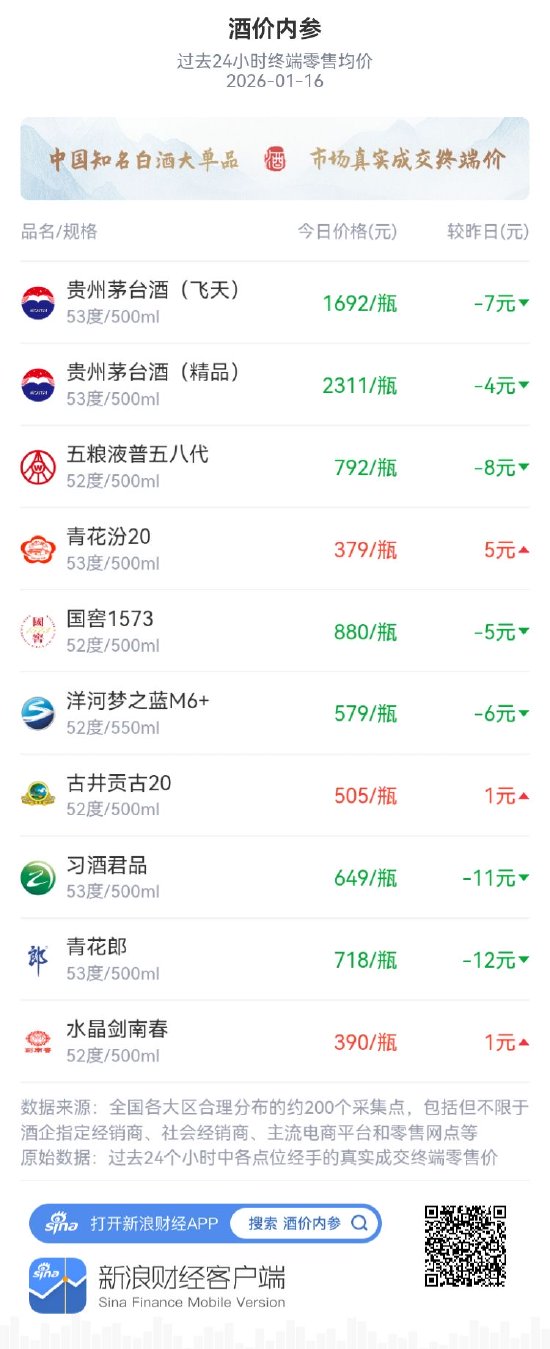
酒价内参1月14日价格发布 市场普跌回调价格中枢下探
Xin Lang Cai Jing· 2026-01-16 01:21
Core Viewpoint - The Chinese liquor market, particularly for the top ten baijiu products, has experienced a general price adjustment, with a moderate decline in retail prices as of January 14, indicating cautious market sentiment [1]. Price Trends - The total retail price for a package of the top ten baijiu products is 8925 yuan, down 44 yuan from the previous day [1]. - Eight out of the ten products have seen price declines, reflecting a bearish market trend [1]. - The leading product, Feitian Moutai, has decreased by 9 yuan per bottle, while other notable declines include Gujing Gonggu and Qinghua Lang, both down 8 yuan per bottle [1][2]. Individual Product Pricing - Feitian Moutai (53 degrees, 500ml) is priced at 1692 yuan, down 7 yuan [2]. - The premium Moutai variant is significantly down by 470 yuan, now at 2311 yuan [2]. - Wuliangye (Pu Wu 8th generation, 52 degrees, 500ml) is priced at 792 yuan, down 8 yuan [2]. - Other products like Guojiao 1573 and Yanghe Dream Blue M6+ have also seen minor declines of 5 yuan and 6 yuan respectively [2][3]. Market Dynamics - The market is characterized by a general decline in prices, with only Wuliangye showing a slight increase of 1 yuan, while Qinghua Fen remains stable [1]. - The overall market sentiment appears cautious, with a narrowing of trading volumes and a clear differentiation in product performance [1].
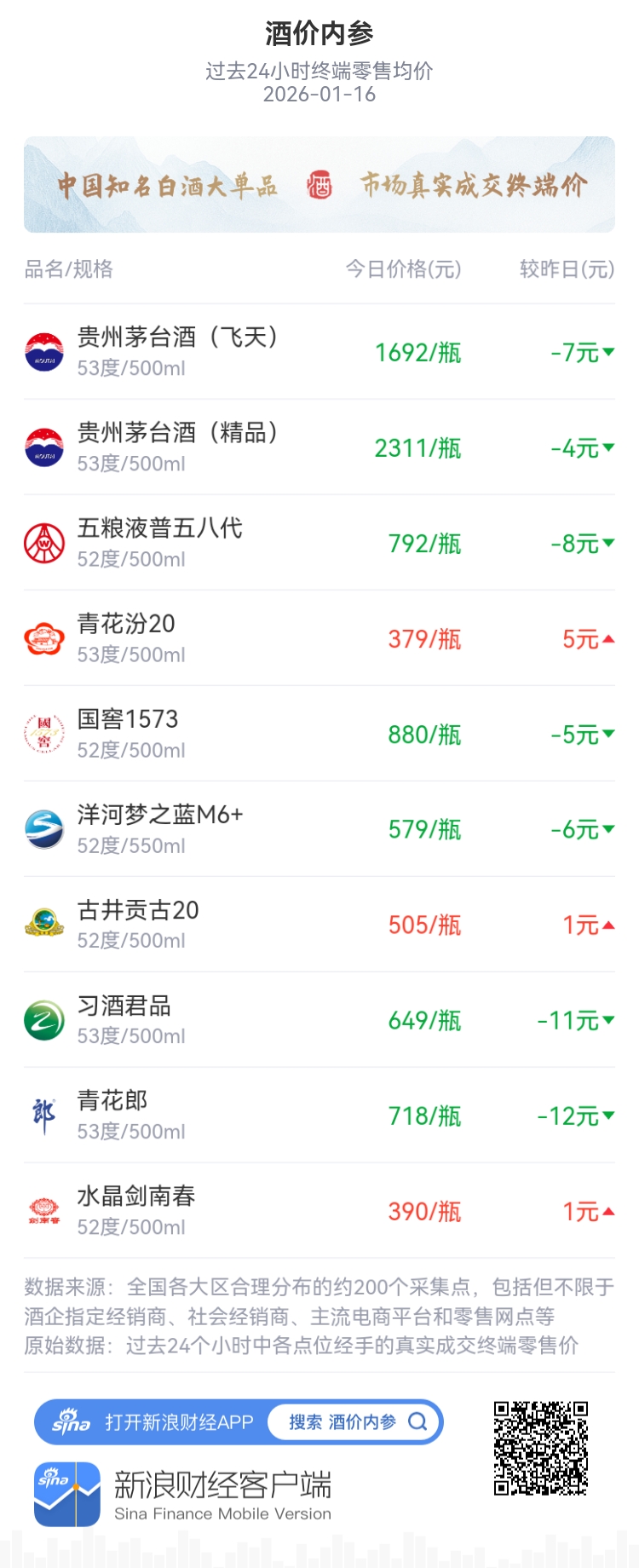
酒价内参1月16日价格发布 习酒君品下跌11元
Xin Lang Cai Jing· 2026-01-16 01:19
Core Insights - The article highlights a significant decline in the retail prices of major Chinese liquor brands, indicating a continued inventory adjustment process within the industry [1][7]. Price Trends - The average retail price of the top ten liquor products fell to 8,895 yuan on January 16, a decrease of 46 yuan from the previous day, marking the lowest price level in nearly two months [1][7]. - Out of the top ten products, seven experienced price drops while three saw increases, with key products collectively contributing to the decline in average prices [1][7]. Specific Price Changes - Major price declines were observed in products such as: - Qinghua Lang and Xijiu Junpin, both dropping over 12 yuan per bottle [1][7]. - Wuliangye Pu Wu Ba Dai decreased by 8 yuan per bottle [1][7]. - Feitian Moutai fell by 7 yuan per bottle, influenced by the iMoutai platform's pricing strategy [1][7]. - In contrast, Qinghua Fen 20 saw an increase of 5 yuan per bottle, while Gujing Gong Gu 20 and Shuijing Jian Nan Chun rose by 1 yuan each [1][7]. Data Collection Methodology - The "Liquor Price Reference" collects data from approximately 200 sampling points across various regions, including designated distributors and retail outlets, to provide an objective and traceable market price for well-known liquors [2][8]. Market Dynamics - The launch of new products on the iMoutai platform, including the 1,499 yuan Feitian Moutai and the 2,299 yuan premium Moutai, has begun to exert a magnetic influence on the market prices of these products [2][8]. - The iMoutai platform has seen a surge in popularity, reaching the top of the Apple App Store's shopping category, with over 2.7 million new users added within nine days of launching the 2026 Feitian Moutai [3][9]. Company Strategy - Moutai is advancing its market-oriented operations through digital marketing, with a new sales model that includes a dynamic pricing adjustment mechanism based on market conditions [3][9]. - As of 2024, Moutai's direct sales channel revenue has reached 43.87% of total revenue, reflecting a strategic shift towards a more collaborative sales approach [3][9].
泸州老窖等新设投资合伙企业
Zheng Quan Shi Bao Wang· 2026-01-16 01:08
人民财讯1月16日电,企查查APP显示,近日,深圳市金骏润湾贰号投资合伙企业(有限合伙)成立,出资 额3.83亿元,经营范围包含:以自有资金从事投资活动;企业管理;企业管理咨询;财务咨询。企查查 股权穿透显示,该企业由泸州老窖(000568)集团有限责任公司旗下四川金舵投资有限责任公司等共同 出资。 ...
茅台价格“松动”掀起连锁降价潮?酒商坦言:行业大洗牌在即
Nan Fang Du Shi Bao· 2026-01-15 11:45
Core Viewpoint - The white liquor market is experiencing unexpected price declines instead of the anticipated seasonal increase, driven by price adjustments of benchmark products like Feitian Moutai, leading to a widespread price reduction across various brands and price segments [1][13]. Price Trends - In major cities like Guangzhou, Shenzhen, Foshan, and Dongguan, the average retail prices of high-end white liquors have generally decreased, with many premium products, especially sauce-flavored liquors, seeing significant price drops [1][11]. - In Guangzhou, the average price of sauce-flavored liquors has fallen sharply, with products like Junpin Xijiu dropping from approximately 731 yuan to around 698 yuan [2][3]. - The average retail price of Feitian Moutai in Shenzhen is reported at 1734.21 yuan, with some channels offering it as low as 1699 yuan [5][6]. Market Dynamics - The price adjustments are attributed to high inventory pressures and a shift towards "price for volume" strategies among distributors, indicating a challenging market environment for the white liquor industry [1][13]. - The introduction of the "i Moutai" platform has intensified competition, causing price fluctuations across the market, particularly affecting products in the 1000 yuan price range [2][7]. Regional Insights - In Shenzhen, high-end products like the eighth-generation Wuliangye have seen a price drop of approximately 39 yuan, while Junpin Xijiu's price has decreased by 22 yuan [5][6]. - In Dongguan, 13 out of 16 comparable high-end liquors have experienced price declines, with the eighth-generation Wuliangye averaging 884.43 yuan, down 20.57 yuan [11][12]. Future Outlook - The current price reductions reflect a lack of market momentum and high inventory levels, with many distributors indicating that clearing stock remains a primary focus [1][13]. - As the Spring Festival approaches, the ability of white liquor prices to stabilize will be a key indicator of the industry's recovery trajectory, with companies demonstrating brand resilience and channel control likely to emerge stronger from this market adjustment [13].
1月15日深证国企ESG(970055)指数涨0.27%,成份股中钨高新(000657)领涨
Sou Hu Cai Jing· 2026-01-15 10:39
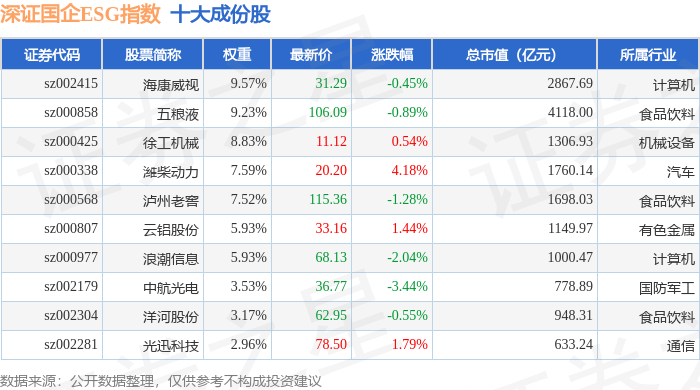
Core Viewpoint - The Shenzhen State-owned Enterprise ESG Index (970055) closed at 1472.43 points, up 0.27%, with a trading volume of 49.598 billion yuan and a turnover rate of 1.79% [1] Group 1: Index Performance - On the day, 23 constituent stocks rose, with Zhongtung High-tech leading with a 5.52% increase, while 25 stocks fell, with Taisen Wind Power leading the decline at 6.2% [1] - The index's constituent stocks experienced a net outflow of 1.149 billion yuan from major funds, while retail investors saw a net inflow of 1.065 billion yuan [1] Group 2: Top Constituents - The top ten constituents of the Shenzhen State-owned Enterprise ESG Index include: - Hikvision (sz002415) with a weight of 9.57%, latest price at 31.29 yuan, down 0.45% [1] - Wuliangye (sz000858) with a weight of 9.23%, latest price at 106.09 yuan, down 0.89% [1] - Xugong Machinery (sz000425) with a weight of 8.83%, latest price at 11.12 yuan, up 0.54% [1] - Weichai Power (sz000338) with a weight of 7.59%, latest price at 20.20 yuan, up 4.18% [1] - Luzhou Laojiao (sz000568) with a weight of 7.52%, latest price at 115.36 yuan, down 1.28% [1] - Yun Aluminum (sz000807) with a weight of 5.93%, latest price at 33.16 yuan, up 1.44% [1] - Inspur Information (sz000977) with a weight of 5.93%, latest price at 68.13 yuan, down 2.04% [1] - AVIC Optoelectronics (sz002179) with a weight of 3.53%, latest price at 36.77 yuan, down 3.44% [1] - Yanghe Distillery (sz002304) with a weight of 3.17%, latest price at 62.95 yuan, down 0.55% [1] - Guangxun Technology (sz002281) with a weight of 2.96%, latest price at 78.50 yuan, up 1.79% [1] Group 3: Fund Flow Details - Major funds saw significant inflows in stocks such as: - Deep Technology (000021) with a net inflow of 503 million yuan [2] - Weichai Power (000338) with a net inflow of 1.12 million yuan [2] - Zhongtung High-tech (000657) with a net inflow of 95.263 million yuan [2] - Conversely, stocks like Yun Aluminum (000807) and Xugong Machinery (000425) experienced net outflows from major funds [2]




茅台定价改革的信号!高盛:白酒行业加速价格出清,下半年有望触底反弹
Hua Er Jie Jian Wen· 2026-01-15 10:24
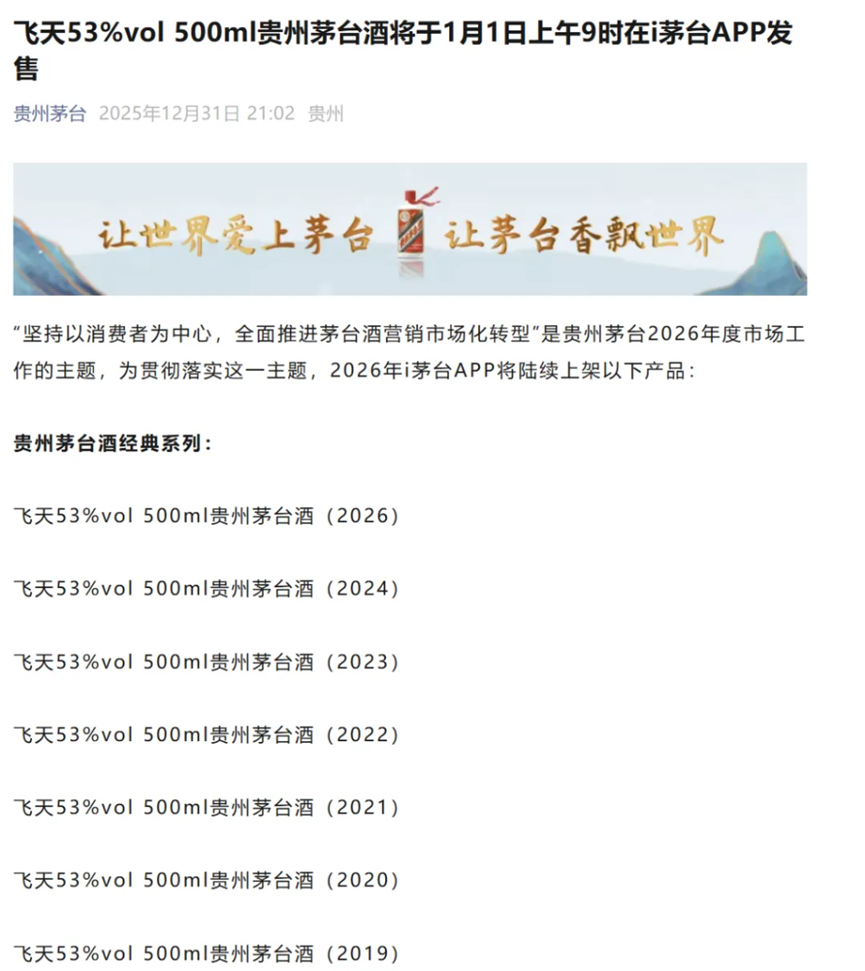
Core Viewpoint - Kweichow Moutai is accelerating its pricing, channel, and direct sales reforms, indicating a clearer market-oriented pricing system, which Goldman Sachs interprets as a signal that the liquor industry is bottoming out [1]. Group 1: Pricing and Sales Adjustments - On January 1, Kweichow Moutai announced adjustments to the suggested retail prices of key products in its non-standard Moutai series, aligning factory prices based on channel research [1]. - The iMoutai platform launched the Feitian Moutai series on January 1, with suggested retail prices set at 1499 RMB per bottle for various product sizes [1]. - Goldman Sachs estimates that iMoutai could contribute approximately 4.5 billion RMB in total sales within the first nine days of 2026, representing about 35% of iMoutai's revenue for the first nine months of 2025 [5]. Group 2: Wholesale Price Trends - Recent trends show a divergence in wholesale prices, with the wholesale price of Feitian Moutai decreasing by 40 RMB per bottle, while other products like Wuliangye and Guojiao 1573 remain stable [6]. - The wholesale prices for other Moutai products have varied, with some increasing while others, such as the boutique Moutai and Moutai 15 years, have seen price reductions [7][8]. Group 3: Market Demand and Recovery - High-end liquor retail demand remains weak year-on-year, with current terminal sales at 50%-70% of previous levels, indicating a need for time to recover [1][9]. - Goldman Sachs anticipates a potential bottoming opportunity for the liquor industry in the second half of 2026, driven by a recovery in high-end banquet and business demand from a low base in June 2025 [9]. - The pricing reforms by Moutai are expected to have a demonstration effect on the entire liquor industry, promoting normalization of channel pricing and profit levels, while also accelerating inventory reduction processes [9].
总规模超3500亿,成都最大产业基金集群来了
FOFWEEKLY· 2026-01-15 10:01
Core Viewpoint - Sichuan is accelerating its venture capital landscape with a total fund size of 355.3 billion yuan, driven by policy innovation and capital aggregation [2][3]. Group 1: Fund Size and Investment Focus - As of January 14, 2026, Sichuan has signed 174 funds with a total scale of 355.3 billion yuan, focusing on key industries such as electronic information, healthcare, and artificial intelligence [5]. - The "Chengdu High-tech Zone Industry Fund Investment List" has been released, detailing the 355.3 billion yuan fund cluster and facilitating capital and project information disclosure [6]. Group 2: Policy Framework and Goals - In May 2025, Sichuan announced measures to promote high-quality development in venture capital, aiming for 500 private equity and venture capital management institutions and a fund management scale exceeding 400 billion yuan by 2030 [8]. - The measures include innovative mechanisms such as breaking the restrictions on fund registration and return ratios, and a loss tolerance mechanism for state-owned funds, allowing up to 60% loss tolerance [8]. Group 3: Ecosystem Development - The venture capital ecosystem in Sichuan is being activated, with a rapid increase in the number and scale of funds, including 50 provincial government-guided funds approved by the end of 2025, targeting a total scale of 99.26 billion yuan [9]. - Sichuan is building a comprehensive capital ecosystem covering various sectors, including hard technology and advanced manufacturing, supported by large-scale mother funds and targeted industry funds [11]. Group 4: Capital Deployment and Collaboration - The Sichuan Social Security Science and Technology Innovation Fund, with a total scale of 50 billion yuan, focuses on strategic emerging industries such as artificial intelligence and biomedicine [11]. - Various local funds have been established, such as a 20 billion yuan gas industry fund focusing on hydrogen energy and LNG, and funds for low-altitude economy, enhancing capital support for technology development [13]. Group 5: National Context and Future Outlook - The national venture capital guidance fund has completed strategic layouts in key regions, with a focus on early-stage investments, indicating a broader trend of capital gathering towards technology innovation and advanced manufacturing [14]. - The capital landscape in Sichuan reflects a national trend of recovery in the primary market, with a growing emphasis on patient capital supporting technological innovation [16].