
广发基金管理有限公司

Search documents
FOF系列研究之七十六:广发中证香港创新药ETF投资价值分析
Orient Securities· 2025-06-22 02:11
Quantitative Models and Construction 1. Model Name: Hang Seng Hong Kong Innovative Drug Index (CNY) - **Model Construction Idea**: The index selects up to 50 listed companies in the Hong Kong market whose main business involves innovative drug research and development, reflecting the overall performance of innovative drug-themed listed companies in Hong Kong[37][61] - **Model Construction Process**: - **Sample Space**: Combines the sample space of the CSI Hong Kong 300 Index and the CSI Hong Kong Stock Connect Composite Index[38] - **Selection Criteria**: - Liquidity: Average daily turnover over the past year must not be less than HKD 10 million - Business Focus: Companies involved in innovative drug R&D or providing related services are selected - Market Cap: Top 50 securities by average daily market cap over the past year are included, or all securities if fewer than 50 meet the criteria - **Weighting Method**: Free-float market capitalization weighting, with individual stock weights capped at 10%[38] - **Adjustment Frequency**: Semi-annual adjustments in June and December[38] - **Model Evaluation**: The index focuses on mid-to-large innovative drug enterprises, with a high degree of industry purity, as 100% of its constituents belong to the "Pharmaceuticals and Biotechnology" secondary industry[43][44] --- Model Backtesting Results 1. Hang Seng Hong Kong Innovative Drug Index - **Annualized Return**: 8.54% (2019.1.1 - 2025.5.31)[49][50] - **Annualized Sharpe Ratio (IR)**: 0.41[49][50] - **Annualized Volatility**: 35.93%[49][50] - **Maximum Drawdown**: -68.18%[49][50]
6月19日广发医疗保健股票A净值下跌1.37%,近1个月累计上涨4.59%
Sou Hu Cai Jing· 2025-06-19 12:05
Group 1 - The core point of the article highlights the performance and holdings of the Guangfa Healthcare Stock A fund, which has a recent net value of 1.8385 yuan, reflecting a decline of 1.37% [1] - The fund's performance over the past month shows a return of 4.59%, ranking 34 out of 316 in its category; over the past six months, it has returned 11.72%, ranking 41 out of 311; and since the beginning of the year, it has achieved a return of 13.74%, ranking 36 out of 311 [1] - The top ten holdings of the fund account for a total of 48.15%, with significant positions in companies such as Zai Lab (10.52%), Kelun Pharmaceutical (8.39%), and others [1] Group 2 - Guangfa Healthcare Stock A fund was established on August 10, 2017, and as of March 31, 2025, it has a total scale of 5.237 billion yuan, managed by fund manager Wu Xingwu [1] - Wu Xingwu has a background in finance with a master's degree in science and has held various positions in fund management, including roles at Morgan Stanley Huaxin Fund Management and Guangfa Fund Management [2]
首批科创债ETF即将“降生”,10只产品材料已被“接受”
Hua Er Jie Jian Wen· 2025-06-18 11:33
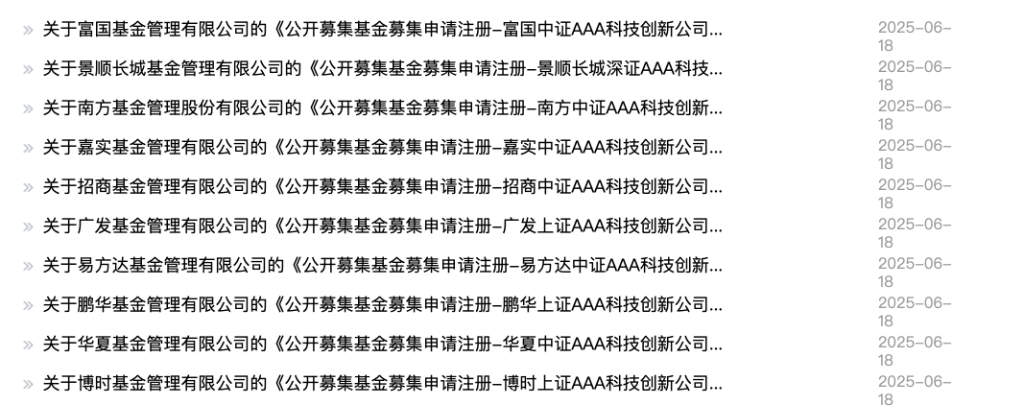
Core Viewpoint - The development of technology innovation is accelerating, with the introduction of science and technology innovation bond ETFs (科创债ETF) being a key initiative to support this growth [1]. Group 1: Introduction of 科创债ETF - On June 18, the chairman of the China Securities Regulatory Commission (CSRC), Wu Qing, announced plans to accelerate the development of 科创债 and launch 科创债ETF [1]. - Ten leading fund companies, including 富国, 景顺长城, 南方, 嘉实, 招商, 广发, 易方达, 鹏华, 华夏, and 博时, have submitted applications for 科创债ETF on the same day [1]. Group 2: Index Tracking - Among the ten submitted 科创债ETF, six will track the 中证AAA科技创新公司债指数, three will follow the 上证AAA科技创新公司债指数, and one will track the 深证AAA科技创新公司债指数 [2]. - The differences among these indices lie in the selection of bond types and the organizations responsible for their compilation [3]. Group 3: Definition and Market Impact of 科创债 - 科创债 serves as a core tool in the bond market to support the national strategy for technological innovation [5]. - The issuers of 科创债 can include various types of technology innovation enterprises, and the issuance scale reached 1.23 trillion yuan in 2024, marking a 56.3% year-on-year increase [6]. Group 4: Advantages of 科创债ETF - 科创债ETF is viewed as a tool that offers trading convenience, low costs, and risk diversification, providing investors with an easy way to invest in high-grade technology innovation company bonds [7]. - The launch of 科创债ETF is expected to enrich the bond market investment tools and facilitate long-term capital entry, addressing the current scarcity of bond ETFs compared to stock ETFs [7].

孙迪败走广发资源优选!“空降兵”苏文杰接管多基金迎战规模困局
Sou Hu Cai Jing· 2025-06-18 08:40
Core Viewpoint - As of January 31, 2025, GF Fund's public fund management scale reached 1.39 trillion yuan, ranking third after E Fund and Huaxia Fund, but the company faces challenges in its active equity business due to declining performance of star fund managers [14][17]. Group 1: Fund Management and Performance - GF Fund has significantly increased its focus on index investment in recent years, yet it struggles to hide the decline in its active equity business scale [14][17]. - The resignation of star fund manager Sun Di from the GF Resource Selection fund is a notable event, with Su Wenjie taking over management responsibilities [6][12]. - Sun Di's management of the GF Resource Selection fund has resulted in a net value drop of 12.66% over the past year, significantly underperforming its benchmark by over 15 percentage points [7][10]. Group 2: Fund Manager Background - Su Wenjie, the new manager of GF Resource Selection, has a strong track record, achieving an annualized return of 19.92% while managing the Jiashi Resource Selection fund, ranking 19th among 305 similar funds [5][6]. - Su Wenjie has also managed the Jiashi Carbon Neutrality theme fund, which performed well, ranking 75th among 4,120 similar funds [5]. Group 3: Concentration and Strategy Issues - The GF Resource Selection fund has a high concentration in its top ten holdings, reaching 75.80%, which is significantly above the industry average [10][12]. - The fund's strategy has been criticized for its high turnover and reliance on a limited number of stocks, which can lead to increased risk, especially in a cyclical industry [10][12]. Group 4: Historical Context and Challenges - GF Fund was once known for its "internal star-making" strategy, successfully creating star fund managers, but this has shifted to a situation where many of these managers are now facing significant performance declines [14][17]. - The company has seen a notable decline in the performance of funds managed by key figures like Sun Di and Liu Gesong, leading to redemption pressures and a potential systemic risk due to over-reliance on star managers [16][17].
6月17日广发医疗保健股票A净值下跌2.54%,近1个月累计上涨6.27%
Sou Hu Cai Jing· 2025-06-17 12:29
Group 1 - The core point of the article highlights the performance and holdings of the Guangfa Healthcare Stock A fund, which has a recent net value of 1.8741 yuan, reflecting a decline of 2.54% [1] - The fund's one-month return is 6.27%, ranking 61 out of 659 in its category; the six-month return is 13.62%, ranking 89 out of 644; and the year-to-date return is 15.94%, ranking 79 out of 648 [1] - The top ten holdings of the fund account for a total of 48.15%, with significant positions in companies such as Zai Lab (10.52%), Kelun Pharmaceutical (8.39%), and others [1] Group 2 - Guangfa Healthcare Stock A fund was established on August 10, 2017, and as of March 31, 2025, it has a total scale of 5.237 billion yuan [1] - The fund manager, Wu Xingwu, has extensive experience in the investment management field, having held various positions in Guangfa Fund Management and other financial institutions [2]
广发中证港股通非银ETF投资价值分析:低估值叠加优异基本面,港股非银标的彰显配置价值
CMS· 2025-06-17 05:53
Quantitative Models and Construction Methods - **Model Name**: Hang Seng Stock Connect Non-Bank Financial Index (931024.CSI) **Model Construction Idea**: The index aims to reflect the overall performance of non-bank financial companies listed in Hong Kong that are part of the Stock Connect program[31][32]. **Model Construction Process**: 1. Calculate the median daily turnover rate for each Stock Connect security over the past month as the monthly turnover rate. Exclude securities with an average monthly turnover rate below 0.1% over the past 12 months or 3 months, unless their average daily trading volume exceeds HKD 50 million[32]. 2. Select securities from industries such as insurance, capital markets, mortgage credit institutions, other comprehensive financial services, special financial services, and consumer credit as candidate samples[32]. 3. Rank the candidate samples by average daily market capitalization over the past year and select the top 50 securities. If fewer than 50 securities meet the criteria, include all eligible securities[32]. 4. Apply weighting factors between 0 and 1 to ensure no single stock exceeds 15% weight and the top five stocks collectively do not exceed 60% weight[33]. **Model Evaluation**: The index demonstrates strong representation of large-cap financial stocks, particularly in the insurance sector, and provides a focused investment tool for non-bank financial themes in Hong Kong[34][35][36]. Model Backtesting Results - **Hang Seng Stock Connect Non-Bank Financial Index**: - **Total Return**: 53.30%[48] - **Annualized Volatility**: 33.26%[48] - **Maximum Drawdown**: 20.29%[48] - **Sharpe Ratio**: 1.56[48] Quantitative Factors and Construction Methods - **Factor Name**: Market Capitalization Weighting **Factor Construction Idea**: Emphasize large-cap stocks to ensure stability and representativeness of the index[36]. **Factor Construction Process**: 1. Divide constituent stocks into market capitalization tiers: above HKD 500 billion, between HKD 200 billion and HKD 500 billion, and below HKD 500 billion[36]. 2. Assign weights based on market capitalization, with stocks above HKD 500 billion collectively accounting for 46.63% of the index weight, stocks between HKD 200 billion and HKD 500 billion accounting for 28.49%, and stocks below HKD 500 billion accounting for 8.31%[36]. **Factor Evaluation**: The factor ensures the index is dominated by stable, large-cap stocks, reducing volatility and enhancing reliability[36][40]. - **Factor Name**: Sector Allocation **Factor Construction Idea**: Focus on insurance and capital market sectors to capture the core of non-bank financial themes[34][35]. **Factor Construction Process**: 1. Allocate weights to sectors based on their representation in the index: insurance accounts for 65.11%, securities companies for 11.08%, and other capital market entities for 20.95%[35]. **Factor Evaluation**: The factor provides a balanced yet focused exposure to key non-bank financial sectors, aligning with the index's thematic goals[34][35]. Factor Backtesting Results - **Market Capitalization Weighting Factor**: - **Weight Distribution**: - Above HKD 500 billion: 46.63%[36] - HKD 200 billion–500 billion: 28.49%[36] - Below HKD 500 billion: 8.31%[36] - **Sector Allocation Factor**: - **Weight Distribution**: - Insurance: 65.11%[35] - Securities Companies: 11.08%[35] - Other Capital Market Entities: 20.95%[35] Additional Observations - **Index Fundamental Characteristics**: - **ROE (2024)**: 11.69%[43] - **ROE (2025 Q1)**: 2.94%[43] - **Dividend Yield (Last 12 Months)**: 4.01%[43] - **Valuation Metrics**: - **PE_TTM**: 8.52 (22.76% below historical average)[44] - **Index Concentration**: - **Top 10 Constituents Weight**: 82.79%[41] - **Largest Constituent (Hong Kong Exchange)**: 17.69% weight[41]





嘉实基金22只ETF同日“改名”,51家公募角逐4万亿ETF蓝海
Sou Hu Cai Jing· 2025-06-16 08:29
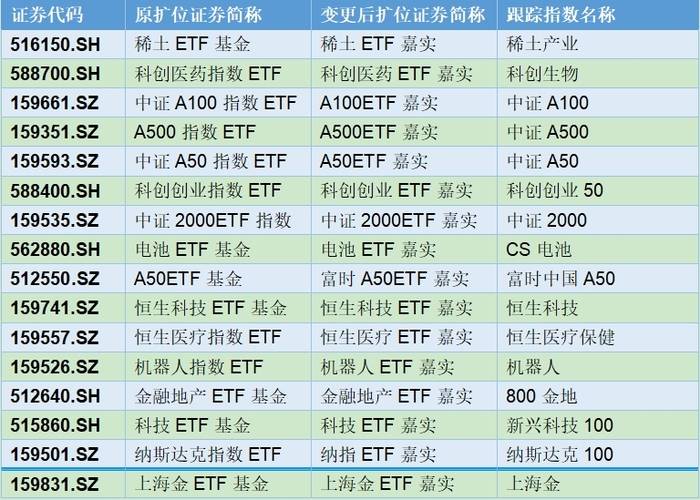
Core Viewpoint - The ongoing trend of renaming ETFs is aimed at enhancing clarity and reducing confusion for investors, as evidenced by the recent announcement from Harvest Fund to rename 22 of its ETFs to a standardized format [1][6]. Group 1: ETF Renaming and Standardization - Harvest Fund announced the renaming of 22 ETFs, including major indices like CSI A500 and CSI A100, to a clearer format that includes "Index + Product Type + Manager" [1][2]. - The renaming process does not affect product codes, fees, or investment strategies, ensuring that existing shareholder rights remain intact [1][2]. - This renaming initiative is part of a broader industry trend, with other firms like Huaxia and E Fund also having renamed their ETFs this year [2][6]. Group 2: Market Growth and Trends - The total scale of ETFs in China surpassed 4 trillion yuan for the first time in April 2023, marking a significant growth from just over 3 trillion yuan in September 2022 [6][10]. - As of June 16, 2023, there are 51 public fund companies managing 1,163 ETFs, with a total net asset value of approximately 3.99 trillion yuan [7][8]. - The ETF market is experiencing a "Matthew Effect," where the top 10 fund companies manage nearly 85% of the total ETF assets, highlighting a concentration of market power [8][9]. Group 3: Fee Structure and Investor Engagement - Management fees for ETFs have increased significantly, with Huaxia Fund's fees rising from 11.9 million yuan in 2022 to 24.53 million yuan in 2024 [9]. - The trend towards lower fees is evident, with many newly launched ETFs adopting a management fee structure of 0.15% [9][10]. - The number of accounts participating in the ETF market has grown to nearly 10 million, reflecting a rising interest in index-based investment strategies [10][11]. Group 4: Future Development and Strategy - The Shanghai Stock Exchange emphasizes the need for high-quality development in the ETF market, focusing on enhancing product supply and optimizing market mechanisms [10][11]. - Public fund managers are increasingly adopting a "research + service + strategy" model to improve transparency and accessibility of ETF products for investors [11].
宏工科技(301662) - 20250612投资者关系活动记录表
2025-06-13 08:20
Group 1: Company Progress and Developments - The company has made significant advancements in the "dry electrode" equipment sector, collaborating with Qingyan Company to develop a hybrid homogenization integrated machine, achieving core performance metrics close to target parameters, and has delivered units to customers [1] - The new signed orders from January to May 2025 show a year-on-year increase, primarily driven by the expansion of leading battery manufacturers, with most new orders related to the battery end rather than materials [2] Group 2: Competitive Landscape and Advantages - The competition in the material automation sector is characterized by industry concentration, with a "Matthew Effect" where stronger players continue to dominate [3] - The company's competitive advantages include experience in powder engineering and fluid mechanics, as well as cost advantages due to its scale and supply chain management [3] Group 3: Future Development Plans - The company aims to increase market share in the lithium battery sector by developing equipment that addresses customer pain points [4] - In the non-energy sector, the company plans to expand its market share through import substitution and the development of currently lacking equipment, targeting a revenue share of approximately 40% from this sector by 2030 [4]
宏信证券ETF日报-20250612
Hongxin Security· 2025-06-12 09:01
Report Investment Rating - No industry investment rating information is provided in the report. Core View - The report presents the market performance of various types of ETFs on June 12, 2025, including stock ETFs, bond ETFs, gold ETFs, commodity futures ETFs, cross - border ETFs, and money ETFs, along with the overall A - share market situation [2][3][4][12][15][17][19] Summary by Directory Market Overview - The Shanghai Composite Index rose 0.01% to 3402.66 points, the Shenzhen Component Index fell 0.11% to 10234.33 points, and the ChiNext Index rose 0.26% to 2067.15 points. The total trading volume of A - shares in the two markets was 13038 billion yuan. The top - rising industries were non - ferrous metals (1.40%), media (1.33%), and beauty care (1.31%), while the top - falling industries were household appliances (-1.77%), coal (-1.14%), and food and beverages (-1.13%) [2][6] Stock ETF - The top - trading - volume stock ETFs included Huaxia CSI A500 ETF (up 0.11%, discount rate 0.02%),嘉实 CSI A500 ETF (up 0.10%, discount rate 0.06%), and Huatai - Peregrine SSE 300 ETF (up 0.05%, discount rate 0.03%) [3][7] - Detailed data of the top ten trading - volume stock ETFs are presented in Chart 1, including price, change rate, tracking index, and other information [8] Bond ETF - The top - trading - volume bond ETFs were Haifutong SSE Benchmark Market - making Corporate Bond ETF (up 0.06%, discount rate 0.07%), Huaxia SSE Benchmark Market - making Corporate Bond ETF (up 0.05%, discount rate 0.11%), and Southern SSE Benchmark Market - making Corporate Bond ETF (up 0.04%, discount rate 0.07%) [4][9] - Detailed data of the top five trading - volume bond ETFs are shown in Chart 2 [10] Gold ETF - Gold AU9999 rose 0.76% and Shanghai Gold rose 0.90%. The top - trading - volume gold ETFs were Huaan Gold ETF (up 0.93%, discount rate 0.92%), Boshi Gold ETF (up 0.97%, discount rate 0.95%), and E Fund Gold ETF (up 0.91%, discount rate 0.90%) [12] - Detailed data of the top five trading - volume gold ETFs are provided in Chart 3 [13] Commodity Futures ETF - Huaxia Feed Soybean Meal Futures ETF rose 0.15% with a discount rate of 0.39%, Dacheng Non - ferrous Metals Futures ETF fell 0.53% with a discount rate of - 0.38%, and Jianxin Yisheng Zhengzhou Commodity Exchange Energy and Chemical Futures ETF fell 0.15% with a discount rate of 0.26% [15] - Detailed data of commodity futures ETFs are presented in Chart 4 [16] Cross - border ETF - The previous trading day saw the Dow Jones Industrial Average fall 0.00%, the Nasdaq fall 0.50%, the S&P 500 fall 0.27%, and the German DAX fall 0.16%. On this day, the Hang Seng Index fell 1.36% and the Hang Seng China Enterprises Index fell 1.53%. The top - trading - volume cross - border ETFs were GF CSI Hong Kong Innovative Drug ETF (up 4.97%, discount rate 5.46%), E Fund CSI Hong Kong Securities Investment Theme ETF (up 0.18%, discount rate - 0.14%), and Huitianfu SZSE - HK Connect Innovative Drug ETF (up 5.57%, discount rate 6.02%) [17] - Detailed data of the top five trading - volume cross - border ETFs are shown in Chart 5 [18] Money ETF - The top - trading - volume money ETFs were Yin Hua Ri Li ETF, Hua Bao Tian Yi ETF, and Money ETF Jian Xin Tian Yi [19] - Detailed data of the top three trading - volume money ETFs are provided in Chart 6 [21]
四只信用债ETF跻身百亿俱乐部
Zhong Guo Zheng Quan Bao· 2025-06-11 21:25
Core Insights - The recent inclusion of credit bond ETFs in the pledged repo trading has significantly boosted trading activity, with two benchmark market-making credit bond ETFs exceeding 10 billion yuan in trading volume on June 11 [1][2] - The rapid influx of funds has led to four credit bond ETFs, established for less than six months, joining the "100 billion club" [1][2] - Fund managers believe that the ability to use credit bond ETFs for pledged financing enhances their attractiveness and expands the potential investor base [1][3] Trading Activity - On June 11, the trading volume of the Southern CSI Benchmark Market-Making Corporate Bond ETF surpassed 15.5 billion yuan, marking an increase of over 7 billion yuan from the previous trading day, setting a new single-day trading record [1] - The E Fund CSI Benchmark Market-Making Corporate Bond ETF also saw trading volume exceed 9 billion yuan, while several other ETFs recorded volumes above 6 billion yuan [1] Growth in Scale - As of June 10, four benchmark market-making credit bond ETFs have surpassed the 10 billion yuan mark in scale, with specific figures being 13.72 billion yuan for E Fund, 13.21 billion yuan for Southern, 10.76 billion yuan for Hai Fu Tong, and 10.17 billion yuan for Hua Xia [2] - Other ETFs like Bosera and GF have also shown significant scale growth, reaching 9.01 billion yuan and 8.27 billion yuan respectively [2] Leverage Strategies - The recent month has seen net inflows exceeding 5 billion yuan for the top four credit bond ETFs, with GF's deep credit bond ETF seeing net inflows over 4 billion yuan [2] - The ability to employ a "buy ETF - pledge financing - reinvest" strategy allows investors to enhance returns through leverage [4] Liquidity Management - The inclusion of credit bond ETFs in the pledged repo trading enhances liquidity and serves as a liquidity management tool, allowing investors to mitigate short-term liquidity risks [3] - This move is seen as a critical step in addressing the developmental shortcomings of credit bond ETFs, significantly increasing their investment appeal [3]