中金基金

Search documents
公募REITs周报(第45期):整体下跌,成交回落-20251207
Guoxin Securities· 2025-12-07 12:11
Report Industry Investment Rating No relevant content provided. Core View of the Report - This week, the REITs index fell 1.0% throughout the week, with average weekly price changes of -0.8% for equity - type REITs and -1.1% for franchise - type REITs. In terms of the weekly price changes of major indices, CSI 300 > CSI Convertible Bond Index > CSI Aggregate Bond Index > CSI REITs Index. As of December 5, 2025, the dividend yield of equity - type REITs was 14 BP lower than the average dividend yield of CSI Dividend Stocks, and the spread between the average internal rate of return of franchise - type REITs and the 10 - year Treasury yield was 274 BP. After nearly five months of continuous volatile corrections, the allocation value of current REITs has been significantly enhanced [1]. Summary by Relevant Catalogs Secondary Market Trends - As of December 5, 2025, the closing price of the CSI REITs (closing) index was 801.18 points, with a price change of -1.0% for the week (December 1 - 5, 2025), performing worse than the CSI 300 index (+1.3%), the CSI Convertible Bond Index (+0.1%), and the CSI Aggregate Bond Index (-0.3%). Year - to - date, the price change rankings of major indices were: CSI 300 (+16.5%) > CSI Convertible Bond Index (+16.3%) > CSI REITs Index (+1.5%) > CSI Aggregate Bond Index (+0.4%) [2][6]. - In the past year, the return rate of the CSI REITs index was 4.9%, with a volatility of 7.5%. The return rate was lower than that of the CSI 300 index and the CSI Convertible Bond Index but higher than that of the CSI Aggregate Bond Index; the volatility was lower than that of the CSI 300 index and the CSI Convertible Bond Index but higher than that of the CSI Aggregate Bond Index. The total market value of REITs on December 5 was 217.8 billion yuan, a decrease of 2.1 billion yuan from the previous week; the average daily turnover rate for the whole week was 0.37%, a decrease of 0.13 percentage points from the previous week [2][8]. - Except for water conservancy facilities and new infrastructure, other types of REITs declined. In terms of different project attributes, the average weekly price changes of equity - type REITs and franchise - type REITs were -0.8% and -1.1% respectively. In terms of different project types, the top three REITs in terms of weekly price increases were Huaxia Fund CR Land Youchao REIT (+2.12%), E Fund Shenzhen Expressway REIT (+1.18%), and Huatai Nanjing Jianye REIT (+1.08%) [3][12][16]. - New infrastructure REITs had the highest trading activity. New infrastructure REITs had the highest average daily turnover rate during the period, with an average daily turnover rate of 0.6%; transportation infrastructure REITs had the highest trading volume proportion this week, accounting for 26.2% of the total REITs trading volume. In terms of the capital flow of different REIT products this week, the top three in terms of net inflow of main funds were Huaxia CR Land Commercial REIT (9.1 million yuan), CICC Anhui Expressway REIT (6.83 million yuan), and Southern Runze Technology Data Center REIT (5.27 million yuan) [3][17][18]. Primary Market Issuance - From the beginning of the year to December 5, 2025, there were 3 REIT products in the exchange at the accepted stage, 1 at the declared stage, 2 at the in -quired stage, 5 at the feedback stage, 6 products that had passed and were waiting to be listed, and 14 first - issued products that had passed and were already listed [20]. Valuation Tracking - REITs have both bond and equity characteristics. From the bond perspective, under the constraint of mandatory high dividends, the average annualized cash distribution rate of public - offering REITs was 6.39% as of December 5. From the equity perspective, the relative net asset value premium rate, IRR, and P/FFO were used to judge the valuation of REITs. Different project types of REITs had different values for these indicators [22]. - Equity - type REITs and franchise - type REITs had significant differences in asset rights, income sources, term characteristics, and risk characteristics. As of December 5, 2025, the dividend yield of equity REITs was 14 BP lower than the average dividend yield of CSI Dividend Stocks, and the spread between the average internal rate of return of franchise - type REITs and the 10 - year Treasury yield was 274 BP [25]. Industry News - China Securities Regulatory Commission Chairman Wu Qing stated that REITs should be steadily developed during the "15th Five - Year Plan" period. This indicates that REITs development will face new opportunities [4][31]. - The first urban renewal - type REITs in China was launched in Beijing Yizhuang, with a scale of 753 million yuan. The underlying assets included Borun Industrial Park and the Economic Development Zone Auto Parts Industrial Park [4][31]. - Huaxia Fund announced the expansion and issuance of Huaxia Fund CR Land Youchao REIT, which was the second approved affordable rental housing REIT expansion project in China. The expansion adopted the original holder placement method, with a placement ratio of 0.9 shares for every 1 share of the fund, and the price was set at 2.53 yuan per share, with an estimated total raised funds of 1.1385 billion yuan [4][31].
公募REITs扩围,商业不动产入场激活存量资产
Huan Qiu Wang· 2025-12-07 03:18
Core Viewpoint - The introduction of commercial real estate investment trusts (REITs) in China is expected to enhance the capital market's ability to serve the real economy, providing a new financing channel for commercial real estate and promoting a diversified development of the REITs market [1][4]. Group 1: Market Development - The China Securities Regulatory Commission has released a consultation draft for the pilot program of commercial real estate REITs, indicating that the market is set to officially launch [1]. - As of November 27, 2023, there are 77 listed REITs in China, with a total financing scale exceeding 200 billion and a total market value surpassing 220 billion [2]. - The China Securities Index REITs total return index has increased by over 22% since the beginning of 2024, highlighting the growing investment value of REITs [2]. Group 2: Economic Impact - The launch of commercial real estate REITs is expected to activate existing commercial real estate assets, converting them into liquid capital, which will help stimulate consumption and expand effective investment [4]. - It will stabilize expectations in the real estate sector and facilitate a smooth transition to a new model of "rent and purchase coexistence" [4]. - The introduction of REITs will provide residents with an investment tool that combines stable cash flow and asset appreciation potential, thereby increasing property income [4]. Group 3: Strategic Transformation - The new financing channel will optimize the capital structure of companies holding substantial commercial real estate, encouraging a shift from a "heavy development, light operation" model to a "heavy management, heavy service" asset management strategy [4]. - The market-oriented pricing mechanism of REITs will incentivize companies to enhance operational management, improve asset quality, and boost profitability, fostering healthy competition in the commercial real estate market [4]. Group 4: Investor Opportunities - The establishment of commercial real estate REITs will enrich the asset allocation options for investors, allowing them to participate in high-quality commercial real estate projects with lower capital thresholds [4]. - Investors will have the opportunity to share in the stable rental income and potential asset appreciation generated by these projects, which is significant for optimizing both personal and institutional investment portfolios [4]. Group 5: Regulatory Framework - The Shanghai and Shenzhen stock exchanges are actively working on revising supporting rules, system upgrades, and pilot project reserves to ensure the smooth implementation of commercial real estate REITs [5]. - The focus will be on supporting high-quality projects with strong operational management capabilities and stable asset performance while ensuring effective risk prevention [5]. - The pilot program of commercial real estate REITs is seen as a significant achievement in China's financial supply-side structural reform, enhancing the efficiency of capital circulation in the commercial real estate sector [5].


底层资产类型进一步丰富——公募REITs拓展服务实体经济深度
Jing Ji Ri Bao· 2025-12-06 21:54
近日,中国证监会发布《中国证监会关于推出商业不动产投资信托基金试点的公告(征求意见稿)》 (以下简称《公告》),向社会公开征求意见。此次试点,将进一步丰富REITs(不动产投资信托基 金)底层资产类型,推动我国REITs市场发展进入新阶段,拓展资本市场服务实体经济的深度和广度。 盘活商业不动产资产 商业不动产投资信托基金(以下简称"商业不动产REITs")是指通过持有商业不动产以获取稳定现金流 并向基金份额持有人分配收益的封闭式公开募集证券投资基金。 此次发布的《公告》内容主要包括:基金注册及运营管理要求,明确基金管理人及基金托管人、尽职调 查、申请材料、商业不动产等方面要求,以及基金管理人的主动运营管理责任;发挥基金管理人和专业 机构作用,压严压实责任,要求严格遵守执业规范和监管要求;强化监管责任,明确各监管机构依法依 规履行商业不动产REITs监管和风险监测处置等职责;等等。 从全球成熟市场发展经验来看,商业综合体、商业零售、写字楼、酒店等商业不动产是REITs产品重要 的底层资产。我国商业不动产存量规模庞大,具有通过REITs进行盘活并拓宽权益融资渠道的内在需 求。借鉴国际经验并结合我国实际,坚持市场化 ...
40只中证A500基金全线上涨,易方达增强ETF领涨
2 1 Shi Ji Jing Ji Bao Dao· 2025-12-05 10:48
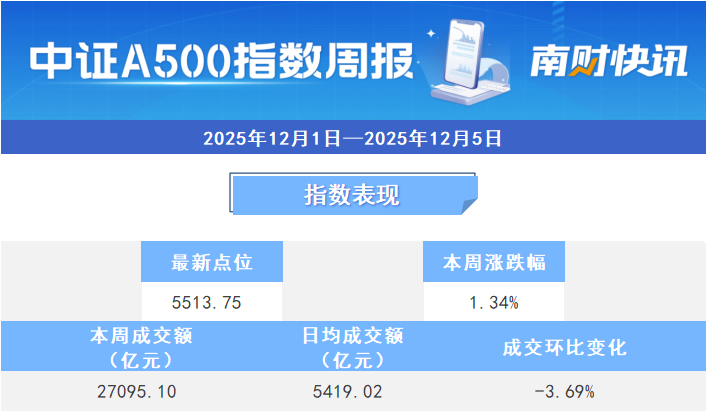
Index Performance - The China Securities A500 Index increased by 1.34%, closing at 5513.75 points on December 5 [5] - The average daily trading volume for the week was 5419.02 billion yuan, with a week-on-week decrease of 3.69% [5] Top Performing Stocks - The top ten stocks with the highest gains included: 1. Aerospace Development (000547 SZ) with a gain of 52.26% 2. Jerry Holdings (002353 SZ) with a gain of 26.40% 3. Tianfu Communication (300394 SZ) with a gain of 25.79% 4. Jiangxi Copper (600362 SH) with a gain of 15.74% 5. Aerospace Electronics (600879 SH) with a gain of 15.68% [3] Underperforming Stocks - The top ten stocks with the largest declines included: 1. BlueFocus Communication Group (300058 SZ) with a loss of 13.98% 2. Hunan YN Energy (301358 SZ) with a loss of 10.59% 3. Dofluorid (002407 SZ) with a loss of 10.39% 4. Zhonggong Education (002607 SZ) with a loss of 9.02% 5. 360 Security Technology (601360 SH) with a loss of 8.88% [3] Fund Performance - All 40 China Securities A500 funds reported gains, with the exception of two funds. The A500 Enhanced ETF from E Fund was the only product with a gain exceeding 2% [6] - The total scale of the A500 funds remained below 200 billion yuan, recorded at 1954.68 billion yuan as of December 4 [6] Market Outlook - Bohai Securities indicated that the A-share market is currently in a consolidation phase, awaiting policy developments. The upcoming important meetings may catalyze market movements if policies exceed expectations [8] - Investment opportunities are suggested in the TMT sector and robotics due to ongoing AI capital expansion and domestic substitution processes [8]
焦点关注:年末权益基金攻防分化,谁更适配跨年行情?
Di Yi Cai Jing· 2025-12-04 13:35
Core Viewpoint - The year-end market dynamics reveal a split among institutional investors, with some adopting a cautious approach to lock in gains while others see market fluctuations as a buying opportunity [3][4][7]. Group 1: Market Performance and Fund Strategies - As of December 3, the average return of 4,686 active equity funds since November has been -2.67%, indicating a significant reduction in performance volatility compared to previous months [3]. - Notably, several high-performing funds with over 50% annual returns have shown reduced monthly volatility, suggesting that fund managers have likely made adjustments to their portfolios [4]. - A significant number of funds, 223, have implemented purchase limits to manage scale and protect existing investors, with some funds limiting daily purchases to as low as 1,000 yuan [5]. Group 2: Investment Outlook and Strategies - Analysts expect that the A-share market will experience a positive trend despite short-term fluctuations, with a potential opening for cross-year investment opportunities [7][8]. - The technology sector is highlighted as a key area for investment, with expectations of continued growth driven by AI and other technological advancements [8][9]. - There is a focus on sectors with high economic vitality, such as technology manufacturing and materials, as well as consumer goods that have already priced in pessimistic forecasts [9].

年末权益基金攻防分化,谁更适配跨年行情?
Di Yi Cai Jing· 2025-12-04 12:48
Core Viewpoint - The year-end market dynamics show a divergence in strategies among institutional investors, with some adopting a cautious approach while others see opportunities in market fluctuations [1][4]. Group 1: Year-End Market Dynamics - As of December 3, the average return of 4,686 active equity funds since November has been -2.67%, indicating a significant reduction in performance volatility compared to previous months [1]. - Notably, several high-performing funds with over 50% annual returns have shown a marked decrease in monthly volatility, suggesting that fund managers have likely made adjustments to their portfolios [2]. - A total of 223 active equity funds have suspended large-scale subscriptions, with 28 funds limiting daily subscriptions to no more than 10,000 yuan to protect existing investors [2][3]. Group 2: Fund Manager Strategies - Some fund managers have reduced stock positions and adjusted their holdings to mitigate risks, while others believe that current market fluctuations may present new buying opportunities [2][4]. - New funds launched in the fourth quarter are rapidly building positions, with nearly 90% of 69 newly established active equity products experiencing net value fluctuations, indicating active investment strategies [3]. Group 3: Market Expectations - Analysts expect that the A-share market will enter a period of upward momentum, with short-term fluctuations not altering the overall positive trend [4][5]. - The market is anticipated to benefit from improved economic conditions, favorable liquidity, and supportive policies, which are expected to strengthen A-shares [5]. Group 4: Sector Focus - The technology sector is highlighted as a key area for investment, with analysts suggesting that high-growth and potential reversal opportunities should be prioritized [5][6]. - Traditional consumer goods, particularly in the leisure food and white goods sectors, are also noted for their attractive dividend yields, making them worthy of attention in the context of year-end valuation adjustments [6].
见好就收?年末基金“攻守战”,基金经理操作不一
券商中国· 2025-12-01 23:31
Core Viewpoint - The article discusses the shift in investment strategies among mutual funds as they approach the end of 2025, with many funds adopting a defensive stance to lock in profits and mitigate risks associated with market fluctuations [1][2][3]. Group 1: Fund Performance and Strategy - As the market enters the fourth quarter, many previously high-performing sectors are experiencing volatility, prompting some actively managed equity funds to take profits and reduce positions to preserve gains [3]. - For instance, the Yimin Service Leading Fund, which had significant holdings in companies like BOE Technology Group and Ping An Insurance, managed to limit its decline to only 0.72% during a market downturn, suggesting a possible reduction in its position [3]. - Historical data indicates that the Yimin Service Leading Fund has successfully navigated market downturns by adjusting its positions, achieving over 30% returns this year with a maximum drawdown of approximately 6% [3]. Group 2: Fund Size and Flexibility - The flexibility in adjusting positions is largely attributed to the relatively small size of the funds, such as the Yimin Service Leading Fund with a size of only 44 million yuan, allowing for quicker tactical changes [4]. - Smaller fund sizes enable managers to execute defensive and offensive strategies more effectively, providing an advantage in rapidly changing market conditions [4]. Group 3: Market Sentiment and Future Outlook - Despite the general belief in long-term investment, fund managers are increasingly focusing on tactical adjustments to enhance investor experience amid market volatility [5]. - Some newly established funds are actively entering the market, with 41 new active equity funds launched in November alone, indicating a belief in future market opportunities despite recent fluctuations [6]. - Research from Dongwu Securities highlights that the fourth quarter is crucial for performance, with institutions shifting focus from seeking excess returns to securing existing profits and avoiding ranking volatility [7]. Group 4: Investment Themes and Expectations - The article notes a divergence in views among institutions regarding future market trends, with some expecting sustained benefits from themes like self-sufficiency in industrial chains amid a resilient domestic capital environment [7]. - The expectation of potential policy stimulus in December may lead to stronger domestic market performance compared to overseas markets [7].

基础设施REITs五年探索 为商业不动产REITs提供有益借鉴
Zheng Quan Shi Bao· 2025-12-01 18:14
Core Viewpoint - The announcement by the China Securities Regulatory Commission regarding the pilot launch of commercial real estate investment trusts (REITs) marks a significant step in capital market development, aiming to revitalize a large stock of commercial real estate assets and enhance the multi-tiered capital market financing system [1][4]. Summary by Sections Development of Infrastructure REITs - The pilot for infrastructure REITs has been ongoing for nearly five years, resulting in over 70 listed products with a total scale exceeding 200 billion yuan [1]. - As of December 1, there are 77 listed infrastructure REITs, with a total market value close to 220 billion yuan, and the average yield of these products is 26.14% [2]. Market Performance and Trends - In 2023, the market for infrastructure REITs has shown a divergence, with assets that have higher dividend certainty being favored, leading to significant price increases [3]. - The CSI REITs total return index has achieved over 20% growth in 2024, with some products like the Huaxia Dayue City Commercial REIT seeing cumulative gains exceeding 30% this year [3]. Future Outlook - The market is expected to see further expansion of infrastructure REITs into more sectors, including urban renewal facilities, hotels, and commercial office spaces, with an emphasis on optimizing the application process for new projects [4]. - The pilot for commercial real estate REITs is anticipated to provide valuable insights from the infrastructure REITs experience, contributing to the development of a new model for real estate growth [4].
券商资管大集合参公改造再添一例
Bei Jing Ri Bao Ke Hu Duan· 2025-12-01 16:18
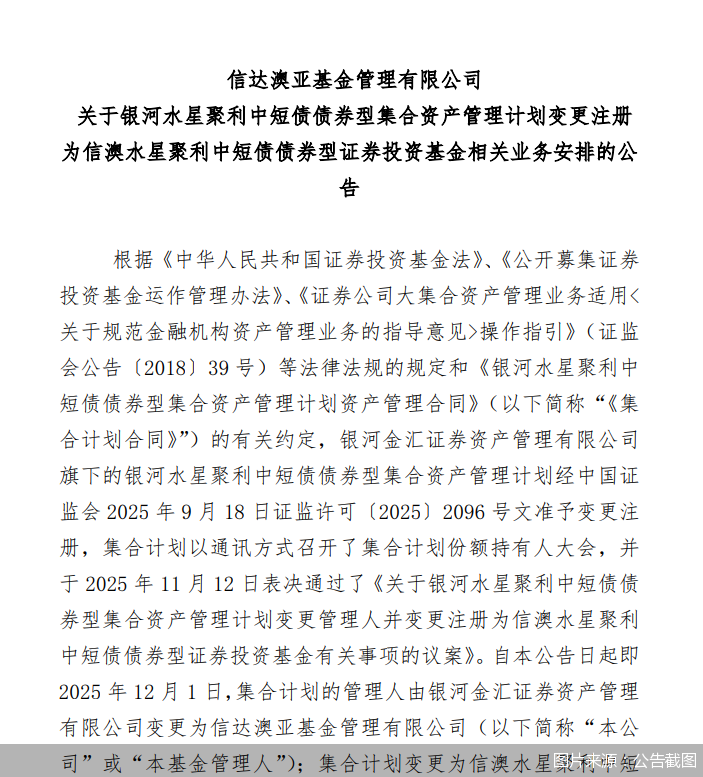
Core Viewpoint - The transformation of brokerage asset management collective products into public funds is accelerating as the deadline for regulatory compliance approaches, with an increasing number of products undergoing this transition [1][3]. Group 1: Regulatory Changes and Compliance - The management of the "Galaxy Mercury Juyi Short-term Bond Collective Asset Management Plan" has been transferred from Galaxy Jin Hui Securities Asset Management to Xinda Australia Fund, marking a significant step in the public fund transformation process [3]. - The deadline for the transformation of brokerage asset management collective products into public funds is set for the end of 2025, following regulatory requirements established in November 2018 [3][4]. - If the original management company does not obtain public fund qualifications, the products will be transferred to affiliated public fund companies or third-party public fund companies, or they may be terminated [3]. Group 2: Trends in Management Transfers - The first instance of a brokerage asset management product transitioning to public fund management occurred in August 2023, when the "Fangzheng Jin Lifang One-Year Holding Mixed Collective Asset Management Plan" was transferred to its affiliated public fund company [4]. - Several brokerage firms have transferred their collective products to affiliated public fund companies, such as CITIC Securities and GF Securities, while some firms are seeking public fund licenses to facilitate this transformation [4][6]. - Despite some firms withdrawing their applications for public fund licenses, the approval process for these applications has not been suspended [5][6]. Group 3: Benefits of Public Fund Transformation - The transformation of brokerage asset management collective products into public funds is expected to optimize resources and promote differentiated development within the industry [7]. - Public fund transformation will enhance the legal status and transparency of operations, allowing for more flexible and proactive performance marketing [7]. - The entry threshold for clients will significantly decrease post-transformation, potentially increasing the scale of assets under management and improving investment management standards [7].

进入冲刺期!券商资管大集合参公改造再添一例
Bei Jing Shang Bao· 2025-12-01 13:44
Core Viewpoint - The transformation of brokerage asset management large collective products into public offerings is accelerating as the deadline for regulatory compliance approaches, with significant changes in management and structure occurring across various firms [1][5][8]. Group 1: Regulatory Changes and Compliance - The deadline for the public offering transformation of brokerage asset management large collective products is set for the end of 2025, following regulatory requirements established in November 2018 [5]. - Firms are required to complete the transformation of existing large collective products to comply with new asset management regulations, with options for management transfer depending on the public offering qualifications of the original managers [5][6]. Group 2: Management Changes - On December 1, 2023, the management of the Galaxy Mercury Juhua Medium and Short Bond Collective Asset Management Plan was transferred from Galaxy Jin Hui Securities Asset Management to Xinda Australia Fund, marking a significant management change [4]. - There is a trend of transferring management to non-affiliated public fund companies, as seen with Wanlian Securities' transfer of its money market fund to Ping An Fund [7]. Group 3: Industry Trends and Implications - The public offering transformation is expected to optimize resources and promote differentiated development within the industry, enhancing transparency and legal status for the products [8]. - The transformation is anticipated to lower entry barriers for clients, potentially increasing the scale of assets under management and improving the investment management standards of the products [8].