奇瑞汽车

Search documents
宁德时代与奇瑞汽车合资公司成立 注册资本20亿元
Jin Rong Jie· 2026-02-14 02:25
公开资料显示,近日,时代奇瑞(合肥) 新能源科技有限公司成立,法定代表人为来永杰,注册资本 为20亿元,经营范围包含:电池制造;电池零配件生产;电池销售;电池零配件销售; 储能技术服务 等。相关信息显示,该公司由 宁德时代、奇瑞汽车、奇瑞商用车(安徽)有限公司共同持股。 ...

跨界投入、腾笼换鸟 汽车企业加速布局机器人赛道
Shang Hai Zheng Quan Bao· 2026-02-14 00:08
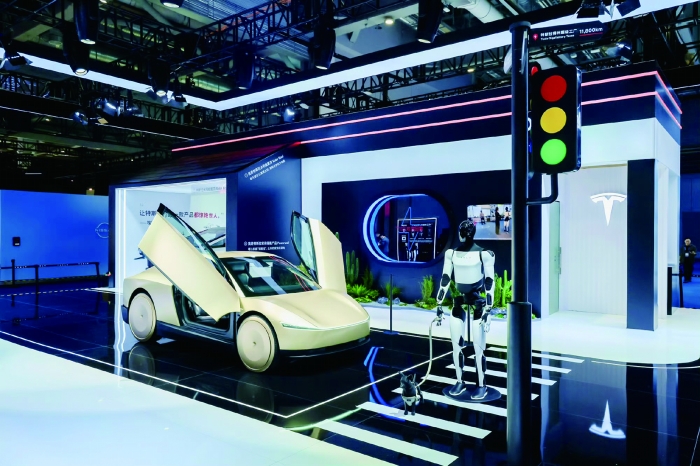
Core Insights - Major automotive companies, including Tesla, Chery, Hyundai, Xpeng, and Seres, are increasingly investing in the robotics sector, with Tesla even halting production of several key models to repurpose its production lines for robot manufacturing [1][5] - The automotive industry is redefining its value through the development of embodied intelligence, moving beyond traditional automotive definitions and integrating "vehicles, people, and machines" [1] Domestic Automotive Companies' Progress - Chery's humanoid robot, "Wuyou" Zhiqing R001, is set to host a segment at the 2026 Wuhu Spring Festival, marking a significant milestone for domestic automotive companies in the robotics field [2] - The "Wuyou" Zhiqing R001 has begun operations in Wuhu, assisting traffic police and showcasing the integration of robotics into smart policing [2] - Chery has received investments from companies like Zhiyuan Robotics and Bertley, indicating that embodied intelligence is seen as a new growth curve for the company [3] International Automotive Companies' Developments - Tesla plans to launch its third-generation humanoid robot in 2026, with an expected annual production capacity of 1 million units, repurposing its Fremont factory's Model S/X production line for this purpose [5][6] - Hyundai aims to deploy over 30,000 humanoid robots in its U.S. factories starting in 2026 to reduce production costs and enhance competitiveness [6][7] Upstream Industry Chain Actions - Companies in the automotive parts sector, such as Top Group and Ningbo Huaxiang, are actively expanding into the embodied intelligence business [8] - Junsen Electronics has launched a series of products related to humanoid robots and is conducting training for these robots in its factories [8] - CATL has initiated a strategic partnership with Horizon Robotics to focus on intelligent upgrades for new energy vehicles, aiming to enhance the smart travel experience [9]




跨界投入 腾笼换鸟 汽车企业加速布局机器人赛道
Shang Hai Zheng Quan Bao· 2026-02-13 17:04
Group 1 - Major automotive companies are accelerating their entry into the robotics sector, with Tesla, Chery, Hyundai, Xpeng, and Seres all making significant moves by 2026, including Tesla repurposing production lines for robots [2][4] - Chery's humanoid robot "Wuyou" has been integrated into local law enforcement in Wuhu, showcasing its capabilities in traffic management and marking a significant step in the application of robotics in public services [3][4] - The automotive industry is redefining its value through the development of embodied intelligence, moving beyond traditional automotive definitions and integrating "car, human, and machine" [2] Group 2 - Chery's humanoid robot has entered over 30 countries and is involved in various applications, indicating a strong growth trajectory for the company in the robotics field [4] - Seres is also expanding into embodied intelligence, establishing a new company focused on smart robotics and artificial intelligence, with a registered capital of 50 million RMB [5] - Tesla plans to produce 1 million units of its third-generation humanoid robot by the end of 2026, indicating a significant commitment to this new product line [7] Group 3 - Hyundai plans to deploy over 30,000 humanoid robots in its U.S. factories by 2026 to enhance production efficiency and reduce costs [8] - The trend of automotive companies venturing into robotics is spreading to upstream suppliers, with companies like Top Group and Ningbo Huaxiang actively exploring embodied intelligence [9] - CATL has launched a humanoid robot named "Xiao Mo" in its battery production line, marking a significant step in integrating robotics into complex industrial processes [10]

北云科技 :Alice 芯片出货超 150 万套,智能汽车应用破百万套
Zhong Guo Qi Che Bao Wang· 2026-02-13 08:36
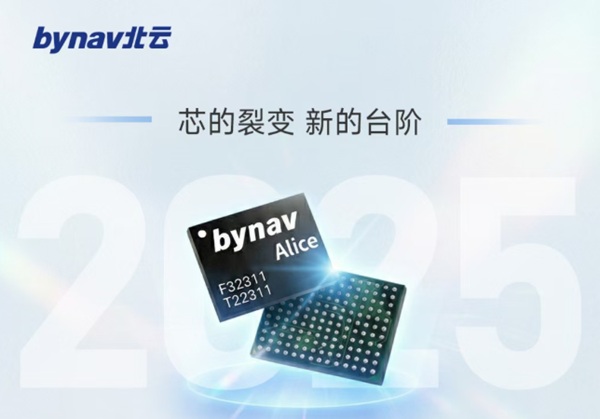
在智能驾驶与机器人技术快速迭代的今天,高精度定位已成为核心"基础设施"。作为行业领跑者, 北云科技凭借自研芯片与组合导航技术,在2025年交出了一份亮眼的成绩单:其核心产品Alice GNSS SOC芯片累计出货量已超150万套,智能汽车应用出货量突破百万套,用硬核实力印证了"车规级品质铸 就百万交付"的行业信赖。 作为组合导航P-Module的首创者,北云科技通过单模块集成GNSS+IMU的创新架构,以自研芯片 驱动深耦合组合导航算法,实现了抗干扰、防欺骗的系统级功能安全(ASIL-B GNSS SoC + ASIL-B IMU芯片),可从容应对复杂电磁环境,确保系统安全可靠。 同时,北云科技的车规级组合导航模块已实现全球首发量产,并搭载地平线、英伟达等主流AI平 台大规模装车。其D3系列车规级高性能IMU 模块,通过全温区间精密标定有效抑制温漂误差,已进入 大规模量产装车阶段,进一步夯实了在智能驾驶领域的技术壁垒。 场景延伸:从智能汽车到割草机器人,技术创新引领行业变革 北云科技的高精度定位技术不仅局限于汽车领域,在割草机器人等新兴场景同样展现出强大的创新 力。通过将硬件架构从三层优化为双层,北云科技推出 ...
奇瑞李坤鹏:加强高阶智驾交付能力 增强中国汽车国际竞争力提升
Zhong Guo Qi Che Bao Wang· 2026-02-13 07:08
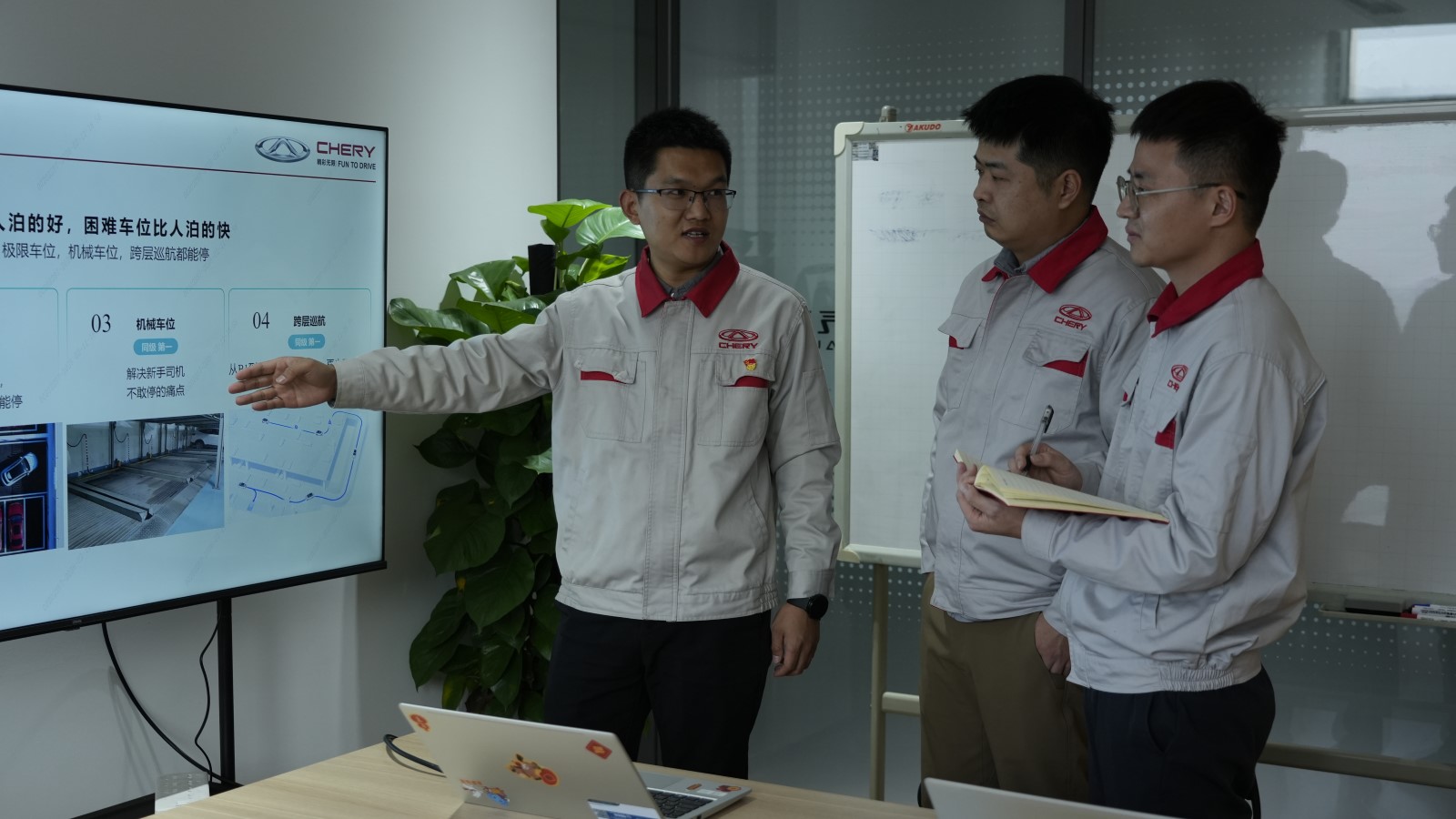
作为奇瑞汽车全球技术创新中心的智驾中心国际交付部主任工程师,李坤鹏主要负责国际高阶智驾方案的量产交付,为了确保海外智能新能源汽车的高 质量交付,李坤鹏和同事们确立了"专业、协同、务实,目标及结果导向"的工作准则,拿出了不错的工作成果。 受国内汽车市场竞争的影响,智驾中心工作节奏也越来越快,研发流程体系也在向敏捷化、客户需求导向转变;用户的需求日新月异,也推动研发部门 对产品的迭代更加迅速。 专业、协同、务实,目标及结果导向 2025年,中国汽车出口超过700万辆,再上一个新台阶。智能化、电动化成为中国汽车出口的重要推动力。奇瑞作为中国汽车出口的领军企业,2025年 的出口量达到134.4万辆,占奇瑞汽车当年总销量的近一半。智能新能源汽车竞争力的快速提升,支撑奇瑞汽车在国内国际两个市场快速开拓。 随着销量的大幅增长,奇瑞汽车也在不断加大研发投入,提升技术水平。智驾中心在智驾方面也取得了很多新突破,如更先进的自动驾驶算法、更智能 的驾驶辅助系统等。李坤鹏表示,"这些新技术的应用,不仅让车辆的安全性和舒适性得到了显著提升,也为整个汽车行业的发展提供了新的思路和方向。" 在李坤鹏看来,对于企业来说,销量的增长和技术的 ...
多家车企明确2027年计划开展全固态电池装车示范工作;MinerU完成10余家国产AI芯片算力适配丨智能制造日报
创业邦· 2026-02-13 03:37
欢迎加入 睿兽分析会员 ,解锁 AI、汽车、智能制造 等相关 行业日报、图谱和报告 等。 1.【多家车企明确2027年计划开展全固态电池装车示范工作】记者获悉,吉利汽车、奇瑞汽车等多家 车企近日披露各自全固态电池产业规划方案。吉利控股高级副总裁兼CTO沈源表示,公司在全固态电 池领域布局了三大技术路线,在应用规划方面,短期目标是2026年完成样车首发;2027年全固态电 池实现小批量产业化;长期目标是2030年完成全固态电池的产业化布局,并在高端车型上批量上 市。奇瑞汽车副总裁古春山表示,公司计划2026年实现0.5GWh中试线投产、PACK样包下线,完成 60Ah级全固态电芯的连续化生产;2027年正式启动全固态电池装车示范工作,推动技术从产线走向 实车验证,逐步实现规模化应用落地。(财联社) 2.【MinerU完成10余家国产AI芯片算力适配】2月12日消息,目前上海人工智能实验室 OpenDataLab团队、DeepLink团队及国产芯片厂家合作,已完成昇腾、平头哥、沐曦、海光、燧 原、摩尔线程、天数智芯、寒武纪、昆仑芯、太初元碁、壁仞等10余家主流国产算力的适配。 MinerU为上海人工智能实验室研发 ...


观察|1月车市三把“王座”全部易主
Guang Zhou Ri Bao· 2026-02-13 03:15
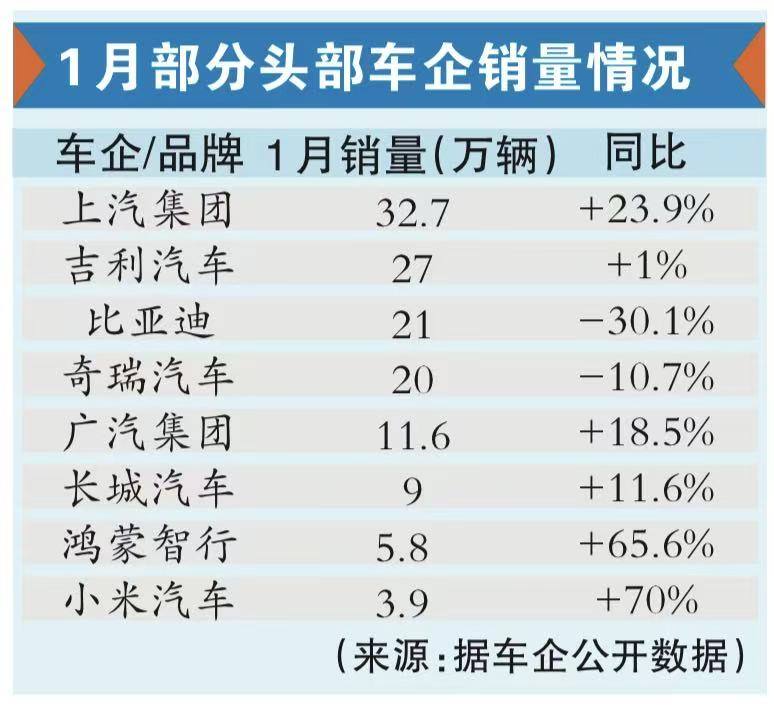
Core Insights - The January sales figures indicate a significant shift in the competitive landscape of the Chinese automotive market, with traditional giants like SAIC and Geely reclaiming leadership positions, while BYD's dominance is challenged [1][3][4] Group 1: Sales Performance - SAIC Group achieved sales of 327,000 vehicles in January, marking a year-on-year increase of 23.9% [2][4] - Geely Automotive sold 270,100 vehicles, a year-on-year growth of 1%, surpassing BYD to become the top-selling domestic brand [2][4] - BYD's sales fell to 210,000 vehicles, experiencing a significant year-on-year decline of 30.1% [2][4] - New energy vehicle sales for SAIC reached 85,000 units, growing by 39.7% [4] - The overall automotive production and sales in January were 2.45 million and 2.346 million units, respectively, with a slight year-on-year production increase of 0.01% [7] Group 2: New Players and Market Dynamics - The new energy vehicle segment saw a reshuffling, with Hongmeng Zhixing leading the new force with 57,915 units sold, a remarkable year-on-year increase of 65.6% [6] - Xiaomi Automotive followed closely with over 39,000 units sold, achieving a year-on-year growth of approximately 70% [6] - The previous leaders in the new force segment, such as Leap Motor, have seen a decline, with their sales dropping to 32,059 units [6] Group 3: International Market Growth - The overseas market is identified as a key growth area for automotive companies, with January exports reaching 681,000 vehicles, a year-on-year increase of 44.9% [7] - Exports of new energy vehicles doubled to 302,000 units, highlighting the importance of global expansion for competitive advantage [7]


早报|影石CEO回应年会送房送车/12306新增「低人一等座」提醒/OpenAI发布新模型,用英伟达对手芯片
Sou Hu Cai Jing· 2026-02-13 01:43
Group 1 - The State Administration for Market Regulation opposes manufacturers engaging in "involution" and selling cars at a loss, aiming to promote healthy competition in the automotive market [3] - The newly released guidelines clarify the boundaries of pricing behavior in the automotive industry, encouraging compliance and fair competition among manufacturers and sellers [3] - The guidelines specify that automotive manufacturers must not engage in pricing behaviors that aim to eliminate competitors or monopolize the market, which poses significant legal risks [3] Group 2 - OpenAI announced the release of a new real-time programming model, GPT-5.3-Codex-Spark, which is a more compact version of GPT-5.3-Codex, optimized for low-latency hardware [5][7] - The Codex-Spark model can generate over 1000 tokens per second and is currently available as a research preview for ChatGPT Pro users [5][7] - The model operates on Cerebras' Wafer Scale Engine 3, which features 40 trillion transistors and 900,000 AI cores, providing extremely low latency [7] Group 3 - Multiple automotive companies, including Geely, Chery, and BYD, have disclosed their plans for solid-state battery technology, with Geely aiming for small-scale production by 2027 and a long-term goal of mass production by 2030 [18][19][20] - Chery plans to start pilot production of solid-state batteries by 2026 and aims to validate the technology in real vehicles by 2027 [20] - BYD is focusing on sulfide solid-state batteries, expecting to achieve small-scale production by 2027 [23] Group 4 - Meizu's smartphone business is reportedly facing dissolution, with the Meizu 23 project allegedly halted [25][26] - The company has not officially responded to the rumors, and customer service has stated that no notifications regarding the business's status have been received [26] Group 5 - ByteDance is set to release the upgraded Doubao model on February 14, 2026, which will include significant enhancements to its foundational model capabilities [34][35] - The Doubao 2.0 model is expected to be a multimodal model with 1 trillion parameters, marking a substantial advancement in the company's AI capabilities [35] Group 6 - Xiaomi has launched its first-generation robot VLA model, which features 4.7 billion parameters and excels in visual language understanding and real-time execution capabilities [39][42] - The model has achieved state-of-the-art results in various benchmarks and is designed for high efficiency in real-world tasks [42] Group 7 - Lenovo reported a 72% year-on-year increase in AI-related revenue, which now accounts for 32% of the company's total revenue, driven by growth in AI PCs, smartphones, and servers [32][36] - The company has successfully navigated challenges in the global AI supply chain, maintaining its commitment to double-digit revenue growth and profitability [32]




央行今日开展1万亿元买断式逆回购操作;氢能19项国家标准征求意见丨盘前情报
2 1 Shi Ji Jing Ji Bao Dao· 2026-02-13 00:59
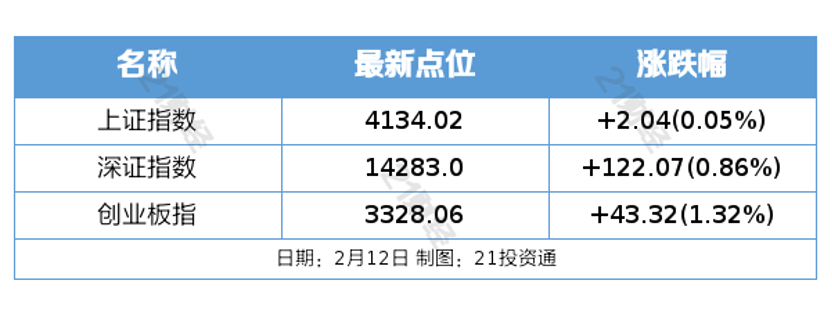
Market Performance - On February 12, the three major indices of A-shares collectively rose, with the ChiNext Index and the Sci-Tech Innovation 50 Index both increasing by over 1% [1] - The Shanghai Composite Index rose by 0.05% to 4134.02 points, the Shenzhen Component Index increased by 0.86% to 14283.0 points, and the ChiNext Index rose by 1.32% to 3328.06 points [2] - The total trading volume of the Shanghai and Shenzhen markets reached 2.14 trillion yuan, an increase of 157.5 billion yuan compared to the previous trading day [1] Sector Performance - The computing power industry chain saw a collective surge, with strong performance in computing power leasing concepts, CPO concepts, and liquid cooling server concepts [1] - The consumer sector experienced a collective decline, with significant drops in the film and television, tourism, retail, and food and beverage sectors [1] International Market Overview - The New York stock market saw declines on February 12, with the Dow Jones Industrial Average falling by 669.42 points (1.34%) to 49451.98 points, the S&P 500 dropping by 108.71 points (1.57%) to 6832.76 points, and the Nasdaq Composite decreasing by 469.32 points (2.03%) to 22597.15 points [3] - In Europe, the FTSE 100 index fell by 0.67%, while the CAC 40 index rose by 0.33%, and the DAX index saw a negligible decline of 0.01% [3] Central Bank Actions - The People's Bank of China announced a 10 billion yuan reverse repurchase operation scheduled for February 13 to maintain ample liquidity in the banking system [5] Policy Developments - The National Development and Reform Commission and other departments plan to establish a mandatory insurance system for unmanned aerial vehicles by 2027, aiming to enhance the low-altitude economy [6] - The Ministry of Commerce announced that starting February 13, 2026, it will impose countervailing duties on imported dairy products from the EU due to subsidies causing substantial harm to domestic industries [8] Technological Advancements - Shenzhen aims to strengthen its semiconductor industry by leveraging AI technology in key areas of the semiconductor supply chain, focusing on high-performance AI chips for various applications [10] - A breakthrough in 3D printing technology allows for the high-resolution printing of complex objects in just 0.6 seconds, marking a significant advancement in the field [13] Automotive Industry Developments - Several automakers, including Geely and Chery, have outlined plans to begin demonstration work on solid-state batteries by 2027, with goals for small-scale industrialization by 2026 [14] Investment Insights - Southwest Securities highlighted the increasing adoption of liquid cooling solutions in AI servers, indicating a structural growth opportunity in the AI computing power chain [15] - Zhongyin International suggested that the real estate sector may present significant profit opportunities in 2026, with some companies potentially reversing previous losses [15]
财经观察:中国车企出海加拿大,机遇还是险滩?
Huan Qiu Shi Bao· 2026-02-12 22:56
Core Viewpoint - Canada is actively pursuing a joint venture with Chinese automakers to establish an electric vehicle (EV) manufacturing plant aimed at global exports, reflecting a significant policy shift to reduce reliance on the U.S. automotive market and strengthen its domestic industry [1][4][5]. Group 1: Joint Venture and Collaboration - The Canadian government is in "active dialogue" with Chinese automakers to explore the establishment of an EV assembly plant in Canada, leveraging a joint venture model that combines Chinese vehicle platforms with Canadian labor and technology [2][4]. - Canadian companies like Magna International and Linamar are already engaged in business in China and are expected to participate in the joint venture, enhancing collaboration between local and Chinese firms [2][4]. Group 2: Policy Changes and Market Dynamics - The Canadian government has made significant adjustments to its EV import policy, allowing for an annual quota of 49,000 Chinese electric vehicles with a reduced tariff of 6.1%, a major shift from the previous 100% tariff [5][9]. - A recent survey indicates that 78% of Canadians support the new EV agreement with China, highlighting a broad public backing for diversifying trade away from the U.S. [5][6]. Group 3: Market Opportunities and Consumer Sentiment - The agreement is expected to lead to over 50% of imported Chinese EVs being priced below CAD 35,000, making them more accessible to Canadian consumers [7]. - Despite concerns about the impact on domestic industries and geopolitical implications, 62% of Canadians support allowing more Chinese EVs into the market, with many believing it will increase competition and lower prices [6][7]. Group 4: Infrastructure and Challenges - Current charging infrastructure in Canada, with 14,500 stations and 38,700 charging points, is deemed sufficient for the anticipated increase in EVs, but expansion is necessary to meet future demand [8]. - Concerns remain regarding after-sales service and the adequacy of infrastructure in remote areas, which could hinder the adoption of electric vehicles [7][8]. Group 5: Strategic Implications - The collaboration with Chinese automakers is seen as a pragmatic step for Canada to diversify its trade relationships and reduce dependency on the U.S. market, with experts suggesting that about 10% of Canada's EV sales could shift to Chinese manufacturers [9][10]. - The investment environment in Canada is under scrutiny, with experts advising caution regarding the sustainability of policies and the real market response to these changes [10].