
TCL

Search documents
阳光电源含量超20%!光伏ETF(159857)逆市上扬涨超1%,17家企业正在搭建联合体,反内卷再提速!
Sou Hu Cai Jing· 2025-10-30 03:04
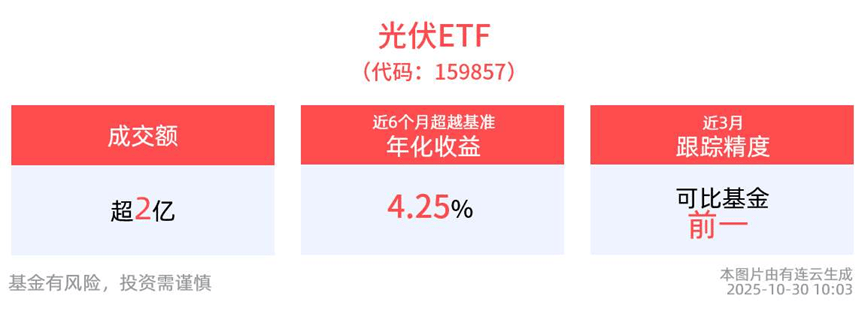
Core Viewpoint - The photovoltaic ETF (159857) has shown significant growth, with a 1.17% increase on October 30, 2025, and a weekly increase of 11.57%, indicating strong investor interest and market recovery in the solar energy sector [2][3]. Product Highlights - The photovoltaic ETF (159857) is characterized by a large scale and superior liquidity, with over 70,000 investors holding shares, making it an efficient tool for investors to capitalize on the global renewable energy revolution and the photovoltaic industry's core assets [2]. - The ETF has seen a significant increase in scale, growing by 94.04 million yuan in the past week [2]. Related Events - A coalition of 17 leading photovoltaic companies, including Longi Green Energy and Tongwei Co., has been formed to establish a storage platform aimed at reducing excessive competition in the industry through joint storage and production cuts, promoting high-quality development [2][3]. - The coalition may include downstream companies like TCL, which could help balance silicon material price fluctuations and component cost issues, ensuring supply chain stability [3]. Institutional Perspectives - According to Industrial Securities, Q3 performance for some photovoltaic companies has shown significant improvement, with GCL-Poly Energy reporting a substantial turnaround in profits for Q3 2025, and Tongwei Co. showing a notable reduction in losses [3]. - The photovoltaic industry is expected to benefit from both performance improvements and the positive impacts of the anti-involution measures, suggesting a favorable environment for investment in the sector [3].






光伏股集体走高,光伏产能收储17家企业基本都已签字,有望引领行业供给侧改革
Zhi Tong Cai Jing· 2025-10-30 02:12
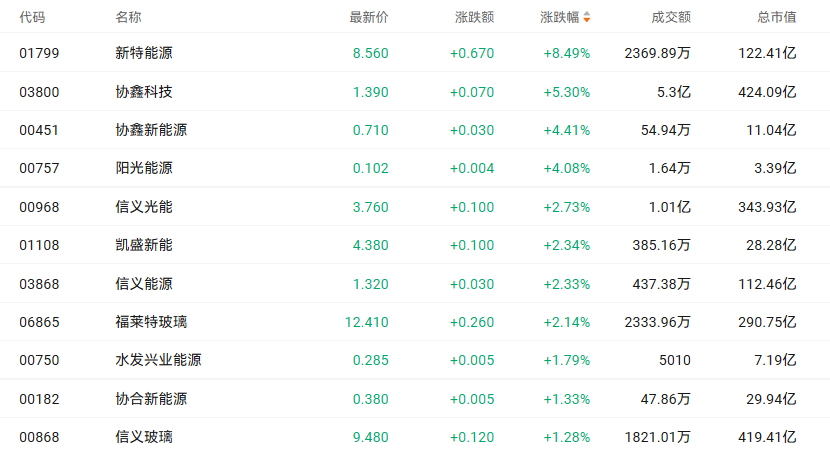
Core Viewpoint - The photovoltaic stocks have collectively risen, with significant increases observed across various companies, indicating a positive market sentiment in the solar energy sector [1]. Company Performance - Xinte Energy (01799) saw a price increase of 8.49%, reaching 8.560, with a trading volume of 236.99 million and a market capitalization of 12.241 billion [2]. - GCL-Poly Energy (03800) increased by 5.30% to 1.390, with a trading volume of 530 million and a market capitalization of 42.409 billion [2]. - GCL-New Energy (00451) rose by 4.41% to 0.710, with a trading volume of 549,400 and a market capitalization of 1.104 billion [2]. - Sunshine Energy (00757) increased by 4.08% to 0.102, with a trading volume of 16,400 and a market capitalization of 0.339 billion [2]. - Xinyi Solar (00968) saw a 2.73% increase to 3.760, with a trading volume of 10.1 million and a market capitalization of 34.393 billion [2]. - Other companies such as Kaisheng New Energy (01108), Xinyi Energy (03868), and Fuchai Glass (06865) also reported positive price movements ranging from 1.28% to 2.14% [2]. Industry Developments - According to a report by Shanghai Securities News, GCL Group's chairman, Zhu Gongshan, mentioned that 17 leading companies in the photovoltaic sector have signed agreements for joint capacity storage [2]. - Shenwan Hongyuan released a research report stating that polysilicon is a key focus for combating industry competition, and the establishment of a joint platform will accelerate supply-side reforms in polysilicon [2]. - The report also indicated that the ongoing efforts to combat competition are leading to noticeable recovery in industry prices and profitability, with expectations for price increases starting in Q3 2025 under a "not below cost sales" pricing regulation [2].


光伏股集体走高 光伏产能收储17家企业基本都已签字 有望引领行业供给侧改革
Zhi Tong Cai Jing· 2025-10-30 02:05
Core Viewpoint - The solar energy stocks have collectively risen, driven by positive developments in the industry, particularly the establishment of a joint storage capacity among leading companies in the domestic photovoltaic sector [1] Group 1: Stock Performance - New Special Energy (01799) increased by 8.75%, reaching HKD 8.58 [1] - GCL-Poly Energy (03800) rose by 6.06%, reaching HKD 1.39 [1] - Xinyi Solar (00968) saw a 3.83% increase, reaching HKD 3.8 [1] - Flat Glass Group (601865) gained 2.39%, reaching HKD 12.44 [1] Group 2: Industry Developments - GCL-Poly Chairman Zhu Gongshan announced that 17 leading companies have signed agreements regarding joint storage capacity during a recent interview [1] - The establishment of a joint platform is expected to accelerate supply-side reforms in the polysilicon sector, as noted in a report by Shenwan Hongyuan [1] - The ongoing efforts to combat "involution" are leading to noticeable recovery in industry prices and profitability [1] Group 3: Future Outlook - By the third quarter of 2025, the polysilicon industry is anticipated to begin price increases under regulations requiring sales at "not lower than cost," gradually recovering above the comprehensive cost line [1]

港股异动 | 光伏股集体走高 光伏产能收储17家企业基本都已签字 有望引领行业供给侧改革
Zhi Tong Cai Jing· 2025-10-30 01:43
Core Viewpoint - The solar energy stocks have collectively risen, driven by positive developments in the industry, particularly the establishment of a joint platform among leading companies for capacity storage and supply-side reforms in the polysilicon sector [1] Group 1: Stock Performance - New Special Energy (01799) increased by 8.75%, reaching HKD 8.58 [1] - GCL-Poly Energy (03800) rose by 6.06%, reaching HKD 1.39 [1] - Xinyi Solar (00968) saw a rise of 3.83%, reaching HKD 3.8 [1] - Flat Glass Group (06865) increased by 2.39%, reaching HKD 12.44 [1] Group 2: Industry Developments - GCL-Poly Chairman Zhu Gongshan announced that 17 leading companies have signed agreements regarding joint capacity storage [1] - The establishment of a joint platform is expected to accelerate supply-side reforms in the polysilicon sector [1] - The ongoing efforts to combat "involution" are leading to noticeable recovery in industry prices and profitability [1] Group 3: Future Outlook - By Q3 2025, the polysilicon industry is expected to start price increases under regulations requiring sales at "not lower than cost" [1] - The industry aims to gradually restore prices above the comprehensive cost line [1]
【企业风景】 透视“中国跨国100大”:制造和基建领风骚
Zheng Quan Shi Bao· 2025-10-13 18:07
Core Insights - The "Top 100 Chinese Multinational Companies" list represents China's integration into the global economy and highlights the achievements of Chinese multinational enterprises [1] - Analyzing the development and characteristics of these companies can provide valuable insights and benchmarks for other Chinese enterprises looking to expand internationally [1] Group 1: Technology Manufacturing - Technology manufacturing companies constitute over one-third of the "Top 100" list, primarily driven by private enterprises like Huawei, Lenovo, and Haier [2] - These companies aim to capture larger markets by leveraging product technology and after-sales service, with a notable increase in solar and new energy firms joining the ranks [2] - The internationalization strategies of these firms are diverse, including direct sales, cross-border mergers, and local production, allowing for flexible market entry [2] Group 2: Resource Production - Resource production companies also make up over one-third of the list, predominantly consisting of large state-owned enterprises [3] - These companies focus on energy and mineral resources, with their overseas operations being more localized and independent compared to technology manufacturers [3] - The investment and operational scale at each overseas site are significant, but the overall global integration is lower [3] Group 3: Infrastructure - Infrastructure companies account for just over 10% of the list and are primarily state-owned, providing essential support for other Chinese enterprises venturing abroad [3] - Their operations include transportation, power engineering, and urban construction, acting as international partners for technology and resource companies [3] Group 4: Service Industry - The service industry, including traditional and emerging internet services, currently represents less than 10% of the list [4] - Traditional service firms are limited in their international expansion, while internet companies are increasingly becoming a new force in internationalization, with notable entries in recent years [4] - Internet firms tend to pursue international growth through cross-border mergers and equity investments, although their overseas revenue remains low compared to their foreign assets [5] Group 5: International Logistics - International logistics companies, such as China COSCO Shipping and China International Marine Containers, are also represented on the list, highlighting their role as inherently international enterprises [5] - These firms support China's global supply chain and have significant operational capabilities, including shipping and port operations [5] Group 6: Comprehensive Holdings - Comprehensive holding companies show fluctuating rankings on the list, influenced by changes in their overseas holdings [5] - The collective representation of these multinational enterprises underscores China's image as a manufacturing powerhouse and infrastructure expert on the global stage [5]
Are TCL shares or FMG shares better value in 2025?
Rask Media· 2025-10-13 05:27
Group 1: Company Overview - Transurban Group specializes in managing and developing urban toll road networks across Australia, Canada, and the United States, holding interests in 22 urban motorways including CityLink in Melbourne and the Hills M2 in Sydney [1][2] - Fortescue Ltd is a leading iron ore production and exploration company, primarily focusing on iron ore production with over 190 million tonnes shipped annually, and expanding exploration efforts for key materials such as copper, rare earths, and lithium [3][4] Group 2: Financial Metrics - For FY24, Transurban Group reported a debt/equity ratio of 175.1%, indicating high leverage, with an average dividend yield of 3.6% over the last 5 years and a return on equity (ROE) of 3.0% [5][6][7] - Fortescue Ltd reported a debt/equity ratio of 27.6% in FY24, indicating more equity than debt, with an average dividend yield of 10.5% since 2019 and an ROE of 30.2% [7]

粤港澳大湾区城市群进阶:迈向创新经济
2 1 Shi Ji Jing Ji Bao Dao· 2025-10-10 13:12
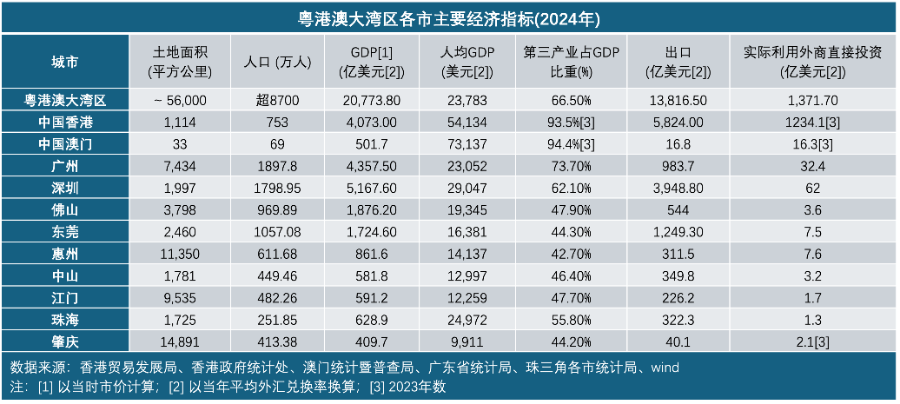
Core Insights - The development of the Guangdong-Hong Kong-Macao Greater Bay Area (GBA) is transitioning from a port-based economy to an innovation-driven economy, with a focus on technological integration and collaboration among cities [5][10][11] - The GBA is projected to surpass New York and San Francisco in economic output by 2024, with an estimated GDP of approximately 14.79 trillion yuan and a per capita GDP of about 170,200 yuan [9][12] - The GBA's urban cluster model is evolving, with a shift from reliance on traditional gateway cities like Hong Kong and Guangzhou to innovation hubs like Shenzhen [3][11] Economic Indicators - The GBA's total land area is approximately 56,000 square kilometers, with a population exceeding 87 million [4] - Key economic indicators for 2024 include: - Total GDP: 20,773.80 billion USD - Per capita GDP: 23,783 USD - Tertiary industry contribution to GDP: 66.50% [4] - Individual city GDPs for 2024 are projected as follows: - Shenzhen: 3.68 trillion yuan - Guangzhou: 3.10 trillion yuan - Hong Kong: 3.18 trillion HKD [12] Talent and Investment Flow - Talent mobility within the GBA has increased by 25% over the past three years, with external exchanges growing by 30% [6] - As of May 2024, the GBA has seen 115,571 participants in the "cross-border wealth management connect," with a total cross-border remittance amounting to 59.061 billion yuan [6][8] - The GBA has attracted over 300 research projects with a total funding exceeding 300 million yuan, highlighting its capacity for innovation and collaboration [8] Strategic Development - The GBA is positioned as a critical hub for linking Southeast Asian markets, leveraging its geographical and market advantages [14][15] - The region is expected to play a significant role in the "dual circulation" strategy, enhancing its function as a key node in both domestic and international supply chains [14][16] - Future development will focus on integrating industry, finance, and innovation to strengthen the GBA's global competitiveness [16]

亿道信息双并购背后,一场AIoT赛道的时间竞赛与战略豪赌
Tai Mei Ti A P P· 2025-09-30 11:00
Core Viewpoint - Yidao Information (001314.SZ) announced a significant acquisition plan to acquire controlling stakes in Guangzhou Langguo Electronic Technology Co., Ltd. and Shenzhen Chengwei Information Co., Ltd., while also planning to raise matching funds. This move is seen as a strategic effort to open new growth avenues amid a competitive landscape in the AI and consumer electronics sectors [2][4]. Group 1: Acquisition Details - The acquisition targets, Langguo Technology and Chengwei Information, have previously attempted independent IPOs but were unsuccessful. Langguo Technology specializes in interactive control and device interconnection solutions, with a product line that includes various TV technologies and partnerships with major brands globally [3][4]. - Chengwei Information focuses on AIDC (Automatic Identification and Data Capture) with products like handheld terminals and RFID readers, serving over 5,000 enterprise clients across more than 150 countries [3][4]. Group 2: Strategic Rationale - The acquisition reflects a strategic pivot for Yidao Information, aiming to enhance its capabilities in AIoT (Artificial Intelligence of Things) and XR (Extended Reality) to address growth challenges. The company reported a revenue of 1.52 billion yuan in the first half of 2025, with a year-on-year growth of 19.24%, but still relies heavily on traditional hardware, which contributes over 70% of its revenue [5][6]. - Yidao Information has identified "AI+" as a top-level strategy, emphasizing the need to strengthen its XR and AIoT product development to capture opportunities in digital transformation and industrial advancements [5][6]. Group 3: Market Context and Challenges - The current IPO environment poses challenges for tech companies, as evidenced by the failed attempts of the acquisition targets to go public. This acquisition is seen as a response to the harsh market conditions and a way to leverage complementary strengths in human-machine interaction and data collection [4][6]. - Despite the clear strategic logic behind the acquisition, uncertainties remain regarding the specific valuation, profit commitments, and integration effectiveness of the acquired companies, which have not yet been disclosed [6].

Omdia: 5G Standalone Networks and RedCap Devices Poised to Transform IoT Landscape in 2025
Businesswire· 2025-09-30 06:42
Core Insights - 2025 is anticipated to be a pivotal year for 5G Standalone (SA) network deployments and RedCap device adoption, creating significant opportunities for IoT applications across various industries [1][2] 5G Standalone Networks - The global rollout of 5G SA networks is gaining momentum after delays in 2024, fulfilling the promise of ultra-fast speeds, ultra-low latency, and extensive connectivity, particularly benefiting manufacturing and industrial automation sectors [2][3] RedCap Devices - The 5G device ecosystem achieved a milestone with T-Mobile launching North America's first commercial 5G RedCap device, the TCL LINKPORT IK511 dongle, in October 2024. Although module costs remain high, prices are expected to decline as adoption increases, especially in China due to anticipated government subsidies [3] Advanced Network Capabilities - Network slicing has moved beyond trial phases, with commercial offerings like T-Mobile's T-Priority and Verizon's FrontLine services now available. Private 5G networks are addressing critical security concerns, which 33% of organizations identified as a top priority for their IoT initiatives according to Omdia's IoT Enterprise Survey 2025 [4] Broader 5G Ecosystem - The 5G ecosystem is expanding through network API monetization, with several key API families being deployed globally [5]

中国银河证券:国补退坡零售下滑 空调出口继续调整
Zhi Tong Cai Jing· 2025-09-23 08:16
Core Viewpoint - The air conditioning retail market in China is experiencing a significant slowdown due to the impact of reduced national subsidies and high year-on-year comparison bases starting from September 2023 [1][2]. Group 1: Domestic Sales and Production - From September to November, the domestic air conditioning production is expected to decline compared to the same period last year, with decreases of -6.3%, -23.4%, and -17.6% respectively, indicating a cautious industry outlook [1][2]. - In August, domestic air conditioning shipments reached 7.737 million units, showing a year-on-year increase of 1.2%, driven by sustained high temperatures across the country [2]. - The reduction in national subsidy funding has led to various measures across provinces to control subsidy spending, including daily limits on subsidies and the suspension of certain categories [2]. Group 2: Export Trends - In August, air conditioning exports totaled 5.287 million units, reflecting a year-on-year decrease of 4.2%, although this was an improvement compared to previous production forecasts [3]. - For September to November, the expected production for household air conditioning exports shows declines of -16.6%, -7.8%, and -9.1% respectively, attributed to the transfer of U.S. orders overseas and high year-on-year comparison bases [3]. Group 3: Pricing Dynamics - The retail average price of air conditioners in the offline market has shown a recovery, rising to 4,301 yuan per unit in September after a decline from April to July [4]. - Online retail prices have also improved, with the average price reaching 2,859 yuan per unit in September, following a downward trend earlier in the year [4]. Group 4: Industry Competition and Service Upgrades - Xiaomi has announced an upgrade to a 10-year free warranty for its air conditioners, reflecting a shift in the industry from price competition to a focus on quality and service [5]. - The extension of service periods is expected to enhance consumer confidence in product quality and increase competitive pressure on manufacturers [5]. Group 5: Investment Recommendations - The current market is active, with traditional home appliance leaders lacking growth potential, while technology-related companies are performing better [6][7]. - Recommendations include companies with low valuations and high dividend yields, such as Midea Group and Haier Smart Home, as well as innovative firms like Ousheng Electric and Rongtai Health [6][7].
