东风股份

Search documents
车市年终“翘尾”失败 2026年市场承压
经济观察报· 2025-12-14 04:51
Core Viewpoint - The automotive market in 2026 is expected to face significant pressure due to the cancellation of subsidies and the introduction of a 50% purchase tax on new energy vehicles [1][4][12]. Group 1: Market Conditions - The automotive market is experiencing a downturn, with retail sales in November dropping to 2.225 million units, a year-on-year decrease of 8.1% [6]. - The cancellation of local subsidies has led to a significant decline in consumer activity, with many dealerships reporting a lack of customers compared to previous years [2][7]. - The expectation of a year-end sales surge has not materialized, as dealers report disappointing sales figures [6][12]. Group 2: Subsidy Policies - The central government's vehicle replacement subsidy is set to continue until December 31, 2025, but many local subsidies have already been exhausted [2][8]. - The introduction of a 50% purchase tax on new energy vehicles starting in 2026 is anticipated to further strain the market [4][12]. - Despite the challenges, some regions are still implementing local subsidies to stimulate sales, with examples of cash incentives being offered in various cities [9][14]. Group 3: Company Responses - In response to the market conditions, many automakers are introducing their own incentives, such as covering the additional purchase tax for customers who order vehicles before the end of 2025 [3][12]. - Companies like Dongfeng Honda and Lynk & Co are optimistic about maintaining stable sales through strategic product offerings and adapting to policy changes [12][13]. - Automakers are focusing on enhancing their product value and aligning their strategies with local market demands to navigate the upcoming challenges [13][14].

车市年终翘尾失败 2026年市场承压
Jing Ji Guan Cha Wang· 2025-12-14 03:10
Group 1 - The automotive market is experiencing a significant slowdown as various regions exhaust their vehicle trade-in subsidies, leading to a lack of consumer activity in dealerships [2][4] - The cancellation of national and local subsidies, along with the introduction of a 50% purchase tax on new energy vehicles starting next year, has negatively impacted market expectations for year-end sales [2][4] - In November, retail sales of passenger vehicles dropped to 2.225 million units, a year-on-year decrease of 8.1%, with fuel vehicles seeing a 22% decline [4][5] Group 2 - Car manufacturers are implementing their own discount policies to stimulate sales, including covering the increased purchase tax for vehicles ordered before the subsidy deadline [3][8] - The China Automobile Dealers Association reported that the overall survival status of dealers is expected to worsen in the coming year, indicating a lack of confidence in the market [4][8] - The 2025 vehicle trade-in subsidy is projected to exceed 180 billion yuan, with a significant portion allocated to automotive subsidies, suggesting potential growth in the market despite current challenges [8][11] Group 3 - Some automakers remain optimistic about the 2026 market, anticipating stable demand for fuel vehicles and growth in hybrid and plug-in models [9][10] - Companies are developing strategies to adapt to policy changes, including monitoring local subsidy dynamics and adjusting product offerings to meet consumer needs [10][11] - There is potential for new growth points in the market, particularly through rural consumption initiatives and the expansion of services related to used cars and aftermarket activities [11]
乌拉圭2025年前11个月新车销量同比增长9.1%
Shang Wu Bu Wang Zhan· 2025-12-13 15:42
在品牌表现方面,今年前11个月全品类汽车总销量排名前五的品牌依次为:菲亚特(8,492辆)、比亚迪(6,875 辆)、雪佛兰(6,711辆)、大众(5,785辆)和雷诺(5,486辆)。在细分市场中,比亚迪在SUV领域位居榜首,在轿 车领域排名第四;小巴士领域则由江淮汽车位列第三;卡车市场方面,江淮和江铃保持领先地位,东风位列第四。 fund (原标题:乌拉圭2025年前11个月新车销量同比增长9.1%) 乌拉圭《国家报》2025年12月10日报道,根据乌拉圭汽车贸易协会的数据,11月该国新车单月销量为6,483辆,同 比微降1.7%。然而,前11个月的累计销量已达到64,477辆,同比增长9.1%。其中,SUV车型表现尤为亮眼,前11个月 销量大幅增长44.7%,达到21,054辆。 ...



为了年销100万辆,为了对冲“含华量”稀释,余承东跟“五界”抱作一团
虎嗅APP· 2025-12-13 13:23
Core Viewpoint - The article discusses the strategic collaboration among six automotive leaders under the "Hongmeng Intelligent Driving" alliance, emphasizing the need for substantial integration and cooperation to enhance user experience and market competitiveness [2][5][21]. Group 1: Alliance Formation and Goals - The "Hongmeng Intelligent Driving" alliance aims to create a unified service system and shared charging network, enhancing the smart automotive ecosystem [4][9]. - The alliance will focus on five key areas: standardized solutions, a standardized service system, a shared charging network, innovation technology implementation, and joint marketing services [7][9]. Group 2: Standardized Service System - The alliance plans to establish the industry's first cross-brand shared after-sales service center network, ensuring standardized processes across all brands [10][13]. - There are concerns about how brands within the alliance, ranging from 150,000 to 1,000,000 yuan, will share standardized services effectively [10][12]. Group 3: Market Performance and Sales Goals - The sales target for the "Hongmeng Intelligent Driving" alliance in 2026 is set between 1,000,000 to 1,300,000 units, aiming to position itself among the top three in the domestic new energy vehicle market [12][15]. - As of November 2025, the alliance achieved retail sales of 498,938 units, marking a year-on-year growth of 26.2% [12][14]. Group 4: Competitive Landscape and Challenges - The article highlights the competitive dynamics in the new energy vehicle market, particularly between "Hongmeng Intelligent Driving" and other brands like Leap Motor, which also targets a sales goal of 1,000,000 units for 2026 [15][21]. - The success of the alliance hinges on the ability of traditional automakers to adapt and collaborate effectively with Huawei, addressing organizational and cultural changes [22][23].
中央经济工作会议最新部署,明确未来五年国企改革方向
Hua Xia Shi Bao· 2025-12-13 09:18
Core Viewpoint - The concentration of state-owned capital in industries crucial to national security and the economy is becoming a key direction for the new round of state-owned enterprise (SOE) reform in China, as highlighted in the Central Economic Work Conference held on December 10-11, which emphasizes the need for further reform plans [1][2]. Group 1: State-Owned Enterprises and Economic Impact - The total assets of state-owned enterprises (excluding financial enterprises) in China have increased from 89.5 trillion yuan in 2012 to 401.7 trillion yuan by the end of 2024, indicating a significant growth trajectory [1]. - In 2024, the operating revenue of state-owned enterprises (excluding financial enterprises) is projected to reach 84.7 trillion yuan, with total profits of 4.35 trillion yuan and tax contributions of 5.88 trillion yuan, all of which have doubled since 2012 [1]. Group 2: Functional Reform and Strategic Focus - The focus of the new round of SOE reform will be on functional reform, aiming to enhance core functions and competitiveness while optimizing the layout and structure of state-owned capital [2][4]. - The reform will involve improving the evaluation system for state-owned enterprises, promoting them as sources of original technology, and enhancing their support roles in critical areas such as national defense, energy resources, and food supply [4]. Group 3: Integration and Optimization - Professional integration has become a key approach for optimizing the layout of state-owned enterprises, with over a thousand projects initiated this year to promote resource concentration towards leading enterprises through asset restructuring and cooperation [4]. - The establishment of the China Salt Lake Industry Group aims to integrate domestic and international potassium and lithium resources, creating a significant player in the salt lake industry [4]. Group 4: Modern Enterprise System - The improvement of the modern enterprise system with Chinese characteristics is a crucial part of the socialist system, with recent policies emphasizing the need for better governance and management efficiency in state-owned enterprises [6][7]. - The government is encouraged to enhance the service system while enterprises focus on internal improvements to adapt to market competition and transformation [6]. Group 5: Governance and Leadership - The principle of maintaining the Party's comprehensive leadership over state-owned enterprises is emphasized, with calls for improved governance structures and management innovation to support high-quality development [7]. - Local governments, such as Shanxi Province, are implementing measures to enhance the governance of state-owned enterprises, including personalized assessments based on industry characteristics [7].

引客入堰 以“工”为媒激活城市文旅消费新动能
Sou Hu Cai Jing· 2025-12-13 08:33
Core Insights - The article highlights the successful implementation of the "Bring Guests to Shiyan" initiative by the Shiyan Municipal Federation of Trade Unions, which has attracted over 25,000 labor model workers from 23 provinces and regions in China this year [1][3]. Group 1: Tourism and Cultural Integration - The Shiyan Municipal Federation of Trade Unions has developed a unique tourism route combining Wudang Dao culture and ecological health, enhancing the experience for labor model workers [3]. - The first group of labor model workers from Tibet visited the Wudang Mountain Health Resort, experiencing both natural and cultural attractions, which received positive feedback [3]. - The initiative aims to create a service system that integrates health care, cultural experiences, and red education, expanding the network of labor model workers [3][4]. Group 2: Economic Impact and Local Engagement - Labor model workers not only engage in tourism but also contribute to local consumption by purchasing local products such as mushrooms, olive oil, and yellow wine [4]. - The Shiyan Municipal Federation of Trade Unions has hosted various national trade union activities, enhancing the city's visibility and attracting more visitors [4]. - Events like the national reading exchange activity have brought together representatives from over 50 trade unions, promoting cultural exchange and showcasing the city's charm [4]. Group 3: Skills Competitions and Talent Engagement - Shiyan has hosted skill competitions and conferences, attracting teams from various provinces and cities, showcasing the city's industrial capabilities [5]. - Educational and technological talents from prestigious universities have visited Shiyan to experience its industrial and cultural landscape, further promoting local development [5]. - The initiatives aim to create a sense of belonging among workers while aligning trade union efforts with urban development [5].
万马科技:公司全资子公司优咔科技是国内领先的第三方车联网服务商
Ge Long Hui· 2025-12-12 14:29
Core Viewpoint - The company, Wanma Technology, is a leading third-party provider in the vehicle networking sector, offering comprehensive solutions to automotive manufacturers through its subsidiary, Youka Technology [1] Group 1: Business Overview - Wanma Technology's vehicle networking business includes a global vehicle connection solution called ONESIM, which utilizes proprietary eSIM and 5G dual-card technologies [1] - The company provides services such as connection management, vehicle operation maintenance, traffic operation, global insights, and compliance management to help automotive companies streamline supply chain management and reduce operational costs [1] Group 2: Market Presence - The total number of connections in the company's vehicle networking business has exceeded 17 million, with over 1.1 million connections overseas [1] - Wanma Technology has established close partnerships with more than 10 well-known automotive manufacturers, including Geely, Zeekr, Li Auto, SAIC, Dongfeng, Lantu, and Zhiji [1] - The company provides overseas connection services for several prominent automotive brands, including Geely, Li Auto, Dongfeng Liuzhou Automobile, Dongfeng Motor, and SAIC [1]
消失的车市翘尾
Jing Ji Guan Cha Wang· 2025-12-12 14:22
Core Viewpoint - The automotive market is experiencing a significant downturn due to the exhaustion of various subsidy programs, leading to a lack of consumer enthusiasm and lower sales performance as the year ends [1][3][7]. Group 1: Market Conditions - The automotive market has cooled significantly, with many dealerships reporting low customer traffic and sales, contrasting sharply with previous years' year-end buying frenzies [1][3]. - In November, the national retail sales of passenger vehicles reached 2.225 million units, a year-on-year decline of 8.1% and a month-on-month decline of 1.1% [3][4]. - The decline in sales is attributed to the cancellation of national and local subsidies, as well as the anticipated introduction of a 50% purchase tax on new energy vehicles starting next year [1][3][7]. Group 2: Subsidy Policies - The central government has allocated automotive replacement subsidies until December 31, 2025, but many local governments have exhausted their funds early, leading to a pause in subsidies [1][5]. - The total subsidy budget for 2025 is set to double to 300 billion yuan, with a significant portion allocated for automotive subsidies, expected to exceed 180 billion yuan [5][7]. - Local governments are implementing their own subsidy programs to stimulate market activity, with some regions offering cash incentives for vehicle purchases [6][9]. Group 3: Industry Responses - In response to the market downturn, many automakers are introducing their own incentives, such as covering the increased purchase tax for customers who order vehicles before the end of 2025 but receive them later [2][8]. - Some companies, like Dongfeng Honda and Lynk & Co, remain optimistic about maintaining stable sales in the fuel vehicle segment and anticipate growth in hybrid and plug-in hybrid models [8][9]. - Automakers are developing strategies to adapt to changing policies and consumer demands, focusing on enhancing product offerings and ensuring compliance with local subsidy regulations [9].
万马科技(300698.SZ):公司全资子公司优咔科技是国内领先的第三方车联网服务商
Ge Long Hui· 2025-12-12 14:16
Core Viewpoint - The company, Wanma Technology, is a leading third-party IoT service provider in the automotive sector, offering a comprehensive global vehicle connectivity solution through its subsidiary, Youka Technology [1] Group 1: Business Overview - Wanma Technology's global vehicle connectivity solution, ONESIM, utilizes proprietary eSIM and 5G dual-card technologies to enhance automotive networking capabilities [1] - The company provides services including connection management, vehicle operation maintenance, traffic operation, global insights, and compliance management, aimed at simplifying supply chain management and reducing operational costs for automotive manufacturers [1] Group 2: Market Presence - As of now, the company's vehicle connectivity business has connected over 17 million vehicles globally, with more than 1.1 million connections overseas [1] - Wanma Technology has established close partnerships with over 10 well-known automotive manufacturers, including Geely, Zeekr, Li Auto, SAIC, Dongfeng, Lantu, and Zhiji, and provides overseas connectivity services for several major automotive brands [1]



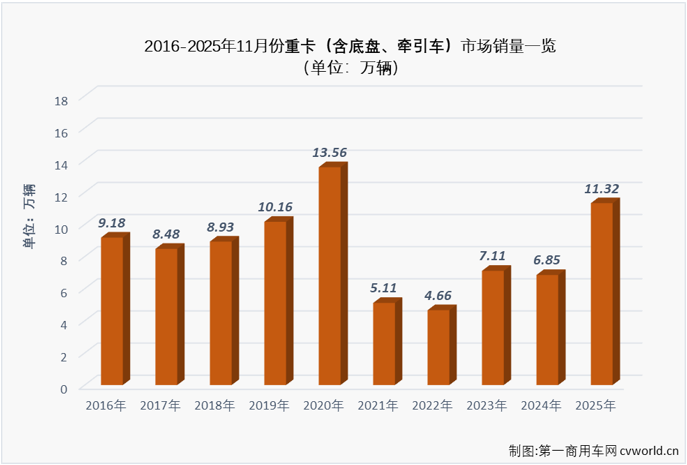
11月份重卡销量同比大增65% 收获同比“8连增”
智通财经网· 2025-12-12 13:36
Core Viewpoint - In November 2025, the heavy truck market in China experienced a significant year-on-year increase of 65%, achieving the highest monthly sales of the year, surpassing the traditional peak months of September and October [1][12]. Sales Performance - Heavy truck sales reached 113,200 units in November, marking a 65% increase year-on-year and a 7% increase month-on-month [2][5]. - Cumulatively, from January to November 2025, heavy truck sales totaled 1,042,300 units, representing a 27% increase compared to the same period last year [5][9]. Market Trends - The heavy truck market has shown a consistent upward trend, with November marking the eighth consecutive month of sales growth [2][7]. - The average monthly sales for the year 2025 stand at approximately 94,600 units, significantly higher than the averages of 2024 and 2023 [5]. Competitive Landscape - The top five companies in the heavy truck market accounted for 87.78% of the total sales in November, with significant contributions from major players such as Heavy Truck and Jiefang [7][11]. - Notable sales figures for November include Heavy Truck at 28,800 units and Jiefang at 23,800 units, both exceeding 20,000 units [7][10]. Year-on-Year Growth - All top ten companies in the heavy truck market reported year-on-year growth in November, with some companies like Foton and Xugong achieving growth rates exceeding 100% [8][10]. - The market concentration has increased, with the top ten companies holding a combined market share of 97.54% [11].