
吉利汽车

Search documents
电动汽车市场洞察,全球前20强生产商排名及市场份额
QYResearch· 2026-02-27 02:23
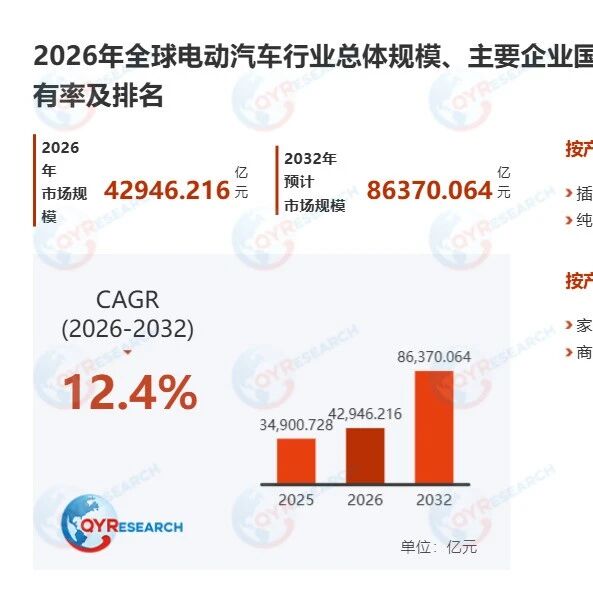
Core Viewpoint - Electric vehicles (EVs) are essential for decarbonizing the transportation sector, offering higher energy conversion efficiency, instant torque, lower noise, and zero tailpipe emissions [2] Market Size - The global electric vehicle market is projected to reach $1,269.9 billion by 2032, with a compound annual growth rate (CAGR) of 12.35% over the coming years [3] Market Landscape - Major global electric vehicle manufacturers include BYD, Tesla, BMW, Volkswagen, Li Auto, Seres Group, Geely, Mercedes-Benz, Volvo, SAIC Motor, Hyundai-Kia, Stellantis, Great Wall Motors, Renault, Chery, NIO, Toyota, GAC Group, Xpeng, Leap Motor, Xiaomi, Ford, and BAIC Group [5][6] - The top five manufacturers hold approximately 47% of the market share [6] Industry Development Opportunities - Advancements in battery technology, thermal management systems, 800V high-voltage architecture, and vehicle electronic platforms provide opportunities for performance enhancement and cost reduction, allowing electric vehicles to penetrate a broader price range [11] - The integration of vehicles with energy systems is expanding application boundaries, promoting a shift from one-time vehicle sales to ongoing service models [11] - The acceleration of electrification in light commercial vehicles, logistics, shared mobility, and emerging markets creates new growth paths for companies with scalable manufacturing, cost control, and localized operations [11] Key Obstacles - Uneven progress in charging network construction across regions affects user experience and convenience [10] - Price fluctuations of key battery materials, supply chain geopolitical risks, and an immature recycling system challenge cost control and long-term stability [10] - Consumer expectations regarding range performance, low-temperature operation, maintenance costs, and second-hand value, along with subsidy policy reductions and electricity price volatility, slow market penetration [10]





魅族:将暂停国内手机新产品自研硬件项目,积极接洽第三方硬件合作伙伴
Xin Lang Cai Jing· 2026-02-27 02:14
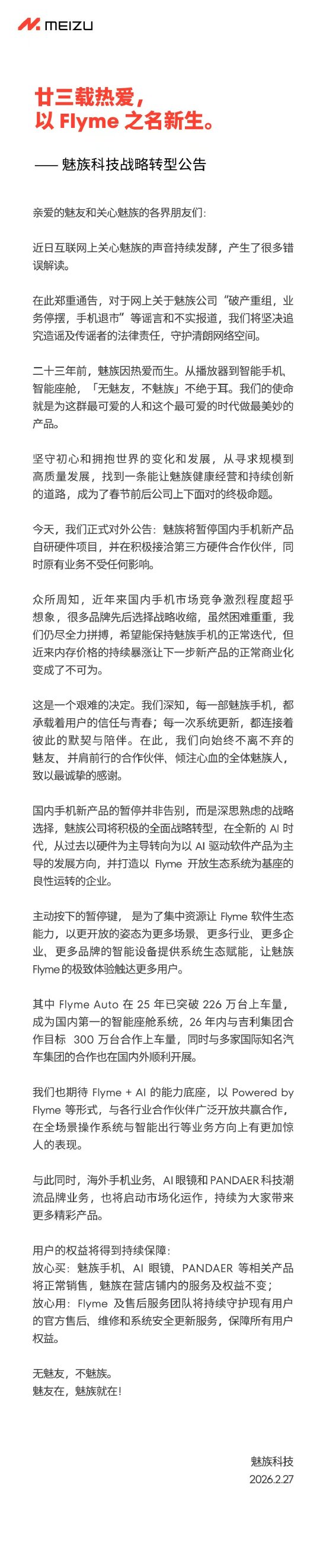
Core Viewpoint - Meizu has announced that rumors regarding its bankruptcy and business suspension are false, and it will pursue legal action against those spreading misinformation. The company will pause its domestic smartphone hardware development while maintaining existing operations and shifting its focus towards AI-driven software products and the Flyme ecosystem [1][5][9]. Group 1: Business Strategy - Meizu will suspend the development of new domestic smartphone hardware projects and is actively seeking partnerships with third-party hardware providers, ensuring that existing business operations remain unaffected [3][9]. - The decision to pause hardware development is a strategic choice aimed at transitioning from a hardware-centric model to one driven by AI software products, with a focus on creating a sustainable business based on the Flyme open ecosystem [3][4][9]. Group 2: Market Context - The domestic smartphone market has become increasingly competitive, leading many brands to scale back their operations. Despite these challenges, Meizu aims to continue the normal iteration of its smartphones [3][9]. - Rising memory prices have made the commercialization of new products increasingly difficult, contributing to the decision to pause new hardware development [3][9]. Group 3: Future Plans - Meizu's Flyme Auto has achieved a milestone of over 2.26 million units in vehicle installations by 2025, making it the leading smart cockpit system in China. The company aims to collaborate with Geely Group to reach a target of 3 million units by 2026 [4][10]. - The company plans to initiate market operations for its overseas smartphone business, AI glasses, and PANDAER technology brand, continuing to deliver innovative products to consumers [6][10].
1月汽车市场总体运行平稳 新能源汽车产销量同比均实现增长
Zhong Guo Zhi Liang Xin Wen Wang· 2026-02-27 01:59
Group 1: Overall Market Performance - In January, the automotive industry in China showed stable overall operation, with production and sales reaching 2.45 million and 2.346 million units respectively, reflecting a month-on-month decline of 25.7% and 28.3%, while production increased by 0.01% year-on-year and sales decreased by 3.2% year-on-year [1] - Domestic sales of automobiles fell to 1.665 million units, a year-on-year decrease of 14.8% and a month-on-month decrease of 33.9% [1] - Exports of automobiles continued to grow, reaching 681,000 units, a year-on-year increase of 44.9% but a month-on-month decline of 9.5% [1] Group 2: Passenger Vehicle Sales - Passenger vehicle sales in January totaled 2.062 million units, with production and sales down 28.4% and 30.2% month-on-month, and down 4.1% and 6.8% year-on-year respectively [2] - Chinese brand passenger vehicles sold 1.329 million units, representing a month-on-month decline of 32.1% and a year-on-year decline of 8.9%, accounting for 66.9% of total passenger vehicle sales [2] - Among major foreign brands, all five key brands experienced double-digit declines compared to the previous month, while American brands saw double-digit growth year-on-year [2] Group 3: Commercial Vehicle Market - The commercial vehicle market continued to show positive trends, with production and sales reaching 388,000 and 359,000 units respectively, reflecting a month-on-month decline of 6.8% and 15.6%, but year-on-year growth of 29.9% and 23.5% [2] Group 4: New Energy Vehicles - The new energy vehicle market remained stable, with production and sales of 1.041 million and 945,000 units respectively, showing month-on-month declines of 39.4% and 44.8%, but year-on-year increases of 2.5% and 0.1% [3] - New energy vehicles accounted for 40.3% of total vehicle sales in January [3] - Among the top 10 automotive companies, sales totaled 1.962 million units, representing 83.6% of total vehicle sales, with several companies like SAIC Group and Geely experiencing varying degrees of growth year-on-year [3] Group 5: Future Market Outlook - The China Automotive Industry Association anticipates that a series of policies aimed at benefiting the public and enterprises will be introduced to stimulate market demand and support stable industry operations [4] - The "14th Five-Year Plan" period is seen as a critical window for the automotive industry in China to transition towards high-quality development, emphasizing the need for quality improvement and efficiency enhancement while maintaining stable market operations [4]
默茨访华,德国汽车更依赖中国了
3 6 Ke· 2026-02-27 01:47
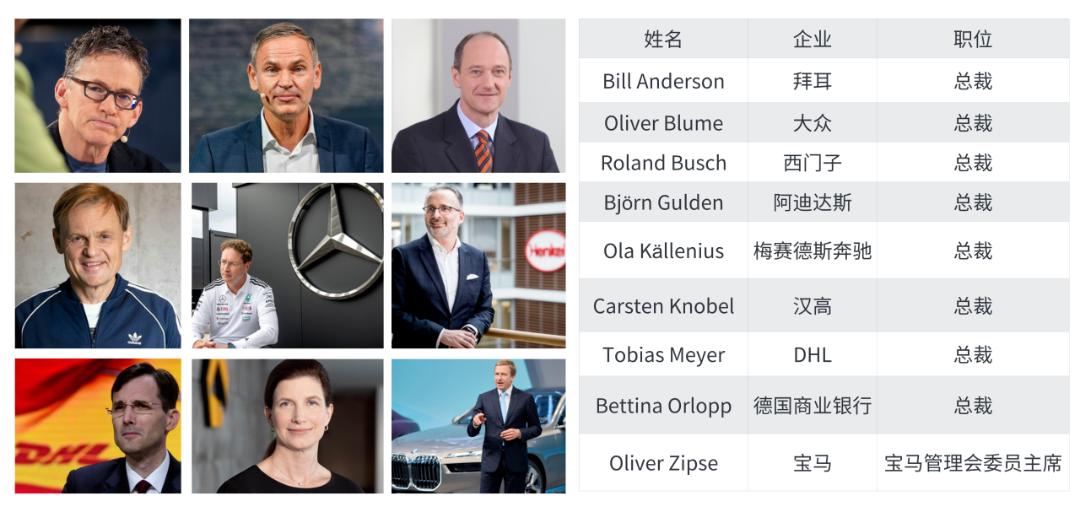
Core Insights - The visit of German Chancellor Merz to China, accompanied by leaders from Volkswagen, Mercedes-Benz, and BMW, signifies a shift in the dynamics of Sino-German cooperation, particularly in the automotive sector, highlighting Germany's increasing dependence on China for technology and market access [1][3][19] Group 1: Trade and Economic Relations - China has become Germany's largest trading partner, with trade volume reaching €251.8 billion in 2025, where Germany imported €170.6 billion from China and exported only €81.8 billion, resulting in a trade deficit of nearly €90 billion [11] - The automotive sector, which accounts for 13% of German industrial employment and 17% of exports, shows a significant trade imbalance, with Chinese electric vehicles and components flooding the German market while German car sales in China decline [11][14] - From 2022 to 2025, German car manufacturers' market share in China is projected to decrease by an average of 33%, with BMW and Mercedes-Benz experiencing declines of 42% and 35% respectively [11] Group 2: Technological Collaboration - The partnership between BMW and CATL focuses on cross-border industrial data usage, which is crucial for stabilizing BMW's electric supply chain, indicating a shift from "market for technology" to "co-creation of technology" [3][6] - Mercedes-Benz's collaboration with Momenta emphasizes practical applications of technology, showcasing the deepening of Sino-German automotive cooperation [6] - The discussions at the Sino-German Economic Advisory Committee highlighted topics such as electrification, green manufacturing, and localized supply chains, indicating a strategic elevation of cooperation from corporate to national levels [6] Group 3: Market Dynamics and Strategic Shifts - German automakers are increasingly investing in local operations in China, with Volkswagen committing over €20 billion to its Hefei base and BMW investing over €10 billion in a battery center in Shenyang, reflecting their reliance on the Chinese market for future growth [14] - Chinese brands like BYD are making significant inroads into the German market, with BYD's electric vehicle deliveries projected to increase by 706.2% by 2025, indicating a competitive shift in the automotive landscape [11][14] - The structural advantages of China's electric vehicle and battery sectors compel German companies to adapt, as they recognize that success in China is essential for success in other markets [14][19] Group 4: Future Outlook - The cooperation between China and Germany is expected to deepen, with German automakers accelerating their localization strategies and Chinese brands leveraging this partnership to expand into the European market [16][19] - The mutual recognition of automotive standards and collaboration in areas like green manufacturing and chip technology will enhance the competitiveness of both nations in the global automotive market [17][19] - The evolving dynamics suggest that while Germany seeks to maintain a strong political stance, the economic realities reveal a deep-seated dependency on China, particularly in the automotive sector [14][19]


港股公告掘金 | 美格智能、埃斯顿、兆威机电及优乐赛共享今日起招股
Zhi Tong Cai Jing· 2026-02-27 01:21
Major Events - 德视佳 (01846) plans to acquire FYEO Europe B.V., a leading refractive surgery company in the Netherlands, with a significant investment [1] - 美格智能 (03268) is set to launch an IPO from February 27 to March 5, aiming to globally offer 35 million H-shares [1] - 埃斯顿 (02715) will also conduct an IPO from February 27 to March 4, with a global offering of 96.78 million H-shares [1] - 兆威机电 (02692) is expected to list on March 9 after its IPO from February 27 to March 4 [1] - 优乐赛共享 (02649) plans to globally offer 20.336 million H-shares during its IPO from February 27 to March 4 [1] - 蔚来-SW (09866) subsidiary has signed a final agreement for a 2.257 billion RMB investment [1] - 贪玩 (09890) has secured exclusive operation rights for the game "天龙八部2:飞龙战天" and invested in game developer 上海阅龙 [1] - 贝康医疗-B (02170) received a medical device registration certificate from the National Medical Products Administration for its Geri embryo culture solution [1] Operating Performance - 百度集团-SW (09888) reported Q4 revenue of 32.7 billion RMB, a 5% quarter-on-quarter increase, with "萝卜快跑" total order volume growing over 200% year-on-year [2] - 香港交易所 (00388) announced a 2025 full-year profit attributable to shareholders of 17.754 billion HKD, a 36% year-on-year increase [2] - 新鸿基地产 (00016) reported a mid-year profit attributable to shareholders of 10.247 billion HKD, a 36.21% year-on-year growth [2] - 银河娱乐 (00027) posted an annual profit attributable to shareholders of 10.7 billion HKD, a 22% increase year-on-year [2] - 周大福创建 (00659) reported a mid-year profit attributable to shareholders growing 15% year-on-year to 1.3343 billion HKD [2] - 百济神州 (06160) showed strong growth in 2025 with an adjusted net profit of approximately 918 million USD, returning to profitability [2] - 再鼎医药 (09688) reported total revenue of 460.2 million USD in 2025, a 15% year-on-year increase, with significant progress in its global innovation pipeline [2] - 百奥赛图-B (02315) released a 2025 annual performance report showing a net profit of 173 million RMB, a 416.37% year-on-year increase [2] - 康希诺生物 (06185) reported a 2025 annual performance report with a net profit of 27.827 million RMB, returning to profitability [2] - 中电控股 (00002) announced an annual profit attributable to shareholders of 10.468 billion HKD, a 10.85% year-on-year decrease [2] - 正力新能 (03677) expects a net profit increase of up to eight times in 2025, estimated at 680 to 820 million RMB, significantly exceeding market expectations [2] - 至源控股 (00990) issued a profit warning, anticipating a 126% year-on-year increase in net profit to approximately 840 million RMB in 2025 [2]

港股股票回购一览:16只个股获公司回购
Mei Ri Jing Ji Xin Wen· 2026-02-27 01:12
Group 1 - On February 26, a total of 16 Hong Kong stocks were repurchased by companies, with 4 stocks having repurchase amounts exceeding 10 million HKD [1] - The companies with the largest repurchase amounts were Xiaomi Group-W (99.9968 million HKD), Geely Automobile (63.1177 million HKD), and Jitu Express-W (15.646 million HKD) [1] - As of February 26, 134 Hong Kong stocks have been repurchased this year, with 14 stocks having cumulative repurchase amounts exceeding 100 million HKD [1] Group 2 - The companies with the highest cumulative repurchase amounts this year are Tencent Holdings (6.358 billion HKD), Xiaomi Group-W (3.832 billion HKD), and Zhongtong Express-W (3.269 billion HKD) [1]



智驾平权系列六:AI 智能涌现新阶段,智驾 VLA 与世界模型之争
Changjiang Securities· 2026-02-27 00:50
Investment Rating - The report maintains a "Positive" investment rating for the automotive and automotive parts industry [11] Core Insights - The report highlights a significant leap in the development of general artificial intelligence large models, with continuous breakthroughs in model scale, training paradigms, and reasoning capabilities, establishing a solid technological foundation for various AI applications. Intelligent driving, being an application of "physical AI," is evolving towards large models, marking a new phase of intelligent emergence [3][6] Summary by Sections Introduction: AI Empowerment, Intelligent Driving Enters the Large Model Era - The report discusses the rapid development of general artificial intelligence large models, emphasizing their role in enhancing intelligent driving through technological iterations [6][19] Emergence of General Large Model Capabilities - The AI large model era is characterized by the use of the Transformer architecture, exponential increases in computing power, and the accumulation of vast multimodal data, leading to critical breakthroughs in AI applications [7][21] Progression of Intelligent Driving Large Models - Intelligent driving has transitioned from rule-based models to end-to-end large models, gradually evolving towards VLA (Vision-Language-Action) and world models, enhancing deep reasoning and decision-making capabilities [8][50] Investment Recommendations - The report suggests that the continuous emergence of AI large model capabilities will accelerate the commercialization of high-level intelligent driving. Key recommendations include companies like XPeng Motors, BYD, and Geely in the vehicle sector, and Top Group and Bertelson in the parts sector [9]





智通港股沽空统计|2月27日
智通财经网· 2026-02-27 00:28
Group 1 - BYD Company Limited (81211), Anta Sports Products Limited (82020), and Great Wall Motor Company Limited (82333) have the highest short-selling ratios at 100.00% each [1][2] - Alibaba Group Holding Limited (09988), Ping An Insurance (Group) Company of China, Ltd. (02318), and Tencent Holdings Limited (00700) lead in short-selling amounts, with 1.503 billion, 1.32 billion, and 892 million respectively [1][2] - The highest deviation values are recorded for BYD Company Limited (43.16%), Geely Automobile Holdings Limited (80175) (40.22%), and Standard Chartered PLC (02888) (36.96%) [1][2] Group 2 - The top ten short-selling ratios include BYD Company Limited (100.00%), Anta Sports Products Limited (100.00%), and Great Wall Motor Company Limited (100.00%) [2] - The top ten short-selling amounts show Alibaba Group Holding Limited leading with 1.503 billion, followed by Ping An Insurance with 1.32 billion, and Tencent Holdings with 892 million [2] - The top ten deviation values highlight BYD Company Limited (43.16%), Geely Automobile Holdings Limited (40.22%), and Standard Chartered PLC (36.96%) [2][3]



申万宏源证券晨会报告-20260227
Shenwan Hongyuan Securities· 2026-02-27 00:25
Group 1: Media Industry Insights - The report highlights the breakthrough of ByteDance's Seedance 2.0, achieving dual advancements in technology and industry application [10] - The global AI video generation market is still in its early stages, with leading companies exhibiting differentiated competitive landscapes [10] - The importance of copyright services in the AIGC era is emphasized, particularly in the music sector, which is progressing faster in AI copyright collaboration due to established rights management systems [10] Group 2: Automotive Industry Insights - The new energy vehicle market in Southeast Asia is projected to grow steadily, with monthly sales increasing from 14,900 units to 23,400 units, and Chinese brands maintaining a market share of 72%-78% [9][13] - Consumer demand in Southeast Asia is shifting from technical experience to lifestyle needs, indicating that new energy vehicles are entering the mainstream consumer choice [13] - The report suggests that the certainty of Chinese automotive companies' overseas expansion is driven by product strength, reputation, and a positive product cycle, recommending companies like BYD, Geely, Xpeng, and Leap Motor for investment [9][13] Group 3: Aerospace and Energy Sector Insights - The report discusses the growth potential of Electric Power Blue Sky (688818), which is positioned as a leading enterprise in aerospace power systems, with significant revenue growth expected from satellite power systems [13] - The company is leveraging its core competencies in aerospace, special, and new energy sectors, with a focus on expanding its satellite power capacity [13] - The demand for special power supplies is expected to remain resilient due to increasing military budgets and the ongoing development of the new energy sector [13] Group 4: Battery and Energy Storage Insights - The report indicates that the battery industry is entering a supply-demand improvement cycle, with a projected increase in lithium battery shipments to 2.3 TWh in 2026, reflecting a growth rate of approximately 30% [16] - The company is expected to benefit from strong downstream demand in both the new energy vehicle and energy storage markets, with significant profit potential anticipated [16] - The report highlights the company's strategic partnerships with key clients, enhancing order visibility and production capacity [16] Group 5: Consumer Goods Insights - The report notes that Supor (002032) is experiencing stable growth in domestic sales, driven by continuous innovation and strong channel advantages [19] - The company is adjusting its profit forecasts for 2025-2027, reflecting a slight decrease in 2025 but an expected recovery in subsequent years [19] - The report emphasizes the importance of adapting to consumer trends, such as the rise of smaller households and the Gen Z demographic, to maintain competitive advantage in the market [19]
1月头部车企销量表现分化 呈现“五增五降”格局
Zhong Guo Zheng Quan Bao· 2026-02-26 21:09
Core Insights - In January 2026, China's automotive sales reached 2.346 million units, reflecting a year-on-year decline of 3.2%, while production was stable at 2.45 million units, showing a slight increase of 0.01% [1][4] - The top ten automotive companies accounted for 1.962 million units sold, representing 83.6% of total sales, indicating a significant concentration in the market [1][2] - The market is characterized by a "stronger getting stronger" effect, with a clear division between companies experiencing sales growth and those facing declines [1][3] Market Performance - The top ten companies displayed a clear tiered performance, with SAIC Motor leading at 327,000 units sold, followed by Geely and FAW at 270,000 and 275,000 units respectively [2] - Among the growth cohort, SAIC Motor saw a substantial increase of 23.9% year-on-year, driven by strong performance in new energy vehicles and overseas sales [2][3] - Conversely, companies like FAW and BYD experienced slight declines, with FAW down 3% and BYD's domestic sales not compensating for its strong export performance [3][4] Industry Trends - The automotive market is undergoing a transformation towards electrification and globalization, with companies that have effectively expanded their new energy product lines and overseas markets showing better resilience [3][4] - The decline in sales for some companies is attributed to mismatches in product structure adjustments and market demand changes, highlighting the importance of aligning product offerings with consumer needs [4] Company Strategies - Major automotive companies have set clear sales targets for 2026, focusing on product launches and technological advancements to capture market share [5][6] - Traditional automakers like FAW and Dongfeng are emphasizing steady growth and new energy transitions, with FAW targeting 3.546 million units and Dongfeng aiming for 3.25 million units [5][6] - New energy leaders like BYD are focusing on global expansion, setting an overseas sales target of 1.3 million units, while startups like Leap Motor and Xiaomi aim for aggressive growth through new product launches [7]


