
石头科技

Search documents
家电周报:石头科技发布黑五战报,莱克电气公告参与认购投资基金-20251207
Shenwan Hongyuan Securities· 2025-12-07 08:12
Investment Rating - The report maintains a positive outlook on the home appliance sector, with the sector index outperforming the CSI 300 index, increasing by 1.8% compared to the 1.3% rise of the CSI 300 [4][5]. Core Insights - The report highlights significant sales growth for Stone Technology during the Black Friday period, with a 41% increase in vacuum cleaner sales and a 361% increase in floor washing machines in Europe [4][13]. - Luck Electric announced its participation in a private equity fund, investing 20 million yuan, which represents 62.40% of the total subscription amount, focusing on equity investment in Shenzhen Cloud Leopard Intelligent Co., a semiconductor company [4][14]. - The report identifies three main investment themes: 1. White goods benefiting from favorable real estate policies and low valuations, recommending companies like Hisense, Midea, and Gree [4]. 2. Export-driven companies like Ousheng Electric and Dechang Co. are expected to see revenue growth due to large customer orders [4]. 3. Core components in the white goods sector are expected to see increased demand, with recommendations for companies like Huaxiang and Shun'an [4]. Data Observations - In October 2025, the air conditioning sector saw a total production of 10.13 million units, a year-on-year decrease of 27.90%, with domestic sales down 21.30% [4][36]. - The refrigerator sector reported a production of 8.27 million units, down 9.8% year-on-year, with domestic sales decreasing by 10.76% [4][42]. - The washing machine sector experienced a slight production decrease of 0.2%, but exports increased by 6.41% [4][46]. - The report notes that raw material prices for copper and aluminum have risen, with copper prices up 22.52% year-on-year [4][16].





IDC:前三季度中国市场扫地机器人出货量同比增长27.2%
Bei Jing Shang Bao· 2025-12-07 07:06
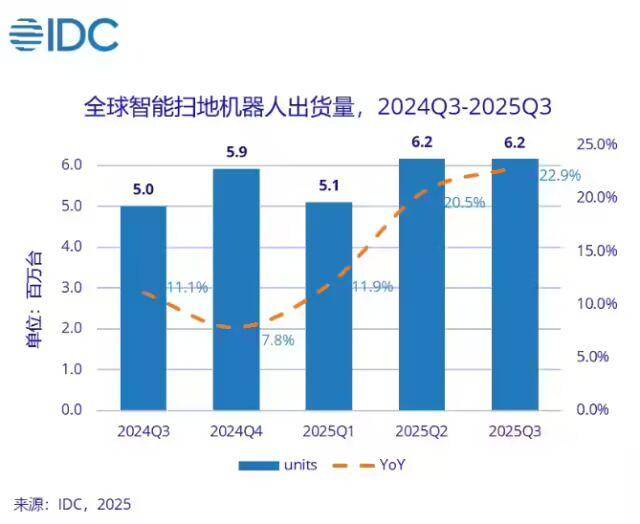
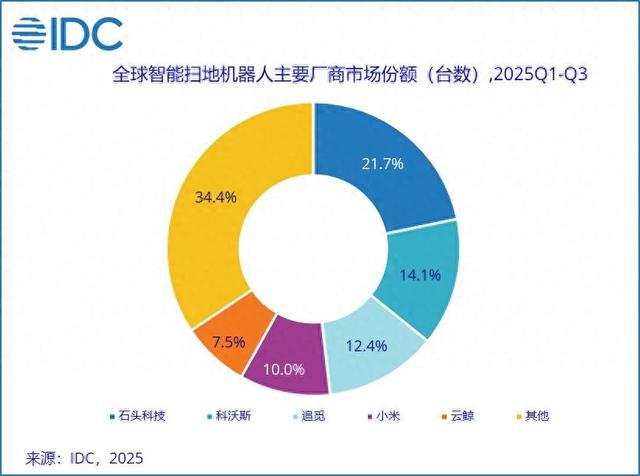
Core Insights - The global smart vacuum cleaner market saw a total shipment of 17.424 million units in the first three quarters of 2025, representing a year-on-year growth of 18.7% [1] - In Q3 2025 alone, shipments reached 6.161 million units, with a year-on-year increase of 22.9% [1] - The Middle East, Africa, and Europe are identified as key growth drivers for the industry [1] Company Performance - Chinese brands dominate the global market, capturing the top five positions in shipment volume [1] - Stone Technology leads with a cumulative shipment of 3.788 million units, ranking first in countries like the USA and Germany [1] - Ecovacs follows with 2.453 million units shipped, achieving a year-on-year growth of 27.7% and maintaining the top position in the Chinese market [1] - Dreame ranks first in the European market with a 26.8% share, although its domestic market share has declined [1] - Xiaomi ranks fourth globally, focusing on mid-range value while expanding into the high-end market [1] - Yunji enters the global top five, experiencing significant growth in overseas markets while holding a 16.2% share in the domestic market [1] Market Trends - The Chinese market saw a total shipment of 4.63 million units in the first three quarters, reflecting a year-on-year growth of 27.2% [1] - DJI entered the market in August, ranking sixth in shipments for Q3 [1]



欠中国代工厂超25亿元 扫地机器人鼻祖iRobot爆雷
是说芯语· 2025-12-07 06:20
Core Insights - iRobot, once a leader in the robotic vacuum industry, is facing a severe financial crisis, with debts exceeding $350 million and cash reserves dwindling to $24.8 million, putting the company on the brink of technical bankruptcy [1] - The company's market share has plummeted from over 80% in the early 2000s to just 7.9% in 2023, largely due to increased competition and internal challenges [1] - iRobot's revenue fell by 24% year-on-year in 2022, resulting in a net loss of $286.3 million, leading to significant layoffs and a failed acquisition attempt by Amazon [1][2] Financial Situation - As of September 2023, iRobot's total assets were $481 million, total liabilities were $508 million, and shareholders' equity was -$26.8 million, indicating insolvency [1] - The company is currently negotiating with its creditor, Shanjun Robotics, for a debt resolution, which may result in a loss of control to a Chinese entity [2] Market Trends - The global robotic vacuum market saw a shipment of 17.424 million units in the first three quarters of 2025, marking an 18.7% year-on-year increase, with a notable 22.9% growth in the third quarter [3] - Chinese manufacturers dominate the market, with Stone Technology leading shipments at 3.788 million units, followed by Ecovacs and others [6][7] - The domestic market in China also experienced a robust growth of 27.2% year-on-year, with a total shipment of 4.63 million units in the first three quarters of 2025 [9]



欠中国代工厂超25亿元 扫地机器人鼻祖iRobot爆雷
Sou Hu Cai Jing· 2025-12-06 11:41
Core Viewpoint - iRobot, once a leader in the robotic vacuum industry, is facing a severe financial crisis, with debts exceeding $350 million and cash reserves dwindling to $24.8 million, putting the company on the brink of technical bankruptcy [1] Financial Situation - As of November 24, iRobot owes over $350 million (approximately 2.5 billion RMB) to its Chinese manufacturing partner, Shanjun Robotics, while its cash reserves are only $24.8 million [1] - The company reported a 24% year-over-year revenue decline in 2022, totaling $1.183 billion, with a net loss of $286.3 million [1] - By September of this year, iRobot's total assets were $481 million, total liabilities were $508 million, and shareholders' equity was negative $26.8 million, officially marking the company as insolvent [4] Market Position - iRobot's global market share has plummeted to 7.9% this year due to increased competition and a rigid pricing strategy [4] - The company was once a dominant player, holding over 80% of the U.S. robotic vacuum market but has since lost significant ground [1] Corporate Actions - Following the failed acquisition by Amazon, which was initially valued at $1.7 billion and later reduced to $1.4 billion, iRobot laid off 350 employees (31% of its workforce) and saw its CEO resign, further deteriorating its financial condition [2][3] - iRobot is currently in negotiations with Shanjun for a debt resolution, which is seen as the company's only potential survival strategy, albeit at the cost of losing control to a Chinese entity [4] Industry Trends - The global robotic vacuum market saw a shipment of 17.424 million units in the first three quarters of 2025, reflecting an 18.7% year-over-year growth, with the third quarter alone showing a 22.9% increase [5] - Chinese manufacturers dominate the global shipment rankings, with companies like Roborock and Ecovacs leading the market [8] - In the domestic market, China experienced a shipment of 4.63 million robotic vacuums in the first three quarters of 2025, marking a significant 27.2% year-over-year increase [10]
又一家美国明星机器人公司,被中国制造卷死了
创业邦· 2025-12-06 10:10
以下文章来源于硅基观察Pro ,作者硅基君 人人都能读懂的AI商业 在2018年最巅峰的时候,收入突破10亿美元,海外市场份额一度超过70%。甚至在2022年,亚马逊 还打算花17亿美元收购它。 硅基观察Pro . 来源丨 硅基观察Pro(ID:wuyazhinengshuo) 作者丨 林白 图源丨Midjourney 不久前,硅基君写了美国具身智能公司K-Scale Labs宣布破产,倒在了量产的前夕。 如今,又一家美国机器人公司濒临破产了!它不是别人,而是美国扫地机器人龙头iRobot。 现在的年轻人,可能不知道iRobot。它可是扫地机器人的开山鼻祖,在石头、科沃斯这些中国厂商还 没起来的时候,这个赛道只有两个牌子: 一个是 iRobot,另一个叫"杂牌"。 但就是这样一家明星公司,这回是真的一只脚踏进了ICU。 根据最新的监管文件,iRobot 整体负债突破3.5亿美元,而兜里的现金只剩下可怜的2480万美元。 这点钱,别说还债了,连维持心跳都费劲。 而那个掌握它生死簿的最大债主,居然是一家中国公司——杉川机器人。如今,这个曾经高高在上的 行业霸主,生死就全看别人脸色了。 从一手遮天的行业霸主,到如今 ...

2025企业家博鳌论坛|“十五五”怎么干?企业家这样说!
Shang Hai Zheng Quan Bao· 2025-12-05 14:14
Group 1: Economic Outlook for the 14th and 15th Five-Year Plans - The representatives express optimism about China's economic prospects during the 15th Five-Year Plan, citing three main reasons: institutional advantages, a large domestic market, and the early development of new productive forces [2][3] - The emphasis on technological innovation and high-quality development is seen as crucial for various industries, with AI and digital economy integration into the real economy being highlighted [3][4] Group 2: Industry Trends and Corporate Strategies - The salt industry is expected to see increased concentration and a shift towards low-sodium products, with China Salt Group taking a leading role in mergers and acquisitions to drive high-quality development [2][4] - In the smart home sector, trends include closer alignment of technology with consumer needs, expansion from indoor to outdoor applications, and a focus on both consumer and commercial markets [4][5] - The process industry, valued at 60 trillion, has significant opportunities for efficiency improvements, which could yield substantial economic value and contribute to GDP growth [3][5] Group 3: International Expansion and Cooperation - Stone Technology has been expanding internationally since 2018, with products in over 170 countries, and plans to enhance localization and overseas R&D during the 15th Five-Year Plan [5] - Zhongkong Technology aims to strengthen its international strategy by establishing a global development headquarters in Singapore and collaborating with major companies like Saudi Aramco [5][6] Group 4: Future Expectations and Commitments - China Salt Group aims to promote industry consolidation and develop strategic emerging industries, focusing on greener salt chemical processes and precise agricultural services [5][6] - Stone Technology plans to continue expanding its smart home offerings, emphasizing technology that meets consumer demands across various settings [5] - Zhongkong Technology is committed to leveraging original technologies to enhance efficiency in the industrial AI sector, aiming to convert improvements into tangible economic value [5][6]


中国公司成扫地机器人鼻祖最大债权人,iRobot业绩恶化
Di Yi Cai Jing· 2025-12-05 11:54
财报显示,iRobot 2025年前三季收入3.75亿美元,同比减少26.47%;净亏损额同比增加90%至1.3亿美 元。其中,其2025年第三季收入1.458亿美元,同比减少24.6%;亏损1770万美元,而其去年同期为盈利 730万美元。 截至2025年9月27日,iRobot的现金及现金等价物为2480万美元,比2024年年底的1.34亿美元大幅减少。 目前,公司没有可获得额外资金的来源。截至今年第三季度末,iRobot运营活动中的净现金为-1.04亿美 元,去年同期为-3047万美元。 中国已形成全球最成熟的扫地机器人产业链集群,iRobot没有跟上中国产业链集群进化的节奏,在全球 竞争中渐处下风。 12月5日,IDC研报显示,2025年前三季度,中国品牌包揽全球扫地机器人市场出货量的前五名,扫地 机器人鼻祖美国iRobot公司首次跌出全球前五。 iRobot近期还陷入债务危机,其代工企业深圳市杉川机器人有限公司(下称"杉川")已购买其1.907亿美 元债权,加上iRobot拖欠杉川1.615亿美元的产品制造费,杉川已成为iRobot的最大债权人,后续债务处 理、是否引发收购还需观察。 近年,iRob ...
IDC:2025年前三季度全球扫地机器人出货量同比增长18.7%,中国品牌包揽前五
Huan Qiu Wang· 2025-12-05 08:55
Core Insights - The global smart vacuum cleaner market shipped 17.424 million units in the first three quarters of 2025, representing a year-on-year growth of 18.7% [1] - Chinese manufacturers dominate the global market, with Stone Technology leading in shipments and holding a 21.7% market share [1] Group 1: Market Performance - Stone Technology shipped 3.788 million units in the first three quarters of 2025, maintaining the top position in global shipments [1] - The company has expanded its products to over 170 countries, serving more than 20 million households [3] - In key markets like the US, Germany, and South Korea, Stone Technology ranks first in shipment volume [3] Group 2: Product and Innovation - Stone Technology has enhanced its high-end product line, focusing on ultra-thin designs to address cleaning challenges in low spaces [4] - The company has significantly increased its R&D investment, with R&D expenditure rising from 3.82% to 8.52% of revenue from 2018 to Q3 2025 [4] - The introduction of advanced technologies such as "AI dual-camera vision + 3D structured light" has improved obstacle avoidance and cleaning efficiency [6] Group 3: Future Outlook - The company aims to continue leveraging technological innovation to meet the growing demand for smart home cleaning solutions [7] - Stone Technology plans to deepen its localized operations and enhance product development to drive high-quality industry growth [7]
广发证券:长期看家电外销有望维持稳健增长 自下而上推荐石头科技(688169.SH)等
智通财经网· 2025-12-05 06:58
Core Viewpoint - The report from GF Securities indicates that the home appliance industry is expected to experience a slowdown in growth in 2026 due to high base effects, despite significant benefits from the "old-for-new" policy in 2025. Leading companies are anticipated to outperform the industry due to their channel and brand advantages. Long-term growth in overseas sales is also expected to remain stable, supported by an increase in global market share [1][2]. Summary by Sections 2025 Review - The home appliance sector has shown a cumulative increase of 8.1% year-to-date as of November 28, 2025, ranking 27th among all sectors and underperforming the CSI 300 index by 10.4 percentage points [2]. - The performance of various segments includes: home appliance components (+64.7%), black appliances (+12.6%), lighting equipment (+11.9%), small appliances (+9.5%), kitchen appliances (-0.7%), and white appliances (-1.1%) [2]. - Retail sales of home appliances from January to October 2025 increased by 20.1% year-on-year, driven by the "old-for-new" policy, although growth slowed in September and October due to high base effects. Exports in the same period decreased by 3.4% in USD terms and 2.5% in RMB terms, primarily due to the impact of the US-China trade war, but the decline was manageable, indicating resilience and global competitiveness [2]. 2026 Outlook - Domestic demand is expected to slow down in 2026 due to high base effects from the "old-for-new" policy in 2025, but leading companies are likely to outperform the industry due to their channel and brand advantages. For external sales, companies have adapted to trade policy fluctuations since 2018-2019, and long-term growth in overseas sales is anticipated [3]. - Profitability is expected to remain stable, with manageable cost pressures as copper prices have risen, shipping costs have returned to normal levels, and the exchange rate has shown slight appreciation [3]. - As of November 28, 2025, the price-to-earnings ratio (PE-TTM) for the home appliance sector increased from 15.1x at the beginning of the year to 17.3x, placing it at the 66th percentile historically since 2016. The proportion of public funds heavily invested in the home appliance sector decreased to 2.5%, down 1.8 percentage points from the previous quarter, marking a continuous decline over three quarters [3]. 2026 Sub-industry Outlook - White Appliances: Expected to face a slowdown in growth due to high base effects from national subsidies, but overseas sales are projected to remain resilient, benefiting from emerging market demand [4]. - Small Appliances: Continued policy support is expected to improve average prices in kitchen small appliances, with significant growth potential in the overseas market for robotic vacuum cleaners [4]. - Black Appliances: Product structure upgrades are anticipated to enhance average prices and profitability, with continued growth in overseas market share [5]. - Two-Wheelers: The implementation of new regulations in 2026 is expected to sustain industry growth, with leading companies likely to increase their market share as smaller competitors exit the market, and significant opportunities in overseas markets [5].

广发证券:长期看家电外销有望维持稳健增长 自下而上推荐石头科技等
Zhi Tong Cai Jing· 2025-12-05 06:55
Core Viewpoint - The report from GF Securities indicates that the home appliance industry is expected to experience a slowdown in growth in 2026 due to high base effects from the "old-for-new" policy in 2025, but leading companies are likely to outperform the industry due to their channel and brand advantages [1][3]. 2025 Review - The overall performance of the home appliance sector has lagged behind, with the Shenyin Wanguo Home Appliance Index showing a cumulative increase of 8.1% from January 1 to November 28, 2025, ranking 27th among all sectors and underperforming the CSI 300 Index by 10.4 percentage points [2]. - The home appliance retail sales from January to October 2025 increased by 20.1% year-on-year, driven by the "old-for-new" policy, but growth rates slowed in September and October due to high base effects [2]. - Home appliance export values from January to October 2025 decreased by 3.4% in USD terms and 2.5% in RMB terms, primarily impacted by the US-China trade war, yet the decline was manageable, reflecting resilience and global competitiveness [2]. 2026 Outlook - On the demand side, the home appliance industry is expected to slow down in 2026 due to high base effects from the "old-for-new" policy in 2025, but leading companies are anticipated to leverage their channel and brand advantages to outperform the market [3]. - The profitability outlook remains stable, with only copper prices rising recently, while shipping costs have returned to normal levels and exchange rates have shown slight appreciation, keeping overall cost pressures manageable [3]. - As of November 28, 2025, the price-to-earnings ratio (PE-TTM) for the home appliance sector increased from 15.1x at the beginning of the year to 17.3x, placing it at the 66th percentile historically since 2016 [3]. 2026 Sub-industry Outlook - In the white goods sector, growth may slow due to high base effects from national subsidies, but exports are expected to remain resilient, supported by emerging markets, leading to stable growth for leading companies [4]. - The small appliance segment is likely to see continued improvement in average prices due to ongoing policy support, with the vacuum cleaner industry expected to gain market share overseas, indicating significant long-term growth potential [4]. - In the black goods sector, product structure upgrades are anticipated to drive price increases and improve profitability, with overseas market share expected to continue rising [5]. - The two-wheeler industry is projected to maintain growth in 2026 with the full implementation of new regulations, as smaller manufacturers exit the market, allowing leading companies to increase their market share, particularly in overseas markets [5].