
北方稀土

Search documents
铜资源争夺加剧!力拓专供亚马逊,AI大战抢完芯片抢铜矿!有色ETF华宝(159876)再涨2.2%创历史新高!
Xin Lang Cai Jing· 2026-01-16 02:10
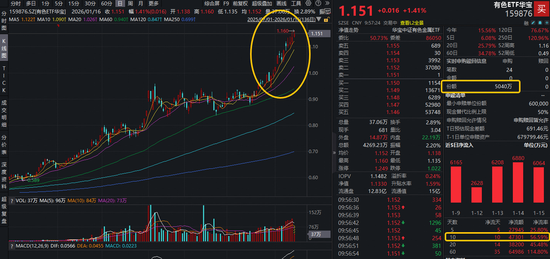
Core Viewpoint - The non-ferrous metal sector is experiencing a strong upward trend, with significant inflows into related ETFs, indicating robust investor interest and potential for continued growth [1][12]. Group 1: Market Performance - The popular non-ferrous ETF, Huabao (159876), saw an intraday increase of 2.2%, currently up 1.41%, reaching a new high since its listing [1][12]. - As of January 15, the latest scale of Huabao ETF reached 1.453 billion, marking a historical peak and ranking first among three ETFs tracking the China Nonferrous Metals Index [1][12]. - The ETF has attracted a net subscription of 50.4 million units, with a total net inflow of 473 million over the past ten days [1][12]. Group 2: Stock Performance - Leading stocks in the sector include Hunan Silver, which surged over 6%, along with Chihong Zn & Ge, Jiangxi Copper, and Jinchuan Group, all rising more than 5% [4][15]. - Other notable performers include Western Mining and Zhongjin Lingnan, both showing positive gains [4][15]. Group 3: Industry Outlook - Analysts predict that the non-ferrous metal sector will continue to thrive due to multiple factors, including global capital expenditure cycles, manufacturing recovery, and improved domestic macro expectations [5][16]. - The sector is expected to enter a bull market by 2026, driven by a confluence of monetary, demand, and supply factors [5][16]. - The demand for strategic metals is anticipated to rise significantly, influenced by new technologies and geopolitical factors, with a focus on metals used in military applications [3][16]. Group 4: Copper Market Insights - China Galaxy Securities suggests that copper prices have substantial upward potential, as historical analysis shows that current prices, adjusted for inflation, have not reached previous supercycle highs [3][14]. - The ongoing reshaping of the international monetary order and the low copper-to-gold ratio indicate a favorable environment for copper investments [3][14]. - The convergence of the AI technology revolution and global order restructuring is expected to create a new supercycle for copper [3][14].






春季躁动已开场!我的“三条线”布局和ETF吃肉心得
Ge Long Hui· 2026-01-15 13:06
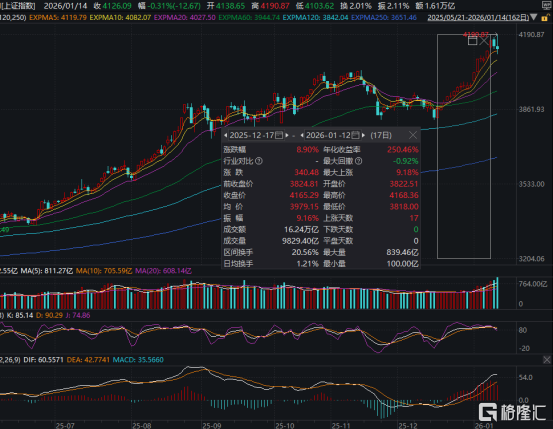
Group 1 - The spot gold price has reached $4600 per ounce and silver has surpassed $90 per ounce, marking historical highs [1] - The Shanghai Composite Index experienced a historic 17-day consecutive rise of 8.9% before facing a two-day adjustment, indicating a potential bull market pullback [1][3] - The spring market rally appears to have started earlier this year, with expectations for a clearer structural market in 2026 [4] Group 2 - The "spring rally" is characterized by a significant seasonal trend in the A-share market, typically occurring from late December to the first quarter of the following year, driven by macroeconomic policies, capital flow, and corporate earnings improvements [5] - Historical data shows that the spring rally usually starts in late January and ends around mid-March, lasting approximately 30 trading days, with an average index increase of about 15% [5][6] Group 3 - During the spring rally, the market has generally favored small-cap and growth stocks, with the TMT sector leading, particularly the computer sector with an average increase of 23% [7] - Key sectors to watch this year include technology and resource sectors, driven by policies aimed at "stabilizing growth" and "strengthening technology" [7][8] Group 4 - The first investment focus is on technology innovation and growth sectors, particularly in AI, which is expected to drive a surge in chip demand [8] - The second focus is on the recovery of manufacturing and resource sectors, influenced by global metal supply chain changes [8] - The third focus is on consumer recovery and overseas opportunities [9] Group 5 - The company has adjusted its portfolio through ETFs, with a focus on the semiconductor sector, which is showing signs of recovery, particularly in the storage chip market [10] - The resource sector is also a key investment area, with strong performance driven by geopolitical tensions and expectations of a weaker dollar [10] - The consumer sector is being targeted for investment, with attractive valuations in Hong Kong stocks despite recent pullbacks [11]
中国铀业(001280):中国铀业深度报告:国内天然铀产业龙头,资源与技术优势显著
GUOTAI HAITONG SECURITIES· 2026-01-15 12:30
Investment Rating - The report initiates coverage with a "Buy" rating and sets a target price of 80 CNY [5][11][15]. Core Insights - China Uranium Industry (001280) derives over 90% of its revenue from natural uranium business and is the exclusive supplier of natural uranium products for its controlling shareholder, China National Nuclear Corporation (CNNC) [2][11]. - The company is expected to benefit from the growing demand for nuclear energy and the ongoing global uranium supply-demand gap, which is projected to persist in the long term [11][39]. Financial Summary - The total revenue is projected to grow from 14,801 million CNY in 2023 to 31,422 million CNY by 2027, reflecting a compound annual growth rate (CAGR) of approximately 21.5% [4][16]. - Net profit attributable to the parent company is expected to increase from 1,262 million CNY in 2023 to 4,428 million CNY in 2027, with a significant growth rate of 87.8% in 2026 [4][11]. - Earnings per share (EPS) is forecasted to rise from 0.61 CNY in 2023 to 2.14 CNY in 2027 [4][11]. Revenue Breakdown - The revenue from natural uranium sales is expected to grow from 13,234.90 million CNY in 2023 to 28,500 million CNY by 2027, with a growth rate of 43.94% in 2024 [16]. - The radioactive co-mineral resource business is projected to see revenue growth from 1,164.08 million CNY in 2023 to 2,672.00 million CNY by 2027, with a notable increase of 39.51% in 2025 [16]. Industry Position - China Uranium Industry is a leading player in the uranium sector, with a strong historical presence and a comprehensive resource layout both domestically and internationally [19][24]. - The company controls significant uranium resources, ranking among the top ten global uranium producers, and has a robust operational footprint in key strategic areas [33][39]. Supply-Demand Dynamics - The global uranium market is characterized by a high concentration of resources, with the top five countries holding 68% of the total uranium reserves [39][40]. - The report highlights a persistent supply-demand gap in the uranium market, driven by increasing nuclear energy requirements and a recovery in global uranium production expected to reach 60,213 tons in 2024 [40][41].
连续10日涌入34亿元!工业有色ETF(560860)逆势收涨1.49%,前十大持有人险资占6席
Sou Hu Cai Jing· 2026-01-15 11:18
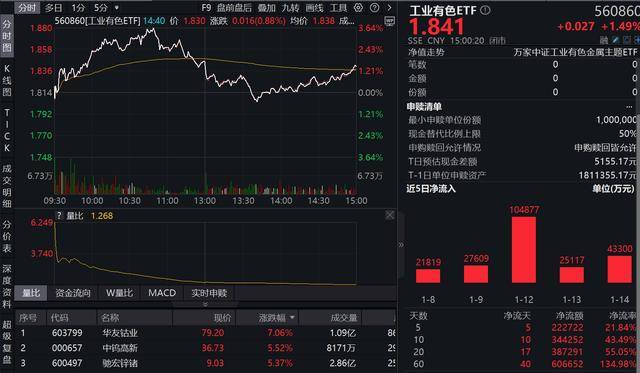
Core Viewpoint - The industrial non-ferrous ETF (560860) has shown strong performance, driven by rising prices of industrial metals like copper and aluminum, and increasing institutional investment interest, indicating a positive outlook for the sector. Group 1: Market Performance - As of January 15, the industrial non-ferrous ETF (560860) has seen a significant increase, with a year-to-date rise of 15.93%, outperforming the non-ferrous metal index (000819) which rose by 13.77% and gold stocks (931238.CSI) which increased by 14.49% [6][9] - The ETF has experienced a net inflow of 3.4 billion yuan over the last 10 trading days, totaling over 6 billion yuan in the past 60 days, bringing its total size to 12.965 billion yuan [1] Group 2: Institutional Investment - Institutional investors' share in the industrial non-ferrous ETF (560860) has risen from 41% at the end of 2024 to nearly 60% by mid-2025, reflecting growing confidence in the sector [3] - The top ten holders of the ETF account for over 48% of its total shares, with six being insurance institutions, indicating strong institutional support for the industrial non-ferrous metal sector during the economic recovery [4] Group 3: Sector Dynamics - The industrial non-ferrous ETF (560860) is heavily weighted towards copper (29.2%), aluminum (26.7%), and rare earths (15.3%), which together make up nearly 70% of the ETF, highlighting its focus on manufacturing-related metals [11] - The demand for key materials like aluminum and copper is expected to rise due to rapid advancements in AI, semiconductors, and robotics, with domestic robot production projected to grow by 33.39% year-on-year from March to October 2025 [6] Group 4: Supply and Demand Factors - The current low inventory levels of copper and aluminum, combined with a cyclical production recovery, are expected to support prices and enhance industry outlook [9] - The recent government policy restricting the approval of mining projects without self-built mines or tailings disposal facilities further emphasizes the scarcity and potential value of the industrial non-ferrous ETF (560860) [13]
中国稀土地位悬了?撬走中方人才,攻克提炼技术,但西方笑得太早
Sou Hu Cai Jing· 2026-01-15 10:51
Core Viewpoint - The announcement by Lynas Corporation regarding the commercial production of dysprosium in May 2025 is perceived as a significant step towards reducing dependence on Chinese rare earths, but the reality reveals a substantial gap in production scale and cost efficiency compared to China [1][3][5]. Production Capacity Discrepancy - Lynas plans to produce 1,500 tons of dysprosium annually, while China's production consistently ranges from 10,000 to 15,000 tons [5][13]. - The export price of Chinese dysprosium is approximately $4 to $7 per kilogram, whereas Lynas's cost is between $10 to $15 per kilogram, highlighting a significant cost disparity [5][7]. Technological and Operational Challenges - Lynas's production capabilities are still at a laboratory level, leading to higher costs and inefficiencies compared to China's well-established industrial processes [7][9]. - The lack of a complete production chain and low efficiency in Lynas's operations raises doubts about its ability to compete effectively in the market [9][11]. Equipment Export Restrictions - Since 2023, China has ceased exporting critical equipment and technology for rare earth separation and magnet production, creating a significant barrier for Western companies attempting to develop their own capabilities [15][17]. - The "0.1% long-arm jurisdiction" rule implemented by China further restricts Western access to technology, as any product containing even a small percentage of Chinese rare earths is subject to export controls [17][19]. Dependency on Chinese Supply - The U.S. and other Western nations are heavily reliant on Chinese rare earths, with 17 out of 50 critical rare earth elements being highly dependent on Chinese supply [19][21]. - The inability to source essential materials for advanced manufacturing, such as the F-35 fighter jet, underscores the critical nature of this dependency [26][28]. Historical Context and Future Outlook - Historical shifts in rare earth production, such as Japan's transition to China due to high environmental costs, illustrate the challenges Western nations face in attempting to rebuild their own supply chains [31][33]. - Lynas's current production levels are insufficient to meet the demands of global high-end manufacturing, indicating that the Western push for self-sufficiency in rare earths is overly optimistic [13][35]. Conclusion - The perceived breakthroughs by Lynas are more reflective of Western anxieties about dependency on China rather than a genuine shift in the global rare earth landscape, suggesting that the industry will continue to rely on China for the foreseeable future [36][37].

太猛了!破5万亿美元
Ge Long Hui A P P· 2026-01-15 10:32
Core Viewpoint - The non-ferrous metal sector is experiencing a significant market transformation, with strong price increases across various metals, making it a focal point for investment in 2026 [3][26]. Group 1: Market Performance - Non-ferrous metals have shown a strong upward trend in both futures and stock markets, with the non-ferrous mining ETF rising 14.88% in the first nine trading days of 2026 [1][3]. - From mid-2025, metals like aluminum, cobalt, lithium, and rare earths entered a super-upward cycle, with tin futures prices soaring from 261,400 CNY/ton to 443,400 CNY/ton, a nearly 70% increase [4][10]. - In 2025, cobalt and silver prices increased by 173% and 148% respectively, while gold rose by 59.27% [7][8]. Group 2: Price Trends - The price of lithium carbonate futures surged to 174,000 CNY/ton, nearly three times the price in Q2 2025 [8]. - Key industrial metals like copper and aluminum also saw significant price increases, with copper futures rising from 78,000 CNY/ton to 105,600 CNY/ton [10]. - The price of tungsten increased from 122,000 CNY/ton to 455,000 CNY/ton, marking a 272% rise [10]. Group 3: Supply and Demand Dynamics - Geopolitical factors, such as the ongoing Russia-Ukraine conflict, have increased demand for gold as a strategic reserve, with central banks globally increasing their gold holdings [10][11]. - Supply disruptions in metals like copper and tin due to mining accidents and export restrictions have contributed to a widening supply-demand gap [11][21]. - Historical data indicates a strong correlation between precious metals and interest rate cuts, suggesting that monetary easing periods lead to increased prices for both precious and industrial metals [11][12]. Group 4: Investment Trends - The global gold ETF holdings increased significantly in 2025, with a total of 3,985.94 tons, marking the second-largest annual increase since 2004 [14]. - Non-ferrous themed ETFs saw a net subscription of over 51 billion CNY in 2025, with total assets growing nearly ninefold [16]. - Major non-ferrous companies like Zijin Mining and Luoyang Molybdenum reported substantial profit increases, with Zijin's net profit growing by 55.45% year-on-year [20][21]. Group 5: Future Outlook - The non-ferrous metal sector is expected to continue its strong performance due to macroeconomic liquidity, geopolitical tensions, and robust demand from industries like renewable energy and electric vehicles [26]. - The non-ferrous mining ETF is positioned to benefit from rising metal prices, with a historical performance showing significant price elasticity compared to the underlying commodities [23][25].



有色金属行业资金流入榜:华友钴业、赣锋锂业等净流入资金居前
Zheng Quan Shi Bao· 2026-01-15 09:45
Core Viewpoint - The Shanghai Composite Index fell by 0.33% on January 15, with 11 industries rising, led by electronics and basic chemicals, which increased by 1.67% and 1.40% respectively. The non-ferrous metals industry ranked third in terms of gains, while the comprehensive and defense industries saw the largest declines of 3.35% and 2.80% respectively [1]. Industry Summary Non-Ferrous Metals Industry - The non-ferrous metals industry rose by 1.37%, with a net inflow of 1.936 billion yuan. Out of 138 stocks in this sector, 108 increased in value, with 4 hitting the daily limit, while 29 declined. A total of 80 stocks experienced net inflows, with 13 stocks seeing inflows exceeding 100 million yuan. The top inflow was from Huayou Cobalt, which received 772 million yuan, followed by Ganfeng Lithium and Northern Rare Earth with inflows of 554 million yuan and 379 million yuan respectively [2]. - The stocks with the largest net outflows included Zijin Mining, Hunan Silver, and Xingye Silver Tin, with outflows of 733 million yuan, 542 million yuan, and 309 million yuan respectively [2]. Fund Flow Analysis - The top stocks in the non-ferrous metals industry by net inflow included: - Huayou Cobalt: +7.06%, turnover rate 5.80%, net inflow 772.03 million yuan - Ganfeng Lithium: +4.26%, turnover rate 7.13%, net inflow 554.29 million yuan - Northern Rare Earth: +1.20%, turnover rate 3.10%, net inflow 379.34 million yuan [3]. - The stocks with the largest net outflows included: - Zijin Mining: -0.65%, turnover rate 1.87%, net outflow 733.09 million yuan - Hunan Silver: +6.25%, turnover rate 25.54%, net outflow 541.94 million yuan - Xingye Silver Tin: -1.05%, turnover rate 6.54%, net outflow 309.11 million yuan [4].
北方稀土:截至2026年1月10日公司的股东总数为667157户
Zheng Quan Ri Bao Wang· 2026-01-15 09:43
证券日报网讯1月15日,北方稀土(600111)在互动平台回答投资者提问时表示,截至2026年1月10日公 司的股东总数为667157户。 ...
北方稀土:公司控股子公司北方嘉轩主要从事永磁电机的研发与制造
Zheng Quan Ri Bao Zhi Sheng· 2026-01-15 09:40
(编辑 袁冠琳) 证券日报网1月15日讯 ,北方稀土在接受调研者提问时表示,公司控股子公司北方嘉轩主要从事永磁电 机的研发与制造,北方嘉轩的永磁技术解锁了更多节能场景:"永磁半直驱改造"方案在系统、性能、节 能效果以及降低成本等方面具有绝对优势,高度契合国家高耗能设备淘汰政策,为皮带机升级提供新方 向;永磁外转子滚筒电机具有预测性维护、能源管理、协同控制、回收价值高等特性,减少突发故障对 生产的扰动,智能驱动器还能记准每度电消耗,是专为皮带输送打造的"电机-滚筒一体化"智能方案; 永磁智能直驱传动让工业传动模式在保持高效运行、降低故障风险、节能环保、节省安装空间的基础 上,还能完美适配液压站、水泵、粉磨、破碎、运输、搅拌、冷却等各类复杂工业场景。目前北方嘉轩 正在积极开拓市场,为实现智能化制造绿色化制造提供驱动力。公司主导完成的"低速大转矩稀土永磁 驱动电机系统的研发"获得中国钢铁工业协会、中国金属学会冶金科学技术奖三等奖。公司还搭建起国 内首条稀土盘式电机智能示范线,该示范线产出的3瓦稀土永磁轴向磁通电机仅有6毫米厚,较同类产品 体积减少60%、重量下降80%,且扭矩转速更高、能耗更小、寿命更长。可服务于消 ...
北方稀土:公司以维护和促进市值提升为目标
Zheng Quan Ri Bao Zhi Sheng· 2026-01-15 09:40
(编辑 袁冠琳) 证券日报网1月15日讯 ,北方稀土在接受调研者提问时表示,目前在市值管理方面对公司有定性的要 求。公司以维护和促进市值提升为目标,以制度建设为基础、多维度协同为路径,系统推进市值管理工 作。公司制定《市值管理办法》,为合规开展市值管理提供制度遵循,通过强化公司治理、规范信息披 露、优化投资者关系管理、并购重组、监测舆情等多措并举开展市值管理,同步联动ESG管理等工作助 力市值提升。公司市值在稀土行业上市公司中保持首位。公司股票于2025年4月首次入选中证A50指数 成分股,12月再次重回上证50指数成分股,公司的资本市场关注度和投资价值吸引力被发现。 ...