博通

Search documents
研判2025!中国以太网交换芯片行业产业链、市场规模及重点企业分析:交换芯片引领网络升级,技术迭代与场景拓展共驱行业增长[图]
Chan Ye Xin Xi Wang· 2025-08-26 01:34
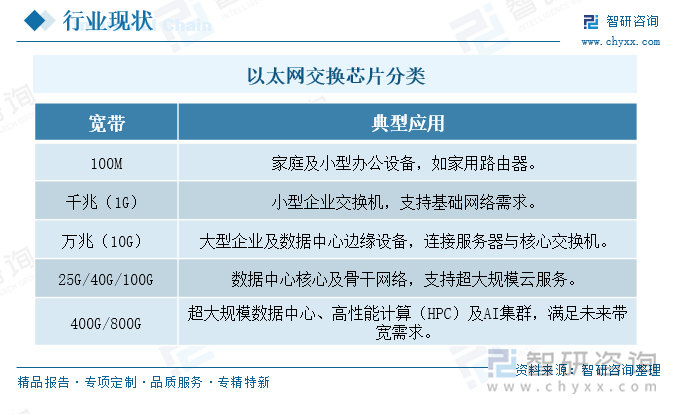
Core Viewpoint - The performance of Ethernet switch chips, as a core component of network devices, directly determines the processing capability and scalability of these devices. The demand for these chips is closely related to the technological iterations and scenario extensions in the switch market. The Chinese Ethernet switch chip industry is projected to reach a market size of approximately 16.2 billion yuan in 2024, reflecting a year-on-year growth of 7.95%, driven by ongoing advancements in digital transformation and network infrastructure construction [1][10]. Industry Overview - Ethernet switch chips are critical components in network devices, enabling data exchange and routing functions in local area networks (LAN) and data center networks. These chips are specialized integrated circuits (ASICs) designed for network applications, featuring multiple ports and routing tables to efficiently forward data frames based on target MAC addresses [6][4]. Market Size - The Chinese Ethernet switch chip market is expected to grow to approximately 16.2 billion yuan in 2024, marking a 7.95% increase from the previous year. This growth is indicative of the continuous progress in domestic network infrastructure and the sustained demand driven by digital transformation [10][1]. Key Companies' Performance - The Ethernet switch chip industry in China exhibits high market concentration, with foreign giants dominating the market. However, domestic companies like Shengke Communication and Yutai Micro are making significant strides. Shengke Communication is the only domestic company to enter the commercial 10G and above chip market, launching the Arctic series chip with 800G support in 2024. Yutai Micro focuses on automotive Ethernet physical layer chips, with plans to release a vehicle-grade TSN chip series by 2025 [12][13]. Industry Development Trends 1. **Technological Upgrades**: The demand for higher performance and lower power consumption in Ethernet switch chips is increasing due to the rapid development of data centers, cloud computing, and artificial intelligence. Companies are focusing on optimizing chip architecture and adopting advanced manufacturing processes to balance performance and power efficiency [17]. 2. **Breaking Foreign Monopoly**: Domestic companies are accelerating the process of replacing foreign products in the Ethernet switch chip market. With significant technological advancements, domestic firms are gradually capturing market share in the high-end chip sector [19][18]. 3. **Emerging Technologies**: The rise of artificial intelligence, the Internet of Things (IoT), and industrial internet technologies is creating new opportunities for the Ethernet switch chip industry. Chips need to support higher data transmission rates and lower latency while ensuring security and reliability for various applications [21].


基金早班车丨权益类ETF规模年内增逾两成四,历史首破四万亿
Sou Hu Cai Jing· 2025-08-26 00:41
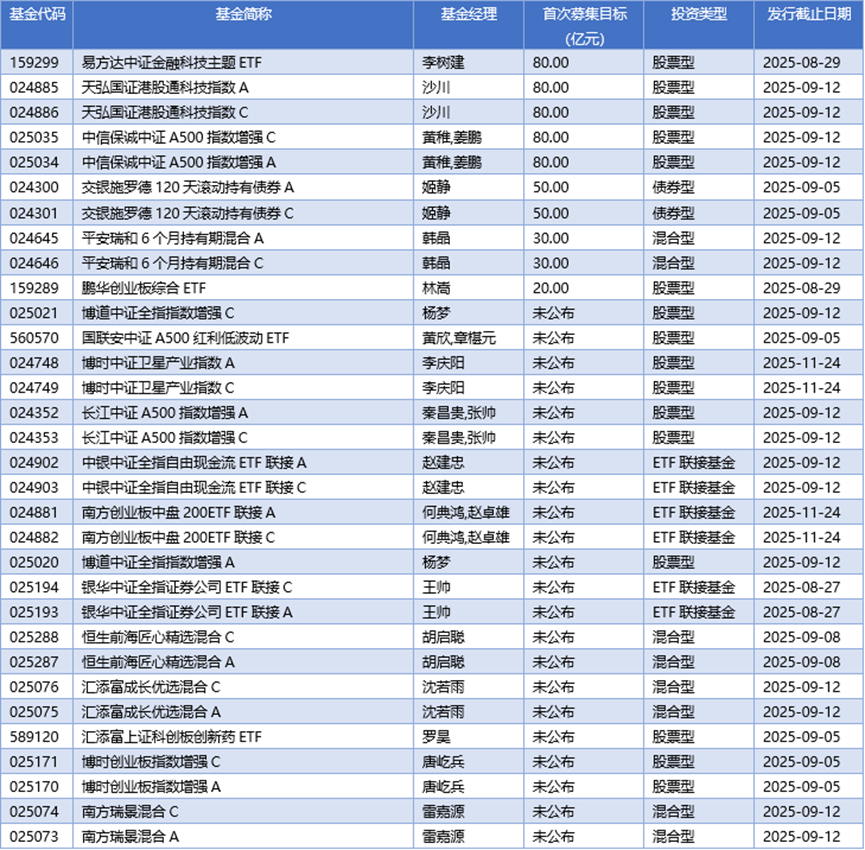
Group 1 - The total scale of domestic equity ETFs reached 41,170.94 billion yuan as of August 25, marking an increase of 7,982.72 billion yuan or 24.05% since the beginning of the year, setting a historical high [1] - The A-share market saw all three major indices rise, with the Shanghai Composite Index up 1.51% to 3,883.56 points, the Shenzhen Component Index up 2.26% to 12,441.07 points, and the ChiNext Index up 3% to 2,762.99 points, with total trading volume exceeding 31,411.37 billion yuan [1] - The issuance of public funds remained robust in August, with 157 new funds launched by August 25, a month-on-month increase of 5.37%, setting a new record for the year [2] Group 2 - The newly launched funds on August 25 included 32 funds, primarily equity and mixed funds, with the E Fund's China Securities Financial Technology Theme ETF targeting a fundraising goal of 8 billion yuan [2] - Over 90% of Fund of Funds (FOF) have reported positive performance this year, indicating strong momentum for incremental capital [2] - The top-performing fund on August 25 was the Huatai-PB Quality Growth Mixed A, with a daily growth rate of 8.0703% [6] Group 3 - The top-performing equity fund was the Caitong Integrated Circuit Industry Stock A, with a daily growth rate of 7.4611% [7] - The top-performing bond fund was the Baoying Rongyuan Convertible Bond A, with a daily growth rate of 2.0384% [7] - The top-performing mixed fund was again the Huatai-PB Quality Growth Mixed A, with a daily growth rate of 8.0703% [7] Group 4 - The total number of new funds launched in August included 125 equity funds, accounting for 79.62% of the total, with 96 being stock funds [2] - The market's positive sentiment is expected to continue, with the Shanghai Composite Index remaining above 3,800 points [2] - The issuance of new funds has maintained a level above 140 for two consecutive months, indicating strong investor interest [2]
深夜,大涨!暂停交易!发生了什么?
券商中国· 2025-08-26 00:09
Core Viewpoint - The article highlights the significant surge in Puma's stock price due to reports that the Pinault family, a major shareholder, is exploring strategic options including a potential sale, which could reshape the global sportswear market [2][5][6]. Group 1: Puma's Stock Surge - Puma's stock price experienced a dramatic increase of over 20%, leading to a temporary trading halt, marking the largest intraday gain since October 2001 [4][6]. - The Pinault family, which holds a 29% stake in Puma through Artémis, is reportedly in discussions with potential buyers, including Chinese sports giants like Anta Sports and Li Ning, as well as American companies and sovereign wealth funds from the Middle East [5][6]. Group 2: Market Performance - The U.S. stock market showed mixed results, with the Dow Jones down 0.50% and the Nasdaq up 0.25% as of the latest update [3]. - Chinese assets outperformed the U.S. market, with the Nasdaq Golden Dragon China Index rising by 1.27%, and various Chinese internet and stock ETFs seeing gains of over 2% [4]. Group 3: Wall Street Optimism - Several Wall Street institutions have raised their targets for the S&P 500 index, reflecting a more optimistic outlook for the U.S. stock market [7][8]. - Jefferies has increased its S&P 500 target to 6600 points, citing strong corporate earnings and a robust macroeconomic environment [8][9]. - UBS has also raised its 2025 year-end target for the S&P 500 from 6200 to 6600 points, indicating a continued bullish trend in the market [9][10].

一则消息突然引爆!巨头因暴涨超20%暂停交易,发生了什么?
Zheng Quan Shi Bao· 2025-08-25 22:22
Group 1: Puma's Strategic Options - Puma's stock price surged over 20%, leading to a trading halt, following reports that major shareholder Pinault family is exploring strategic options, including a potential sale [1][3][4] - The Pinault family, through Artémis, holds a 29% stake in Puma and is in preliminary talks with potential buyers, including Chinese sports giants and sovereign wealth funds from the Middle East [4][5] - Puma reported a net profit of €281.6 million and sales of €8.8 billion last year, with sponsorships including Manchester City and the Portugal national team [5] Group 2: US Market Outlook - Wall Street institutions are increasingly optimistic about the US stock market, raising their targets for the S&P 500 index due to strong corporate earnings [1][6][7] - Jefferies raised its S&P 500 target to 6,600 points, citing good earnings and alleviated concerns about the US economy [6][7] - UBS, HSBC, and Citigroup also raised their S&P 500 targets, with UBS increasing its 2025 year-end target from 6,200 to 6,600 points, reflecting a bullish outlook on the market [7][8]
深夜,大涨!暂停交易!发生了什么?
Zheng Quan Shi Bao Wang· 2025-08-25 16:04
Group 1: Puma's Strategic Developments - Puma's stock price surged over 20%, leading to a temporary trading halt, following reports that major shareholder Pinault family is exploring strategic options, including a potential sale [1][3][4] - The Pinault family, through Artémis, holds a 29% stake in Puma and is in preliminary discussions with potential buyers, including Chinese sports giants and sovereign wealth funds from the Middle East [4][5] - Puma reported a net profit of €281.6 million and sales of €8.8 billion last year, with sponsorships including Manchester City and the Portugal national team [5] Group 2: US Market Outlook - Wall Street institutions are increasingly optimistic about the US stock market, collectively raising their target for the S&P 500 index [6][7] - Jefferies raised its annual target for the S&P 500 to 6,600 points, citing strong corporate earnings and a robust macroeconomic environment [7][8] - UBS, HSBC, and Citigroup also adjusted their S&P 500 targets upward, reflecting strong corporate profitability and improved market sentiment [8]
海外策略周报:MIT报告引发近期美股科技股波动较多-20250823
HUAXI Securities· 2025-08-23 14:47
Group 1 - The report highlights significant volatility in US tech stocks, influenced by an MIT report indicating that 95% of companies see no returns on generative AI investments, affecting stocks like Palantir Technologies and Nvidia [1][16] - The TAMAMA tech index has a price-to-earnings (P/E) ratio of 35.1, indicating a high valuation, while the Philadelphia Semiconductor Index's P/E has slightly decreased to 49.4, still near the high 50 range [1][16] - The Nasdaq index, heavily weighted with US tech stocks, maintains a P/E ratio of 40.3, suggesting potential for valuation corrections in the medium term due to high valuations and lack of new fundamental highlights from major tech companies [1][16] Group 2 - The S&P 500 Shiller P/E ratio has risen to 38.96, approaching the 40 mark, indicating potential for further adjustments in the market [1][16] - The report notes that various sectors within the US market, including finance, consumer, communication services, and industrials, may face medium-term adjustments due to high valuation levels and underlying economic uncertainties [1][16] - The report anticipates continued volatility in the Hong Kong stock market, with a divergence in performance among sectors, where high-valued assets may experience profit-taking while lower-valued assets could present buying opportunities [1][38] Group 3 - The report indicates that the Hang Seng Index and the Hang Seng China Enterprises Index both saw increases of 0.27% and 0.45% respectively, while the Hang Seng Hong Kong Enterprises Index decreased by 1.05% [23] - The Hang Seng Tech Index rose by 1.89%, reflecting some positive movement in specific tech stocks within the Hong Kong market [23][38] - The report identifies that the non-essential consumer sector in Hong Kong saw the largest increase of 1.64%, while the materials sector experienced the largest decline of 2.15% [27][38] Group 4 - The report notes that the European markets are expected to experience fluctuations due to high price-to-book ratios exceeding 2 in several major indices, including the French CAC40 and the German DAX [1] - The report highlights that the consumer confidence index in the Eurozone fell to -15.5 in August, down from -14.7, indicating a decline in consumer sentiment [39][45] - The report also mentions that the Japanese Nikkei 225 index is likely to face medium-term corrections due to tight monetary policy and high price-to-book ratios [1][39]
万通发展董事长突遭拘留,8.54亿元投资芯片公司再谋转型,股价又提前涨停被疑“老剧本”重演
Hua Xia Shi Bao· 2025-08-20 16:53
Core Viewpoint - The recent detention of Wang Yihui, the actual controller and chairman of Wantong Development, raises concerns about the company's ongoing transformation and investment strategies, particularly in light of its recent announcement to invest in a technology firm [2][3][4]. Group 1: Company Developments - On August 19, Wantong Development announced that its chairman Wang Yihui was detained by the Beijing police, with the investigation unrelated to the company's daily operations [2][3]. - Following the detention, the company appointed Qian Jinzhu, the CEO, to assume the responsibilities of the chairman and legal representative until Wang Yihui resumes his duties or a new appointment is made [3]. - The company maintains that its corporate governance structure and internal control systems are robust, ensuring that daily operations continue without significant disruption [4]. Group 2: Investment Activities - Wantong Development is in the process of investing 854 million yuan (approximately 8.54 billion) to acquire nearly 63% of Beijing Shuduo Information Technology Co., which specializes in PCIe high-speed switching chips [5][6]. - The investment in Shuduo Technology is part of Wantong's strategic shift towards technology, particularly in the AI and server sectors, where PCIe chips are critical [6][7]. - Despite the promising technology, Shuduo Technology is currently operating at a loss, with a projected net profit of -138 million yuan for 2024, although its revenue is expected to double to 32.38 million yuan [6][7]. Group 3: Market Reactions - Wantong Development's stock price has experienced significant volatility, rising from around 7 yuan to nearly 12 yuan before dropping to approximately 9 yuan following the chairman's detention [5]. - The company has faced scrutiny from regulators, similar to its previous failed acquisition of Solstice Optoelectronics, as it navigates the complexities of its new investment strategy [8][9]. - Investors are cautious, drawing parallels between the current situation and past events, as the stock price surged prior to the announcement of the investment in Shuduo Technology [9].


中国产业叙事:新易盛
新财富· 2025-08-20 08:05
Core Viewpoint - The explosive growth in global AI computing power demand has led to a significant performance surge for Xinyi, redefining the growth boundaries of the optical module industry, with Q1 2025 revenue soaring to 4.1 billion yuan, a year-on-year increase of 264%, and net profit reaching 1.6 billion yuan, up 385% year-on-year [1][5][9]. Group 1: Company Overview - Xinyi was founded in Chengdu in 2008, focusing on high-performance optical modules for data centers, telecom networks, security monitoring, and smart grids [5][9]. - The company established a wholly-owned subsidiary in 2011, separating its production and R&D centers to enhance its focus on high-speed optical module technology [6]. - Xinyi went public on the Shenzhen Stock Exchange in 2016, raising 417 million yuan, marking a strategic leap in its development [9]. Group 2: Technological Advancements - Xinyi has achieved breakthroughs in various optical module technologies, including 100G, 400G, and 800G, and plans to start small-scale delivery of 1.6T optical modules in Q2 2025 [6][10]. - The company has successfully captured nearly 30% of the global market share for 800G optical modules, with a significant reduction in power consumption [11][14]. - The acquisition of US-based Alpine has positioned Xinyi to lead in silicon photonics technology, enhancing its competitive edge in the optical module market [14][17]. Group 3: Market Dynamics - The demand for AI computing power is driving the need for higher capacity data centers, with projections indicating that the average capacity of new large-scale data centers will double in the next four years [22][23]. - Major tech companies are significantly increasing their capital expenditures for data centers, with Microsoft and Amazon projected to spend $80 billion and $100 billion, respectively, by 2025 [23]. - The industry is undergoing a transformation driven by AI technology, which is expected to reshape power supply and cooling systems in data centers, marking a shift from quantitative to qualitative changes in the sector [23].
特朗普迷上了“以股换补”! 继英特尔后台积电、三星等芯片巨头或面临美国政府入股
智通财经网· 2025-08-20 02:33
Core Viewpoint - The U.S. government is exploring a plan to exchange equity stakes in semiconductor companies for funding under the CHIPS Act, potentially expanding beyond Intel to include companies like Micron, TSMC, and Samsung [1][2][4]. Group 1: Government Initiatives - U.S. Commerce Secretary Howard Lutnick is investigating the possibility of the federal government acquiring equity in semiconductor giants that receive funding from the CHIPS Act [1][2]. - The plan aims to provide substantial financial support to companies building chip factories in the U.S., with the government potentially holding stakes in these firms [1][4]. - The initiative has received backing from former President Trump, who views it as a novel approach to bolster national security and economic interests [2][5]. Group 2: Financial Implications - The U.S. government has already committed significant cash subsidies to major chip manufacturers, including $4.75 billion to Samsung, $6.2 billion to Micron, and $6.6 billion to TSMC [4]. - The government is also re-evaluating previous cash subsidies, suggesting that some may be deemed overly generous [4]. - The equity stake approach could provide long-term financial benefits to the government amid a rising demand for AI-related chips and infrastructure [5][6]. Group 3: Market Outlook - The global semiconductor market is expected to grow significantly, with a projected increase of 11.2% in 2025, reaching a total value of $700.9 billion, driven by strong demand in AI and cloud computing sectors [7]. - The demand for AI chips and related infrastructure is anticipated to continue expanding, with companies like SK Hynix predicting a 30% annual growth in the HBM market over the next decade [7].


全线下跌!英伟达一夜蒸发超万亿
Zheng Quan Shi Bao· 2025-08-20 00:40
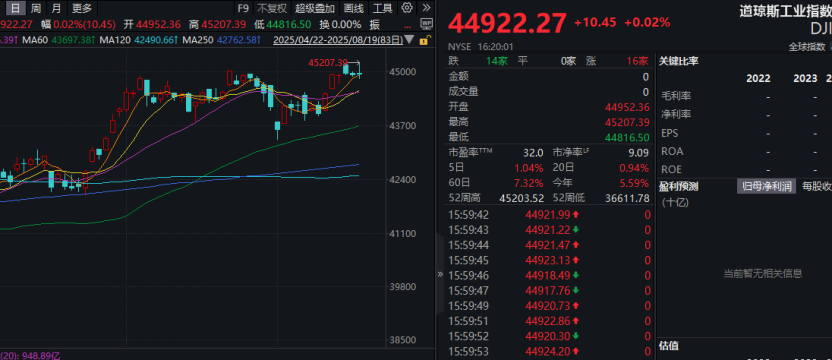
Group 1: Market Performance - The US stock market showed mixed results, with the Dow Jones Industrial Average reaching a record high before declining, while the S&P 500 and Nasdaq Composite indices fell [1][3] - The Dow Jones Industrial Average closed at 44,922.27 points, up 0.02%, after hitting an intraday high [3][4] - The Nasdaq Composite index experienced a significant drop of 1.46%, closing at 21,314.95 points [3][4] Group 2: Technology Sector - Major technology stocks faced widespread declines, with Nvidia leading the drop, falling over 3% and losing more than $155 billion in market value [1][5] - Other notable declines included Marvell Technology down over 6%, Oracle and Advanced Micro Devices down over 5%, and Broadcom and TSMC down over 3% [1][7] - Meta Platforms fell over 2%, while Tesla, Amazon, Microsoft, and Google all experienced declines of over 1% [5][7] Group 3: Semiconductor Sector - The Philadelphia Semiconductor Index dropped by 1.81%, reflecting a negative trend in semiconductor stocks [7] - Intel was one of the few gainers in the sector, rising nearly 7% [7] Group 4: Banking Sector - Most major US banks saw declines, with Goldman Sachs down over 1%, Citigroup down 0.52%, and Morgan Stanley down 0.49% [8] - However, Bank of America and Wells Fargo managed slight gains, up 0.39% and 0.13% respectively [8] Group 5: Energy and Other Sectors - Energy stocks showed mixed results, with ExxonMobil up 0.66% and Chevron down over 1% [9] - Airline stocks also had varied performances, with Delta Air Lines down nearly 1% while American Airlines rose 0.38% [9]