
同花顺

Search documents
国泰海通:AI+金融行业拐点已至 在核心业务及中后台场景加速渗透
Zhi Tong Cai Jing· 2025-11-17 09:01
Core Insights - The financial industry is experiencing a significant shift towards AI applications, driven by both internal and external factors, marking a pivotal moment for AI implementation in finance [2] - The release of DeepSeek R1 in 2025 is expected to enhance general model reasoning capabilities and reduce costs, facilitating localized AI deployment in financial institutions [1][3] - AI is anticipated to transform financial business processes and organizational structures, ushering in a new era of digital intelligence in finance [1] Industry Drivers - The financial sector is characterized as data, information, and decision-intensive, making it an ideal testing ground for AI applications [2] - Since the introduction of GPT-1 by OpenAI in 2018, general model technology has progressed from "technology validation" to "industry adaptation," indicating readiness for large-scale application in vertical sectors [2] - Recent policies and top-level designs have provided external impetus for financial institutions to transition from "digital intelligence" to "artificial intelligence" [2] Technological Pathways - There are two main technological approaches for integrating AI in finance: 1. Training general models with financial data, enhancing the ability to solve complex financial problems, with DeepSeek R1 marking a key industry milestone for localized AI deployment [3] 2. Developing financial-specific models that better address industry-specific challenges and compliance requirements [3] - AI agents, particularly multi-agent collaboration, are identified as a future focus area, with current applications primarily in short-thinking financial scenarios like understanding and information extraction [3] Investment Opportunities - Suggested sectors for investment include: 1. Financial information services with recommended stocks like Tonghuashun and JiuFang Zhitou Holdings [4] 2. Third-party payment services with recommended stocks like Newland and New Guodu [4] 3. Banking IT with recommended stocks including Yuxin Technology and Jingbeifang [4] 4. Securities IT with recommended stocks such as Hengsheng Electronics and Jinzhen Shares [4] 5. Insurance IT with recommended stocks like New Wisdom Software and Zhongke Software [4]

AI投研“工具箱”实测:普通股民的炒股搭子好用吗?
Nan Fang Du Shi Bao· 2025-11-17 07:51
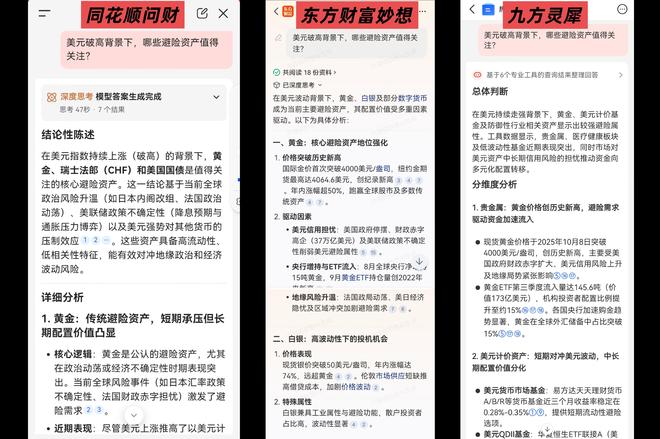
Core Insights - The A-share market has seen a significant increase in trading activity, with daily trading volume consistently exceeding 1 trillion yuan, leading to a rapid expansion of AI advisory management scale [1] - The number of A-share investors has surpassed 240 million, indicating that approximately 1 in every 6 Chinese individuals is now a stock investor [1] - AI is addressing traditional issues faced by ordinary investors, such as information asymmetry and emotional biases, by translating research capabilities into actionable investment advice [1] AI Advisory Experience - A recent evaluation of three mainstream AI advisory systems—Tonghuashun Wencai, Dongfang Caifu Miaoxiang, and Jiufang Lingxi—focused on their performance in investment analysis, particularly in hot topic interpretation, stock screening, and stock diagnosis [2] - Each AI advisory system has its strengths: Tonghuashun Wencai excels in natural language understanding and visualization, Dongfang Caifu Miaoxiang integrates multiple information sources for analysis, and Jiufang Lingxi offers strong reasoning and personalized service capabilities [2] Market Hotspot Analysis - In the context of fluctuating international markets, particularly the rising US dollar, the AI systems provided multi-dimensional analyses on which safe-haven assets to consider, with common mentions of gold, silver, Swiss francs, and US Treasury bonds [3] - Jiufang Lingxi provided more detailed insights, including recent trends in spot gold and gold ETFs, as well as defensive sector funds in healthcare and consumer sectors [3] Stock Screening and Analysis - The AI systems demonstrated distinct stock screening criteria, with Tonghuashun Wencai focusing on comprehensive valuation metrics, Jiufang Lingxi emphasizing higher ROE and revenue growth, and Dongfang Caifu Miaoxiang targeting non-ST stocks with significant market capitalization [6] - Jiufang Lingxi's analysis included a multi-dimensional approach, combining profitability, industry trends, and policy support, showcasing its strong logical analysis capabilities [6][10] Individual Stock Analysis - The evaluation included in-depth analyses of popular chip stocks, with Jiufang Lingxi providing comprehensive insights across various dimensions, while Tonghuashun Wencai focused on fundamental, technical, capital, and news aspects [8][9] - All three AI systems effectively utilized data visualization and interactive elements to enhance user engagement and understanding [9] User Experience and Design - Jiufang Lingxi achieved an overall user satisfaction rate of 83.7%, indicating strong performance in user interaction and experience design [11] - Each AI advisory system has a unique interface: Jiufang Lingxi emphasizes clear functional divisions, Tonghuashun Wencai follows a data-first approach, and Dongfang Caifu Miaoxiang opts for a clean and straightforward design [11]

金融科技ETF指数(563670)收涨超1.4%,银行加速发展数字金融
Xin Lang Cai Jing· 2025-11-17 07:29
Group 1 - The core viewpoint is that the financial technology sector is experiencing significant growth, driven by banks' increasing investments in technology to enhance their competitive edge amid digital transformation challenges [1][2] - The China Securities Financial Technology Theme Index (930986) has risen by 1.52%, with notable increases in constituent stocks such as Xinghuan Technology (688031) up 11.31% and Geer Software (603232) up 10.00% [1] - Recent procurement signals from multiple banks indicate a strong demand for technology solutions, with some project bids exceeding 20 million yuan and service periods extending up to three years [1] Group 2 - Dongwu Securities highlights that the internet finance sector is focusing on short-term performance elasticity, while securities IT is paying attention to the demand for trusted computing [2] - The financial technology ETF index closely tracks the performance of the China Securities Financial Technology Theme Index, which reflects the overall performance of listed companies in the financial technology sector [2] - As of October 31, 2025, the top ten weighted stocks in the China Securities Financial Technology Theme Index account for 54.41% of the index, indicating a concentration in key players such as Tonghuashun (300033) and Dongfang Caifu (300059) [2]




涨超1.4%,金融科技ETF华夏(516100)近3月获资金净申购8.2亿
Sou Hu Cai Jing· 2025-11-17 03:47
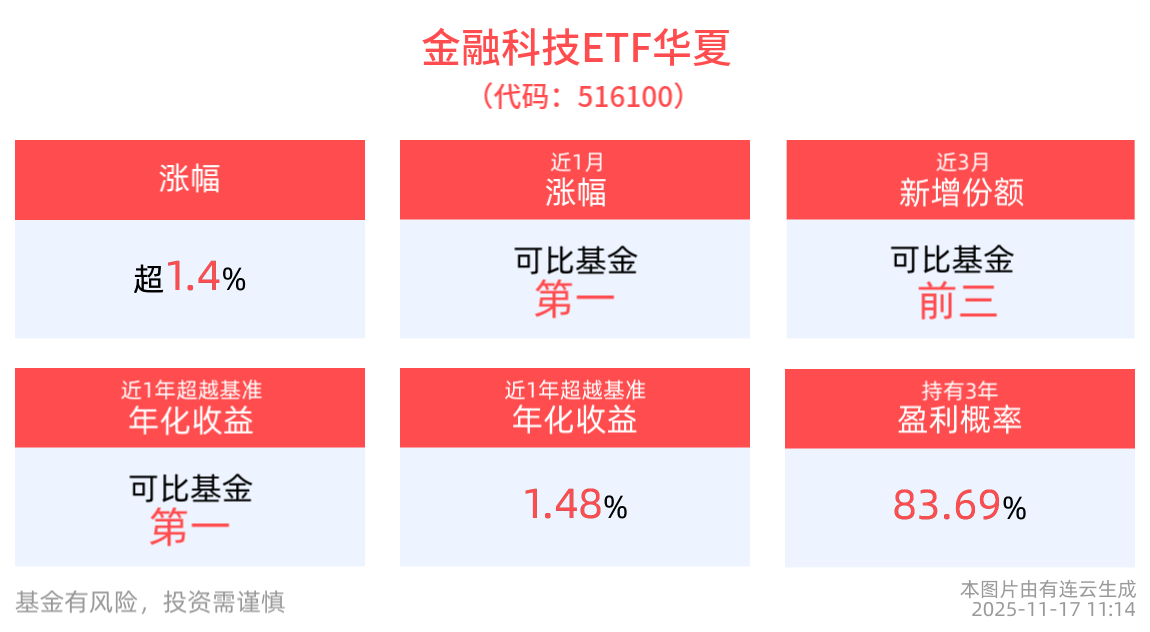
Core Insights - The financial technology ETF Huaxia (516100) has shown strong performance, with a net inflow of 820 million in the last three months and a total scale of 1.34 billion as of November 14, 2023 [3][4] - The ETF closely tracks the CSI Financial Technology Theme Index, which includes sectors such as software development, internet finance, and digital currency, positioning it as a potential beneficiary of market recovery and AI-related catalysts [4] Performance Metrics - As of November 14, 2023, the financial technology ETF Huaxia has achieved a net value increase of 12.99% over the past six months [3] - The highest single-month return since inception is 55.18%, with the longest consecutive monthly gain being four months and a maximum increase of 47.15% [3] - The average monthly return during rising months is 10.21%, with an annual profit percentage of 66.67% and an 83.69% probability of profit over a three-year holding period [3] Top Holdings - The top ten weighted stocks in the financial technology ETF Huaxia account for 54.41% of the index, with notable companies including Tonghuashun (300033), Dongfang Caifu (300059), and Zhinan Zhen (300803) [4][6] - The performance of these stocks varies, with notable increases in stocks like Runhe Software (4.12%) and Dazhihui (4.17%) [6]


虚拟电厂重构能源生态,开启电网智慧革命
Xin Hua Ri Bao· 2025-11-16 21:55
Group 1 - The core viewpoint of the news is the emergence of a potential market for virtual power plants in China, with a projected market size reaching hundreds of billions, driven by government policies and industry developments [2][3]. - The National Development and Reform Commission and the National Energy Administration have issued guidelines to accelerate the development of virtual power plants, aiming for a regulation capacity of over 20 million kilowatts by 2027 and over 50 million kilowatts by 2030 [2][3]. - The virtual power plant index has shown strong growth, with an overall increase of 41.89% from January 1 to November 14, 2025, indicating significant market interest and investment [2]. Group 2 - The "Energy e+" virtual power plant in Jiangsu has aggregated 113 flexible adjustment resources, providing peak shaving and valley filling capabilities, and has generated over 7 million yuan in additional revenue for renewable energy companies [3][4]. - The rise of virtual power plants represents a profound transformation in energy production, consumption, and scheduling relationships, with a focus on establishing a unified national electricity market [3][5]. - Companies like GCL-Poly Energy have developed platforms that utilize AI to optimize resource matching and trading strategies, resulting in improved accuracy and increased revenue from market transactions [4][5]. Group 3 - Virtual power plants are transitioning from reliance on single demand response subsidies to diversified revenue sources, including electricity spot markets and auxiliary service markets, indicating a shift towards market-oriented profitability [7]. - As of June 2025, over 40 virtual power plants have participated in the spot market, with transaction amounts exceeding 200 million yuan, highlighting the growing market engagement [7]. - Jiangsu province has approved 43 virtual power plant operators, with companies actively entering this emerging market, indicating a robust competitive landscape [7][8]. Group 4 - Local governments in Jiangsu are accelerating the development of virtual power plants, with plans to establish a mature ecosystem by 2027, aiming for a regulation capacity of 120 megawatts [8]. - Policies in cities like Wuxi are promoting the construction of new energy storage facilities and smart microgrids, with expectations for significant installed capacity by 2030 [8].
非银金融行业周报:3季度险企权益配置提升明显,积极备战开门红-20251116
KAIYUAN SECURITIES· 2025-11-16 13:14
Investment Rating - The industry investment rating is "Positive" (maintained) [1] Core Viewpoints - The insurance index increased by 2.63%, outperforming the CSI 300 index which decreased by 1.08%, indicating a positive outlook for the insurance sector as companies prepare for the 2026 "opening red" [5] - The insurance sector's equity asset allocation has significantly increased in Q3, with a total investment balance reaching 37.46 trillion, a quarter-on-quarter increase of 3.4% and a year-on-year increase of 16.5% [6] - The brokerage sector continues to show high performance, with daily average stock fund turnover reaching 2.50 trillion, a year-on-year increase of 77.2% [7] Summary by Sections Insurance Sector - In Q3, the balance of stocks and funds reached 5.59 trillion, a year-on-year increase of 35.9% and a quarter-on-quarter increase of 18.3%, with equity investments now accounting for 15.5% of total assets [6] - Major life insurance companies have launched new products for 2026, with dividend insurance being a market leader, comprising 45.9% of new life insurance products [6] - The long-term interest rates are stabilizing, which is expected to improve the profitability of insurance companies, leading to a potential increase in return on equity (ROE) and valuation recovery [6] Brokerage Sector - The average daily turnover for stock funds is 2.50 trillion, with a year-to-date average of 2.03 trillion, reflecting strong market activity [7] - The China Securities Regulatory Commission is planning strategic tasks for the capital market during the 14th Five-Year Plan, aiming for a more resilient and attractive market [7] - The brokerage sector is expected to see improved profitability driven by core businesses such as public funds and investment banking, with a focus on strategic allocation opportunities [7]
中国智能投顾产业:现状、问题与对策|财富与资管
清华金融评论· 2025-11-15 04:45
Core Viewpoint - The development of China's smart investment advisory industry is essential for better meeting residents' wealth management needs and facilitating long-term capital market investments, highlighting the necessity of addressing current obstacles to its growth [2][3]. Group 1: Necessity for Development - The application of AI large model technology in the financial services industry has accelerated, with smart investment advisory services becoming a key focus area [3]. - The demand for professional wealth management services among Chinese residents is rapidly increasing, with smart investment advisory serving as a crucial vehicle for this [5][6]. - China's economic context, including slowing growth, aging population, and urbanization challenges, is shifting wealth growth drivers from real estate to financial assets [6][7]. Group 2: Challenges and Obstacles - The current legal framework in China restricts full discretionary authority in investment advisory services, primarily to protect investors, which reflects concerns about the implementation of fiduciary duties [3][16]. - There is a lack of clarity regarding responsibility among key stakeholders in the smart investment advisory process, leading to potential gaps in investor protection [16][17]. - The confidentiality requirements and limitations in algorithm design pose significant challenges, as the subjective nature of algorithm optimization and lack of transparency can undermine investor trust [17]. Group 3: Market Growth and Trends - The global smart investment advisory market has seen rapid growth in assets under management (AUM), revenue, and client base, indicating a strong trend towards digital investment solutions [6]. - By 2024, the proportion of financial assets held by Chinese residents is projected to reach 47.6%, reflecting a growing inclination towards financial products [7]. - The diversification of financial products available to residents has increased, complicating the investment landscape and intensifying the demand for specialized wealth management services [8][10].
11月14日区块链50(399286)指数跌1.49%,成份股汉得信息(300170)领跌
Sou Hu Cai Jing· 2025-11-14 16:42
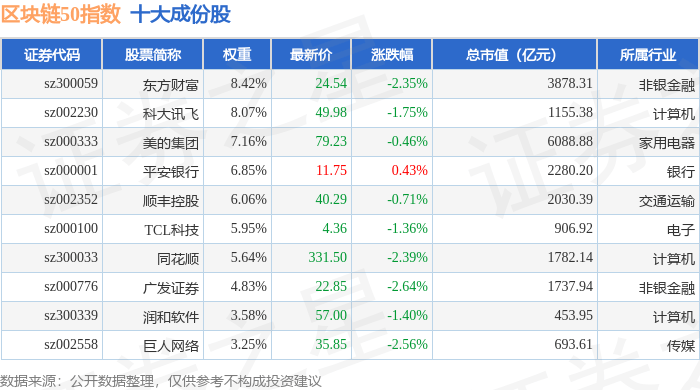
Market Performance - The Blockchain 50 Index (399286) closed at 3982.08 points, down 1.49%, with a trading volume of 35.197 billion yuan and a turnover rate of 1.74% [1] - Among the index constituents, 4 stocks rose while 45 stocks fell, with Yihualu leading the gainers at 3.15% and Handexin leading the decliners at 3.57% [1] Key Constituents - The top ten constituents of the Blockchain 50 Index include: - Dongfang Caifu (8.42% weight) at 24.54 yuan, down 2.35% [1] - Keda Xunfei (8.07% weight) at 49.98 yuan, down 1.75% [1] - Midea Group (7.16% weight) at 79.23 yuan, down 0.46% [1] - Ping An Bank (6.85% weight) at 11.75 yuan, up 0.43% [1] - SF Holding (6.06% weight) at 40.29 yuan, down 0.71% [1] - TCL Technology (5.95% weight) at 4.36 yuan, down 1.36% [1] - Tonghuashun (5.64% weight) at 331.50 yuan, down 2.39% [1] - Guangfa Securities (4.83% weight) at 22.85 yuan, down 2.64% [1] - Runhe Software (3.58% weight) at 57.00 yuan, down 1.40% [1] - Giant Network (3.25% weight) at 35.85 yuan, down 2.56% [1] Capital Flow - The net outflow of main funds from the Blockchain 50 Index constituents totaled 2.988 billion yuan, while retail investors saw a net inflow of 2.268 billion yuan [3] - Notable capital flows include: - Ping An Bank with a main fund net inflow of 12.8 million yuan [3] - Yihualu with a main fund net inflow of 41.29 million yuan [3] - Midea Group with a main fund net inflow of 10.00 million yuan [3]





回调是布局机会?创业板50ETF(159949)年内日均成交金额14.38亿居同类首位
Xin Lang Ji Jin· 2025-11-14 10:28
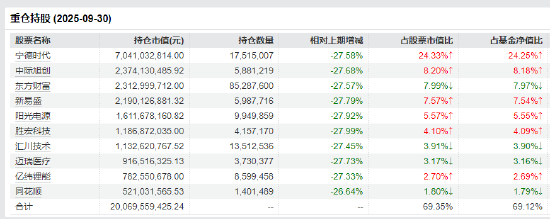
Core Viewpoint - The market is experiencing a downturn, with major indices declining, particularly affecting the ChiNext 50 ETF, which saw a significant drop in its top holdings [1][2]. Group 1: Market Performance - On November 14, the major indices opened lower and continued to decline, with the Shanghai Composite Index falling below 4000 points and the ChiNext Index dropping over 2% [1]. - The ChiNext 50 ETF (159949) fell by 2.91% to 1.470 yuan, with a turnover rate of 5.73% and a trading volume of 1.464 billion yuan, leading among similar ETFs [1]. Group 2: Top Holdings Analysis - All top ten holdings of the ChiNext 50 ETF experienced a pullback, with notable declines in their market values compared to the previous period [1]. - The largest holding, CATL, had a market value of approximately 7.04 billion yuan, down by 27.58%, representing 24.33% of the stock's market value and 24.25% of the fund's net value [1]. - Other significant holdings included Zhongji Xuchuang, Dongfang Caifu, and Yangguang Electric, all showing similar declines in both market value and percentage [1]. Group 3: Liquidity and Trading Volume - As of November 14, the ChiNext 50 ETF had a cumulative trading amount of 40.145 billion yuan over the last 20 trading days, averaging 2.007 billion yuan per day [1]. - Year-to-date, the ETF has seen a total trading amount of 301.988 billion yuan over 210 trading days, averaging 1.438 billion yuan per day [1]. - The ETF has delivered over 57% returns this year, outperforming its peers, ranking 251st among 2833 funds [1]. Group 4: Investment Strategy - Analysts suggest a "barbell strategy" in the current market environment, balancing high-dividend assets with technology growth sectors [2]. - The renewable energy sector is highlighted as a key area for investment, with signs of price stabilization in upstream materials like silicon [2]. - For investors optimistic about the long-term growth of China's technology sector, the ChiNext 50 ETF offers a convenient investment vehicle [2].

同花顺果指数概念下跌2.76%,9股主力资金净流出超亿元
Zheng Quan Shi Bao Wang· 2025-11-14 09:50
Market Performance - The Tonghuashun Fruit Index concept fell by 2.76%, ranking among the top declines in concept sectors as of the close on November 14 [1] - The leading gainers in concept sectors included Hainan Free Trade Zone (+4.63%) and Horse Racing Concept (+1.65%), while the National Big Fund Holdings and Storage Chips saw declines of -3.07% and -2.94% respectively [1] Capital Flow - The Tonghuashun Fruit Index concept experienced a net outflow of 4.089 billion yuan, with 18 stocks seeing net outflows and 9 stocks exceeding 100 million yuan in outflows [1] - The stock with the highest net outflow was Industrial Fulian, with a net outflow of 1.760 billion yuan, followed by Dongshan Precision, Lens Technology, and Changdian Technology with net outflows of 425 million yuan, 388 million yuan, and 365 million yuan respectively [1] Notable Stocks - The stocks with significant net inflows included Wentai Technology and Zhuhai Guanyu, with net inflows of 131 million yuan and 15.35 million yuan respectively [2] - The top stocks in the outflow list included Industrial Fulian (-5.47%), Dongshan Precision (-4.24%), and Lens Technology (-4.32%) [1][2]



