
翰森制药

Search documents
抗抑郁药物,卖爆了
虎嗅APP· 2025-09-17 10:02
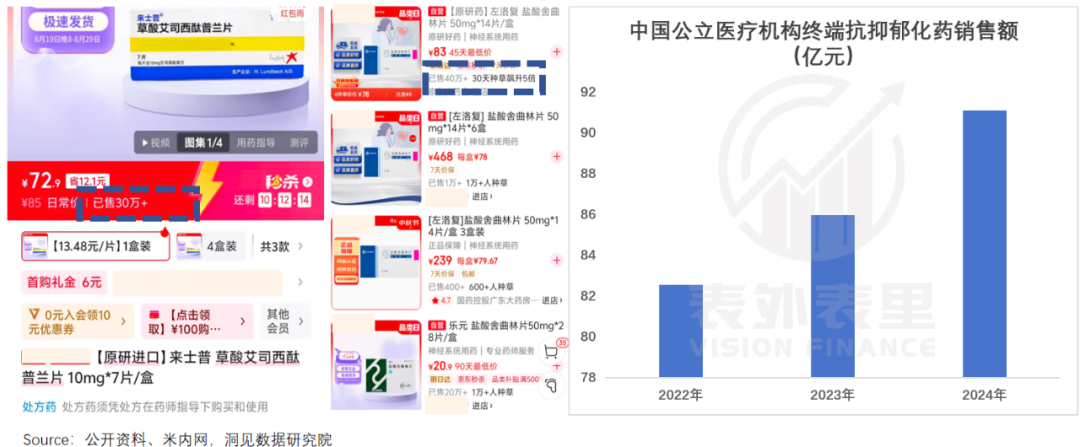
Core Viewpoint - The article discusses the rising prevalence of depression in China, the increasing demand for antidepressant medications, and the evolving pharmaceutical market dynamics surrounding these drugs. Group 1: Market Dynamics - The total number of individuals with depression in China has reached 95 million, with approximately 38 million registered patients as of 2023, leading to a booming pharmaceutical market for antidepressants [5]. - Sales of antidepressant medications in public medical institutions exceeded 9.1 billion yuan last year, marking a 6% year-on-year increase [5]. - The demand for antidepressants has led to significant sales growth for companies like Hansoh Pharmaceutical, which ranks among the top three in the antidepressant market, and others like Jingwei Pharmaceutical and Green Leaf Pharmaceutical, which have seen substantial sales increases [7]. Group 2: Changing Perceptions and Treatment - There is a noticeable shift in societal attitudes towards mental health, with more individuals, especially the younger generation, actively seeking treatment for depression [11]. - The article highlights the importance of early detection and intervention in mental health issues, emphasizing that many individuals delay seeking help due to societal stigma [11]. - The development of community mental health services and educational initiatives has contributed to a gradual change in public awareness regarding mental health [13]. Group 3: Pharmaceutical Competition - The market for antidepressants is becoming increasingly competitive, with over 40 generic antidepressants approved for sale in China this year alone, and at least 32 new antidepressant drugs in various stages of clinical approval [16]. - The entry of numerous generic manufacturers has intensified competition, particularly for drugs like Vortioxetine, which has seen a surge in the number of companies producing it [15]. - The article notes that the pricing of antidepressants has significantly decreased due to collective procurement policies, which have allowed generic drugs to capture a larger market share [26][29]. Group 4: Patient Experience and Treatment Challenges - Many patients face financial burdens due to the high costs of antidepressant medications, which can consume a significant portion of their income [20]. - The article discusses the challenges patients encounter when discontinuing medication, often misinterpreted as addiction, but more accurately described as withdrawal reactions [36]. - Psychological therapy remains a critical component of treatment, yet the high costs and variable quality of services deter many patients from pursuing this option [39].

抗抑郁药物,卖爆了
投中网· 2025-09-17 02:52
Core Viewpoint - The article discusses the growing market for antidepressant medications in China, driven by an increasing number of patients suffering from depression and the rising acceptance of mental health treatment [5][14][28]. Group 1: Market Dynamics - The total number of individuals with depression in China has reached 95 million, with approximately 38 million registered patients as of 2023, leading to a booming pharmaceutical market [6][7]. - Sales of antidepressant medications in public medical institutions reached a record high of over 9.1 billion yuan in the previous year, marking a 6% year-on-year growth [6]. - The demand for antidepressants has led to significant sales increases for companies like Hansoh Pharmaceutical, which ranks among the top three in the antidepressant market, and Green Leaf Pharmaceutical, whose new drug saw a 99.9% sales surge [7][8]. Group 2: Changing Perceptions and Treatment - There is a noticeable shift in societal attitudes towards mental health, with more individuals, especially the younger generation, actively seeking treatment for depression [14][11]. - The stigma surrounding mental health issues is gradually diminishing, allowing for greater awareness and acceptance of conditions like depression [14][11]. - The article highlights the importance of early detection and intervention in managing depression, although many patients still face barriers to seeking help [11][14]. Group 3: Competitive Landscape - The number of companies producing generic antidepressants has increased significantly, with over 40 generic antidepressants approved for sale this year alone [15][16]. - The competitive landscape is intensifying, with domestic companies aggressively entering the market, leading to price reductions for antidepressant medications [25][28]. - The introduction of centralized procurement has further driven down prices, making medications more accessible to patients [26][28]. Group 4: Challenges in Treatment - Despite the growing market, many patients still struggle with the high costs of original branded medications, which can consume a significant portion of their income [21][22]. - The article notes that the development of new antidepressants is slow due to high research and development barriers, leading to a relatively stable market for existing medications [22][24]. - The perception of antidepressants as "addictive" is discussed, with experts clarifying that withdrawal symptoms are often misinterpreted as addiction [33][34]. Group 5: Future Outlook - The article suggests that as more patients seek treatment and the market continues to evolve, the demand for antidepressants will likely remain strong, despite current market fluctuations [29][30]. - The ongoing changes in pricing and market dynamics may lead to a more sustainable and accessible treatment landscape for patients suffering from depression [28][29].

中泰国际每日动态-20250917
ZHONGTAI INTERNATIONAL SECURITIES· 2025-09-17 01:43
Market Overview - The Hang Seng Index slightly declined by 8 points or 0.03%, closing at 438 points on September 16, 2025[1] - The Hang Seng Tech Index rose by 0.6%, closing at 6,077 points[1] - Market turnover was recorded at HKD 294.1 billion, with a net outflow of HKD 3.18 billion from the Hong Kong Stock Connect[1] Economic Indicators - Investor sentiment is cautious, awaiting the outcome of the upcoming FOMC meeting[1] - The U.S. Federal Reserve's potential rate cut is anticipated to have limited impact on Hong Kong stocks due to already high valuations[2] - Sectors sensitive to interest rates, such as AI, robotics, semiconductors, and real estate, may benefit more directly from monetary policy changes[2] Sector Performance - The automotive parts sector saw a significant rise, with Sanhua Intelligent Controls (2050 HK) increasing by 12.8%[3] - The pharmaceutical sector experienced minor declines, with a focus on innovative drugs and leading CXO companies[3] - The renewable energy sector showed mixed performance, with solar stocks generally rising, such as Xinyi Solar (968 HK) up by 2.1%[4] Company Insights - Chaoyun Group (6601 HK) reported a 7.2% increase in revenue to RMB 1.34 billion, with pet category revenue doubling to RMB 96 million, a growth of 101.4%[5][6] - The overall gross margin improved by 2.9 percentage points to 49.3%[5] - The company plans to expand its offline pet store count to 200 by 2027 and is expected to maintain a high dividend payout ratio of 80%[8] Investment Strategy - The report suggests focusing on technology leaders and sectors benefiting from industrial upgrades, such as semiconductors and AI, amidst market volatility[9] - The anticipated rate cut by the Fed is expected to attract foreign capital back to Hong Kong stocks, with a focus on sectors showing strong earnings certainty[9]
抗抑郁药物,卖爆了
Hu Xiu· 2025-09-16 23:51
Core Insights - The article highlights the increasing prevalence of depression in China, with a total of 95 million individuals affected, leading to a booming market for antidepressant medications [5][6][25] - The demand for antidepressants has surged, with significant sales growth reported in public medical institutions, reaching over 9.1 billion yuan in the previous year, a 6% increase [6][28] - The market is experiencing a shift as domestic pharmaceutical companies are gaining market share due to the introduction of generic drugs and price reductions, challenging the dominance of international brands [41][46][48] Group 1: Market Dynamics - The number of registered depression patients in China is approximately 38 million, contributing to a vibrant pharmaceutical market [5] - Sales of common antidepressants on online shopping platforms have increased dramatically, with some products seeing a fivefold rise in sales within 30 days [6] - The competitive landscape is intensifying, with companies like Hansoh Pharmaceutical and Green Leaf Pharmaceutical achieving significant sales figures, such as 700 million yuan for escitalopram [8] Group 2: Patient Experience and Treatment Challenges - Many patients face difficulties affording medications, with some reporting that antidepressants consume a significant portion of their income [30][32] - The article discusses the stigma surrounding mental health, which often prevents individuals from seeking timely treatment, leading to more severe conditions [14][17] - The withdrawal effects of antidepressants are often misunderstood as addiction, complicating the treatment process for many patients [61][68] Group 3: Industry Trends and Future Outlook - The article notes a growing recognition of mental health issues, particularly among younger generations, leading to increased treatment-seeking behavior [18][19] - The introduction of community mental health services and educational initiatives is gradually improving public awareness and access to care [22] - Despite the challenges, the market for antidepressants is expected to continue expanding as more patients seek treatment, indicating a long-term growth trajectory for the industry [49]
医药生物行业简评报告:外部风险可控,创新药仍为重要投资主线
Capital Securities· 2025-09-16 10:58
Investment Rating - The industry investment rating is "Positive" [1][23] Core Viewpoints - External risks are controllable, and innovative drugs remain an important investment theme. The report suggests that the commercial value of innovative drugs is being realized smoothly, with biotech and biopharma operational efficiency continuously improving. The long-term outlook indicates that Chinese companies are significantly enhancing their position in the global innovative drug supply chain, with increasing source innovation capabilities [5][16]. Summary by Sections 1. Source Innovation Capability and External Risks - In the first half of 2025, the transaction amount related to the pharmaceutical sector in China reached 60.8 billion USD, a year-on-year increase of 129%, with 144 transactions, up 67% year-on-year. China's share in global pharmaceutical transactions was 46.63% in amount and 31.58% in number [6][8]. - The report emphasizes that U.S. government restrictive policies will have limited impact on the overseas market expansion of Chinese innovative drugs due to the collaborative interests of multinational corporations (MNCs) and biotech firms [5][8]. 2. Commercialization Value of Innovative Drugs - The report analyzed 19 representative large pharmaceutical companies, which collectively generated revenue of 139.5 billion CNY in the first half of 2025, with a net profit of 25.4 billion CNY, showing stability. Notably, innovative drug revenues are growing rapidly, with companies like Hengrui Medicine and Hansoh Pharmaceutical showing significant increases in their innovative drug sales [10][12]. 3. Investment Recommendations - The report suggests selecting stocks based on validated R&D and commercialization capabilities, including industry leaders like Hengrui Medicine and 3SBio. Companies that are entering a performance release phase, such as Eddingpharm and Kangzhe Pharmaceutical, are also recommended. Additionally, it highlights event-driven or valuation-sensitive stocks like Innovent Biologics and Genscript Biotech [16].
上市三个月股价暴涨46倍,药捷安康成创新药“黑马”?
2 1 Shi Ji Jing Ji Bao Dao· 2025-09-16 07:09
据了解,"临床默示许可"是国家药品监督管理局针对药物临床试验申请(IND)设立的一种高效审批机 制。按照规则,药物临床试验申请在提交后经过60个公示日且未收到否定或质疑意见,即视为获得默示 许可,企业可依据提交的试验方案启动相应临床试验。 值得注意的是,药捷安康于今年6月23日登陆港交所,彼时IPO发行价格为13.15港元/股。以9月16日午 间休盘价格计算,上市未满三个月,药捷安康股价涨超46倍。面对近2500亿港元的市值规模,市场不少 声音质疑药捷安康及其在研管线能否支撑起如此高的市值? 临床进展亮眼,短期亏损与资金压力待解 21世纪经济报道记者 韩利明 9月16日,港股上市药企药捷安康(02617.HK)延续近期强劲上涨态势,截至午间休盘,报收620港元/ 股,上涨49.4%,总市值达2460.8亿港元。回溯至9月10日,药捷安康股价开启持续上行通道,其中9月 15日涨幅尤为显著,最终暴涨115.58%报415 港元/股收盘,16日药捷安康尾盘跳水转跌6%,盘中一度涨 超60%。短期股价波动引发市场广泛关注。 从消息面来看,药捷安康此次股价异动或与公司核心产品的临床进展密切相关。9月10日,药捷安康公 ...
中泰国际每日晨讯-20250916
ZHONGTAI INTERNATIONAL SECURITIES· 2025-09-16 04:53
Market Overview - On September 15, the Hong Kong stock market experienced narrow fluctuations, with the Hang Seng Index rising by 58 points or 0.2% to close at 26,446 points. The Hang Seng Tech Index increased by 0.9% to 6,043 points. The market turnover decreased to over HKD 290.2 billion, with a net inflow of HKD 14.47 billion from the Stock Connect, continuing to support the market [1] - Economic data from China in August indicated a slowdown in growth momentum, with moderate consumption growth, significant investment slowdown, and ongoing downward pressure in the real estate sector. Notably, the credit pulse index in August declined for the first time in nine months, which may exert pressure on the Hong Kong stock market [1] Macroeconomic Dynamics - In August, China's retail sales growth slowed significantly, with a year-on-year increase of only 3.4%, the lowest since November of the previous year. Fixed asset investment growth from January to August was only 0.5%, with real estate investment declining by 12.9% [2] - The new housing transaction volume in major cities showed a mixed performance, with a year-on-year decline of 6.3% in the last week, contrasting with a rise in first-tier cities [2] Industry Dynamics - The Hong Kong automotive sector saw a rebound after a period of stagnation, with companies like BYD and NIO experiencing stock price increases. NIO is set to launch its new E8 model on September 20 [4] - The healthcare index in Hong Kong rose by 0.2%, driven by the CXO sector. Recent government meetings emphasized the promotion of biomedical technology innovation and the upgrading of the biopharmaceutical industry [4] Pharmaceutical Sector Insights - The innovative drug and CXO sectors are expected to maintain robust growth, with leading companies in these areas showing strong performance in the first half of 2025. The demand for innovative drugs in oncology, metabolism, and autoimmune diseases is anticipated to grow steadily [6][7] - Traditional medical service sectors are expected to recover gradually, although the impact of medical insurance cost control remains a concern. Government policies aimed at alleviating financial issues for medical institutions are expected to improve the operating environment over time [8] Key Company Recommendations - China Biologic Products (1177 HK) reported a 10.7% increase in revenue to RMB 17.57 billion in the first half of 2025, with a net profit increase of 12.3% to RMB 3.39 billion. The company is expected to achieve double-digit growth in product sales revenue [10] - Hansoh Pharmaceutical (3692 HK) saw a 14.3% increase in revenue to RMB 7.43 billion, with a net profit increase of 15.0% to RMB 3.14 billion, driven by strong performance in its oncology products [10] - WuXi AppTec (2359 HK) reported a 20.6% increase in revenue to RMB 20.80 billion, with a net profit increase of 95.5% to RMB 8.29 billion, reflecting strong core business performance [11] Environmental Sector Insights - Gree Power (1330 HK) reported a 24.5% increase in net profit to RMB 380 million in the first half of 2025, driven by increased waste processing and electricity generation [12] - The company has rationally expanded its capacity, with waste processing capacity growing from 33,710 tons/day in FY21 to 40,310 tons/day in FY24, indicating a compound annual growth rate of 6.1% [13]
国内市场需求与政策支持双轮驱动 创新药板块表现亮眼
Huan Qiu Wang· 2025-09-16 02:27
Core Insights - The Chinese innovative drug sector has become a hot area in the capital market this year, driven by the real demand for high-quality innovative drugs from domestic patients, which is seen as the core driver for industry recovery [1] Group 1: Market Performance - In the first half of this year, 21 innovative drug companies listed on A-shares achieved a revenue of 28.69 billion yuan, a year-on-year increase of approximately 42%, while 32 innovative drug companies listed on H-shares reported a revenue of 42.13 billion yuan, a year-on-year increase of about 10% [2] - Leading companies have shown particularly strong performance, with Heng Rui Medicine's innovative drug sales revenue reaching 7.57 billion yuan, a year-on-year increase of approximately 14.5% [2] - Innovative drugs from Bai Jie Shen Zhou, such as Bai Yue Ze and Bai Ze An, reported sales of 1.192 billion yuan and 2.643 billion yuan respectively, with year-on-year growth rates of 36.5% and 20.6% [2] Group 2: Policy and Market Dynamics - The Chinese innovative drug market is entering a dual development cycle with domestic medical insurance and overseas markets, leading to a gradual path to profitability for companies [2] - Since its establishment in 2018, the National Medical Insurance Bureau has included 149 innovative drugs in the medical insurance catalog through seven rounds of adjustments, significantly optimizing the clinical medication structure [3] - By May 2025, the medical insurance fund is expected to pay a cumulative 410 billion yuan for negotiated drugs, driving related drug sales to exceed 600 billion yuan [3] Group 3: Future Outlook - The innovative drug market in China is projected to reach a scale of 162 billion yuan by 2024, with medical insurance payments accounting for approximately 43.8% [4] - The commercial success of innovative drugs is seen as a starting point for higher-level research and development, with many companies increasing their R&D investments despite revenue growth [4] - China currently holds a 30% share in global drug research and development, with 1,775 first-in-class drug pipelines, representing 19% of the global total [4]



翰森制药(03692.HK):2025年中报发布 内生增长超预期
Ge Long Hui· 2025-09-15 19:29
Core Viewpoint - The company reported strong financial performance for H1 2025, with total revenue of 7.434 billion RMB, a year-on-year increase of 14.3%, and a net profit attributable to shareholders of 3.135 billion RMB, up 15.02% [1] Financial Performance - Total revenue for H1 2025 reached 74.34 billion RMB, reflecting a 14.3% year-on-year growth [1] - Net profit attributable to shareholders was 31.35 billion RMB, marking a 15.02% increase compared to the previous year [1] - Revenue from innovative drug products amounted to 61.45 billion RMB, up 22.1%, accounting for 82.7% of total revenue [1] Product Revenue Breakdown - Revenue from the oncology product portfolio, including drugs like Amatinib and Flumatinib, was 45.31 billion RMB, remaining stable year-on-year [1] - Revenue from the anti-infection product portfolio, including Adefovir and Metronidazole, reached 7.35 billion RMB, a 4.9% increase [1] - Revenue from the central nervous system disease product portfolio, including Inalizumab, was 7.68 billion RMB, up 4.8% [1] - Revenue from the metabolic and other diseases product portfolio surged to approximately 14.00 billion RMB, a significant increase of 134.5% [1] Strategic Developments - The company received an upfront payment of 112 million USD from MSD for the agreement related to HS-10535 (an oral small molecule GLP-1RA) [1] - The sales data from sample hospitals indicated a growth from 18.41 million RMB in 2020 to 1.784 billion RMB in 2024, with a compound annual growth rate of 214% [2] - Amatinib has expanded its indications related to NSCLC, with four approved indications and additional ones under review [2] Clinical Development - The company has over 40 candidate innovative drugs undergoing more than 70 clinical trials as of H1 2025 [3] - Eight new innovative drugs entered clinical trials in H1 2025, including HS-20122 (EGFR/c-Met ADC) and HS-10510 (PCSK9) [3] - Three new drugs entered Phase III clinical trials, including HS-20137 (IL-23p19) for psoriasis and two ADCs for bone and soft tissue sarcoma and ovarian cancer, with overseas rights granted to GSK [3] Revenue and Profit Forecast - The company's revenue forecast for 2025 has been revised upward from 13.741 billion RMB to 14.668 billion RMB, with expected revenues of 15.835 billion RMB and 17.779 billion RMB for 2026 and 2027, respectively [3] - The net profit forecast for 2025 has been adjusted from 4.746 billion RMB to 5.167 billion RMB, with expected net profits of 5.325 billion RMB and 6.133 billion RMB for 2026 and 2027, respectively [3]

REGN Loses 21.1% Year to Date: Buy, Sell or Hold the Sock?
ZACKS· 2025-09-15 14:56
Core Insights - Regeneron Pharmaceuticals (REGN) shares have declined by 21.1% year-to-date, underperforming the industry growth of 5.2% and the S&P 500 Index [1][8] - The lead drug Eylea has faced significant sales pressure due to competition from Roche's Vabysmo, impacting investor sentiment [2][6] - Despite challenges, Regeneron's oncology portfolio shows promise with recent approvals and strong sales growth in certain products [8][14] Company Performance - Eylea, the primary revenue driver, has seen declining sales due to competition, although Eylea HD sales in the U.S. increased by 29% in Q2 2025 [5][6] - The FDA has extended the review periods for Eylea HD submissions to Q4 2025, causing further uncertainty [7][10] - Dupixent continues to perform well, contributing positively to Regeneron's top line, with recent label expansions expected to drive sales growth [12][13] Oncology Portfolio - Regeneron's oncology franchise, including Libtayo, has shown strong performance with sales of $661.6 million in the first half of 2025, up 18% year-over-year [14] - Recent FDA approvals for Lynozyfic and Ordspono enhance the oncology portfolio, although Ordspono faced a setback with a complete response letter from the FDA [16][17] - The company is actively expanding its oncology pipeline, which is expected to diversify revenue sources [25] Future Outlook - Regeneron is exploring opportunities in the obesity market through a licensing agreement with Hansoh Pharmaceuticals, which could enhance its clinical-stage portfolio [19] - The company is also developing investigational allergen-blocking antibodies, with positive results from phase III studies [20] - Current valuation metrics indicate that REGN shares are trading at a price/earnings ratio of 17.87X forward earnings, higher than the large-cap pharma industry average [21] Challenges - Pipeline setbacks, particularly related to the mixed results from late-stage studies on itepekimab, pose risks to the company's near-term outlook [26] - The transition from Eylea to Eylea HD is expected to take time, creating additional pressure on the stock [25][27]
