海信视像

Search documents
专访斯洛文尼亚前副总理布尔克:希望欧中尽快签署一项全面协议
Di Yi Cai Jing· 2025-12-03 06:17
Core Viewpoint - The essence of future EU-China cooperation lies in maintaining dialogue and interaction to create new markets and opportunities, especially in sectors like energy, automotive, and pharmaceuticals [1][2][7]. Group 1: Economic Cooperation - Slovenia's economy heavily relies on the automotive and pharmaceutical industries, which together account for 16% of its GDP [1]. - Slovenia welcomes Chinese investment, particularly in energy, automotive, and pharmaceutical sectors, indicating a strong foundation for bilateral cooperation [1]. - The EU is undergoing a transformation and is open to leading global trends, emphasizing the importance of EU-China dialogue [2]. Group 2: Technological Advancements - Emerging technologies such as artificial intelligence, quantum mechanics, and new materials present excellent opportunities for EU-China collaboration [7]. - The electric vehicle sector is a key strategic direction for both regions, with a focus on sustainable energy sources and technological development [5][7]. - The low-altitude economy is reshaping industry dynamics, providing new development spaces for logistics and urban air traffic, which can alleviate ground traffic pressure [6]. Group 3: Future Outlook - A comprehensive agreement between the EU and China is desired to define trade cooperation and address mutual understandings of differences [7][8]. - The need for a unified global regulatory framework is emphasized to foster business predictability and growth amid political polarization [7][8]. - The collaboration in addressing climate change, green technology, and high-tech solutions is seen as a long-term opportunity for both regions [7].


高端电视迎来RGB-Mini LED热潮 海信独占九成市场份额
Xin Hua Cai Jing· 2025-12-03 03:20
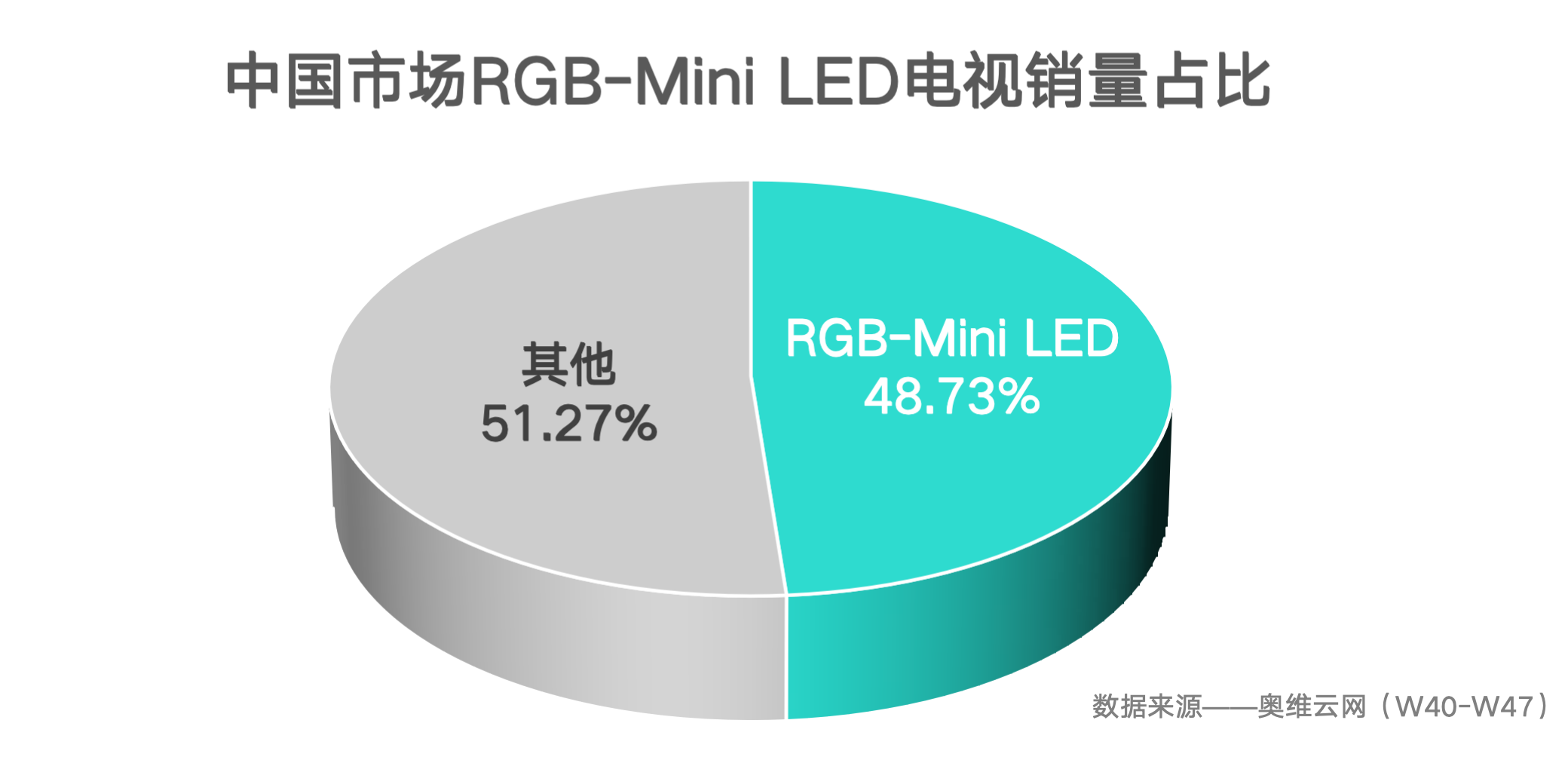
Core Insights - The domestic consumer market is transitioning from scale growth to value upgrading, with quality and high-end products becoming the core demands of family consumption [1] - The emergence of new display technologies, particularly RGB-Mini LED, is reshaping the high-end television market and setting new technical standards [1] Market Performance - In the offline market for high-end televisions priced above 20,000 yuan, RGB-Mini LED televisions accounted for 43.68% of sales revenue and 48.73% of sales volume during the W40 to W47 period, indicating a strong market presence [4] - Hisense has a dominant position in the RGB-Mini LED segment, with a sales revenue share of 93.35% and a sales volume share of 95.67% [4] - In the ultra-large size market (above 25,000 yuan and 98 inches), Hisense maintains a strong advantage with online and offline sales volume shares of 90.93% and 99.04%, respectively [4] Technological Advancements - RGB-Mini LED technology offers significant advantages over traditional LCDs by using RGB light source chips, allowing for direct color output and enhanced picture quality [6] - The technology includes precise color control, leading to exponential improvements in picture quality and is viewed as a promising direction for LCD display technology over the next decade [7] Product Launches and Global Expansion - Hisense launched the world's first RGB-Mini LED television in March and has since introduced flagship models that have gained significant market traction [9] - By Q3 2025, Hisense's RGB-Mini LED televisions are expected to be available in over 20 countries, with a quarterly shipment growth exceeding 300% [9] - The anticipated global demand for high-end televisions, particularly during major events like the World Cup and gaming releases in 2026, is expected to further solidify Hisense's market leadership [9] Competitive Edge - Hisense's competitive advantage stems from continuous technological breakthroughs, including the introduction of advanced AI picture quality chips and new multi-crystal RGB-Mini LED light source chips [10] - These innovations enhance color accuracy and stability while reducing energy consumption by over 40% compared to QD-OLED, positioning Hisense as a leader in the high-end display market [10]

日本制造黄金时代落幕:系统性崩塌背后的多重危机
Sou Hu Cai Jing· 2025-12-02 23:40
Core Insights - Japan's manufacturing sector is experiencing a systemic collapse, with the Purchasing Managers' Index (PMI) remaining below the neutral line for five consecutive months, indicating ongoing contraction in manufacturing activity [1][3] - The Japanese economy has entered a negative growth phase, with a reported annualized decline of 1.8% in Q3 2023, marking the first negative growth since Q1 2024 [1][11] - Japan's exports to the U.S. have seen a continuous decline for seven months, further exacerbating economic challenges [1][11] Group 1: Credibility Crisis - Japan's manufacturing industry is facing an unprecedented trust crisis, with multiple long-standing data falsification scandals across various sectors, including automotive and steel [3] - Major companies like Kobe Steel and Mitsubishi Electric have been implicated in decades-long data manipulation, undermining the credibility of Japanese manufacturing [3] - The recent scandal involving Kobayashi Pharmaceutical, which resulted in over a hundred deaths, has intensified the crisis of confidence in Japanese products [3] Group 2: Market Setbacks - Japanese brands are losing significant market share to Chinese competitors, particularly in the home appliance sector, where domestic brands hold 72% of the market compared to less than 8% for Japanese brands [5] - The market share of Japanese cars in China has plummeted to 10.8% in the first ten months of 2025, down from 24.1% in 2020, while domestic brands have surged to a 58.3% market share [5] - In Japan, 70% of home appliances are now manufactured in China, with brands like Hisense and TCL dominating the market [5] Group 3: Transformation Challenges - Japanese automakers are struggling to adapt to the global shift towards electric and smart vehicles, with domestic brands capturing nearly 90% of the new energy vehicle market in China, while Japanese brands account for less than 2% [7] - The focus on hydrogen fuel technology has caused Japanese manufacturers to miss the lithium-ion battery opportunity, leading to a slow transition to electric vehicles [7] - Japanese car manufacturers are adopting a defensive multi-path strategy, which has delayed their transition to electric vehicles and caused a disconnect with market demands for smart features [7] Group 4: External Pressures - U.S. tariff policies have severely impacted Japanese manufacturers, with the seven major automakers facing a combined profit loss of approximately 1.5 trillion yen (around 10 billion USD) between April and September 2025 [9] - The automotive sector's profit margins are now only 7%-8%, leading to a situation where all seven major automakers reported declining profits for the first time since the COVID-19 pandemic began [9] - The decline in automotive exports is negatively affecting Japan's GDP growth and impacting related industries such as electronics and steel [9] Group 5: Economic Dilemma - Japan's economy is facing significant internal and external challenges, with a sharp contraction in external demand contributing to the negative growth in Q3 2023 [11] - The impact of U.S. tariffs has led to a 1.2% decline in goods and services exports, contributing negatively to economic growth [11] - Domestic consumption is also weak, with only a marginal increase of 0.1% in personal consumption, which constitutes over half of Japan's economy [11] Group 6: Policy Response - In response to the economic challenges, the Japanese government has introduced a 21.3 trillion yen economic stimulus plan, though experts question its effectiveness [13] - Concerns regarding fiscal sustainability are prominent, as Japan's government debt is approximately 263% of GDP, raising questions about the long-term viability of increased spending [13] - The current government is also focusing on military expansion, which contrasts with public demand for improved living standards and tax relief [15]

快手发布“可灵O1”;滴滴自动驾驶在广州试运行全天候、全无人载客测试服务|未来商业早参
Mei Ri Jing Ji Xin Wen· 2025-12-02 23:07
Group 1: Kuaishou's Keling AI Launch - Keling AI has released "Keling O1," positioned as the world's first unified multimodal creation tool, aiming to streamline the entire process from generation to deep editing [1] - The launch signifies a shift in the domestic AIGC sector from isolated functional breakthroughs to an ecosystem competition focused on reshaping complete workflows [1] - Challenges remain regarding high computing costs, reliability of actual outputs, and establishing a unique ecosystem amidst strong competition from major players [1] Group 2: Didi's Autonomous Driving Testing - Didi has commenced all-weather, fully unmanned passenger testing in designated areas of Guangzhou, allowing users to summon autonomous vehicles via the Didi app [2] - This public trial is a crucial step in Didi's commercialization roadmap, requiring proof of both technical feasibility and economic viability for large-scale operations [2] - The competition in autonomous driving is shifting from technology demonstration to cost, user experience, and operational efficiency, with Didi leveraging its network advantages [2] Group 3: JD's Digital Human Live Streaming - JD has announced that its digital human live streaming service will be free for all merchants, enabling quick setup of 24/7 live streaming rooms [3] - This move represents a strategic upgrade from "tool selling" to "ecosystem building," aiming to attract a larger supply of live streaming content to enhance overall traffic and transaction volume [3] - The sustainability of this free strategy will depend on whether the resulting GMV increase can cover the technological investments and how to balance digital human live streaming with content diversity on the platform [3]


慧谷新材:国产涂层替代隐形冠军,IPO迎来新进展
Zheng Quan Shi Bao Wang· 2025-12-02 13:55
Core Viewpoint - Shenzhen Stock Exchange announced the upcoming IPO review meeting for Guangzhou Huigu New Materials Technology Co., Ltd. on December 9, 2025, highlighting the company's focus on polymer materials and functional coating materials driven by independent research and development [1] Company Overview - Huigu New Materials specializes in high polymer materials, forming an industrial layout system of "1+1+N" with functional resin technology and coating materials as core components [1] - The company serves a diverse client base, including major domestic and international companies such as Gree, Midea, Haier, and Samsung, indicating strong product competitiveness and market recognition [1] Financial Performance - The company's revenue for 2022, 2023, and 2024 was 664 million, 717 million, and 817 million yuan respectively, while net profit increased from 30 million to 146 million yuan, with net profit growth outpacing revenue growth [2] - Gross margin improved from 29.56% to 40.68%, reflecting a trend of "expanding scale and stronger profitability" [2] Industry Recognition - In March 2024, the company was recognized as a national manufacturing single champion by the Ministry of Industry and Information Technology, and its subsidiary was recognized as a "little giant" enterprise in October 2025, underscoring its leadership in industrial innovation [2] Market Position - The company holds over 60% market share in energy-saving coatings for heat exchangers and over 30% in aluminum cap coatings, successfully breaking the long-standing monopoly of companies like Sherwin-Williams and PPG in the new energy battery collector coatings and MiniLED optical coatings [2] Technological Innovation - Technological innovation is the core driving force for Huigu New Materials, with multiple breakthroughs in key industry technologies since its establishment [2] - The company has a provincial-level technology center and employs 206 R&D personnel, with R&D investment consistently above 6% of revenue [2] IPO Details - In the upcoming IPO, Huigu New Materials plans to issue up to 15.78 million shares to raise 900 million yuan, with funds allocated for various projects including an expansion project for eco-friendly coatings and resins, a research center, and working capital [3] - The investment projects are closely aligned with the company's main business and core technologies, aimed at enhancing market competitiveness and core capabilities [3] Future Outlook - The company will continue to focus on the dual core product line strategy of functional resins and coating materials, promoting the localization and green development of key materials [3] - The goal is to deepen the development of composite functional materials and expand applications in home appliances, packaging, new energy, and electronics, establishing itself as a benchmark in the global functional materials sector [3]
京东数字人直播免费 百位数字人总裁将空降京东直播间
Zhong Guo Xin Wen Wang· 2025-12-02 13:51
Core Insights - JD.com has officially announced the free opening of its digital human live streaming service to all merchants, allowing them to easily set up their own AI hosts [3][4]. Group 1: Digital Human Live Streaming Features - The digital human live streaming service enables merchants to create 24/7 live streaming rooms, enhancing transaction efficiency [1][6]. - Merchants can choose from nearly 300 character models and over 200 voice styles, providing flexibility in presentation [4][6]. - AI-generated scripts simplify content creation, reducing the pressure on merchants to produce live content [4][6]. - Digital humans can interact with users in real-time, addressing inquiries and preventing engagement drop-offs [1][4]. - AI-driven content distribution maximizes reach, allowing for effective user engagement and content virality [1][4]. Group 2: Business Impact and Performance - The digital human initiative has already driven hundreds of billions in GMV, showcasing significant business impact [6][7]. - The average conversion rate for sales through digital humans has increased by 30%, indicating improved sales performance [6]. - During the 11.11 shopping festival, the number of merchants using digital human live streaming grew nearly sixfold compared to the previous year [7]. Group 3: Technological Advancements - The JoyAI model has evolved to support a wide range of applications, including the generation of long-form videos and high-quality character animations [7]. - Advanced technologies such as DPO reinforcement learning have addressed common challenges in AI-generated content, enhancing precision and speed [7]. - The latest digital human technology allows for the rapid creation of personalized digital hosts, making it accessible for small and medium-sized businesses [7].

又一AI产品全面免费,这次是京东数字人
Guan Cha Zhe Wang· 2025-12-02 09:18
Core Insights - JD.com has officially announced that its digital human live streaming service will be free for all merchants, marking a significant step in the adoption of AI technology in the e-commerce live streaming sector [1][3] - The platform aims to lower technical barriers for merchants, enhancing operational efficiency and sales conversion rates [1][3] Group 1: Service Features - Merchants can access the service by logging into the JD Mai service market, searching for "JD Official Digital Human," and completing the subscription process [1] - The service offers 24/7 uninterrupted live streaming and integrates various AI capabilities, including nearly 300 selectable avatars, over 200 stylized voice options, automatic script generation, real-time interaction responses, and automatic content slicing and distribution [1][3] - The digital human live streaming costs approximately one-tenth of traditional live streaming, with an average conversion rate increase of about 30% [3] Group 2: Market Impact - Over 45,000 brands have already adopted the service, and the number of merchants using digital human live streaming is expected to grow nearly sixfold by the 2025 "Double 11" shopping festival, contributing hundreds of billions in total merchandise volume (GMV) [3][5] - JD.com will provide some public traffic resources to merchants using digital human live streaming to enhance exposure and conversion efficiency [3] Group 3: Technical Advancements - The digital human technology is based on JD's self-developed JoyAI model, with the core module LiveHuman capable of generating high-quality videos in minutes, achieving breakthroughs in lip-syncing, natural expression, and hand movement accuracy [4] - The model employs advanced techniques such as flow matching, DPO reinforcement learning, and distribution matching distillation, improving inference speed by six times and addressing long-standing issues in AI-generated hand distortions [4] Group 4: Broader Applications - Beyond e-commerce, JD's digital human technology has expanded into various fields, including cultural promotion, brand endorsement, and advertising production [5] - The company collaborates with brands like Lenovo and MCM to create IP-based digital personas, evolving digital humans from mere execution tools to creative entities [5] Group 5: Industry Context - In the increasingly competitive landscape of live e-commerce, platforms are accelerating the integration of AI technology to optimize supply-side efficiency [5] - The comprehensive free offering of digital human live streaming by JD.com represents a significant support for the digital transformation of small and medium-sized enterprises [5]

黑色家电板块12月2日跌0.12%,四川长虹领跌,主力资金净流出9319.87万元
Zheng Xing Xing Ye Ri Bao· 2025-12-02 09:03
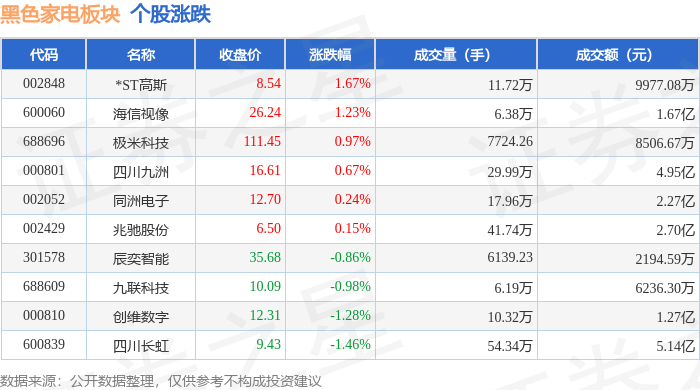
Market Overview - The black home appliance sector experienced a slight decline of 0.12% on December 2, with Sichuan Changhong leading the drop [1] - The Shanghai Composite Index closed at 3897.71, down 0.42%, while the Shenzhen Component Index closed at 13056.7, down 0.68% [1] Stock Performance - Notable stock performances included: - *ST Gauss (002848): Closed at 8.54, up 1.67% with a trading volume of 117,200 shares and a turnover of 99.77 million yuan - Hisense Visual (600060): Closed at 26.24, up 1.23% with a trading volume of 63,800 shares and a turnover of 167 million yuan - XGIMI Technology (688696): Closed at 111.45, up 0.97% with a trading volume of 1,772 shares and a turnover of 8.51 million yuan - Sichuan Changhong (600839): Closed at 9.43, down 1.46% with a trading volume of 543,400 shares and a turnover of 514 million yuan [1] Capital Flow - The black home appliance sector saw a net outflow of 93.2 million yuan from main funds, while retail funds had a net inflow of 27.4 million yuan [1] - Detailed capital flow for selected stocks included: - Sichuan Jiuzhou (000801): Main funds net inflow of 28.04 million yuan, retail funds net outflow of 39.08 million yuan - Hisense Visual (600060): Main funds net inflow of 13.18 million yuan, retail funds net outflow of 15.20 million yuan - Creative Digital (000810): Main funds net outflow of 22.48 million yuan, retail funds net inflow of 19.91 million yuan [2]

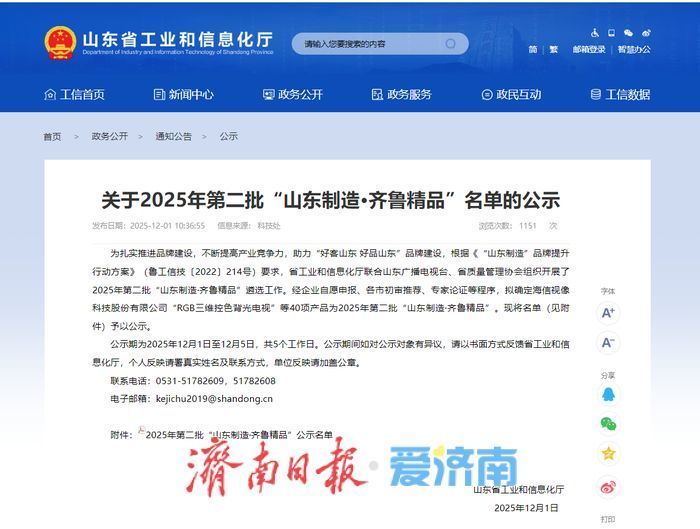
2025年第二批“山东制造·齐鲁精品”名单公示,这40项产品入选!
Feng Huang Wang Cai Jing· 2025-12-02 07:16
Core Viewpoint - The Shandong Provincial Department of Industry and Information Technology announced the second batch of "Shandong Manufacturing · Qilu Quality" products for 2025, highlighting 40 products including Hisense's "RGB 3D Color Control Backlight TV" to enhance brand building and industrial competitiveness [1]. Group 1: Announcement Details - The selection process involved voluntary applications from companies, preliminary reviews by cities, and expert evaluations [1]. - The public notice period for the selected products is from December 1 to December 5, 2025, allowing for feedback on the listed products [1]. Group 2: Objectives and Significance - The initiative aims to select products that are clear in ownership, energy-efficient, innovative, of high quality, and have significant economic and social benefits [1]. - The program supports the enhancement of the "Shandong Manufacturing" brand influence and core competitiveness [1]. Group 3: Selected Products - Notable products include: - Hisense's "RGB 3D Color Control Backlight TV" [2][3]. - A range of innovative equipment such as 3D visual control heavy-load handling robots and advanced medical imaging diagnostic devices [2][3][4]. - The list includes products from various categories such as equipment, information technology, new materials, chemicals, and pharmaceuticals [2][3][4].

潮涌南海千帆竞 十年同心向未来——写在2025企业家博鳌论坛开幕之际
新华网财经· 2025-12-02 04:48
Core Viewpoint - The 2025 Boao Forum for Entrepreneurs emphasizes the theme "Linking the World, Leading the Future: New Opportunities in the 14th Five-Year Plan," reflecting on the evolution of the forum over the past decade and its alignment with national development strategies [2][4]. Group 1: Forum Themes and Focus - The forum has consistently addressed contemporary issues such as high-quality development, digitalization, and green economy, aligning with national priorities like optimizing economic structure and promoting sustainable development [4][6]. - It has created a platform for discussions on new production capacities and global value chain integration, particularly in response to the "14th Five-Year Plan" [4][6]. Group 2: Activities and Structure - The forum features a comprehensive structure including a main forum, key activities, over 30 parallel forums, and more than 20 supporting events, covering diverse topics such as digital finance, health, and cultural industries [6][7]. - New forums like "AI China" and the Digital Financial Security Development Conference are introduced to align with strategic goals of advancing digital China and new production capacities [6]. Group 3: Entrepreneurial Spirit and Innovation - The forum highlights the importance of innovation as a driving force for development, with leaders from various companies emphasizing the need for technological breakthroughs and structural changes in production [10][11]. - The entrepreneurial spirit is underscored as vital for navigating market dynamics and fostering high-quality development, with notable figures advocating for a commitment to national and consumer interests [11][12]. Group 4: Global Linkages and Future Directions - The forum aims to enhance corporate innovation capabilities and foster international cooperation, particularly in the context of the Hainan Free Trade Port, which focuses on policies like zero tariffs and low tax rates [14][16]. - It serves as a platform for exploring new models of development that integrate free trade and industry, contributing to China's broader goals of economic stability and growth [14][16].