翰森制药

Search documents
华源证券:PD1/VEGF/IL-2 潜力可期 坚持创新药作为全年主线
智通财经网· 2025-09-15 03:49
Core Viewpoint - The pharmaceutical industry is expected to experience a marginal improvement in 2025, with further operational performance enhancements anticipated in 2026, particularly in structurally high-growth segments and individual stocks [1] Group 1: Industry Trends - The focus on "innovation" will be the main theme for 2025, with attention on "going overseas" and "aging" assets that are relatively undervalued in the second half of the year [1] - The Chinese pharmaceutical industry has largely completed the transition from old to new growth drivers, with innovation replacing generics and enhanced overseas capabilities [3] - The demand side is being driven by an accelerating aging population, leading to increased needs for chronic disease treatments such as cardiovascular, endocrine, and orthopedic care [4] Group 2: Investment Opportunities - The report suggests focusing on Shanghai Yizhong (688091.SH) due to its complementary mechanisms involving PD1, VEGF, and IL-2, which are integrated into a single molecule for enhanced therapeutic efficacy [2] - The Chinese innovative pharmaceutical sector has gained significant scale, with companies like Heng Rui Medicine (600276.SH, 01276) and Hansoh Pharmaceutical (03692) successfully transitioning to innovation [3] - The medical device and home care equipment sectors are expected to stabilize and recover in performance starting from Q3 2025, with a focus on the aging population and outpatient consumption [4] Group 3: Market Dynamics - The healthcare payment system is experiencing steady growth, with the National Healthcare Security Administration actively promoting the development of commercial insurance to create a multi-tiered payment system [4] - New technologies, particularly AI, are anticipated to accelerate industry transformation, providing new growth logic for the pharmaceutical sector [4]

需求旺盛!国产创新药,从“吞金巨兽”变成了“现金奶牛”!
Sou Hu Cai Jing· 2025-09-15 03:19
Core Viewpoint - The Chinese innovative drug sector has shown remarkable performance in the capital market this year, driven by record-high business development (BD) amounts for overseas expansion and a rapid growth in domestic revenue, indicating a shift from a "cash-burning" model to a "cash cow" model [1][2]. Group 1: Domestic Demand - The demand for high-quality innovative drugs in China is continuously being released, with A-share innovative drug companies achieving a revenue of 28.69 billion yuan in the first half of the year, a year-on-year increase of approximately 42% [2]. - Leading companies like Heng Rui Medicine reported a 14.5% increase in innovative drug sales revenue to 7.57 billion yuan, primarily from the domestic market [2]. - Other companies such as Bai Jie Shen Zhou and Yi Fan Medicine also reported significant revenue growth, with Bai Jie Shen Zhou's flagship product achieving a 36.5% increase in sales [3]. Group 2: Policy Support - The Chinese government has been actively supporting the development of innovative drugs, with 149 innovative drugs included in the national medical insurance directory since 2018 [4]. - The National Healthcare Security Administration has indicated that by May 2025, the cumulative payment for negotiated drugs will reach 410 billion yuan, driving related drug sales to exceed 600 billion yuan [4]. - New policies are being introduced to address pricing and reimbursement challenges for innovative drugs, including the establishment of a commercial health insurance directory for innovative drugs [5]. Group 3: Research and Development Investment - Despite revenue growth, many innovative drug companies are increasing their R&D investments, creating a positive cycle of revenue growth leading to increased R&D and a rich pipeline [7]. - Heng Rui Medicine invested 3.87 billion yuan in R&D, with over 100 innovative products in clinical development [7]. - The overall trend indicates that companies are focusing on building a robust pipeline to sustain future revenue growth [7]. Group 4: Global Positioning - China currently holds nearly 30% of the global drug R&D market share, with a significant number of first-in-class drug pipelines [8]. - The country has become an important source of global pharmaceutical innovation, with a notable increase in technology licensing and overseas expansion [8]. - The past years of investment during the "innovation drug bubble" period are expected to yield significant results in the coming years [8].



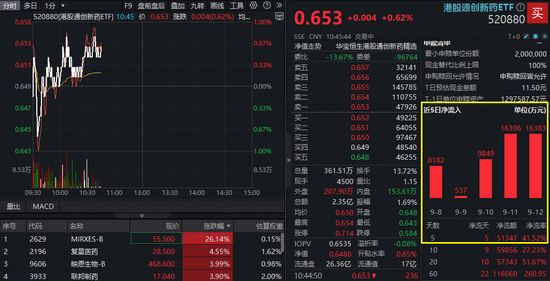
新进股冰火两重天,MIRXES-B狂飙26%一枝独秀,药捷安康-B回调10%,港股通创新药ETF(520880)高频溢价
Xin Lang Ji Jin· 2025-09-15 02:59
Core Viewpoint - The Hong Kong Stock Connect Innovation Drug ETF (520880) is experiencing strong performance and investor interest, with significant inflows and a focus on innovative drug development companies [1][3]. Group 1: ETF Performance - The Hong Kong Stock Connect Innovation Drug ETF (520880) has seen a trading volume exceeding 2.3 billion CNY, with a total inflow of over 5.1 billion CNY in the past week [1]. - The ETF is currently trading at a price of 0.653 CNY, reflecting a slight increase of 0.62% [2]. - The ETF has been consistently trading at a premium, indicating strong demand from investors [1]. Group 2: Market Trends - The ETF's underlying index has been revised to exclude CXO companies, focusing solely on innovative drug development firms, which enhances its ability to reflect the performance of China's innovative pharmaceutical sector [3]. - Recent policy support, including the inclusion of HPV vaccines in the national immunization program, is expected to benefit the innovative drug industry [3]. - The core product of one of the ETF's constituent companies, Yaojie Ankang, has received approval for a Phase II trial, marking a significant advancement in its research and development efforts [3]. Group 3: Sector Analysis - Analysts from Guojin Securities and Industrial Securities express optimism about the innovative drug sector, noting that while there may be increased volatility, the overall upward trend remains intact [3]. - The innovative drug sector is expected to continue being a core focus within the pharmaceutical industry, with ongoing policy support anticipated to enhance global competitiveness and commercial profitability [3]. - The top ten weighted stocks in the ETF include major players such as China Biologic Products, BeiGene, and CSPC Pharmaceutical Group, indicating a strong representation of leading companies in the innovative drug space [4].
从“吞金巨兽”到“现金奶牛” 中国创新药内需旺盛
Zheng Quan Shi Bao· 2025-09-14 22:16
Core Insights - The Chinese innovative drug sector has shown remarkable performance in the capital market this year, driven by record-high business development (BD) amounts for overseas expansion and a rapid growth in domestic revenue, indicating a shift from a "cash-burning" model to a "cash cow" model [1][2] Domestic Demand - There is a strong and growing domestic demand for high-quality innovative drugs, with A-share innovative drug companies achieving a revenue of 28.69 billion yuan in the first half of the year, a year-on-year increase of approximately 42%, while H-share companies reported 42.13 billion yuan, up about 10% [2] - Leading companies like Heng Rui Medicine reported a 14.5% increase in innovative drug sales revenue to 7.57 billion yuan, primarily from the domestic market, with several drugs contributing to this growth due to expanded indications [2][3] Revenue Growth and Market Dynamics - Innovative drugs from companies like Bai Jie Shen Zhou and Yi Fan Medicine have seen significant sales growth, with Bai Jie Shen Zhou's flagship product achieving 1.19 billion yuan in sales, a 36.5% increase, and Yi Fan's products growing by 169.57% [3] - The Chinese innovative drug industry is in a rapid development phase, benefiting from both domestic insurance market expansion and overseas market opportunities, leading to a trend towards profitability [3] Policy Support - The Chinese government has been actively supporting the development of innovative drugs, with 149 innovative drugs included in the national insurance catalog since 2018, significantly improving the accessibility of new and effective medications [4] - Companies like Jingxin Pharmaceutical and Bei Da Pharmaceutical have reported early signs of revenue growth from drugs that have recently been included in the insurance catalog, demonstrating the positive impact of policy support [4] Future Outlook - The year 2025 is anticipated to be a turning point for revenue growth among innovative drug companies, with 80% of A-share and H-share companies expected to see significant revenue increases following insurance negotiations [5] - The introduction of a commercial health insurance catalog for innovative drugs is expected to alleviate the financial burden on patients and enhance the market for innovative drugs [5][6] R&D Investment - Despite revenue growth, many innovative drug companies are increasing their R&D investments, creating a positive cycle of revenue growth leading to increased R&D and a rich pipeline of future products [7] - Companies like Heng Rui Medicine and Bai Jie Shen Zhou are significantly investing in R&D, with Heng Rui reporting 3.87 billion yuan in R&D spending and over 100 innovative products in clinical development [7] Global Positioning - China is becoming a significant player in global drug development, holding nearly 30% of the global market share, with a notable number of first-in-class drug pipelines and technology licensing agreements [8] - The past years of investment in innovative drug development are expected to yield substantial results around 2025, although caution is advised regarding potential future investment slowdowns [8]
从“吞金巨兽”到“现金奶牛”中国创新药内需旺盛
Zheng Quan Shi Bao· 2025-09-14 17:58
Core Viewpoint - The Chinese innovative pharmaceutical sector has shown remarkable performance in the capital market this year, driven by record-high business development (BD) amounts for overseas expansion and a rapid growth in domestic revenue, indicating a shift from a "cash-burning" model to a "cash cow" model for innovative drugs [1] Domestic Demand - The demand for high-quality innovative drugs in China is significantly increasing, with A-share innovative drug companies reporting a revenue of 28.69 billion yuan in the first half of the year, a year-on-year growth of approximately 42%, while H-share companies reported 42.13 billion yuan, a growth of about 10% [2] - Leading companies like Heng Rui Medicine reported a 14.5% increase in innovative drug sales revenue to 7.57 billion yuan, primarily from the domestic market, with several drugs contributing to this growth due to expanded indications [2][3] - Other companies such as BeiGene and Yifan Pharmaceutical also reported substantial revenue growth from their innovative products, indicating a robust domestic market for innovative drugs [3] Policy Support - The Chinese government has been actively supporting the development of innovative drugs through policy reforms, with 149 innovative drugs included in the national medical insurance directory since 2018, significantly improving the accessibility of new drugs [4] - The introduction of commercial health insurance for innovative drugs is expected to alleviate the financial burden on patients and enhance the market for innovative drugs [5][6] Research and Development Investment - Despite the growth in revenue, many innovative drug companies are increasing their R&D investments, creating a positive cycle of revenue growth leading to increased R&D and a rich pipeline of future products [7] - Companies like Heng Rui Medicine and BeiGene are significantly investing in R&D, with substantial portions of their revenue allocated to developing new drugs [7][8] Global Positioning - China is becoming a significant player in global drug development, holding nearly 30% of the global market share, with a notable increase in first-in-class drug pipelines and technology licensing [8] - The past years of investment during the "innovation drug bubble" period are expected to yield significant results in the coming years, particularly around 2025 [8]
创新药行业周报:关注pan-KRAS抑制剂胰腺癌潜在突破投资机会-20250914
Xiangcai Securities· 2025-09-14 12:39
Investment Rating - The industry investment rating is "Buy" (maintained) [2] Core Viewpoints - The domestic innovative drug industry is entering a turning point in 2025, shifting from capital-driven to profit-driven operations, with ongoing support from fundamentals and policies expected to continue the dual recovery trend in performance and valuation [6][38] - The demand side shows significant certainty advantages, while the supply side is improving in terms of industry and market competition, leading to an overall optimization of the supply-demand structure [6][41] Summary by Sections Market Analysis and Outlook - The innovative drug sector is experiencing a recovery, with key policies supporting market expansion, including the introduction of the first Class B medical insurance directory and ongoing support for innovative drug pricing mechanisms [6][39][40] - Recent performance data shows a median weekly decline of 2.62% among 85 sample innovative drug companies, with notable performers including Yaoke Ankang-B and Shengnuo Pharmaceutical-B [7][18] Clinical Progress and Investment Opportunities - The KRAS G12D clinical progress indicates significant unmet clinical needs in pancreatic cancer, with promising data from Revolution Medicines showing improved efficacy compared to traditional chemotherapy [7][30][36] - The report highlights two main investment lines: 1. Pharma companies transitioning to innovation, with strong performance resilience and a focus on companies like Sanofi Pharmaceutical and Aosaikang [8][41] 2. Biotech companies with potential for overseas product registration, emphasizing the growth of R&D platforms and commercialization [8][41] Performance Metrics - The annual performance from January 1, 2025, to September 13, 2025, shows significant gains, with the Hang Seng Biotech index up 103.30%, A-share biotech up 53.54%, and NASDAQ biotech up 10.57% [10][20]
创新药的“收获季”:从亏损到盈利,药企中报答卷亮了
Xin Lang Cai Jing· 2025-09-12 09:21
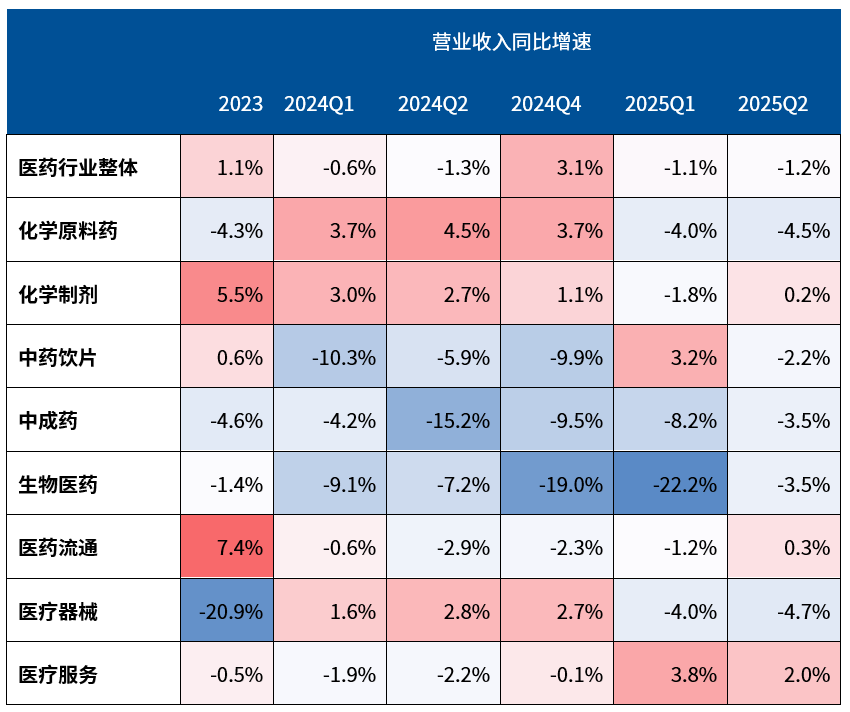
Core Viewpoint - The pharmaceutical industry is experiencing structural differentiation, with the innovative drug sector (Biotech) emerging as a significant growth driver, showcasing a revenue increase of 14.12% in the first half of 2025, particularly a remarkable 44.63% growth in Q2 [1][4]. Industry Overview - The overall pharmaceutical industry reported a slight revenue decline of 1.15% in Q2 2025, but net profit showed a positive growth of 0.79% [1]. - Despite challenges such as centralized procurement and external disruptions, there are signs of performance recovery driven by policy optimization, commercial insurance expansion, and AI empowerment [1][2]. Financial Performance - The Biotech sector's revenue growth in H1 2025 was 14.1%, with Q2 alone achieving a growth rate of 44.6% [6]. - The gross profit margin for the Biotech sector was 85.0%, indicating a narrowing of losses and a shift towards profitability [6]. - The sales expense ratio increased, but management and R&D expense ratios decreased, reflecting cost control and efficiency improvements [6]. Growth Drivers - The growth in innovative drugs is attributed to the launch of effective and safe new drugs, supportive national policies, and significant revenue from licensing agreements [4][6]. - The average transaction amounts for licensing agreements in 2025 have reached global averages, indicating a robust international market for Chinese innovative drugs [9][11]. Market Trends - The innovative drug sector is transitioning from a "burning cash" phase to a "profit-making" phase, with several companies reporting net profits for the first time [6][14]. - The number of significant licensing deals has surged, with China accounting for over 25% of global heavy-weight transactions in 2025 [11][13]. Investment Opportunities - The innovative drug sector is entering a harvest phase, with expectations for further growth driven by upcoming clinical data and favorable economic conditions [14]. - Investors are encouraged to consider diversified investment products, such as ETFs, to mitigate risks associated with individual stock selection in the innovative drug space [14][16].

有点缺钱的“创新药第一股”贝达药业再谋港股上市
Sou Hu Cai Jing· 2025-09-12 06:49
Core Viewpoint - Beida Pharmaceutical plans to issue H-shares and apply for listing on the Hong Kong Stock Exchange to enhance its capital strength and competitiveness, as well as to advance its internationalization process [1][10]. Company Overview - Beida Pharmaceutical, established in 2003 and listed on the Shenzhen Stock Exchange in 2016, is recognized as China's "first innovative drug stock" [3]. - The company's flagship product, Alectinib (brand name: Kaimena), is China's first independently developed small molecule targeted anti-cancer drug [3]. Financial Performance - From 2019 to 2024, Beida's revenue is projected to grow from 1.5 billion to 2.8 billion yuan, with the best net profit at 400 million yuan and the worst at 30 million yuan [7]. - In the first half of this year, Beida achieved revenue of 1.731 billion yuan, a year-on-year increase of 15.37%, but its net profit decreased by 11.91% to 191 million yuan [7][8]. Market Position and Competition - Beida's Alectinib is a first-generation EGFR-TKI product, facing increasing competition from six approved third-generation EGFR-TKIs in China, five of which are domestically developed [5][9]. - The company has lost its leading position in the EGFR-TKI market, with its third-generation EGFR-TKI, Beifu, lacking a first-mover advantage as it was approved later than competitors [9]. Product Portfolio - Besides EGFR-TKIs, Beida also has ALK-TKIs and CDK4/6 inhibitors, but the market for ALK-TKIs is limited, and CDK4/6 inhibitors are in a highly competitive field [9]. - Beida's only commercially mature products are biosimilars, which face challenges in a price-sensitive environment [9]. Funding and Financial Structure - As of mid-2023, Beida's current assets were 1.359 billion yuan, while current liabilities were 1.757 billion yuan, indicating potential liquidity issues [10]. - The company aims to use funds from the H-share issuance for new drug research, clinical trials, debt repayment, and to improve its financial structure [10].
中州国际证券:港股晨報
CENTRAL CHINA INTERNATIONAL SECURITIES· 2025-09-12 02:46
Core Insights - The report highlights the performance of the Hong Kong stock market, with the Hang Seng Index at 26,086 points, reflecting a year-to-date increase of 30.0% despite a daily decline of 0.4% [3] - The report discusses the impact of macroeconomic factors, including the recent interest rate adjustments by the People's Bank of China and ongoing trade tensions between China and the U.S., which are expected to influence market conditions in the short to medium term [10][11] - The report provides a detailed analysis of the performance of individual stocks within the Hang Seng Index, noting significant gains for companies like SMIC and China Hongqiao, while highlighting losses for companies such as Hansoh Pharmaceutical [4][25] Market Overview - The Hang Seng Index has seen a trading volume of HKD 3,252.1 billion, with a price-to-earnings (PE) ratio of 11.9 and a price-to-book (PB) ratio of 1.22 [5] - The report notes that the H-share index and technology index also experienced declines, with the H-share index at 9,260 points, down 0.7% for the day and up 27.0% year-to-date [3][11] - The report indicates that the A-share market has shown positive performance, with the Shanghai Composite Index rising to 3,875 points, an increase of 1.7% [13] Company Performance - Galaxy Entertainment reported a year-on-year revenue increase of 8.3% to HKD 23.25 billion, with adjusted EBITDA rising 14.2% to HKD 6.87 billion, and a net profit increase of 19.4% to HKD 5.24 billion [25][26] - The report details the revenue breakdown for Galaxy Entertainment, noting a 10.7% increase in gaming operations revenue, while hotel and shopping center revenues grew by 2.5% [25] - The company's total assets are approximately HKD 94.8 billion, with total liabilities decreasing by 18.9% to HKD 14.7 billion, indicating a strong balance sheet [26] New Stock Dynamics - The report outlines upcoming IPOs, including Health 160 and Jinfang Pharmaceutical-B, with expected market interest due to their moderate fundraising sizes and potential for high demand [30][31] - The report provides insights into the pricing and expected market performance of these new listings, suggesting a favorable environment for new stock offerings [31]
半导体板块,逆市大涨
中国基金报· 2025-09-11 11:20
【导读】庞大AI算力需求引爆半导体板块!中芯国际领涨蓝筹,Wind半导体行业指数逆市大涨5.42% 恒生科技指数成 份 股中19只上涨,11只下跌。其中,商汤涨5.50%,华虹半导体涨4.63%,ASMPT涨3.12%。 从行业表现看,恒生行业指数涨跌不一,原材料业指数涨1.97%,公用事业指数涨0.8%,工业指数涨0.7% ; 跌幅方面,医疗保健业 指 数 跌3.09%,能源业指数跌1.19%,非必需性消费行业指数跌0.57%。 从盘面来看,Wind概念板块涨跌不一,富士康指数涨11.79%,芯片替代指数涨5.35%,紫光系指数涨5.12% ; CRO指数跌4.05%,创 新药指数跌3.73%,抗肿瘤指数跌3.52%。 中国基金报记者 郭玟君 9月11日,香港三大股指齐跌。恒生指数收盘跌0.43%,恒生科技指数跌0.24%,恒生中国企业指数跌0.73%。全日市场成交额 为 3252 亿港元,较前一交易日有所增加。南向资金净买入额 为 189.89亿港元。 | 恒生指数 恒生国企 | 恒生科技 | | --- | --- | | 26086.32 9260.25 | 5888.77 | | -113.94 - ...