
江淮汽车

Search documents
江淮汽车今日大宗交易成交8.89万股,成交额425.56万元
Xin Lang Cai Jing· 2025-12-29 09:41
Group 1 - On December 29, Jianghuai Automobile had a block trade of 88,900 shares, with a transaction amount of 4.2556 million yuan, accounting for 0.18% of the total transaction amount for the day [1] - The average transaction price was 47.87 yuan, which is a discount of 3.18% compared to the market closing price of 49.44 yuan [1] - The highest transaction price recorded was 49.44 yuan, while the lowest was 46.47 yuan [1] Group 2 - The transaction details indicate that on December 29, 2025, Jianghuai Automobile's stock was traded at 49.44 yuan for a total amount of 2.0715 million yuan, with a volume of 4,190 shares bought by CITIC Securities [2] - Another transaction on the same day showed a price of 46.47 yuan, with a total amount of 2.1841 million yuan and a volume of 4,700 shares bought by China Merchants Securities [2]


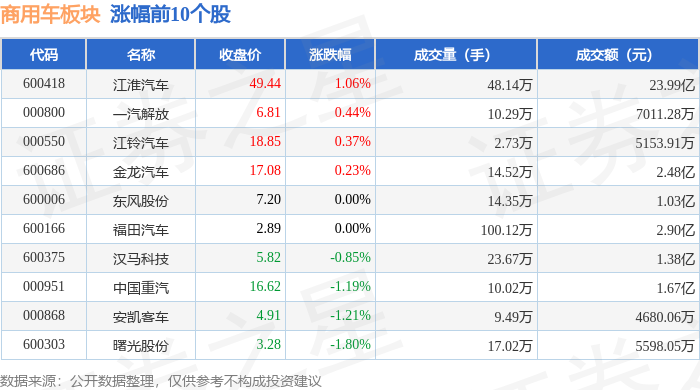
商用车板块12月29日跌0.33%,中集车辆领跌,主力资金净流出1.85亿元
Zheng Xing Xing Ye Ri Bao· 2025-12-29 09:06
Group 1 - The commercial vehicle sector experienced a decline of 0.33% on December 29, with CIMC Vehicles leading the drop [1] - The Shanghai Composite Index closed at 3965.28, up 0.04%, while the Shenzhen Component Index closed at 13537.1, down 0.49% [1] - Key stocks in the commercial vehicle sector showed varied performance, with Jianghuai Automobile up 1.06% and CIMC Vehicles down 3.09% [2] Group 2 - The net outflow of main funds in the commercial vehicle sector was 185 million yuan, while retail investors saw a net inflow of 179 million yuan [2] - The trading volume for Jianghuai Automobile was 481,400 shares, with a transaction value of 2.399 billion yuan [1] - The stock performance of major companies included a 1.06% increase for Jianghuai Automobile and a 3.09% decrease for CIMC Vehicles [2][3]




2025/12/22-2025/12/28汽车周报:补贴落地践行渐进,看好预期修复下的交易机会-20251229
Shenwan Hongyuan Securities· 2025-12-29 09:00
Investment Rating - The report maintains a positive outlook on the automotive industry, particularly focusing on the mid-to-high-end and used car markets, with specific recommendations for companies like BYD and Geely [1]. Core Insights - The upcoming subsidies are expected to alleviate previous concerns regarding the total market volume for 2026, enhancing demand for mid-to-low-end vehicles [1]. - The report highlights the potential for significant performance improvements in parts manufacturers due to subsidy support, recommending companies with strong fundamentals and low valuations [1]. - The report emphasizes the advantages of new energy vehicle companies like Xpeng, NIO, and Li Auto, as well as key Tier 1 suppliers such as Desay SV and Jingwei Hirain [1]. - The report notes a positive trend in the used car market, benefiting from the industry's recovery and improved profitability for dealers, recommending companies like Uxin [1]. Industry Update - According to the China Passenger Car Association, the average daily retail sales of passenger cars in the third week of December reached 77,000 units, a year-on-year decrease of 11% but a month-on-month increase of 9% [1]. - The automotive industry recorded a total transaction value of 582.81 billion yuan, with the automotive index rising by 2.74% during the week, outperforming the Shanghai Composite Index [1][4]. - The report indicates that 172 automotive stocks rose while 94 fell, with the largest gainers being Chaojie Co., Longi Machinery, and Zhejiang Sebao, which saw increases of 41.6%, 33.7%, and 33.3% respectively [1][9]. Market Conditions - The report highlights a rise in traditional and new energy raw material price indices, with traditional vehicle raw material prices increasing by 1.3% and 1.0% over the past week and month, respectively, while new energy vehicle raw material prices rose by 5.6% and 6.8% [1][54]. - The automotive industry’s price-to-earnings ratio stands at 29.17, ranking 19th among all primary industries, indicating a moderate valuation compared to the Shanghai Composite Index's 14.15 [6]. Key Events - The report discusses the optimization of toll road policies and the improvement of autonomous driving regulations, which are expected to enhance the operational efficiency of the transportation system [2][3]. - The report notes significant developments in the automotive sector, including the launch of new models and strategic partnerships aimed at enhancing market competitiveness [17][18][19].




中国汽车ABS和ESC系统市场现状研究分析与发展前景预测报告
QYResearch· 2025-12-29 08:18
Core Viewpoint - The article discusses the current status and future trends of the automotive ABS (Antilock Brake System) and ESC (Electronic Stability Control) systems in the Chinese market, highlighting the transition from traditional mechanical braking to electronic and intelligent systems, driven by regulatory requirements and technological advancements [3][10][14]. Market Development Status and Future Trends - The revenue from the automotive ABS and ESC systems in China is projected to reach 12.31 billion yuan in 2024, with an expected decline to 6.022 billion yuan by 2031, indicating a compound annual growth rate (CAGR) of -10.10% from 2025 to 2031 [3]. - The market is experiencing a shift towards electronic hydraulic brake (EHB) systems, particularly the One-Box solution, which integrates multiple functions and is expected to penetrate the market significantly, with over 10 million units installed by 2024 [10][13]. Industry Concentration and Competition Analysis - Major players in the Chinese market include Bosch, Continental, ZF, Aisin, and others, with the top three companies holding approximately 65.25% of the market share in 2024 [7]. Technological Evolution - The transition from traditional hydraulic braking to ABS and ESC systems has been rapid, with ESC installation rates exceeding 90% in new passenger vehicles since 2020 [10]. - In the commercial vehicle sector, the market is primarily dominated by pneumatic braking systems, with a projected EBS penetration rate of 80% by 2025 for key models [11][12]. Driving Factors - Regulatory requirements are a significant driver, with ABS and ESC becoming mandatory for all new passenger and commercial vehicles in China [14]. - The growth in vehicle ownership and sales, particularly in the new energy vehicle segment, is expanding the market for ABS and ESC systems [15]. - The development of intelligent driving and ADAS (Advanced Driver Assistance Systems) is increasing the demand for enhanced vehicle dynamic control systems [16]. Constraints - The industry faces challenges such as reliance on imported high-end chips and core technologies, which creates barriers for domestic manufacturers [18]. - Intense price competition and the pressure on suppliers to reduce costs are compressing profit margins and limiting R&D investments [19]. - The lengthy certification process for new products poses significant entry barriers for new players in the market [20]. Supply Chain Analysis - The supply chain for automotive ABS and ESC systems includes upstream suppliers of raw materials, midstream manufacturers who integrate and assemble the systems, and downstream customers, primarily automotive OEMs [28][29]. - Key components of ABS and ESC systems include electronic control units (ECUs), hydraulic control units (HCUs), and various sensors, with a focus on technological integration and system performance [29][32].
2025汽车大事记:全年超十次精准出手 监管重拳整治汽车行业乱象
Zhong Guo Jing Ji Wang· 2025-12-29 07:32
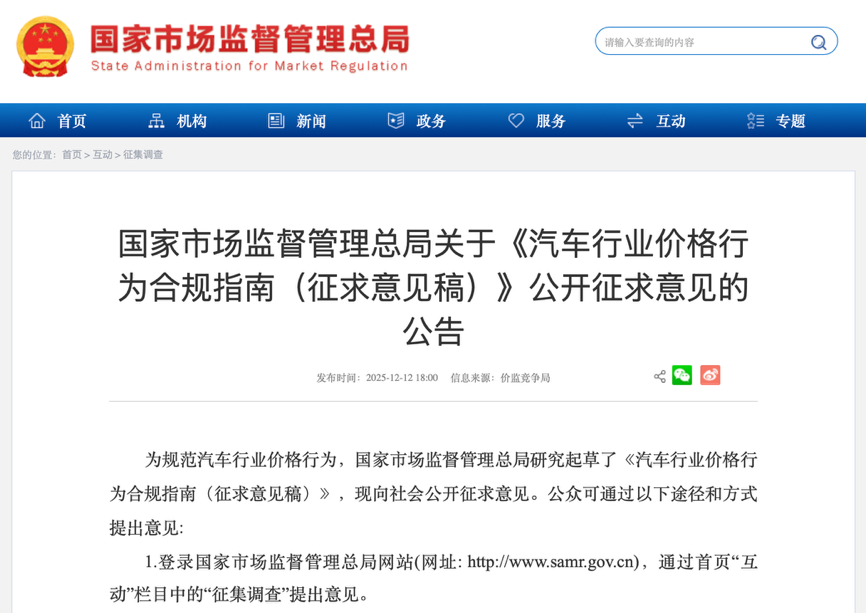
Core Viewpoint - The Chinese automotive industry is undergoing a significant transformation towards new energy and intelligence, facing intense competition and regulatory scrutiny to ensure healthy development [1] Regulatory Policies and Market Dynamics - The National Market Supervision Administration has solicited opinions on the "Guidelines for Compliance of Price Behavior in the Automotive Industry," which prohibits loss sales, requires clear pricing, and bans price fraud [2] - The introduction of these guidelines aims to curb the detrimental effects of price wars, which have severely impacted industry profitability, with the automotive industry's sales profit margin dropping to 3.9% in October, the lowest in five years [4][6] - The government has emphasized the importance of addressing "involution-style" competition in the 2025 government work report, highlighting a commitment to restoring healthy development in the automotive sector [4] Industry Response to Price Wars - Major automotive companies, including BYD and Great Wall, have pledged to adhere to the pricing guidelines and eliminate unfair competition practices [4] - The China Automotive Industry Association has called for fair competition and has initiated measures to prevent price dumping and misleading advertising [6] Regulatory Interventions and Compliance - A series of regulatory measures have been implemented to address issues such as production consistency and payment terms, with the Ministry of Industry and Information Technology launching checks on production consistency to ensure quality [8][9] - The average accounts payable turnover days for listed automotive companies reached 182 days in 2024, creating significant financial pressure on suppliers [9][11] - A commitment from 17 automotive companies to adhere to a 60-day payment term for suppliers has been established to alleviate financial strain [11] Addressing Network and Marketing Issues - The government has initiated a campaign to combat online misinformation and negative publicity affecting automotive companies, with actions taken against accounts spreading false information [12] - The Ministry of Industry and Information Technology has proposed new standards for intelligent driving systems to enhance safety and consumer protection [14][17] Innovation and Safety Concerns - The automotive industry faces challenges related to "involution" in technological innovation, where companies may compromise safety and quality to reduce costs and accelerate product development [13] - Recent incidents have raised concerns about the safety of new energy vehicles, particularly regarding their acceleration capabilities and the risks associated with hidden door handle designs [15][16] Conclusion on Industry Health - The regulatory environment in 2025 has seen over ten significant policy introductions aimed at addressing competition issues, with a focus on maintaining market order and promoting healthy competition among automotive companies [18][19] - The proactive measures taken by regulatory bodies and the automotive industry indicate a collective effort to navigate the challenges of transformation while ensuring sustainable growth [20]
2025汽车大事记:反内卷!汽车行业齐心落实“六十天账期承诺”
Zhong Guo Jing Ji Wang· 2025-12-29 07:22
从国家政策到行业倡议,从企业争相承诺到被集体约谈,2025年,一套国家政策、行业倡议、企业约谈"组合拳",精准直击行业外少有人关注的"支付账 期"问题。 近年来,不断加剧的"内卷式"竞争让汽车产业陷入"增量不增收、增收不增利"怪象,这一现象在今年前5个月尤为显著。据国家统计局数据,1—5月,我国 汽车产销量同比增长均超10%;同时,汽车制造业营业收入上涨7.1%;但利润总额却下滑11.9%。 与此同时,这一压力更已传导至供应商等上游环节。据行业数据,2024年,中国上市车企平均应付账款周转天数达182天,部分企业超过240天,导致中小供 应商资金链压力巨大,融资成本高达5%—8%,远高于整车企业的3%—5%,对汽车产业链条带来极大安全风险。 由此,"缩短账期"已刻不容缓。中国汽车流通协会专家委员会委员章弘表示,"缩短账期"能够缓解供应商的资金压力,提升其经营韧性和创新能力。 其实早在3月17日,国务院就发布修订版《保障中小企业款项支付条例》,其中明确提出,大型企业从中小企业采购货物、工程、服务,应当自货物、工 程、服务交付之日起60日内支付款项。该条例已于6月1日起正式施行。 为巩固"六十天账期承诺"的贯彻执 ...

汽车周报:补贴落地践行渐进,看好预期修复下的交易机会-20251229
Shenwan Hongyuan Securities· 2025-12-29 07:16
Investment Rating - The report maintains a positive outlook on the automotive industry, particularly focusing on the mid-to-high-end and used car markets, as well as the impact of new subsidies [2]. Core Insights - The upcoming subsidies are expected to alleviate previous concerns regarding the total market volume for 2026, with a focus on companies like BYD and Geely, which cater primarily to mid-to-low-end demand [2]. - The report highlights the potential for significant performance improvement in parts manufacturers in the first half of 2026 due to subsidy support, recommending companies with strong fundamentals and low valuations [2]. - The report identifies new energy vehicle companies such as XPeng, NIO, and Li Auto, which have advantages in AI and robotics, as potential investment opportunities [2]. - The report notes a positive trend in the used car market and overall dealer profitability, recommending companies like Uxin [2]. - The report emphasizes the importance of state-owned enterprise reforms, particularly for SAIC and Dongfeng, as a key area to watch [2]. Industry Update - According to the China Passenger Car Association, the average daily retail sales of passenger cars in the third week of December reached 77,000 units, a year-on-year decrease of 11% but a month-on-month increase of 9% [2]. - The automotive industry recorded a total transaction value of 582.81 billion yuan for the week, with an industry index increase of 2.74%, outperforming the Shanghai Composite Index [6]. - The report indicates that 172 automotive stocks rose while 94 fell, with the largest gainers being Chaojie Co., Longi Machinery, and Zhejiang Sebao [11]. Market Conditions - The report notes that traditional and new energy raw material price indices have risen recently, with traditional vehicle raw materials increasing by 1.3% week-on-week and 1.0% month-on-month, while new energy vehicle raw materials rose by 5.6% week-on-week and 6.8% month-on-month [62]. - The automotive industry’s price-to-earnings ratio stands at 29.17, ranking 19th among all sectors, indicating a moderate valuation compared to the Shanghai Composite Index's 14.15 [8][10]. Key Events - The report highlights the optimization of toll road policies and the improvement of autonomous driving regulations as significant developments that will enhance the operational efficiency of the transportation system [3][4]. - The report mentions the launch of the first L3 autonomous driving license plate in China, awarded to Changan Automobile, marking a milestone in the industry [24][44].



强势吸金!规模TOP6的A500ETF本月资金净流入额超972亿元
Ge Long Hui A P P· 2025-12-29 06:59
Core Insights - The CSI A500 Index has become a major attraction for capital inflow, with a total net inflow of 96.065 billion yuan in December alone, driven primarily by institutional investors [1][5]. Group 1: Fund Inflows - The top six A500 ETFs accounted for nearly all of the net inflow in December, with significant contributions from A500 ETF Southern (24.825 billion yuan), A500 ETF Huatai-PB (21.061 billion yuan), and A500 ETF Fund (18.196 billion yuan) [1][3]. - The total net inflow for the top six A500 ETFs reached over 97.2 billion yuan, highlighting a concentration of capital in larger funds [1][3]. Group 2: Regulatory Changes - In December, regulatory adjustments reduced the risk factors for insurance companies' stock investments, effectively lowering capital costs and facilitating greater market participation from insurance funds [5]. - The adjustments specifically targeted core assets, including stocks in the CSI 300 Index and the CSI Dividend Low Volatility 100 Index, which are expected to release approximately 290 billion yuan in capital for potential market investment [5]. Group 3: Market Dynamics - The recent inflow into A500 ETFs is influenced by a seasonal "calendar effect," where historical patterns show increased inflows near quarter-end [6]. - The CSI A500 Index is favored for its balanced industry allocation and selection of leading companies, making it an attractive option for year-end investment strategies [6].

研判2025!中国汽车镁合金轮毂行业市场政策、产业链图谱、市场规模、竞争格局及发展趋势分析:汽车轻量化浪潮席卷,未来大有可为[图]
Chan Ye Xin Xi Wang· 2025-12-29 02:35
Overview - The rapid rise of the new energy vehicle industry is driving the growth of the automotive magnesium alloy wheel hub sector, with increasing demand for lightweight components to alleviate range anxiety [1][9] - The market size of China's automotive magnesium alloy wheel hub industry is projected to reach 1.42 billion yuan in 2024, representing a year-on-year growth of 47.9%, although the current market share of magnesium alloy wheel hubs is less than 2% [1][9] Market Policies - China has implemented a series of policies to support the development of the automotive magnesium alloy wheel hub industry, creating a favorable policy environment [4] Industry Chain - The upstream of the automotive magnesium alloy wheel hub industry includes suppliers of magnesium alloys and coating materials, while the downstream primarily targets the automotive market, with new energy passenger vehicles being the largest demand source [5][7] Current Development - The automotive market in China is experiencing rapid growth, with production and sales of automobiles reaching 24.43 million and 24.36 million units respectively in the first nine months of 2025, showing year-on-year growth of 13.3% and 12.9% [7][8] Competitive Landscape - The industry is transitioning from "technical reserves" to "scale application," with few companies capable of mass production. Key players include Dewey Technology Co., Ltd., Baowu Magnesium Industry, and others [9][10] Development Trends - Continuous optimization of material formulations is expected, with a focus on combining magnesium with rare earths and carbon fibers to enhance performance [13] - Smart manufacturing processes will be integrated into production, utilizing AI and 3D printing technologies to improve efficiency [14] - Green production will become a core competitive advantage, with a focus on reducing carbon emissions and enhancing recycling systems [15] - Vertical integration of the industry chain will be pursued by leading companies to ensure supply stability and reduce costs [16]





锂电产业链的板块节奏与投资方向梳理
2025-12-29 01:04
Summary of Key Points from Conference Call Industry Overview - The conference call primarily discusses the **lithium battery industry** and the **automotive sector**, particularly focusing on the **new energy vehicle (NEV)** market and its dynamics in response to policy changes and market conditions [1][3][5]. Core Insights and Arguments - **Automotive Sales Decline**: In October and November, automotive sales dropped by 9% and 11-12% respectively, with expectations of continued decline in December due to policy exits and consumer hesitation [1][3]. - **NEV Export Growth**: By 2026, NEV exports are projected to reach **3.3 million units**, a year-on-year increase of approximately **40%**, contributing to over **10% growth** in the wholesale sector [1][6]. - **Investment Opportunities**: Key investment opportunities identified include: - **Overseas Expansion**: Companies like BYD plan to export **1.5 million vehicles** [1][6]. - **High-end Market**: Companies such as JAC and Geely are highlighted for their high-end offerings [1][6]. - **Smart Driving**: Companies like Xpeng and Li Auto are noted for their advancements in smart driving technology [1][6]. - **Lithium Battery Sector Recovery**: The lithium battery sector has seen significant price recovery since September, driven by increased demand for energy storage and improved pricing conditions [2][7]. - **Heavy-Duty Vehicle Market**: The penetration rate of new energy in heavy-duty vehicles is expected to exceed **30%** next year, with exports becoming a significant growth driver [1][9]. - **Storage Demand Growth**: By 2026, a notable increase in energy storage demand is anticipated, supported by mature economic models and commercial frameworks in China and the U.S. [1][10]. Additional Important Insights - **Market Valuation**: The lithium battery sector's valuation is considered reasonable, with lithium hexafluorophosphate valued at approximately **7-8 times** earnings and battery segments around **20 times** or lower [3][11][12]. - **Short-term Catalysts**: Key short-term catalysts include successful price negotiations within the supply chain, with lithium hexafluorophosphate prices reaching **170,000-180,000 CNY** and potential increases for major clients [3][13]. - **Long-term Outlook**: The domestic power battery market outlook remains optimistic, with expected recovery in demand starting from January, driven by policy support and storage sector growth [3][14]. - **Investment Recommendations**: Recommended investment directions in the lithium battery midstream include segments with price elasticity, reasonable profitability, and new technology themes such as solid-state batteries [3][15]. - **Upstream Resource Opportunities**: The upstream lithium carbonate market is experiencing a price surge, with expectations for prices to potentially exceed **150,000 CNY** [3][18][19]. - **Equipment Sector Growth**: The lithium battery equipment sector is expected to see significant growth, with orders increasing by over **50%** year-on-year [3][20]. This summary encapsulates the key points discussed in the conference call, providing insights into the current state and future outlook of the lithium battery and automotive industries.