国泰基金

Search documents
不破不立?!指数高点回撤近5%,宽基ETF或迎“低吸”机会
Sou Hu Cai Jing· 2025-12-17 08:38
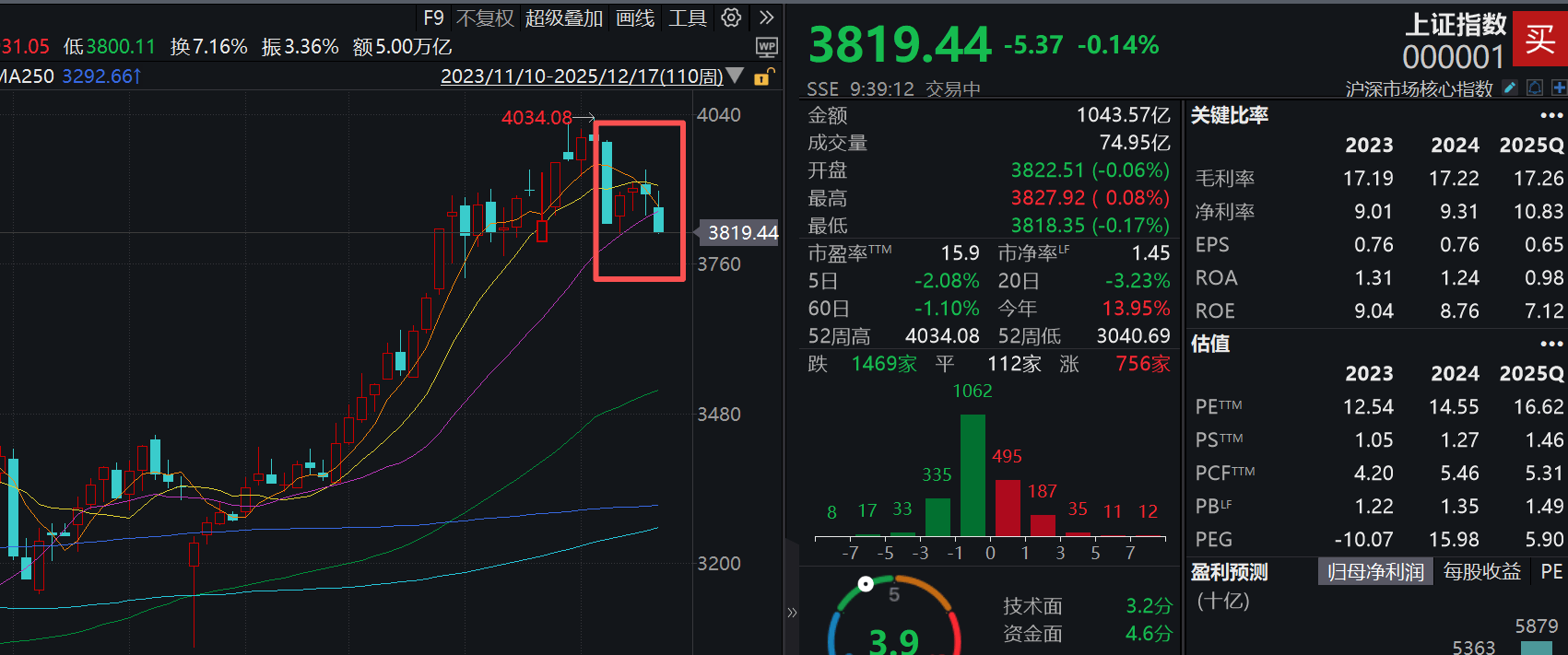
Group 1 - The market is experiencing a correction, with the Shanghai Composite Index retreating to around 3800 points, which has caused confusion among investors who were previously optimistic when the index surpassed 4000 points [1][2] - The recent market adjustment is attributed to a combination of emotional reactions rather than a fundamental collapse, triggered by external factors such as the potential interest rate hike by the Bank of Japan [4] - Small-cap stocks have seen significant declines, with the micro-cap index dropping over 6% in December, while larger indices like the Shanghai 50 and CSI 300 have only seen minor declines, indicating a divergence in market performance [5] Group 2 - Recent policy announcements aimed at expanding domestic demand have not met immediate expectations, leading to disappointment among some investors, despite positive underlying economic indicators such as GDP growth and manufacturing PMI [6] - The current market adjustment is likened to a temporary emotional outburst rather than a fundamental issue, suggesting that the long-term outlook remains positive due to supportive policies and a stable economic foundation [6] - There is a growing interest in broad-based ETFs, particularly the CSI 500 index, which has seen significant inflows, indicating a shift in investor preference towards more stable investment vehicles amid market volatility [8][9] Group 3 - The CSI 500 index has become a focal point for investors, with several ETFs linked to it experiencing substantial growth in assets under management, reflecting its increasing popularity [9][11] - The broad-based index funds are viewed as a reliable means for investors to achieve average market returns, especially in the context of China's economic transition towards high-quality growth [10][11] - The market is expected to present better allocation opportunities as it stabilizes, particularly for broad-based ETFs, which are currently perceived as undervalued compared to historical averages [7][10]

如何挑选一只中证A500ETF?
Xin Lang Cai Jing· 2025-12-17 08:26
Core Viewpoint - The market is experiencing volatility due to expectations of interest rate hikes in Japan, tightening global liquidity, and concerns over an AI bubble, while domestic economic data shows weak demand. However, the downturn at the end of 2025 may create opportunities for 2026, particularly in high-growth sectors like AI supported by policy [1][15]. Group 1: Market Conditions - The macroeconomic environment is influenced by strengthened expectations of interest rate hikes in Japan and increased concerns over global liquidity tightening [1][15]. - Domestic economic data for November indicates continued weak demand, contributing to market volatility [1][15]. - Despite current challenges, there is optimism for significant opportunities in 2026, especially in sectors with high growth potential like AI [1][15]. Group 2: Investment Strategy - Investors looking to capitalize on overall market trends may consider using broad-based products like the CSI A500 ETF (159338) as a foundational investment, employing a "technology + dividend" strategy [1][15]. - The CSI A500 ETF is positioned to outperform traditional broad indices like the CSI 300 by having a lower allocation to traditional high-weight sectors like banking and a higher allocation to growth sectors such as power equipment, new energy, electronics, home appliances, media, and military [2][16]. Group 3: CSI A500 ETF Characteristics - The CSI A500 index is constructed to prioritize leading companies within each industry, enhancing growth potential and representativeness by including firms with the largest free-float market capitalization [5][19]. - The CSI A500 ETF has demonstrated strong performance, being a preferred choice for core asset allocation in China, reflecting the new economic upgrade and high-quality development trends [8][22]. - The ETF's structure allows for controlled volatility and diversified industry exposure, making it suitable for long-term passive investment strategies [8][22]. Group 4: Performance Metrics - The CSI A500 ETF has shown a strong profit performance, with a reported profit of 4.275 billion yuan in the first three quarters of the year, aligning with its goal of generating returns for investors [14][28]. - The ETF's tracking error is minimal, indicating effective performance in mirroring the index, which is crucial for investor confidence [10][24]. - The fund's average daily scale is leading in the market, providing better liquidity and stability, which contributes to lower tracking errors [11][25].

抄底!越跌越买
Zhong Guo Ji Jin Bao· 2025-12-17 06:19
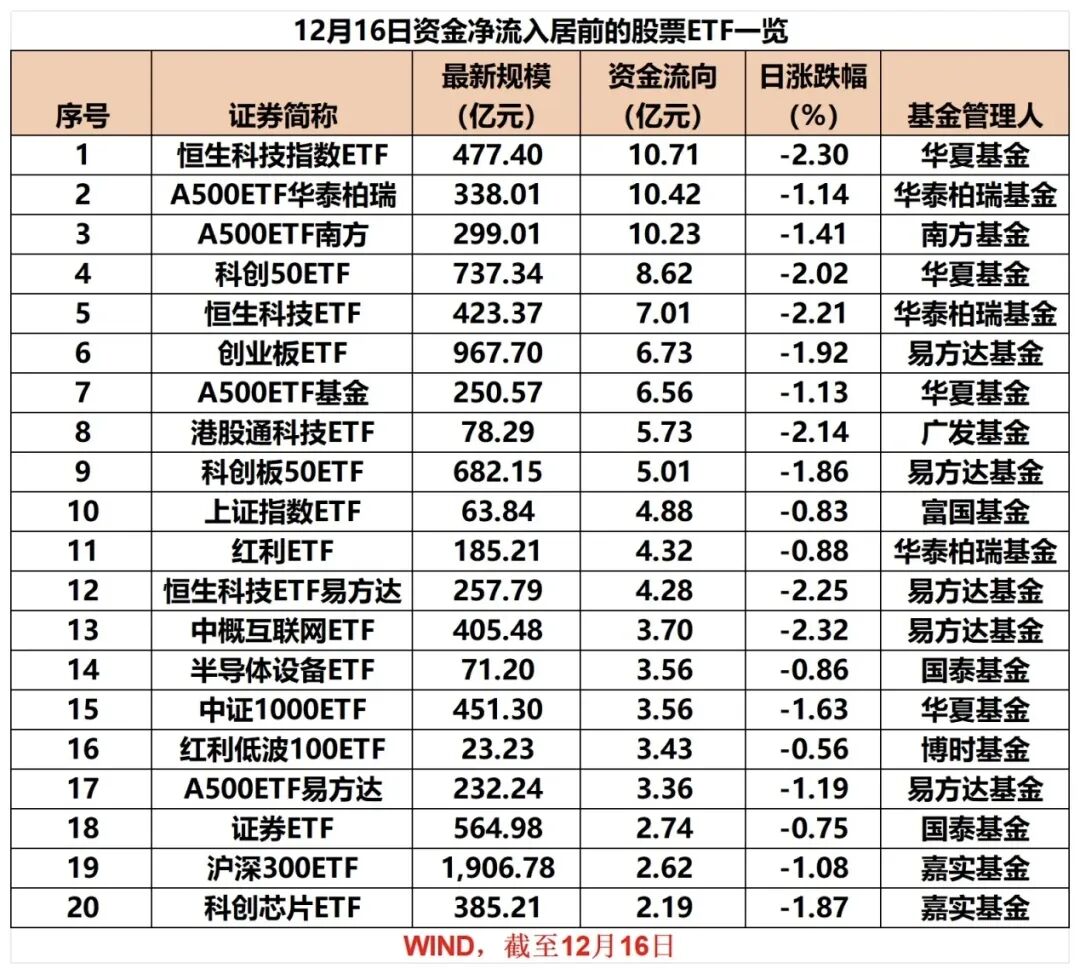
Group 1 - On December 16, the total net inflow of stock ETFs in the A-share market exceeded 15.71 billion yuan, with significant contributions from Hong Kong-related ETFs such as the Hang Seng Technology ETF and the China Concept Internet ETF [1][2] - The major inflows were observed in broad-based ETFs, with net inflows of 6.177 billion yuan and 4.087 billion yuan for broad-based and Hong Kong market ETFs, respectively [2] - The net inflow for the CSI A500 index-related ETFs reached 3.585 billion yuan, with a total of over 17.1 billion yuan flowing into the CSI A500 index ETFs in the past five days [2] Group 2 - The top-performing ETFs on December 16 included the Hang Seng Technology ETF with a net inflow of 1.071 billion yuan and the A500 ETF from Huatai-PB with a net inflow of 1.042 billion yuan [5] - The latest scale of the Hang Seng Technology ETF reached 47.74 billion yuan, while the Sci-Tech 50 ETF reached 73.734 billion yuan, with average daily trading volumes of 4.187 billion yuan and 3.547 billion yuan, respectively [3] - The top net outflows were seen in broad-based ETFs such as the SSE 50 ETF and the CSI 300 ETF, which experienced significant losses [6] Group 3 - Industry experts suggest that the domestic policy continues to support the A-share market, and the trend of domestic residents allocating to equity assets is still in its early stages [6] - The market style is expected to become more balanced and refined by 2026, with opportunities for valuation recovery and profit improvement in cyclical sectors due to easing deflationary pressures [7] - Companies with real technological barriers and commercialization capabilities in sectors like AI applications and domestic substitution are likely to continue attracting market interest due to their high growth potential [7]
抄底!越跌越买
中国基金报· 2025-12-17 06:16
Core Viewpoint - On December 16, the A-share market experienced a turbulent adjustment, with a net inflow of over 15.7 billion yuan into stock ETFs across the market, indicating a strong interest in certain sectors despite overall market declines [2][4]. Group 1: ETF Fund Flows - The total net inflow of stock ETFs (including cross-border ETFs) reached 15.71 billion yuan on December 16 [4]. - Among the major categories, broad-based ETFs and Hong Kong market ETFs led the inflows, with net inflows of 6.18 billion yuan and 4.09 billion yuan, respectively [5]. - The net inflow for the CSI A500 index-related ETFs was 3.58 billion yuan, highlighting investor interest in this index [5]. Group 2: Leading Fund Companies - E Fund's ETF reached a latest scale of 808.78 billion yuan, with a net inflow of 3.08 billion yuan on December 16, and an increase of 208.13 billion yuan since 2025 [5]. - Huaxia Fund's ETFs, particularly the Hang Seng Technology Index ETF and the Sci-Tech 50 ETF, saw significant net inflows of 1.07 billion yuan and 0.86 billion yuan, respectively [5]. Group 3: Top Gaining ETFs - The top gaining ETFs by net inflow on December 16 included: - Hang Seng Technology Index ETF: 1.07 billion yuan [8] - A500 ETF (Huatai Baichuan): 1.04 billion yuan [8] - Sci-Tech 50 ETF: 0.86 billion yuan [8] - Other notable inflows were seen in the ChiNext ETF and the Hong Kong Stock Connect Technology ETF, with net inflows of 0.67 billion yuan and 0.57 billion yuan, respectively [8]. Group 4: ETFs with Significant Outflows - The ETFs with the largest net outflows included: - SSE 50 ETF: -1.04 billion yuan [9] - 800 ETF: -0.44 billion yuan [9] - ChiNext 50 ETF: -0.42 billion yuan [9] - The total outflow from broad-based ETFs like the CSI 300 ETF was -0.26 billion yuan, indicating a trend of capital withdrawal from these funds [9]. Group 5: Market Outlook - Industry analysts suggest that there is no need for excessive concern over short-term market fluctuations, as domestic policies continue to support the A-share market [9]. - The trend of domestic residents allocating to equity assets is still in its early stages, with expectations of accelerated foreign capital inflows into A-shares as the RMB appreciates [9].

ETF午评 | 有色金属领涨,稀有金属ETF涨3%
Ge Long Hui· 2025-12-17 04:10
Market Overview - The Shanghai Composite Index rose by 0.17%, the Shenzhen Component Index increased by 0.83%, and the ChiNext Index gained 1.21%, while the North Stock 50 fell by 0.83% [1] - The total market turnover was 1,040.2 billion yuan, a decrease of 99.3 billion yuan compared to the previous day [1] Sector Performance - The lithium battery industry chain led the market, with CPO concept stocks showing repeated activity, and sectors such as aviation and non-ferrous metals performing well [1] - Stablecoins, commercial aerospace, and Hainan Free Trade Zone themes experienced adjustments [1] New Listings - Newly listed company Muxi Co., Ltd. saw a significant increase of nearly 700% in the first half of the trading day, with its market capitalization briefly exceeding that of Moore Threads [1] ETF Movements - The Southern Fund's Yangtze River Protection Theme ETF surged by 9.94%, with a latest premium/discount rate of 9.71% [1] - Lithium metal prices continued to rise, with various rare metal ETFs from GF Fund, ICBC Credit Suisse Fund, and Harvest Fund increasing by 3.33%, 3.24%, and 3.23% respectively [1] - The CPO sector rebounded, with the Guotai Fund's Communication ETF, the Fortune Fund's Communication Equipment ETF, and the Guotai Fund's ChiNext AI ETF rising by 2% [1] - Two Brazilian ETFs fell by 3%, while the satellite internet sector corrected, with the General Aviation ETF and Aviation ETF both declining by 2% [1] - Crude oil futures continued to decline, with the S&P Oil & Gas ETF dropping by 1.9% [1]
321只ETF获融资净买入 富国中债7—10年政策性金融债ETF居首
Zheng Quan Shi Bao Wang· 2025-12-17 03:53
Core Viewpoint - As of December 16, the total margin balance of ETFs in the Shanghai and Shenzhen markets reached 124.408 billion yuan, an increase of 6.429 billion yuan from the previous trading day [1] Group 1: ETF Financing and Margin Balances - The ETF financing balance was 117.118 billion yuan, up by 6.598 billion yuan compared to the previous trading day [1] - The ETF margin short balance was 7.29 billion yuan, showing a decrease of 0.169 billion yuan from the previous trading day [1] Group 2: Net Inflows into ETFs - On December 16, 321 ETFs experienced net financing inflows, with the top net inflow being the Fuguo Zhongzhai 7-10 Year Policy Financial Bond ETF, which saw a net inflow of 3.25 billion yuan [1] - Other ETFs with significant net inflows included the Bosera Zhongzhai 0-3 Year National Development Bank ETF, the Guotai Securities Shanghai Stock Exchange 5-Year Government Bond ETF, the Haifutong Zhongzhai Short-term Bond ETF, and the Huaxia Hang Seng Technology ETF [1]
美联储年内第三次降息!影响多大
2025-12-17 02:27
Summary of Conference Call Records Industry Overview - The records primarily discuss the impact of the Federal Reserve's interest rate cuts on the global financial markets, particularly focusing on the A-share market in China and the technology sector. [1][2][3] Key Points and Arguments Federal Reserve's Interest Rate Cuts - The Federal Reserve has implemented three interest rate cuts in 2025, primarily due to easing trade tensions and a weakening job market. The expectation for 2026 is limited further cuts, with a focus on U.S. employment data. [1][2] - The third rate cut in 2025 faced unusual dissent within the Federal Reserve, indicating significant internal disagreements. [2] - The rate cuts are expected to enhance global liquidity, weaken the dollar's attractiveness, and boost Chinese exports, especially in the context of a recovering U.S. manufacturing cycle. [1][3] Impact on A-share Market - The Fed's rate cuts positively influence the A-share market through increased global liquidity and reduced dollar appeal, leading to a rebalancing of global financial assets. [3] - China's export growth, particularly to Asia, Africa, and Latin America, is highlighted as a key economic driver, benefiting from the U.S. economic pressures that prompted the Fed's actions. [3] Global Asset Price Fluctuations - The dollar's depreciation, which fell by 11% in the first half of the year, has led to significant volatility in global asset prices, particularly affecting dollar-denominated commodities like oil. [4] - Gold and silver have shown strong performance, with gold nearing historical highs at $4,300 per ounce. [4] Global Stock Market Performance - In 2025, global stock markets exhibited strong bullish trends across various regions, including A-shares, Southeast Asia, and major European markets, driven by the Fed's rate cuts and a weaker dollar. [5] - The Trump administration's strategy aims to leverage a weaker dollar to boost exports and manufacturing jobs, enhancing risk appetite in the market. [5] Technology Sector Outlook - The technology sector is expected to remain a market focus in 2026, driven by advancements in high-end manufacturing and new technologies like artificial intelligence that enhance productivity. [6][7] - Government policies are strongly supportive of technological innovation, with significant emphasis on AI and robotics as strategic emerging industries. [6] Investment Strategies - Investors are advised to focus on sectors with strong profit growth, particularly TMT (Technology, Media, and Telecommunications) and electronics, while considering a shift towards broad-based index funds as the year ends. [2][8][9] - The 中证 A500 index is recommended as a suitable investment option, offering broader exposure to emerging growth sectors compared to traditional indices like the 沪深 300. [10][11] Recommendations for New Investors - New investors are encouraged to consider the 中证 A500 ETF, which has a broad investor base and demonstrates stability during market fluctuations. [12] Additional Important Insights - The capital market's recovery in 2025 is attributed to a correction of previously undervalued assets rather than significant fundamental improvements. [7] - Future investment focus should be on sectors that show potential for growth and are supported by government policies, particularly in technology and cyclical industries. [7]
如何挑选中证A500ETF?
Zhong Guo Ji Jin Bao· 2025-12-17 01:53
近日,中央经济工作会议在京闭幕,为未来宏观经济政策与产业发展方向定下新基调。会议在总体要求 上实施更加积极有为的宏观政策,增强政策前瞻性针对性协同性,并强调了要围绕发展新质生产力,推 动科技创新和产业创新深度融合。高层定调不仅为经济高质量发展明晰了路径,也为资本市场指明了中 长期结构性投资主线。 不过,政策暖风之下,临近年底的A股市场仍处于震荡整理格局。沪指继续在3900点附近反复波动;叠 加市场热点轮动快、"突破即回调"等现象,不少投资者感叹目前市场个股选择难度较大。对普通投资者 而言,在此背景下,借道具备一定科技属性的优质宽基布局或是更好选择。 上周,基金君聊了聊主流的大盘宽基中证A500ETF(159338),并探讨在产品同质性趋强环境下,投资 者该怎么选择相应的ETF。 市场波动加剧,宽基配置价值凸显 从投资本质来看,应对市场起伏核心,关键或在于回归"买入并持有优质资产"这一朴素原则。但普通投 资者常面临研究资源有限、个股价值判断难度大等现实因素制约,此时借道指数化投资工具,尤其是能 代表市场中坚力量的宽基指数,通过分散配置一篮子股票,或可以捕捉市场整体趋势,成为更具可行性 的选择。 从市场表现观察, ...
如何挑选中证A500ETF?
中国基金报· 2025-12-17 01:51
近日, 中央经济工作会议 在京闭幕,为未来宏观经济政策与产业发展方向定下新基调。会议 在总体要求上实施更加积极有为的宏观政策,增强政策前瞻性针对性协同性,并强调了要围 绕发展新质生产力,推动科技创新和产业创新深度融合。高层定调不仅为经济高质量发展明 晰了路径,也为资本市场指明了中长期结构性投资主线。 不过,政策暖风之下,临近年底的A股市场仍处于震荡整理格局。沪指继续在3900点附近反 复波动;叠加市场热点轮动快、"突破即回调"等现象,不少投资者感叹目前市场个股选择难 度较大。对普通投资者而言,在此背景下,借道具备一定科技属性的优质宽基布局或是更好 选择。 上周,基金君聊了聊主流的大盘宽基 中证A500ETF(159338) ,并探讨在产品同质性趋强 环境下,投资者该怎么选择相应的ETF。 市场波动加剧,宽基配置价值凸显 从投资本质来看,应对市场起伏核心,关键或在于回归"买入并持有优质资产"这一朴素原 则。但普通投资者常面临研究资源有限、个股价值判断难度大等现实因素制约,此时借道指 数化投资工具,尤其是能代表市场中坚力量的宽基指数,通过分散配置一篮子股票,或可以 捕捉市场整体趋势,成为更具可行性的选择。 被动投 ...

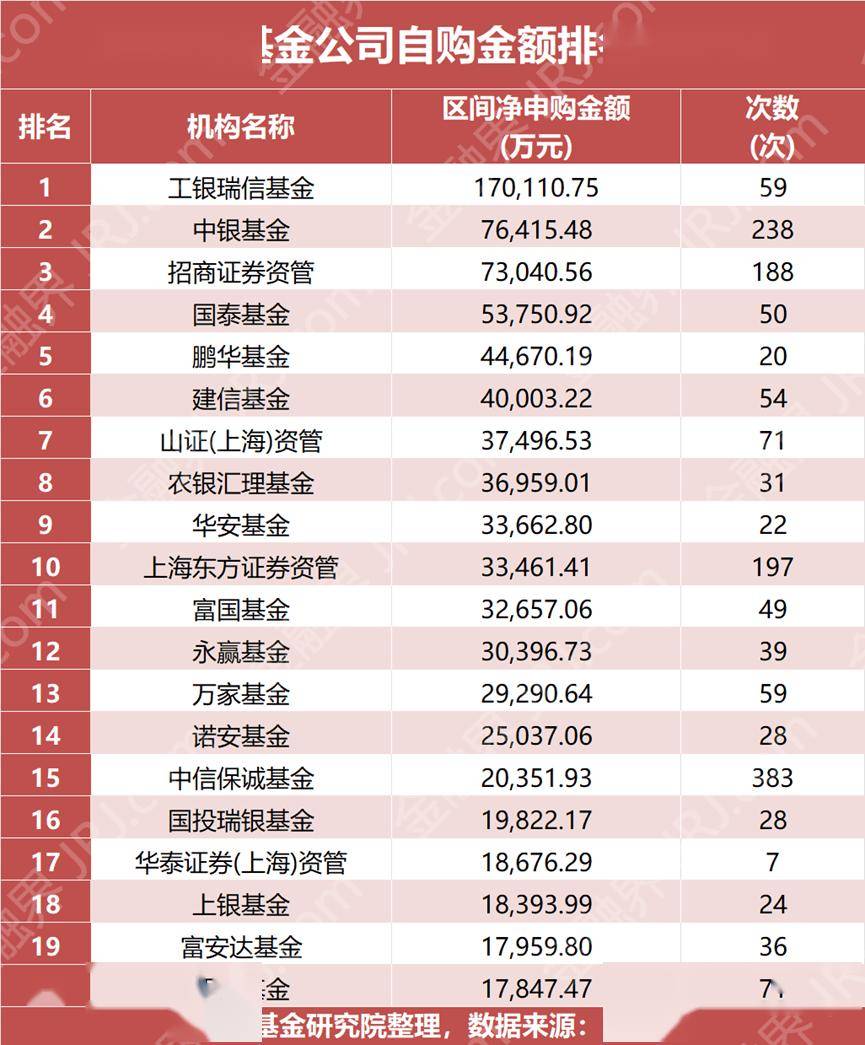
传递信心!年内基金公司自购盘点
Sou Hu Cai Jing· 2025-12-16 23:33
Core Viewpoint - The recent draft of the "Guidelines for Performance Assessment Management of Fund Management Companies" has introduced significant changes in the public fund industry, particularly emphasizing the requirement for executives and fund managers to invest their own money in their funds [1] Group 1: Guidelines Overview - The guidelines mandate that executives, heads of major business departments, and fund managers must allocate a certain percentage of their performance-based compensation to purchase their company's public funds, with a holding period of no less than one year [1] - Specifically, executives and department heads are required to use 30% of their total performance compensation to buy their company's public funds, with at least 60% of that amount allocated to equity funds unless the company does not offer equity funds [1] - Fund managers must invest 40% of their total performance compensation in the funds they manage [1] Group 2: Self-Purchase Statistics - As of December 15, 138 public fund institutions have made a total of 8,546 self-purchases, with a net subscription amount reaching 255.09 billion yuan, involving 1,561 fund products [1] - This represents a dramatic increase of 1,733.71% compared to the net subscription amount of 13.91 billion yuan in the same period of 2024 [1] Group 3: Major Self-Purchasing Institutions - The top self-purchasing institution is ICBC Credit Suisse Fund, with a net subscription amount exceeding 17 billion yuan and 59 self-purchases [2][4] - Following closely is Bank of China Fund with over 7 billion yuan in net subscriptions and 238 self-purchases, and China Merchants Securities Asset Management with over 7 billion yuan and 188 self-purchases [4] - Other notable institutions include Guotai Junan Fund, Penghua Fund, and CCB Fund, with net subscription amounts exceeding 5 billion yuan, 4 billion yuan, and 4 billion yuan respectively [4]