
双林股份

Search documents
“ 汽车人,变形出发!”
Zhong Guo Zheng Quan Bao· 2025-12-28 21:08
Core Viewpoint - The automotive parts industry in Zhejiang is collectively transforming towards humanoid robots, viewing this sector as a significant growth opportunity following the success of electric vehicles and intelligent driving [1][3]. Group 1: Industry Transformation - The transformation was initiated by Junsheng Group's subsidiary, Junsheng Electronics, which upgraded its strategy to "Automotive + Robotics Tier 1" in early 2025, marking the beginning of a new growth curve [2]. - Over 100 humanoid robot-related companies exist in Zhejiang, with more than 40 listed on the A-share market, primarily from the automotive parts sector [2]. - The collective shift towards humanoid robots is seen as a strategic response to the increasing competition in the electric vehicle market, with companies aiming to tap into the "trillion-dollar blue ocean" of humanoid robotics [3]. Group 2: Market Potential - The global humanoid robot market is projected to reach 12,400 units and 6.339 billion yuan in 2025, with expectations to exceed 5 million units and 400 billion yuan by 2035 [3]. - The commercialization of humanoid robots is accelerating, with significant milestones such as the delivery of the 5,000th general-purpose robot and substantial order volumes for specific models [3]. Group 3: Cost Reduction and Technological Advancements - The rise of humanoid robots is supported by advancements in domestic production of core components, leading to reduced costs; for instance, the cost of the Walker series robots has decreased by 25% compared to 2024 [5]. - The integration of production capabilities for both electric vehicles and humanoid robots allows companies to lower investment costs and enhance equipment utilization [5][6]. - The potential for further cost reductions exists, particularly in key components like harmonic reducers and planetary roller screws, where domestic production rates can still improve [6]. Group 4: Synergy and Supply Chain Advantages - The existing supply chain in Zhejiang, developed over years in the automotive sector, provides a strong foundation for the humanoid robot industry, facilitating a seamless transition [7][8]. - The overlap in customer bases between electric vehicle and humanoid robot sectors is significant, with a 70% overlap reported, allowing companies to leverage existing channels for component procurement [8]. - The technological similarities between automotive parts and humanoid robots enable companies to transfer knowledge and capabilities, reducing R&D costs and risks associated with the transition [7][8].

证监会对智谱华章、壁仞科技、阳光电源、海澜之家等34家企业出具补充材料要求
梧桐树下V· 2025-12-28 16:05
Core Viewpoint - The China Securities Regulatory Commission (CSRC) has announced supplementary material requirements for overseas listing applications from 34 companies, indicating a focus on compliance and regulatory scrutiny in the context of international capital markets [1]. Group 1: Company-Specific Requirements - Zhizhu Huazhang is required to clarify the ownership and evaluation of intellectual property rights related to its technology, as well as the background of its shareholders and the compliance of its overseas subsidiaries [2][3]. - Hailan Home must provide details on the debt repayment capabilities of its controlling shareholders and the implications of share pledges on control changes [4][10]. - Pulaia is asked to explain the compliance of its subsidiaries' operations in the cultural and entertainment sectors with foreign investment regulations [5][28]. - Sunshine Power needs to clarify its industrial internet and big data services, including necessary qualifications and compliance with foreign investment restrictions [6][35]. - The company Haipai Ke is required to explain the pricing and compliance of its recent acquisitions and the operational compliance of its payment settlement model [7][36]. Group 2: Regulatory Compliance and Governance - Companies are required to provide legal opinions on the compliance of their shareholding structures, including any potential issues related to shareholding changes and the implications for control [10][12]. - Companies must clarify the rationale behind share pricing discrepancies among new shareholders and assess whether there are any signs of profit transfer [12][30]. - The necessity of obtaining necessary licenses for various business operations, especially in sectors with foreign investment restrictions, is emphasized [5][28][35]. Group 3: Financial and Operational Transparency - Companies are required to disclose the specific uses of raised funds, including the proportion allocated for domestic and overseas investments, and ensure compliance with relevant approval processes [20][30]. - The need for companies to clarify their business models, especially those involving AI and big data, is highlighted, including the specific applications and functionalities [6][32]. - Companies must provide updates on any ongoing litigation or regulatory issues that may impact their operations or listing processes [20][36].







长三角企业全球化路径:资本锚定全球,产业链扬帆远航|2025中国经济年报
Hua Xia Shi Bao· 2025-12-25 09:54
Core Viewpoint - In 2025, "globalization" has become a high-frequency term in the development strategies of enterprises in the Yangtze River Delta, as companies accelerate their global layout through diversified collaborative paths amid the dual waves of global industrial restructuring and regional economic integration [2] Group 1: Capital and Market Trends - The Yangtze River Delta region has seen a surge in A-share companies planning to list H-shares in Hong Kong, with 47 out of approximately 122 companies (38.5%) coming from this region [2] - Companies like Estun and Huayi Group are preparing for H-share listings to optimize financial structures and expand overseas production capacity [3][4] - Suzhou Naxin Microelectronics successfully listed on the Hong Kong Stock Exchange, raising approximately HKD 2.096 billion, with 25% allocated for expanding overseas sales networks [4] Group 2: Collaborative Ecosystem Development - The Yangtze River Delta has established various outbound bases and service platforms to support collective development among enterprises, highlighting a "cluster outbound" ecosystem [6] - The G60 Science and Technology Corridor has formed an outbound service alliance to integrate services such as market access and compliance, benefiting over 20,000 enterprises [7] Group 3: Transition from Product to Brand Globalization - Enterprises in the Yangtze River Delta are transitioning from "product export" to "brand export" and "value chain export," focusing on building international brand influence [9] - Companies like Zhongyuan Home and Gujia Home are investing in overseas production bases in Vietnam and Indonesia to enhance supply chain resilience and respond to international trade uncertainties [9] Group 4: Case Studies of Globalization - XCMG Group has evolved from merely exporting machinery to establishing local operations and acquiring global resources, showcasing a deepening commitment to localization [10] - The company has introduced customized products that meet European standards and has established training centers and subsidiaries in Europe to strengthen its local operational capabilities [10]




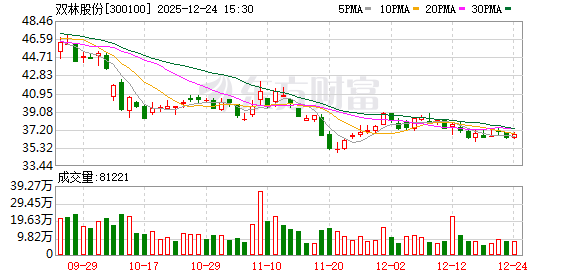
双林股份:不存在逾期担保
Zheng Quan Ri Bao· 2025-12-24 10:45
(文章来源:证券日报) 证券日报网讯 12月24日,双林股份发布公告称,公司不存在对合并报表外单位提供担保的情况,亦不 存在逾期担保金额或涉及诉讼的担保金额及因担保被判决败诉而应承担的损失金额等情形。 ...
从春晚扭秧歌到演唱会空翻 2026年人形机器人还能“火力全开”吗?
天天基金网· 2025-12-24 08:42
Core Viewpoint - The humanoid robot industry is on the verge of mass production, with significant interest from major companies and expected policy support, indicating a strong upward trend and a favorable investment window by 2026 [2][4][8]. Industry Overview - The recent performance of humanoid robots, showcased at a concert, highlights the technological advancements and commercial potential in entertainment [7]. - The humanoid robot sector has seen a surge in orders and capital activity since 2025, with leading companies initiating IPOs and mergers [7]. Market Outlook - Multiple brokerages predict that 2025 will mark the beginning of mass application for humanoid robots, with 2026 expected to see expanded application scenarios and deeper industry involvement [4][8]. - The humanoid robot product output is anticipated to increase exponentially in 2026 compared to 2025, with significant sales and delivery milestones expected [4][8]. Investment Opportunities - Key suppliers in the humanoid robot supply chain are recommended for investment consideration as the market prepares for mass production [4][8]. - Recent data shows a rebound in the humanoid robot sector index and leading stocks, indicating a return of capital to the market [8].

双林股份(300100) - 关于为全资子公司担保的进展公告
2025-12-24 07:54
证券代码:300100 证券简称:双林股份 公告编号:2025-111 双林股份有限公司 关于为全资子公司担保的进展公告 | | | 双林股份有限公司(以下简称"公司")分别于 2025 年 4 月 15 日、2025 年 5 月 6 日召开的第七届董事会第十次会议、2024 年度股东大会审议通过了《关 于为全资子公司提供担保的议案》,同意为湖北新火炬科技有限公司(已更名为 "湖北双林轴承有限公司",以下简称"湖北双林轴承")、宁波双林模具有限 公司等在内的公司下属全资子公司 2025 年度经营所需,提供不超过 92,150 万元 的连带责任担保、抵押或质押担保。同时授权公司董事长或董事长指定的授权代 理人在担保额度内办理相关业务,代表公司办理相关手续、签署相关法律文件。 有效期限自 2024 年度股东大会通过后一年。具体内容详见公司于 2025 年 4 月 16 日在巨潮资讯网刊登的《关于为全资子公司提供担保的公告》。 近日,公司与中国建设银行股份有限公司襄阳汽车产业经济技术开发区支行 (以下简称"建行襄阳汽车产业经济技术开发区支行")续签了《最高额保证合 同》,约定公司为湖北双林轴承向建行襄阳汽车产业经济 ...
汽车行业周报:宇树机器人伴舞获马斯克称赞,自动驾驶加速迈向“量产应用”-20251221
Huaxin Securities· 2025-12-21 15:38
Investment Rating - The report maintains a "Recommended" rating for the humanoid robot sector and the automotive industry [2][12]. Core Insights - The humanoid robot industry is accelerating from technology development to large-scale commercial application, with significant order growth from leading manufacturers [7]. - The first batch of L3 autonomous driving vehicles has received approval for conditional market entry, marking a critical step towards commercialization in China [10]. - The overall order volume for humanoid robots in 2025 is projected to exceed 30,000 units, with leading companies like UBTECH and UTree capturing significant market shares [6]. Summary by Sections Humanoid Robot Sector Market Performance - The Huaxin humanoid robot index fell by 1.47% this week, with a year-to-date return of 88.8% [21]. - The total order value for leading companies in the humanoid robot sector has surpassed 5 billion, with UBTECH's Walker series accounting for 1.3 billion [6][4]. Automotive Sector Market Performance and Valuation - The CITIC automotive index increased by 0.1%, outperforming the broader market by 0.4 percentage points [37]. - The automotive sector's PE ratio is at 31.8, positioned at the 36.4% percentile over the past four years, while the PB ratio is at 3.0, at the 96.3% percentile [54]. Industry Data Tracking - From December 1-14, the average daily retail of passenger vehicles in China decreased by 24% year-on-year, with total retail reaching 76.4 million units [60]. - The average price of rubber has increased, while prices for steel, copper, and aluminum have decreased [67]. Company Announcements - UBTECH has secured a strategic partnership with Texas Instruments, with total orders exceeding 1.3 billion [5]. - Moulding Technology has signed a procurement framework agreement for humanoid robot components, marking a significant step into the humanoid robot industry [74].




人形机器人企业集体扩产背后是机遇还是“不扩产就丢单”的焦虑?
Tai Mei Ti A P P· 2025-12-19 04:33
文 | GPLP看科技,作者 | 马赫环 2025年对于人形机器人行业来说,确实可以被称为"量产元年",其中的重要标志就是已经有企业初步构 建了一定的量产能力。如智元机器人已经于12月8日宣布,其通用具身机器人已经累计下线5000台,其 中远征系列(A1/A2)下线1742台,精灵系列(G1/G2)为1412台,灵犀系列(X1/X2)达到了1846 台。 在目前的政策态度、市场氛围以及技术发展方向来看,2026年的国内人形机器人企业将具备更大规模的 量产能力。然而,现在的问题是当前阶段的市场能承载下快速增长的产能吗? 海内外同频,人形机器人产能扩张势不可挡 日前,人形机器人赛道正上演着预期与现实的激烈碰撞,这种碰撞不止是源于核心零部件对现有产品的 制约,也有产能快速扩张与现有市场的不匹配。 11月就有报道称,高盛发布了《中国人形机器人供应链实地调研报告》,高盛调研9家中国机器人产业 链企业,认为这些机器人零部件公司正规划中国及海外产能,规划年产能10万台至100万台机器人。但9 家公司中,尚无任何一家获得确定性大额订单,也没有明确的量产计划。 这9家企业中包括了三花智控(002050.SZ/2050.HK)、 ...


航天智造(300446):双轮驱动打造航天七院优质上市平台
Xin Lang Cai Jing· 2025-12-18 00:35
Core Viewpoint - The company is initiating coverage on Aerospace Intelligent Manufacturing with a "Buy" rating and a target price of 26.00 yuan, based on a 20x PE valuation for 2026, driven by "technological barriers + policy dividends" for growth [1] Group 1: Company Overview - Aerospace Intelligent Manufacturing has undergone a significant asset restructuring, becoming the core listed platform of the Aerospace Seventh Academy by acquiring 100% stakes in Aerospace Energy and Aerospace Molding [1] - The company is expected to achieve revenues of 58.60 billion yuan and 77.81 billion yuan in 2023 and 2024, respectively, representing year-on-year growth of 20.10% and 32.78% [1] - The net profit attributable to shareholders is projected to be 4.23 billion yuan and 7.92 billion yuan for 2023 and 2024, with year-on-year increases of 61.36% and 87.02% [1] Group 2: Automotive Components Business - Aerospace Molding, established in 2000, focuses on the development and production of automotive interior and exterior parts, smart cockpit components, and lightweight engine parts [2] - The company provided components for 10.95 million vehicles in 2023, accounting for 42% of the total passenger car sales in China [2] - The new energy vehicle segment is expected to contribute 72% of new products in 2024, surpassing industry penetration rates, with successful entries into the supply chains of new car manufacturers like NIO and AITO [2] - Revenue for the automotive components business is projected to grow at a CAGR of 20.96% from 2025 to 2027 [2] Group 3: Oil and Gas Equipment Business - Aerospace Energy, founded in 2013, specializes in the research and manufacturing of perforating tools and high-end completion equipment for the oil and gas sector [3] - The company holds over 60% market share in unconventional oil and gas extraction and approximately 35% in conventional oil and gas extraction as of 2021 [3] - The business is expected to benefit from increasing domestic oil and gas production and the development of deep-sea and deep-earth resources, with a projected revenue CAGR of 17.94% from 2025 to 2027 [3] Group 4: Market Perspective - The market underestimates the company's long-term growth potential, particularly in the automotive components sector, which benefits from the electrification, connectivity, and intelligence transformation of downstream customers [4] - The oil and gas equipment business is expected to gain from policy support for deep-sea and deep-earth technologies, leading to increased demand for perforating tools and completion equipment [4] Group 5: Profit Forecast and Valuation - The company is expected to achieve net profits of 9.48 billion yuan, 11.02 billion yuan, and 12.76 billion yuan from 2025 to 2027 [5] - Comparable companies in the automotive and oil and gas sectors have an average PE of 30x for 2026, while Aerospace Intelligent Manufacturing is assigned a target PE of 20x, leading to a target price of 26.00 yuan [5]

A股午后上攻 创业板指涨超3%
Mei Ri Jing Ji Xin Wen· 2025-12-17 06:37
Group 1 - The A-share market saw significant gains on December 17, with the Shanghai Composite Index rising over 1% and the ChiNext Index increasing by more than 3%, driven by active performances from stocks like Tianfu Communication and New Yi Sheng [1] - On December 15, the ChiNext Index underwent a sample stock adjustment, adding eight new companies, including Shuanglin Co., Changshan Pharmaceutical, and Fulin Precision, which increased the weight of strategic emerging industries in the index to 93% [1] - The newly adjusted sample companies reported a year-on-year revenue growth of 16% and a net profit growth of 24% for the first three quarters, with R&D expenses increasing by 13%, highlighting a strong focus on innovation [1] Group 2 - The low-cost broad-based ChiNext ETF, Guangfa (159952), attracted significant net inflows, exceeding 13.4 billion yuan, providing investors with a cost-effective tool for investing in leading companies in the ChiNext market [2] - Current market conditions, characterized by a combination of overseas easing and domestic supportive policies, are favorable for risk assets, suggesting a potential for a cross-year market rally [2] - Looking ahead to next year, as corporate earnings continue to recover, the market structure is expected to evolve from a focus on technology to a more balanced performance across various sectors, with key themes including artificial intelligence, anti-involution, and new energy [2]
