中国中铁

Search documents
建筑业景气环比提升,建议关注低估值高股息标的
Guotou Securities· 2025-10-13 07:35
Investment Rating - The report maintains an investment rating of "Outperform the Market - A" for the construction industry [5]. Core Insights - The construction industry shows a month-on-month improvement in activity, with the overall PMI output index at 50.6%, indicating continued growth above the critical point [1][18]. - The construction sector is expected to benefit from a traditional peak season in Q4, with project construction accelerating as weather conditions improve, leading to steady growth in infrastructure investment throughout the year [1][18]. - The construction decoration sector has underperformed the market, with a year-to-date increase of 17.43%, ranking 24th among 31 SW primary industries [2][19]. - The report highlights the potential for low-valuation, high-dividend stocks in the construction sector, suggesting that these may offer better value amid rising risk aversion due to escalating trade tensions [2][19]. Summary by Sections Industry Dynamics - The construction industry's business activity index rose to 49.3% in September, with new orders increasing to 42.2%, indicating a slight recovery in demand [1][18]. - The government is expected to enhance policy support for housing, which may lead to a rebound in the real estate market, with an estimated 50 billion square meters of new residential sales during the 14th Five-Year Plan [3][20]. Market Performance - The construction decoration sector saw a weekly increase of 2.84%, outperforming major indices such as the Shenzhen Composite Index and the CSI 300 [2][21]. - The overall PE ratio for the construction decoration sector is at 12.06 times, which is lower than the broader market indices, suggesting potential for valuation recovery [2][25]. Key Stocks to Watch - Recommended stocks include Jianghe Group (dividend yield of 7.27%, PE of 13.34), Anhui Construction (dividend yield of 5.78%, PE of 6.24), and Sichuan Road and Bridge (dividend yield of 5.07%, PE of 10.32) among others [2][19][29]. - The report emphasizes the importance of focusing on low-valuation construction central enterprises and companies with strong international business prospects [12][13].
建筑PMI小幅回暖,继续推荐结构景气的专业工程板块
Soochow Securities· 2025-10-13 07:25
Investment Rating - The report maintains an "Overweight" rating for the construction and decoration industry [1] Core Views - The construction PMI slightly rebounded to 49.3% in September, indicating a minor improvement in the industry's economic sentiment. The new orders index rose to 42.2%, and the business activity expectation index increased to 52.4%, reflecting an alleviation of pressure on new orders and a recovery in business expectations [2][11][16] - Despite ongoing pressure on revenue and profits in the construction sector, cash flow has improved. The report highlights that while infrastructure and real estate investments remain weak, there is potential for increased support from steady growth policies and major infrastructure projects [2][11] - The report recommends focusing on state-owned enterprises with strong fundamentals and low valuations, such as China Communications Construction Company, China Power Construction Company, and China Railway Group, as they are expected to see valuation recovery [2][11] Industry Dynamics - The report notes that in the first half of 2025, China's overseas contracting engineering business saw a year-on-year revenue growth of 9.3% and a new contract signing growth of 13.7%, with significant growth in contracts signed in Belt and Road Initiative countries [3][12] - The report emphasizes the potential for new investment opportunities in the semiconductor cleanroom sector, driven by increased capital expenditures from international semiconductor giants and cloud service providers [3][12] - The report also highlights the completion of 102 major transportation projects under the "14th Five-Year Plan," which is expected to release substantial physical workload and benefit related engineering and material demand [22] Weekly Market Review - The construction and decoration sector experienced a weekly increase of 2.84%, outperforming the Shanghai Composite Index and the Wind All A Index, which saw declines of -0.51% and -0.36%, respectively [26] - Notable gainers in the sector included Guanzhong Ecology, China Nuclear Engineering, and Xinjiang Communications Construction, while laggards included Hainan Development and Huaxi Nonferrous Metals [26][28]
周期论剑 -三季报展望
2025-10-13 01:00
Summary of Key Points from Conference Call Records Industry Overview - **Financial Conditions**: Domestic financial conditions are stabilizing, with loose fiscal and monetary policies aimed at stabilizing the capital market, which helps to build consensus, boost expectations, and attract foreign capital [1][3] - **Investment Focus**: The main investment themes include technology, particularly AI innovation and semiconductor equipment, as well as adjusted financial sectors and industries like non-ferrous metals, chemicals, steel, and new energy [1][4] Company Insights - **Aviation Industry**: During the 2025 National Day holiday, air passenger traffic significantly increased, with ticket prices rising beyond expectations. The aviation industry is expected to see profits surpassing 2019 levels in Q3 2025, contingent on the recovery of business travel demand [1][5] - **LNG Shipping Market**: The LNG shipping market is expected to perform well in Q4 2025, benefiting from OPEC's production increase and additional supply from South America and West Africa, indicating a rebound in profitability for shipping companies [1][7] - **Coal Market**: The coal market is experiencing a dual improvement in supply and demand, with prices expected to rise gradually starting in the second half of 2026. The focus on coal stocks is increasing due to supply constraints and unexpected demand [1][14][15][16] Key Industry Trends - **Oil Prices**: Recent declines in oil prices are attributed to geopolitical factors, tariffs, and OPEC+ production increases. Future price movements will depend on the attitudes of oil-producing countries and geopolitical developments [1][8][9] - **Steel Industry**: The steel sector is expected to perform well in Q4, with historical data suggesting that policy-related factors can lead to year-end rallies. The industry is also seeing a shift towards a more stable supply-demand balance, with potential profit increases in the coming years [1][19][20] Recommendations - **Investment Recommendations**: - **Aviation**: Focus on companies that can capitalize on the recovery of business travel and rising ticket prices [1][5] - **LNG Shipping**: Companies like China Merchants Energy and China Ship Leasing are recommended due to expected profitability rebounds [1][7] - **Coal**: Companies like China Shenhua and other major state-owned enterprises are highlighted for their strong market positions and potential for profit growth [1][18][17] - **Steel**: Recommended companies include Baosteel and Hualing Steel, which have cost advantages and strong market positions [1][20] Additional Insights - **Geopolitical Impact**: The current geopolitical landscape is influencing market dynamics, with clearer boundaries around trade risks compared to earlier in the year. This clarity is seen as an opportunity for investors to increase their holdings in Chinese assets [2][3] - **Consumer Building Materials**: The consumer building materials sector is showing signs of recovery, with leading companies expected to perform well despite a challenging market environment [1][24][25] This summary encapsulates the key insights and recommendations from the conference call records, providing a comprehensive overview of the current state and future outlook of various industries and companies.
若市场“高切低”,建筑板块买什么?
GOLDEN SUN SECURITIES· 2025-10-12 09:44
Investment Rating - The report maintains an "Increase" rating for the construction decoration industry, indicating a potential for allocation in the fourth quarter [6][9]. Core Viewpoints - The construction sector is expected to benefit from a "high-cut-low" market style in the fourth quarter, driven by factors such as the need for institutional portfolio adjustments and a shift in market risk preferences due to rising trade tensions [1][11]. - The construction sector has significantly lagged behind other sectors, with a year-to-date increase of only 10.1%, ranking 19th among 30 industries, compared to the Shanghai Composite Index's 16.3% and the ChiNext Index's 45.4% [1][11]. - The current price-to-book (PB) ratio for the construction sector is 0.84, placing it in the 18th percentile over the past decade, indicating historical low valuations [1][11]. Summary by Sections Market Performance - The construction sector has underperformed this year, with a cumulative increase of 10.1%, significantly lower than major indices [1][11]. - The sector's PB ratio is currently at 0.84, which is historically low [1][11]. Earnings Outlook - The performance of major construction state-owned enterprises (SOEs) is showing signs of marginal improvement, with a total new order signing of 77,859 billion yuan in the first half of 2025, a year-on-year increase of 0.2% [2][17]. - The second quarter of 2025 saw new orders of 38,900 billion yuan, reflecting a 2% increase year-on-year and a 4 percentage point acceleration from the first quarter [2][17]. Dividend Yield and Valuation - Several leading construction SOEs have attractive dividend yields, with expected yields exceeding 3% for companies like China State Construction (4.9%) and China Railway Construction (3.6%) [3][24]. - The report highlights low valuations for key companies, recommending investments in those with strong dividend yields and potential for revaluation [4][25]. Investment Recommendations - The report recommends focusing on undervalued SOEs such as China Metallurgical Group and China Railway Group, which have significant revaluation potential [4][25]. - Other recommended stocks include China State Construction, China Communications Construction, and China Railway Construction, all of which exhibit low PB ratios [4][25].
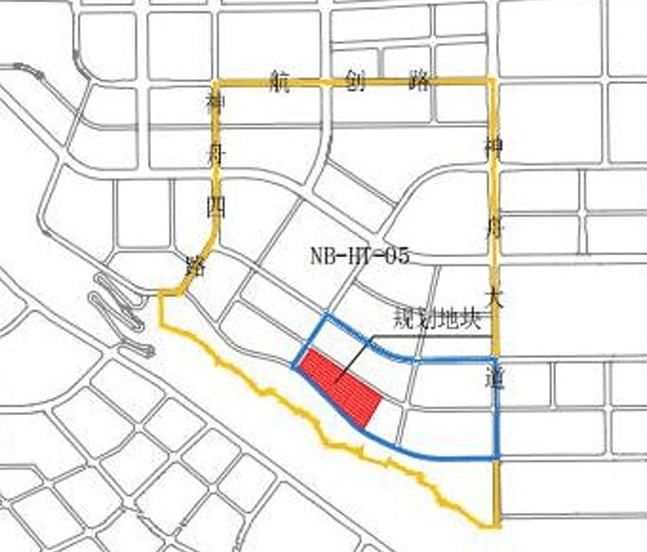
百亩体量、容积率1.2-1.46!西安低密地块整装待发!
Sou Hu Cai Jing· 2025-10-10 15:48
Core Viewpoint - The article discusses the recent public planning of a low-density residential land parcel in Xi'an, highlighting its significance in the current real estate market characterized by a decrease in land supply with low plot ratios [1][10]. Group 1: Land Supply and Characteristics - The recent land supply in Xi'an has seen a reduction in plot ratios, with most residential areas maintaining ratios around 2.5 to 2.8, while those below 2.0 are scarce [1][8]. - A notable land parcel with a plot ratio of 1.2-1.46, covering approximately 99.614 acres, has been publicly announced, marking it as a rare opportunity for low-density living in the main urban area [1][10]. - The land is strategically located near existing high-end residential projects and educational institutions, enhancing its attractiveness for potential buyers [4][6]. Group 2: Advantages of the New Land Parcel - The land parcel is situated on a high terrain with scenic mountain views, providing a unique ecological advantage [4]. - It is in proximity to prestigious educational institutions, including the Xi'an Aerospace Elite School, which adds to the area's appeal for families [4]. - The surrounding area is characterized by high-end residential developments, indicating a pure and affluent community [4]. Group 3: Market Context and Future Supply - Historically, Xi'an's residential projects had plot ratios exceeding 3.5, but recent urban planning has imposed stricter limits, leading to a scarcity of low-density land [7][8]. - In the first nine months of the year, only four parcels with plot ratios below 2.0 were supplied, underscoring the rarity and value of the newly announced land [10]. - Future low-density land supply is expected to be concentrated in specific areas, such as the Qujiang region, indicating a potential shift towards more luxury residential developments [12].

每日报告精选-20251010
GUOTAI HAITONG SECURITIES· 2025-10-10 12:50
Market Overview - The overall valuation of the market has increased, with the Wind All A Index leading the rise, up by 2.9 percentage points in PE-TTM historical percentile[5] - The PB-LF historical percentile also saw an increase across indices, with the CSI 300 leading at a rise of 4.4 percentage points[5] Industry Insights - In the automotive sector, PE valuation increased by 1.1 percentage points, leading among industries[6] - The non-ferrous metals sector saw a significant rise in PB valuation, up by 14.0 percentage points, indicating strong performance[6] Trading Activity - Trading activity has increased, with the turnover rate rising by 26.0% for the SSE 50 index, while total transaction volume decreased by 1.25%[6] - As of September 30, 2025, the margin trading balance was 2.39 trillion yuan, reflecting a decrease of 1.25% compared to September 26, 2025[6] Company Performance - The company reported a revenue growth from 678,800 yuan in 2022 to 1,908,800 yuan in 2024, with a compound annual growth rate of 67.7%[12] - The gross profit margin improved significantly from 19.9% in 2022 to 32.7% in 2024, maintaining at 32.4% in the first half of 2025[12] Risk Factors - Risks include uncertainties in overseas economic conditions and geopolitical factors that may impact market stability[8] - Potential risks in the pharmaceutical sector include uncertainties in original IP incubation and fluctuations in consumer demand[13]
国证国际港股晨报-20251010
Guosen International· 2025-10-10 06:11
Group 1 - The core viewpoint of the report highlights that international gold prices have surpassed the $4000 per ounce mark, impacting various sectors positively, particularly the metals sector [2][4][6] - The Hong Kong stock market showed mixed results with the Hang Seng Index declining by 0.29%, while the Hang Seng Tech Index fell by 0.66%, indicating volatility in the market [2][3] - The report notes significant inflows from northbound funds, with a net inflow of HKD 30.43 billion into Hong Kong stocks, suggesting strong investor interest [2][3] Group 2 - The report provides insights into the software and internet industry, indicating a robust domestic tourism performance during the National Day holiday, with total tourism revenue reaching CNY 809 billion and a year-on-year increase of 15% in revenue per capita [7][8] - The report anticipates a stable growth rate of 10% for the overall tourism market in 2025, with expectations of a rebound in average spending per person in the second half of the year [7][10] - Online travel agencies (OTAs) like Ctrip and Qunar have shown strong performance, with significant increases in outbound travel orders and hotel bookings, reflecting a positive trend in consumer behavior [9][10]
多元配置、分散配置,在科技成长高波动的情况下,中证A500红利低波ETF(561680)备受关注
Xin Lang Cai Jing· 2025-10-10 06:02
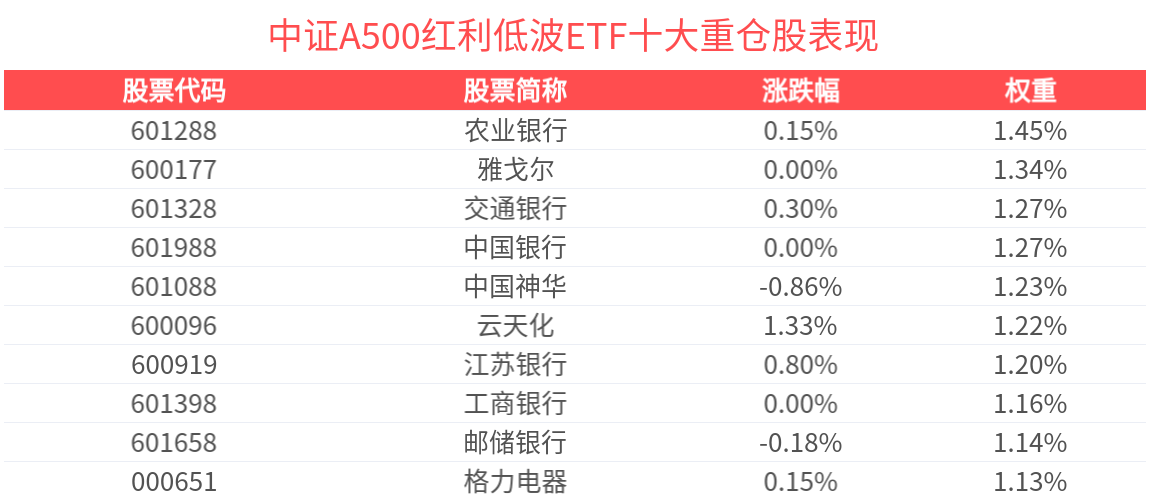
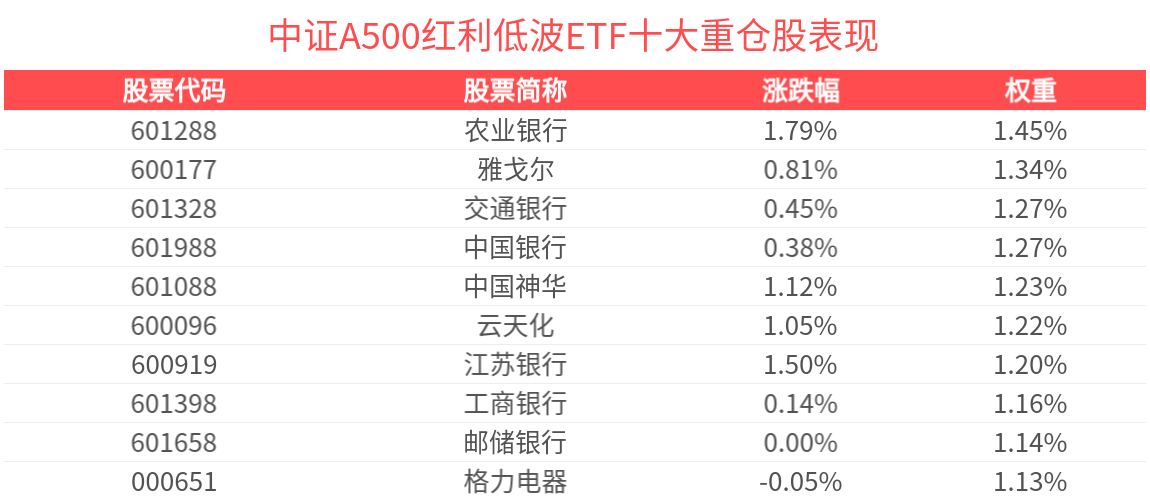
数据显示,截至2025年9月30日,中证A500红利低波动指数(932422)前十大权重股分别为农业银行(601288)、雅戈尔(600177)、中国神华(601088)、云天化 (600096)、中国银行(601988)、交通银行(601328)、工商银行(601398)、江苏银行(600919)、邮储银行(601658)、格力电器(000651),前十大权重股合计占比 30.72%。 流动性方面,中证A500红利低波ETF盘中换手1.97%,成交984.50万元。拉长时间看,截至10月9日,中证A500红利低波ETF近1年日均成交3139.01万元。回 撤方面,截至2025年10月9日,中证A500红利低波ETF成立以来最大回撤3.42%,相对基准回撤0.23%。费率方面,中证A500红利低波ETF管理费率为 0.50%,托管费率为0.10%。跟踪精度方面,截至2025年10月9日,中证A500红利低波ETF近1月跟踪误差为0.035%,在可比基金中跟踪精度最高。从估值层 面来看,中证A500红利低波ETF跟踪的中证A500红利低波动指数最新市盈率(PE-TTM)仅9.78倍,处于近1年18.75%的分位 ...
电科网安:截至2025年半年度,数据安全业务占营业收入的比重为3.62%
Mei Ri Jing Ji Xin Wen· 2025-10-10 04:42
电科网安(002268.SZ)10月10日在投资者互动平台表示,截至2025年半年度,数据安全业务占营业收 入的比重为3.62%。针对国内航空、建筑、电力等行业数据治理和数据安全防护需求,设计面向央企的 数据安全体系能力,推广央企数据安全统一防护解决方案,打造标杆项目,目前已服务于中国华电集 团、中国中铁等客户单位。 (记者 张明双) 每经AI快讯,有投资者在投资者互动平台提问:公司参与十余个数据安全国家、行业标准制定,且密 立方数据安全流通体系已为世纪华通提供服务。请问,数据安全业务当前的营收占比多少?在航空、铁 路等领域的重大项目落地进展如何,已实现的订单金额有多少?随着数据要素市场发展,预计该业务未 来3年的复合增长率能达到多少? ...

高波市场中的稳定器,中证A500红利低波ETF(561680)投资机会受关注
Xin Lang Cai Jing· 2025-10-10 02:25
Core Viewpoint - The Zhongzheng A500 Dividend Low Volatility Index and its corresponding ETF are showing positive performance, with a low valuation and high tracking accuracy, indicating potential investment opportunities in the underlying stocks. Group 1: Index Performance - As of October 10, 2025, the Zhongzheng A500 Dividend Low Volatility Index (932422) increased by 0.11%, with notable gains from stocks such as YTO Express (600233) up 1.76% and Yuntianhua (600096) up 1.33% [1] - Over the past two weeks, the Zhongzheng A500 Dividend Low Volatility ETF (561680) has accumulated a rise of 1.34% [1] - The ETF's trading volume was 109.33 million yuan with a turnover rate of 0.22% [1] Group 2: Liquidity and Drawdown - The average daily trading volume of the Zhongzheng A500 Dividend Low Volatility ETF over the past year was 31.39 million yuan [1] - The maximum drawdown since the ETF's inception is 3.42%, with a relative benchmark drawdown of 0.23% [1] Group 3: Fee Structure and Tracking Accuracy - The management fee for the Zhongzheng A500 Dividend Low Volatility ETF is 0.50%, and the custody fee is 0.10% [1] - The tracking error for the ETF over the past month is 0.035%, which is the highest among comparable funds [1] Group 4: Valuation Metrics - The latest price-to-earnings ratio (PE-TTM) for the Zhongzheng A500 Dividend Low Volatility Index is 9.78, placing it in the 18.75th percentile over the past year, indicating it is undervalued compared to 81.25% of the time in the last year [2] - The index consists of 50 stocks selected for continuous dividends, high dividend yields, and low volatility, reflecting the overall performance of these securities [2] Group 5: Top Holdings - As of September 30, 2025, the top ten weighted stocks in the Zhongzheng A500 Dividend Low Volatility Index account for 30.72% of the index, including Agricultural Bank of China (601288) and Gree Electric Appliances (000651) [2]