
宁波银行

Search documents
上市银行,密集出手!9家赎回,超1000亿!
券商中国· 2025-12-25 11:55
Core Viewpoint - The motivation for listed banks to redeem existing "high-interest" preferred shares is increasing in a low-interest-rate environment, aiming to save on interest costs [1][4]. Group 1: Redemption of Preferred Shares - Changsha Bank announced the redemption of 6 billion yuan of its preferred shares "Changyin You 1" on December 25, 2025, marking it as the fifth bank to redeem preferred shares in December [1][4]. - A total of 9 banks have redeemed preferred shares since 2025, with a cumulative redemption amount exceeding 1,000 billion yuan [4][5]. - The redemption actions include banks such as Nanjing Bank (4.9 billion yuan), Shanghai Bank (20 billion yuan), and Beijing Bank (4.9 billion yuan) [3][4]. Group 2: Market Trends and Supply - The total outstanding preferred shares of banks is 6,453.5 billion yuan, accounting for 99.58% of the preferred share market [5]. - Since 2020, the issuance of new preferred shares has nearly halted, leading to a gradual reduction in the outstanding volume [5][6]. - The introduction of perpetual bonds in 2019 has diversified the capital supplement tools available to banks, reducing the attractiveness of preferred shares [5][6]. Group 3: Investment Dynamics - Preferred shares are becoming increasingly scarce, making them a valuable asset for asset management institutions, including public funds and insurance funds [8][9]. - As of June 2025, approximately 3,079 billion yuan of bank preferred shares were held by wealth management products, representing 40.66% of the total outstanding preferred shares [8]. - The liquidity of bank preferred shares remains low compared to other capital supplement tools, with a low turnover rate in the market [9].







年度之约!宁波银行2026年大展望带您抓住新年新机遇
和讯· 2025-12-25 10:08
Core Viewpoint - The article discusses the upcoming "2026 Year Outlook" event hosted by Ningbo Bank, focusing on macroeconomic trends and investment strategies for the new year, addressing key questions regarding monetary policy, fiscal policy, currency trends, export performance, and market conditions for A-shares and Hong Kong stocks [1]. Group 1: Event Overview - The "2026 Year Outlook" event will take place on December 27, featuring discussions on macroeconomic conditions and asset strategies for 2026 [1]. - The event will include insights from four senior experts at Ningbo Bank, including the Vice President and heads of various departments [1]. Group 2: Agenda Highlights - The event will feature a series of presentations, including: - Macroeconomic and capital market outlook for 2026 by Zhou Yanchang, Chief Strategy Analyst [4]. - Bond market outlook for 2026 by Chai Feibin, General Manager of the Investment Banking Department [4]. - RMB exchange rate outlook for 2026 by Wang Dandan, Vice President [4]. - Outlook for commodities and precious metals market for 2026 by Qiu Difan, General Manager of the Research Department [4]. Group 3: Live Broadcast Information - The event will be live-streamed on Ningbo Bank's corporate finance video account and wealth management Douyin account, with coverage from multiple mainstream media outlets [6].


城商行板块12月25日涨0.07%,上海银行领涨,主力资金净流出1.11亿元
Zheng Xing Xing Ye Ri Bao· 2025-12-25 09:14
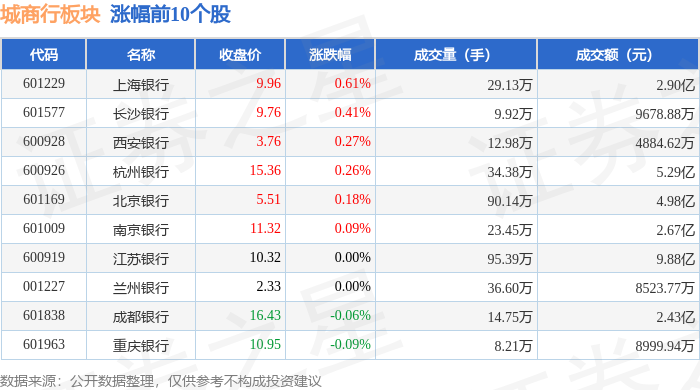
Market Performance - The city commercial bank sector increased by 0.07% compared to the previous trading day, with Shanghai Bank leading the gains [1] - The Shanghai Composite Index closed at 3959.62, up 0.47%, while the Shenzhen Component Index closed at 13531.41, up 0.33% [1] Individual Stock Performance - Shanghai Bank (601229) closed at 9.96, up 0.61% with a trading volume of 291,300 shares and a transaction value of 290 million [1] - Other notable performers include: - Changsha Bank (601577) at 9.76, up 0.41% [1] - Xi'an Bank (600928) at 3.76, up 0.27% [1] - Hangzhou Bank (600926) at 15.36, up 0.26% [1] - Beijing Bank (601169) at 5.51, up 0.18% [1] Capital Flow Analysis - The city commercial bank sector experienced a net outflow of 111 million from institutional investors, while retail investors saw a net inflow of 121 million [2] - The overall capital flow indicates a mixed sentiment, with institutional investors withdrawing funds while retail investors are increasing their positions [2] Detailed Capital Flow by Bank - Hangzhou Bank (600926) had a net inflow of 38.46 million from institutional investors, but a net outflow of 43.46 million from speculative funds [3] - Beijing Bank (601169) saw a net inflow of 23.41 million from institutional investors, with a net outflow of 18.77 million from speculative funds [3] - Guizhou Bank (601997) had a significant net inflow of 22.19 million from institutional investors, but a net outflow of 36.07 million from retail investors [3]
一级市场退出之战
投资界· 2025-12-25 08:29
Core Viewpoint - The article discusses the challenges and strategies related to exit opportunities in the investment landscape, particularly focusing on private equity and venture capital exits in China, highlighting the need for adaptive strategies in a changing economic environment [2][10]. Group 1: Exit Challenges and Strategies - The current economic downturn has created significant challenges for exits, with many funds facing systemic exit difficulties, particularly for projects invested in 2014, where 70% have yet to exit [10][11]. - The exit environment has changed drastically compared to previous years, necessitating proactive management and strategic planning for exits rather than a passive approach [8][10]. - The need for organizational restructuring within investment firms has been emphasized to better manage the complexities of the current exit landscape [8][9]. Group 2: Investment Focus and Performance - Various investment firms have reported their focus areas, with East Capital managing 63 funds totaling 390 billion yuan, and Puhua Group focusing on early-stage investments in healthcare, new energy, and hard technology [3][4]. - Tianchuang Capital has successfully listed 25 portfolio companies and maintains an annual investment of 300-400 million yuan, focusing on hard technology sectors [5][6]. - The performance of exits varies, with some firms achieving notable success while others struggle, indicating a mixed landscape of exit opportunities [7][10]. Group 3: Regulatory and Market Support - Recent regulatory changes, such as the updated merger loan management measures, are expected to enhance support for mergers and acquisitions, with increased leverage ratios and more flexible financing options [12][13]. - The bond market is also seen as a potential source of lower-cost funding for mergers, with current interest rates being favorable compared to traditional loans [13]. - The overall sentiment is cautiously optimistic regarding the future of exits, with expectations of a more favorable market environment in 2026, particularly for IPOs and mergers [23][24]. Group 4: Future Outlook and Recommendations - The article suggests that investment firms should establish closer collaborations with listed companies to better align acquisition targets and exit strategies [16][17]. - There is a call for clearer investment strategies, focusing on companies with high growth potential and stable cash flows, to facilitate smoother exits [17][18]. - The importance of continuous communication with founders and portfolio companies is highlighted to ensure accurate assessments of business performance and exit timing [27][28].



对话2026年关键词:金融地产篇
2025-12-25 02:43
Summary of Conference Call Records Industry Overview - The non-bank financial sector, particularly online insurance and brokerage firms, is expected to have greater growth potential compared to banks in the coming year. Online insurance benefits from an increase in equity positions, which could enhance investment returns if the stock market performs well. Additionally, adjustments in household asset allocation favor stable income products from insurance [1][2][3]. Key Insights on Insurance and Brokerage - Insurance companies listed in H-shares have shown significant recovery, while A-shares lag behind. It is anticipated that the fundamentals of insurance will further improve in 2026. The optimization of insurance product structures, including new products like commercial insurance and dividend-type critical illness insurance, is expected to contribute to growth [1][2]. - Brokerages have performed well during year-end market conditions, particularly in the spring season, where historical data shows a high success rate. Despite underperformance in A-share brokerages this year, ongoing performance releases and increased market activity suggest potential for excess returns in the coming year [1][3]. Banking Sector Strategy - The banking sector's strategy for 2026 will focus on interest margins and asset growth. The balance between volume and price is expected to stabilize under real estate policy impacts, with interest margins becoming a key revenue growth driver. Loan pricing is projected to bottom out and recover, while deposit rates are expected to decline, supporting a gradual recovery in interest margins [4][5]. - Credit growth is expected to remain flat or slightly lower than in 2025, with a continued divergence between social financing growth and credit growth. The overall credit expansion is anticipated to slow down, maintaining a tight balance between deposits and loans [5]. Capital Supplementation in Banking - In 2025, the Ministry of Finance added four state-owned banks, with plans to complete additional capital increases for two more major state-owned banks in 2026. Due to a constrained external financing environment, smaller banks are expected to rely on convertible bonds for growth. Long-term funds from insurance capital, bank shareholders, and asset management companies are becoming primary sources of funding for bank stocks [6]. Macroeconomic Outlook - A positive macroeconomic trend is expected to support the banking sector's fundamentals, although rapid profit growth is unlikely. The public fund reform may lead to a shift in asset allocation towards performance benchmark indices, potentially alleviating revenue pressures in the banking industry in 2026 [7]. Real Estate Sector Predictions - The real estate industry is expected to rely on economic recovery for resolution of its issues. Predictions indicate a decline of approximately 10% in sales amounts and areas, with new construction and actual completions expected to drop by about 15% [9]. - Developers face significant risks in land acquisition, including accurately assessing customer demand and high-risk investments. The stability of the asset side is increasingly uncertain, with high leverage posing additional risks [11]. Investment Recommendations in Real Estate - Investors should focus on real estate companies with high accuracy in land acquisition, low valuations with potential for marginal improvement, and those with strong competitive advantages in shopping center operations. Companies like Greentown China and China Resources Land are highlighted for their high acquisition accuracy rates [12][13]. - The second-hand housing intermediary sector, exemplified by Beike, is noted for its potential growth and should be considered as part of the investment strategy [14].
双融日报-20251225
Huaxin Securities· 2025-12-25 01:39
Market Sentiment - The current market sentiment score is 85, indicating an "overheated" market condition, which suggests a high level of investor optimism [6][9][21] - Historical trends show that when the sentiment score is below or close to 30, the market tends to find support, while scores above 70 indicate potential resistance [9] Hot Themes Tracking - **Liquid Cooling Theme**: Liquid cooling solutions are becoming mainstream in data centers due to their higher cooling efficiency and lower PUE. Major AI companies like NVIDIA and Google are accelerating the adoption of this technology, with Google increasing its TPU chip shipment target by 50% to 6 million units by 2026. Related stocks include Yingwei Technology (002837) and Feilong Co., Ltd. (002536) [6] - **Banking Theme**: Bank stocks are characterized by high dividend yields, with the China Securities Bank Index yielding 6.02%, significantly higher than the 10-year government bond yield. In a slowing economy with increased market volatility, bank stocks are becoming important investment targets for long-term funds like insurance and social security. Related stocks include Agricultural Bank of China (601288) and Ningbo Bank (002142) [6] - **Brokerage Theme**: The chairman of the China Securities Regulatory Commission emphasized the need for differentiated regulation and support for quality institutions. The focus is shifting from scale and speed to high-quality development, encouraging smaller firms to differentiate their operations. Related stocks include CITIC Securities (600030) and Guotai Junan Securities (601211) [6] Capital Flow Analysis - The top ten stocks with the highest net inflow include Demingli (001309.SZ) with a net inflow of 955.33 million, and Tianji Co., Ltd. (002759.SZ) with 884.72 million [10] - The top ten stocks with the highest net outflow include Xinyi Sheng (300502.SZ) with a net outflow of -927.80 million, and Shenghong Technology (300476.SZ) with -438.13 million [12] - The top ten industries with the highest net inflow include the electronics sector with 236.04 million, and the non-ferrous metals sector with 140.84 million [19] Investment Strategy Recommendations - In an "overheated" market, it is advisable to consider reducing positions to avoid buying at market peaks and to be cautious of potential market bubbles [21] - The report suggests that during periods of high market sentiment, investors should be vigilant and may need to adjust their strategies accordingly to mitigate risks associated with overvaluation [21]
城商行板块12月24日跌0.35%,宁波银行领跌,主力资金净流出1.85亿元
Zheng Xing Xing Ye Ri Bao· 2025-12-24 09:10
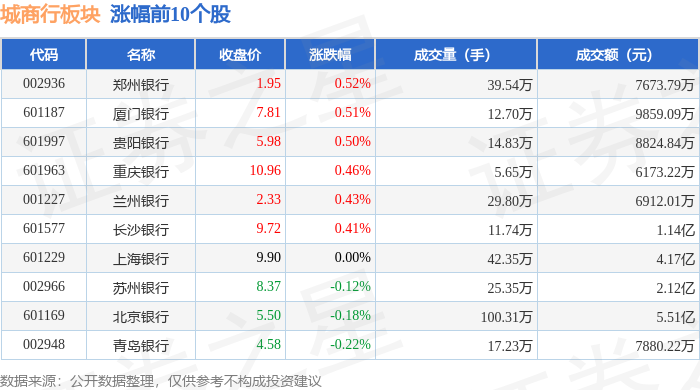
Group 1 - The city commercial bank sector experienced a decline of 0.35% on December 24, with Ningbo Bank leading the drop [1] - The Shanghai Composite Index closed at 3940.95, up 0.53%, while the Shenzhen Component Index closed at 13486.42, up 0.88% [1] - Key individual stock performances in the city commercial bank sector included Zhengzhou Bank at 1.95 with a rise of 0.52% and Ningbo Bank at 28.37 with a decline of 0.84% [2] Group 2 - The net outflow of main funds in the city commercial bank sector was 185 million yuan, while speculative funds saw a net inflow of 384 million yuan, and retail investors experienced a net outflow of 199 million yuan [2] - The fund flow data indicated that Ningbo Bank had a main fund net inflow of 33.33 million yuan, while retail investors had a significant net outflow of 1.05 billion yuan [3] - Other banks like Hangzhou Bank and Chengdu Bank also showed mixed fund flows, with Hangzhou Bank having a main fund net inflow of 14.83 million yuan and Chengdu Bank experiencing a slight net outflow of 43.16 thousand yuan [3]
A股午后涨幅扩大:商业航天概念股再度爆发,4125股收涨
Xin Lang Cai Jing· 2025-12-24 07:37
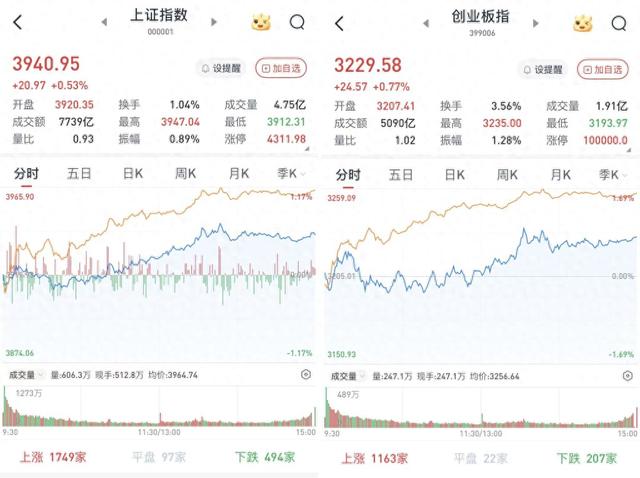
A股三大股指12月24日集体小幅高开。沪指早盘震荡攀升,深市则高位震荡。午后沪深两市同频上攻, 三大股指涨幅迅速扩大。 从盘面上看,商业航天概念股再度爆发,福建本地股反复活跃,光伏、锂电池、算力硬件、AI手机、 智能驾驶、化纤题材走强。 至收盘,上证综指涨0.53%,报3940.95点;科创50指数涨0.9%,报1352.13点;深证成指涨0.88%,报 13486.42点;创业板指涨0.77%,报3229.58点。 Wind统计显示,两市及北交所共4125只股票上涨,1132只股票下跌,平盘有200只股票。 农林牧渔领跌两市,生物股份(600201)跌超7%,粤海饲料(001313)、罗牛山(000735)、福成股 份(600965)、海大集团(002311)等跌超2%。 银行股逆市下挫,邮储银行(601658)、常熟银行(601128)、宁波银行(002142)、瑞丰银行 (601528)、交通银行(601328)等跌幅靠前。 食品饮料表现不佳,庄园牧场(002910)跌停,得利斯(002330)、欢乐家(300997)跌超3%,妙可 蓝多(600882)、千味央厨(001215)、西部牧业(300106 ...
【盘中播报】沪指涨0.47% 国防军工行业涨幅最大
Zheng Quan Shi Bao Wang· 2025-12-24 06:41
| 银行 | | | | 宁波银行 | | | --- | --- | --- | --- | --- | --- | | 食品饮料 | -0.32 | 190.88 | -19.64 | 庄园牧场 | -9.15 | | 农林牧渔 | -0.73 | 224.40 | -10.12 | 生物股份 | -5.38 | | 煤炭 | -1.03 | 60.90 | 10.23 | 云维股份 | -3.58 | (文章来源:证券时报网) 证券时报·数据宝统计,截至下午13:57,今日沪指涨0.47%,A股成交量880.80亿股,成交金额15086.78 亿元,比上一个交易日减少3.05%。个股方面,4015只个股上涨,其中涨停79只,1228只个股下跌,其 中跌停6只。从申万行业来看,国防军工、电子、建筑材料等涨幅最大,涨幅分别为2.62%、1.71%、 1.67%;煤炭、农林牧渔、食品饮料等跌幅最大,跌幅分别为1.03%、0.73%、0.32%。(数据宝) 今日各行业表现(截至下午13:57) | 申万行业 | 行业涨跌(%) | 成交额(亿元) | 比上日(%) | 领涨(跌)股 | 涨跌幅(%) | | - ...
金融如何为小微企业“量体裁衣”?解构宁波银行的三重角色
Mei Ri Jing Ji Xin Wen· 2025-12-24 06:06
Core Viewpoint - Small and micro enterprises are vital to the national economy, serving as a foundation for employment, livelihood, and innovation, with Ningbo Bank positioning itself as a supporter of these enterprises through inclusive finance [1] Group 1: Financial Support and Innovation - Ningbo Bank has introduced a series of credit products such as "Small Micro Loan," "Easy Loan," "Export Extreme Loan," "Science and Technology Innovation Loan," and "Order Loan" to alleviate financing difficulties for small and micro enterprises [2] - The bank simplifies application processes and implements exclusive preferential policies to reduce the financing burden on stable small enterprises, enabling them to access necessary funds easily [2] - The bank provides comprehensive services throughout the growth cycle of small enterprises, including tailored financial and non-financial solutions [2][3] Group 2: Digital Transformation and Efficiency - Digital transformation is essential for small enterprises to enhance competitiveness and achieve high-quality development, with Ningbo Bank offering various digital solutions like "Financial Manager" and "Foreign Exchange Manager" [4][5] - The "Financial Manager" platform integrates various financial systems to improve fund management efficiency, significantly reducing time and errors in financial operations [4] - The "Foreign Exchange Manager" utilizes advanced technologies to streamline cross-border payment processes, allowing enterprises to complete transactions quickly and efficiently [5] Group 3: Resource Integration and Industry Upgrading - Ningbo Bank extends its services beyond financial support to include resource integration, helping small enterprises connect with academic and research institutions for technology transfer and innovation [6] - The bank has developed an "Overseas Service" platform to assist small enterprises in international expansion by collaborating with over 70 professional firms and institutions [6] - By addressing specific needs of enterprises, such as providing local expertise for international ventures, Ningbo Bank facilitates smoother market entry and operational success [6] Group 4: Commitment to Inclusive Finance - Ningbo Bank is committed to transforming inclusive finance from a policy benefit into a driving force for enterprise development, continuously exploring new service paths for small and micro enterprises [7]