江淮汽车

Search documents
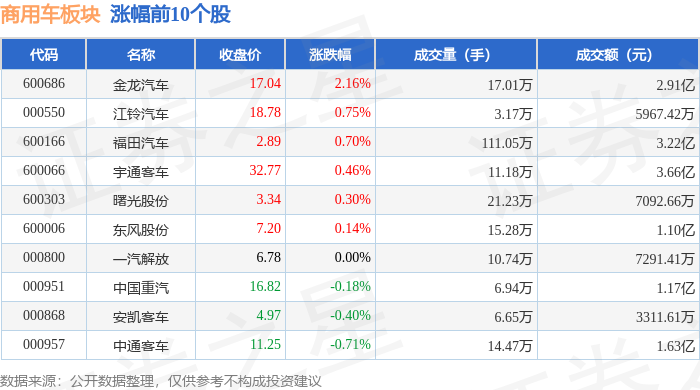
商用车板块12月26日涨0.23%,金龙汽车领涨,主力资金净流出2.26亿元
Zheng Xing Xing Ye Ri Bao· 2025-12-26 09:07
Core Viewpoint - The commercial vehicle sector experienced a slight increase of 0.23% on December 26, with Jinlong Automobile leading the gains, while the overall market indices also showed modest increases [1]. Group 1: Market Performance - The Shanghai Composite Index closed at 3963.68, up 0.1%, and the Shenzhen Component Index closed at 13603.89, up 0.54% [1]. - The commercial vehicle sector's individual stock performances varied, with Jinlong Automobile closing at 17.04, up 2.16%, and China National Heavy Duty Truck down 0.18% at 16.82 [1]. Group 2: Trading Volume and Value - Jinlong Automobile had a trading volume of 170,100 shares and a transaction value of 291 million yuan [1]. - Jiangling Motors recorded a closing price of 18.78 with a trading volume of 31,700 shares, resulting in a transaction value of approximately 5.97 million yuan [1]. Group 3: Capital Flow - The commercial vehicle sector saw a net outflow of 226 million yuan from institutional investors, while retail investors contributed a net inflow of 175 million yuan [2]. - The sector's overall capital flow indicates a mixed sentiment, with institutional investors withdrawing funds while retail investors increased their positions [2]. Group 4: Individual Stock Capital Flow - Jianghuai Automobile had a net inflow of 6.35 million yuan from institutional investors, but a net outflow of 2.91 million yuan from retail investors [3]. - China National Heavy Duty Truck experienced a significant net outflow of 5.06 million yuan from institutional investors, while retail investors contributed a net inflow of 16.72 million yuan [3].





二十载同行,再启新程!2025商用车新驱动大会在京举行
Zhong Guo Qi Che Bao Wang· 2025-12-26 07:21
Group 1 - The 2025 Commercial Vehicle New Drive Conference was held in Beijing, focusing on low-carbon and intelligent transformation in the commercial vehicle industry [2] - The 20-year history of the Commercial Vehicle News reflects the evolution of China's commercial vehicle industry, transitioning from scale expansion to efficiency and quality competition, and from traditional fuel to diverse new energy technologies [3][5] - The industry has experienced significant changes, with a shift from domestic focus to global outreach, symbolizing the transformation from "Made in China" to "Intelligent Manufacturing in China" [3] Group 2 - The commercial vehicle industry can be divided into two phases: a rapid development period and an adjustment and transformation period, supported by policy guidance, technological innovation, and market competition [7] - The upcoming 2026 marks the beginning of the 14th Five-Year Plan, presenting new opportunities and challenges for the commercial vehicle industry [7] - Energy conservation remains a core concern for the commercial vehicle industry, directly impacting user value realization [8] Group 3 - The 2025 energy-saving tests showcased significant advancements in energy consumption, range management, and intelligent control across various models, establishing new benchmarks for energy efficiency [10] - The logistics sector is pivotal for the transition to new energy in commercial vehicles, with the "Youyun Wang" offline experience event highlighting the evolving demands in urban logistics [10][11] - The eighth "Youyun Wang" event recognized several models that set new standards in urban logistics, reflecting the industry's technological advancements [11] Group 4 - The "Vehicle Enterprise Service Satisfaction Survey" has become a key focus for the Commercial Vehicle News, emphasizing the importance of service quality in market competition [14] - Digitalization and intelligence are driving improvements in service capabilities, with China National Heavy Duty Truck Group receiving high praise for its service quality [14] - The Commercial Vehicle News aims to continue its role as an observer and leader in the industry, contributing to high-quality development in the next five to ten years [16]

“尊界效应”观察:为何顶级企业家换掉了劳斯莱斯?
经济观察报· 2025-12-25 11:49
Core Viewpoint - The story of the ZunJie S800 transcends the success of a single vehicle, representing a solid foothold and leap for a Chinese brand in the ultra-luxury market traditionally dominated by century-old brands through its full value chain capabilities in R&D, manufacturing, supply chain, and user operations [1][2]. Market Performance - The ZunJie S800 was launched on May 30, with a price starting above 700,000 yuan, generating significant market interest [4]. - By August, the cumulative pre-orders exceeded 10,000 units, far surpassing initial industry expectations [4]. - In October, the S800 achieved a monthly delivery of 1,970 units, topping the sales chart for luxury sedans priced above 700,000 yuan [4]. - By December, the monthly delivery stabilized above 2,000 units, surpassing the combined sales of competitors like the Porsche Panamera and BMW 7 Series [4][6]. Quality and Delivery - ZunJie emphasizes stable delivery and quality over mere sales speed, aiming for a "zero defects" manufacturing control system [6]. - The S800 has set a new record for delivery speed in the luxury car segment, with over 10,000 units delivered since its launch [6]. - The company aims to complete all orders by the Spring Festival in 2025, showcasing its efficient supply chain and commitment to users [6]. User Experience and Technology - The S800 integrates top-tier intelligent technology with craftsmanship, providing a unique driving experience that appeals to high-net-worth individuals [8][9]. - The vehicle features advanced systems like Huawei's ADS for driving assistance and a high-voltage silicon carbide platform for performance and safety [8]. - The seamless integration of technology results in a smooth driving experience, even with significant power reserves [8]. Brand Effect and User Engagement - The "ZunJie Effect" refers to a phenomenon where satisfied users recommend the S800 to peers, creating a network of trust and value recognition [10][11]. - Users often come from backgrounds of owning traditional luxury brands, making their choice of the S800 a rational decision based on technology and craftsmanship [12]. - The S800 serves as a "mobile business card" for users, reflecting their values and status in high-end social circles [14][15]. Industry Impact - The development of the S800 has catalyzed innovation within the Chinese automotive supply chain, involving over 220 core suppliers in the process [18]. - The collaboration with suppliers has led to breakthroughs in high-end materials and manufacturing processes, raising the overall standards in the industry [18]. - The S800's success signifies a systemic leap for the Chinese automotive industry, moving beyond individual product success to a broader impact on high-end manufacturing capabilities [18][20]. Future Outlook - The ZunJie S800's milestone of 10,000 units sold marks both an achievement and a starting point for future challenges in the high-end automotive market [22]. - The competition in the automotive industry is shifting towards a focus on systemic high-end capabilities rather than just product features, requiring long-term strategic commitment and deep integration across industries [22].

一周一刻钟,大事快评(W137):二手车出海——日本经验;零部件观点更新;岱美股份重申-20251225
Shenwan Hongyuan Securities· 2025-12-25 10:24
Investment Rating - The report maintains a positive investment rating for the automotive industry, specifically recommending companies with strong alpha potential and growth prospects [2][4][5]. Core Insights - The report highlights the challenges faced by the used car export market, particularly from Japan, emphasizing the need for standardized rating systems and trust-building measures between buyers and sellers [3]. - It suggests that companies with strong operational capabilities, such as large dealership groups and platforms like Uxin, are well-positioned to capitalize on the growth of used car exports [3]. - The report notes that the automotive parts sector is currently facing headwinds due to high inventory levels and the exhaustion of trade-in subsidies, but there is a cautious optimism for market recovery in the coming year [4]. - Companies like Daimay and Fuda are highlighted for their stable performance and growth potential, particularly in the robotics sector and their international market presence [5][6]. Summary by Sections Used Car Export Insights - The used car export market is hindered by trust issues and a complex transaction chain, with Japan's stringent vehicle inspection policies serving as a potential model for improvement [3]. - Uxin is identified as a key player with a growing inventory of nearly 7,000 used cars, making it a recommended investment for the next two to three years [3]. Automotive Parts Sector Update - The automotive industry did not experience the anticipated year-end surge, primarily due to the depletion of trade-in subsidies and consumer hesitance [4]. - Recommendations include companies with strong alpha characteristics such as Shuanghuan Transmission and Yinlun, which are expected to benefit from stable growth and high market ceilings [4]. Daimay and Robotics Sector - Daimay is recognized for its stable earnings, low valuation, and significant growth potential, particularly in automotive interior components and robotics [5][6]. - The company has made significant strides in expanding its client base, including partnerships with major electric vehicle manufacturers, and is positioned to support Tesla's localization efforts in North America [6].





江淮汽车今日大宗交易折价成交4.9万股,成交额229.57万元
Xin Lang Cai Jing· 2025-12-25 09:47
12月25日,江淮汽车大宗交易成交4.9万股,成交额229.57万元,占当日总成交额的0.13%,成交价46.85 元,较市场收盘价49.32元折价5.01%。 | No. 27-4 082 year 111 trive 交易日期 | 证券简称 | 证券代码 | 成交价(元) 成交金额(万元) 成交量( *) 买入营业部 | | | 卖出营业部 是否为专场 | | --- | --- | --- | --- | --- | --- | --- | | 025-12-25 | 江淮汽车 | 600418 | 46.85 229.57 | 4.9 | 發動量和醫與製品 | 180 不可是多产奖基礎 | ...

日本经验,零部件观点更新,岱美股份重申-20251225
Shenwan Hongyuan Securities· 2025-12-25 09:14
Investment Rating - The report maintains a positive outlook on the automotive industry, specifically recommending companies like Uxin and Daimay as strong investment opportunities [2][5]. Core Insights - The second-hand car export market faces significant challenges, including the non-standard nature of vehicles and a complex transaction chain. Japan's experience in this sector offers valuable lessons, such as stringent vehicle inspection policies and the establishment of standardized auction platforms [3][4]. - The automotive parts sector has not seen the anticipated year-end surge due to exhausted subsidies and consumer hesitance. The report suggests focusing on companies with strong alpha, such as Shuanghuan Transmission and Yinlun, which have stable growth and high market ceilings [4]. - Daimay is highlighted as a stable, undervalued company with significant growth potential, particularly in the automotive interior and robotics sectors. The company has made substantial progress in expanding its client base, including partnerships with major players like Tesla [5][7]. Summary by Sections Second-Hand Car Export - The second-hand car export market is hindered by trust issues and a lack of standardized practices. Japan's strict vehicle inspection policies and auction platforms provide a model for improvement. Uxin, with a current inventory of nearly 7,000 vehicles, is positioned for growth in this market [2][3]. Automotive Parts Sector - The automotive industry did not experience the expected late-year demand surge due to depleted subsidies and cautious consumer behavior. The report emphasizes the need to monitor the continuation of trade-in policies and suggests focusing on companies with strong alpha characteristics, such as Shuanghuan Transmission and Yinlun [4]. Daimay - Daimay is recognized for its stable performance and low valuation, with 80% of its revenue coming from overseas markets. The company is well-positioned to withstand domestic market pressures and has made significant strides in the robotics field, particularly in electronic skin technology [5][7].

汽车行业资金流入榜:飞龙股份等12股净流入资金超亿元
Zheng Quan Shi Bao Wang· 2025-12-25 09:10
Market Overview - The Shanghai Composite Index rose by 0.47% on December 25, with 25 out of the 28 sectors experiencing gains, led by defense and military industry at 2.91% and light industry at 1.59% [2] - The automotive sector increased by 1.46%, while the sectors with the largest declines were comprehensive and non-ferrous metals, down by 1.12% and 0.77% respectively [2] Capital Flow Analysis - The net outflow of capital from the two markets was 18.129 billion yuan, with 8 sectors seeing net inflows [2] - The automotive sector had the highest net inflow of capital at 2.747 billion yuan, followed by the machinery equipment sector with a net inflow of 1.862 billion yuan [2] Automotive Sector Performance - In the automotive sector, 283 stocks were tracked, with 224 stocks rising and 55 stocks declining; 9 stocks hit the daily limit up [3] - The top three stocks with the highest net inflow were Feilong Co., Ltd. (8.01 billion yuan), Wanxiang Qianchao (7.13 billion yuan), and Xusheng Group (4.39 billion yuan) [3] - The stocks with the largest net outflows included Zhejiang Shibao (3.80 billion yuan), Sailis (2.42 billion yuan), and Shanzigaokao (1.68 billion yuan) [3] Automotive Sector Capital Inflow - The top stocks in terms of capital inflow included: - Feilong Co., Ltd. (7.84% increase, 28.38% turnover, 800.65 million yuan inflow) - Wanxiang Qianchao (9.98% increase, 4.53% turnover, 712.97 million yuan inflow) - Xusheng Group (10.01% increase, 9.00% turnover, 438.97 million yuan inflow) [4] Automotive Sector Capital Outflow - The stocks with the largest capital outflows included: - Zhejiang Shibao (3.92% increase, 28.02% turnover, -380.27 million yuan outflow) - Sailis (-0.49% decrease, 0.72% turnover, -241.87 million yuan outflow) - Shanzigaokao (-1.94% decrease, 8.12% turnover, -167.85 million yuan outflow) [5]



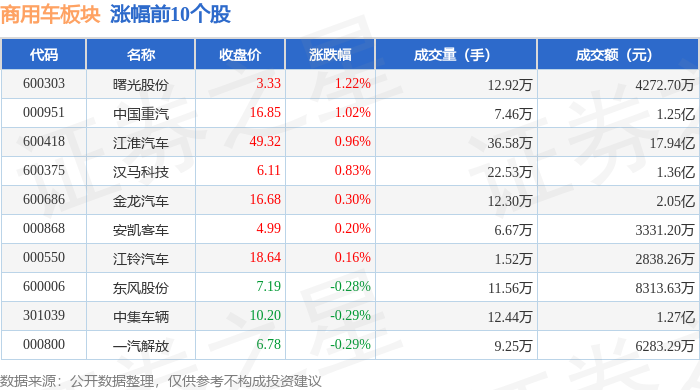
商用车板块12月25日涨0.05%,曙光股份领涨,主力资金净流出3546.76万元
Zheng Xing Xing Ye Ri Bao· 2025-12-25 09:07
Group 1 - The commercial vehicle sector saw a slight increase of 0.05% on December 25, with Shuguang Co. leading the gains [1] - The Shanghai Composite Index closed at 3959.62, up by 0.47%, while the Shenzhen Component Index closed at 13531.41, up by 0.33% [1] - Key stocks in the commercial vehicle sector included Shuguang Co. with a closing price of 3.33, up by 1.22%, and China National Heavy Duty Truck Group with a closing price of 16.85, up by 1.02% [1] Group 2 - The commercial vehicle sector experienced a net outflow of 35.47 million yuan from institutional investors, while retail investors saw a net inflow of 23.6 million yuan [2] - Major stocks with significant net inflows from retail investors included Jianghuai Automobile with 90.02 million yuan and Ankai Bus with 54.19 million yuan [3] - Conversely, stocks like FAW Jiefang and Ankai Bus experienced notable net outflows from institutional investors, with FAW Jiefang seeing an outflow of 8.39 million yuan [3]


【乘联分会论坛】2025年11月皮卡市场分析
乘联分会· 2025-12-25 08:32
Core Viewpoint - The pickup truck market in China is experiencing significant growth, with strong sales and export performance, particularly in the southwestern and northwestern regions, while the demand in eastern developed areas is relatively weak [2][3][9]. Group 1: Overall Market Analysis - In November 2025, the pickup truck market sold 56,000 units, a year-on-year increase of 22% and a month-on-month increase of 17%, marking a high point in the last five years [2][8]. - From January to November 2025, the total sales reached 519,000 units, up 8% year-on-year [8]. - The production of pickup trucks in November 2025 was 52,000 units, a year-on-year increase of 8%, with a total production of 527,000 units from January to November, reflecting a 14.5% increase [2][8]. Group 2: Export Performance - In November 2025, China exported 32,000 pickup trucks, representing a year-on-year increase of 54% and a month-on-month increase of 19% [3][10]. - The total exports from January to November 2025 reached 268,000 units, a 22% increase compared to the previous year [10]. - By November 2025, exports accounted for 57% of total pickup truck sales, indicating a strong international demand for Chinese-made pickups [10]. Group 3: New Energy Pickup Trucks - In November 2025, sales of new energy pickup trucks reached 8,000 units, a year-on-year increase of 152% and a month-on-month increase of 40% [3][14]. - Cumulatively, from January to November 2025, 67,000 new energy pickups were sold, reflecting a staggering growth of 335% [14]. - The market for new energy pickups is expected to grow rapidly, driven by increasing domestic and international demand [14]. Group 4: Regional Sales Characteristics - The main demand for pickup trucks is concentrated in the southwestern and northwestern regions, which accounted for 46% of total demand in November 2025 [15][18]. - The eastern developed regions are showing weaker performance, with significant growth observed in smaller cities and rural areas [18][20]. - The market dynamics are shifting, with urban areas experiencing a decline while county and township markets are recovering [20][31]. Group 5: Competitive Analysis - Great Wall Motors continues to dominate the pickup truck market, holding nearly 50% of the domestic market share, with strong performances from Changan, SAIC Maxus, and Zhengzhou Nissan [23][26]. - The competitive landscape is evolving, with emerging players like Geely and new energy brands gaining traction [26][31]. - The export performance of major manufacturers is robust, with Great Wall Motors leading, followed by Changan and SAIC Maxus [28][31].
汽车出海的决胜关键是什么?
3 6 Ke· 2025-12-25 07:10
Core Viewpoint - The Chinese automotive industry is at a critical juncture in its globalization efforts, with a strong market presence but facing potential short-term growth slowdowns due to various constraints. The focus on deep localization and industry chain collaboration is essential for maintaining competitive advantages in international markets. Group 1: Globalization and Market Strategy - The Chinese automotive industry has successfully entered the global mainstream, achieving market share comparable to American and Korean manufacturers, with a promising outlook for future growth [1] - By 2030, it is projected that China's overseas sales share could reach 15% to 20%, although growth may slow in the next two years due to factors like overseas inventory and localization challenges [1] - Key criteria for selecting target markets include large market size and a relatively mature industry chain, or a faster transition towards electrification [5][10] Group 2: Localization and Industry Collaboration - "Industry chain collaboration" and "deep localization" are identified as critical factors for Chinese automotive companies to maintain their leading position in the global market [2] - Deep localization is emphasized as a key focus for the next phase of automotive globalization, requiring companies to adapt their products and strategies to local market needs [2][17] - Companies must integrate their core value propositions with local insights to transition from a purely global layout to a symbiotic local presence [17] Group 3: ESG and Core Competitiveness - ESG (Environmental, Social, and Governance) factors are not only entry barriers for international markets but also represent core competitive advantages for companies [6][13] - Quality and trust are highlighted as essential components of ESG, which are crucial for Chinese automotive companies to succeed globally [13][16] - The traditional supply chain structures are inadequate for meeting the demands of smart electric vehicles, presenting an opportunity for restructuring the supply chain [7][13] Group 4: Market Entry and Development Strategies - Companies are encouraged to develop differentiated market expansion strategies tailored to various regions, leveraging their technological and cost advantages from the domestic market [17] - Successful global companies must ensure their values are recognized globally, and their innovative technologies and products meet local demands [17][20] - Establishing distribution and service channels is critical for overseas development, and finding local partners can facilitate market entry [23]