芒果超媒

Search documents
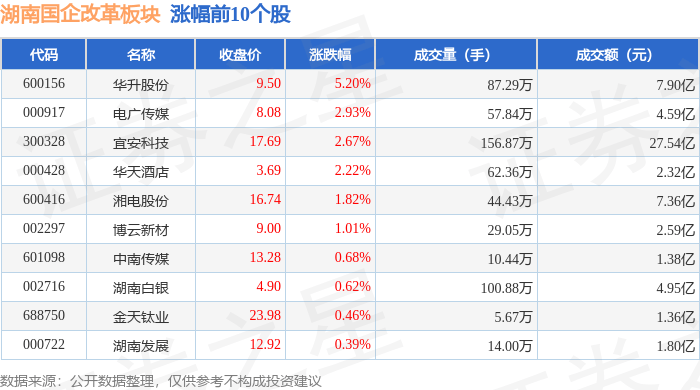
湖南国企改革板块8月22日涨0.12%,华升股份领涨,主力资金净流出4.44亿元
Sou Hu Cai Jing· 2025-08-22 08:54
Market Performance - On August 22, the Hunan state-owned enterprise reform sector rose by 0.12% compared to the previous trading day, with Huasheng Co., Ltd. leading the gains [1] - The Shanghai Composite Index closed at 3825.76, up 1.45%, while the Shenzhen Component Index closed at 12166.06, up 2.07% [1] Stock Performance - The top-performing stocks in the Hunan state-owned enterprise reform sector included: - Huasheng Co., Ltd. (600156) with a closing price of 9.50, up 5.20% and a trading volume of 872,900 shares, totaling 790 million yuan [1] - Electric Broadcasting Media (000917) closed at 8.08, up 2.93% with a trading volume of 578,400 shares, totaling 459 million yuan [1] - Yian Technology (300328) closed at 17.69, up 2.67% with a trading volume of 1,568,700 shares, totaling 2.754 billion yuan [1] Capital Flow - The Hunan state-owned enterprise reform sector experienced a net outflow of 444 million yuan from institutional investors, while retail investors saw a net inflow of 359 million yuan [2][3] - The capital flow for individual stocks showed varied trends, with significant net inflows for some stocks and outflows for others, indicating mixed investor sentiment [3]


板块跌超50%,救命稻草来了?
Ge Long Hui A P P· 2025-08-21 10:21
Group 1 - The media and film industry once thrived in the capital market, with the media sector rising 172% in 2015, becoming the best-performing industry that year [2][3] - Following the release of the new policies, film stocks surged, with companies like Mango Super Media and Ciweng Media hitting their limits [3][4] - Despite the recent policy boost, the capital market remains skeptical about the long-term recovery of film stocks, which have seen a decline of over 50% since 2016 [4][6] Group 2 - Major film companies like Wanda Film and Huayi Brothers have experienced stock declines of over 80%, while companies focused on long dramas like Ciweng Media have seen declines of over 70% [6][7] - Mango Super Media, despite a 15-fold increase in stock price since its listing in 2015, has seen a 70% drop from its peak in 2021, with revenue and net profit both declining significantly in 2024 [8][9] - The overall industry is facing a profit volatility issue, with only a few companies like Huayi Brothers and Beijing Culture showing positive net profit growth in 2024 [11][12] Group 3 - The new policies have relaxed content restrictions and improved review efficiency, which could potentially benefit production companies and enhance the quality and efficiency of industry output [24][26][28] - The short drama market has rapidly grown, surpassing 500 billion in 2024, accounting for 70% of the long drama market, indicating a shift in viewer preferences [30][31][32] - The supply side of the industry is under pressure, with a 73% decrease in the number of TV dramas approved for release over the past decade [36][39] Group 4 - The introduction of AI technology in video production and advertising is expected to empower companies like Mango Super Media, potentially transforming the industry's cost structure and investment returns [43][45] - The film industry is navigating through a complex landscape of regulatory changes, content ecology, and technological advancements, which will shape its future [46][47] - The ongoing decline in supply and the need for capital reinvestment are critical for the industry's recovery and long-term growth [47]



板块跌超50%,救命稻草来了?
格隆汇APP· 2025-08-21 09:42
Core Viewpoint - The article discusses the volatility and challenges faced by the media and film industry, highlighting the recent policy changes that may provide a potential turnaround for the sector, while also noting the skepticism in the market regarding these changes [5][34][44]. Group 1: Historical Performance - In 2015, the media and film sector in A-shares surged by 172%, becoming the best-performing industry that year [3]. - Since 2016, the film index has declined by over 50%, with major companies like Wanda Film and Huayi Brothers experiencing drops of over 80% [9][11]. - The stock price fluctuations in the film sector are attributed to a lack of substantial performance support, leading to unsustainable growth [13]. Group 2: Recent Developments - The introduction of the "New 21 Articles" policy has led to a significant rally in film stocks, with companies like Mango Super Media and Ciweng Media seeing substantial price increases [6][8]. - Despite the policy's positive implications, the market remains cautious, as the benefits have not yet been fully recognized [8][34]. Group 3: Company Performance - Mango Super Media's stock price has dropped by 70% from its peak, with 2024 projections showing a revenue decline of 3.75% and a net profit drop of 61.63% [17][19]. - The overall industry is facing similar challenges, with only a few companies like Huayi Brothers and Beijing Culture reporting positive net profit growth in 2024 [23][24]. Group 4: Policy Impact - The "New 21 Articles" policy aims to relax content restrictions and improve review efficiency, which could enhance production quality and efficiency in the industry [35][42]. - The policy also allows for longer series and removes previous restrictions on episode counts, potentially increasing revenue for production companies [40][41]. Group 5: Market Trends - The short drama market has seen explosive growth, surpassing 500 billion in 2024 and accounting for 70% of the long drama market [47]. - The short drama market is expected to maintain a CAGR of 25% from 2024 to 2027, reaching 910 billion by 2027 [48]. Group 6: Supply and Investment Challenges - The number of TV dramas receiving distribution licenses has decreased by 73% over the past decade, indicating a significant supply issue [53][56]. - Investment in the film industry is becoming more cautious due to low profit margins and high uncertainty, leading to tighter funding for long-form content [59][60]. Group 7: Future Outlook - The integration of AI technology in video production and advertising is anticipated to enhance efficiency and reduce costs for companies like Mango Super Media [64][70]. - The article suggests that the industry's long-term recovery will depend on stabilizing the competitive ecosystem and confirming the effectiveness of technological advancements [80].

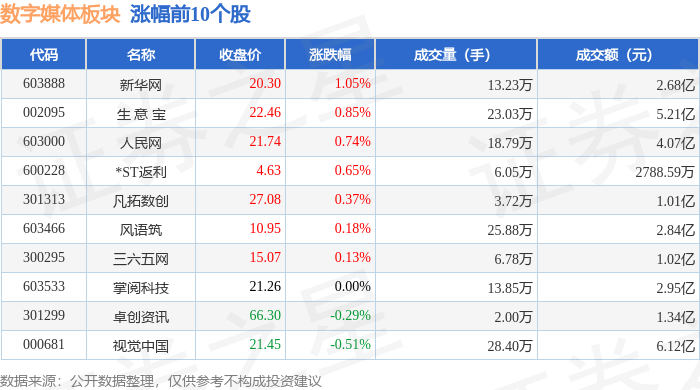
数字媒体板块8月21日跌0.06%,川网传媒领跌,主力资金净流出1.2亿元
Zheng Xing Xing Ye Ri Bao· 2025-08-21 08:38
Market Overview - On August 21, the digital media sector experienced a slight decline of 0.06%, with Chuanwang Media leading the drop [1] - The Shanghai Composite Index closed at 3771.1, up 0.13%, while the Shenzhen Component Index closed at 11919.76, down 0.06% [1] Stock Performance - Notable stock performances in the digital media sector included: - Xinhua Net (603888) closed at 20.30, up 1.05% with a trading volume of 132,300 shares and a turnover of 268 million yuan - Shining Star (002095) closed at 22.46, up 0.85% with a trading volume of 230,300 shares and a turnover of 521 million yuan - People's Daily (603000) closed at 21.74, up 0.74% with a trading volume of 187,900 shares and a turnover of 407 million yuan - Chuanwang Media (300987) closed at 19.49, down 1.22% with a trading volume of 78,100 shares and a turnover of 154 million yuan [1][2] Capital Flow - The digital media sector saw a net outflow of 120 million yuan from institutional investors, while retail investors contributed a net inflow of 113 million yuan [2] - The capital flow for specific stocks included: - People's Daily (603000) had a net inflow of 19.66 million yuan from institutional investors, while retail investors had a net outflow of 10.59 million yuan [3] - Xinhua Net (603888) experienced a net inflow of 16.98 million yuan from institutional investors, with a net outflow of 4.36 million yuan from retail investors [3] - Chuanwang Media (300987) had a net outflow of 18.30 million yuan from institutional investors, while retail investors had a net inflow of 9.26 million yuan [3]




中原证券晨会聚焦-20250821
Zhongyuan Securities· 2025-08-21 00:32
Core Insights - The report highlights a positive outlook for the A-share market, with expectations of a gradual upward trend supported by policy easing and increased capital inflow from residents' savings transitioning to the capital market [9][10][12] - The semiconductor and beverage sectors are leading the market performance, while the automotive industry is experiencing a stable operation despite seasonal fluctuations [6][18] - The gaming, publishing, and IP derivative sectors are identified as promising investment opportunities due to strong fundamentals and favorable policies [14][15][16] Domestic Market Performance - The Shanghai Composite Index closed at 3,766.21, up by 1.04%, while the Shenzhen Component Index rose by 0.89% to 11,926.74 [4] - The average P/E ratios for the Shanghai Composite and ChiNext are 15.25 and 45.20, respectively, indicating a suitable environment for medium to long-term investments [9][10] International Market Performance - Major international indices such as the Dow Jones and S&P 500 experienced slight declines, with the Dow down by 0.67% and the S&P 500 down by 0.45% [5] Industry Analysis - The automotive industry saw a year-on-year growth in production and sales, with July figures showing a production of 259.11 million vehicles, a 13.33% increase year-on-year [18][19] - The gaming sector is expected to benefit from AI applications, with the domestic gaming market reaching new highs in H1 2025 [15][16] - The publishing sector is stable, with a strong demand for educational materials and a focus on high-dividend state-owned companies [17] Investment Recommendations - The report suggests maintaining a "stronger than market" rating for the automotive sector, emphasizing the importance of policy support and technological advancements in smart driving [20] - In the semiconductor industry, the report recommends focusing on domestic AI chip manufacturers due to the increasing demand for localized solutions [34][35] - The gaming and publishing sectors are highlighted for their growth potential, with specific attention to companies that are leveraging AI technology and exploring IP derivative markets [15][16][30]
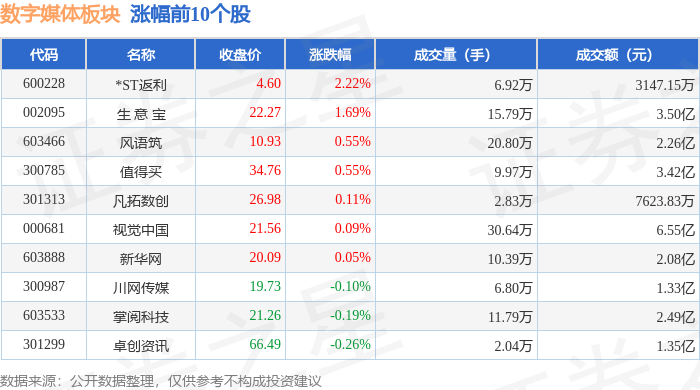
数字媒体板块8月20日跌0.41%,芒果超媒领跌,主力资金净流出2.55亿元
Zheng Xing Xing Ye Ri Bao· 2025-08-20 08:52
证券之星消息,8月20日数字媒体板块较上一交易日下跌0.41%,芒果超媒领跌。当日上证指数报收于 3766.21,上涨1.04%。深证成指报收于11926.74,上涨0.89%。数字媒体板块个股涨跌见下表: | 代码 | 名称 | 主力净流入(元) | 主力净占比 游资净流入 (元) | | 游资净占比 散户净流入(元) | | 散户净占比 | | --- | --- | --- | --- | --- | --- | --- | --- | | 300785 | 值得买 | - 1540.32万 | 4.50% | -742.82万 | -2.17% | -797.50万 | -2.33% | | 600228 | *ST返利 | 738.42万 | 23.46% | -237.24万 | -7.54% | -501.19万 | -15.93% | | 603888 | 新华网 | 545.81万 | 2.63% | -591.11万 | -2.85% | 45.29万 | 0.22% | | 002095 | 生意宝 | -169.49万 | -0.48% | -63.06万 | -0.18% | 232 ...
1.2亿年轻人,让腾讯又发了笔“横财”
3 6 Ke· 2025-08-20 08:34
Group 1 - Tencent's revenue for the first half of 2025 reached 364.53 billion yuan, a year-on-year increase of 14%, leading to a new high in market capitalization in nearly four years [1] - Tencent Music's market capitalization surged to over 30 billion USD, ranking among the top 10 Chinese internet companies [3][4] - Tencent Music's market capitalization increased from around 16 billion USD at the beginning of the year to nearly 40 billion USD, showcasing significant growth [6] Group 2 - Tencent Music faced three major challenges: loss of exclusive copyrights, decline in social entertainment services, and impacts from fan economy regulations [9][12][14] - The company adapted by enhancing monetization strategies for both non-paying and paying users, including advertising and premium membership offerings [17][25] - Tencent Music's revenue for the first half of the year was 15.7 billion yuan, with a net profit of 6.7 billion yuan, outperforming many competitors in the entertainment industry [26] Group 3 - The competitive landscape is intensifying, with ByteDance's products like Tomato Listening and Soda Music gaining traction, posing a challenge to Tencent Music [31][35] - Despite its current leading position, Tencent Music must remain vigilant as new entrants continue to emerge in the music streaming market [37]


“去土味”后短剧迎政策东风,上电视钱从哪来?
Hua Xia Shi Bao· 2025-08-20 05:11
Core Insights - The recent policy by the National Radio and Television Administration encourages the broadcast of high-quality micro-short dramas on television, indicating a significant shift in the industry towards the integration of short dramas into mainstream media [1][2][4] Industry Impact - The policy is expected to alleviate the issue of personnel surplus in television stations by reallocating some staff to short drama production, creating a win-win situation for both production companies and TV stations [4][8] - The micro-short drama market in China has reached a scale of 50.5 billion yuan in 2024, surpassing the box office revenue of films for the first time, with projections indicating growth to 63.43 billion yuan in 2025 and 85.65 billion yuan by 2027, reflecting a compound annual growth rate of 19.2% [2][3] Content Quality and Innovation - The policy aims to enhance content quality and innovation, with a focus on diversifying the themes of short dramas beyond traditional genres, thus enriching the overall content landscape [3][6] - The introduction of a tiered management system for micro-short dramas is intended to promote a focus on quality and standardization within the industry [6] Challenges and Considerations - The adaptation of short dramas for television presents challenges, including the need for adjustments in narrative style and pacing to meet the expectations of traditional TV audiences [7][8] - Financial constraints remain a significant barrier for television stations, particularly for second and third-tier local stations, which may struggle to fund high-quality micro-short drama projects without external support [8]


古装剧相对放开了,影视投资会变多吗?丨消费参考
2 1 Shi Ji Jing Ji Bao Dao· 2025-08-20 01:31
Industry Insights - The National Radio and Television Administration has implemented measures to enhance content supply for television, emphasizing the need for quality content and innovation in programming [1][2] - The new policies will allow for more flexible broadcasting measures for historical dramas, increasing the total number of episodes allowed during prime time from 15% to 30% of the annual total [2] - Historical dramas are identified as a competitive advantage for the Chinese film and television industry, with recent successes like "Ling Jiang Xian" achieving significant advertising metrics [3] Company Performance - Tencent's video platform has seen a decline in paid subscribers, dropping by 3 million to 114 million as of Q2 2025, indicating challenges in the long video content sector [4] - iQIYI reported a 9% year-on-year revenue decline to 7.19 billion yuan in Q1 2025, highlighting a trend of audience loss in long video content over the past few years [5][6] - Despite the new regulations, the overall impact on the film and television industry may be limited, although companies excelling in historical dramas could benefit [7] Market Trends - The broadcasting and television service industry reported a total revenue of 688.41 billion yuan in the first half of 2025, reflecting a year-on-year growth of 5.24% [33]
新政松绑?111部积压剧迎来春天——203亿投资全盘点
3 6 Ke· 2025-08-20 00:50
Core Viewpoint - The recent policy from the National Radio and Television Administration aims to enhance the supply of quality television content, particularly benefiting the drama industry by encouraging creativity and market-driven production [1][6]. Group 1: Impact on the Industry - The new measures are seen as a significant boost for the drama industry, with expectations that long-pending dramas may finally get aired [1][3]. - Companies like Baida Qiancheng, Huace Film & TV, Mango Excellent Media, and others experienced stock price surges due to the news, as they hold a substantial number of backlog dramas [1][3]. - In 2025, 71 backlog dramas are scheduled to be released, a decrease of 36 from the previous year, indicating a trend towards addressing the backlog despite overall declining numbers [3]. Group 2: Financial Implications - There are 111 dramas from 2015 to 2022 that remain unaired, with 36 of them having a combined production cost of approximately 9.071 billion, indicating significant sunk costs in the industry [3][6]. - The total estimated sunk cost for backlog dramas could reach between 16.571 billion to 20.321 billion, highlighting the financial stakes involved [3][6]. Group 3: Challenges and Opportunities - A significant portion of backlog dramas (24%) is delayed due to controversies surrounding key actors, which has led to financial losses for production companies [7][8]. - The industry is exploring various methods to revitalize backlog dramas, including the use of AI technology for actor replacement and selling to secondary platforms [25][31]. - The trend of backlog dramas being sold at low prices (2-5 million per episode) reflects the financial strain on production companies, with many opting for revenue-sharing models to recoup costs [6][29]. Group 4: Market Dynamics - The market has seen a structural transformation, with a previous surge in production leading to an oversupply of content that is now being addressed through policy changes [15][18]. - The shift towards direct collaboration between platforms and production companies is reducing the role of intermediaries, which may impact the profitability of backlog dramas [32].