五粮液

Search documents
五粮液:以“美酒+美食”新叙事 让中国白酒融入全球餐桌
Xin Hua Cai Jing· 2026-01-19 12:36
高端引领:携手米其林指南对话全球餐饮圈层 2024年9月23日,法国巴黎,五粮液与米其林指南正式缔结全球合作伙伴关系,成为行业唯一米其林指 南全球合作伙伴,开启中国白酒品牌国际化全新探索。签约落地后,五粮液系统性嵌入"顶级美酒搭配 世界多元美食"的核心场景,实现了中国白酒与全球顶级餐饮资源的深度对接。 当长江之头的千年浓香邂逅全球餐桌的多元风味,中国白酒龙头企业五粮液正以"美酒+美食"的创新融 合模式,重塑中国白酒的全球叙事。 2025年,在行业消费结构与市场格局加速变革的背景下,五粮液深耕全球布局、拓展多元场景、传递东 方文化,开辟出一条兼具高度、深度与温度的国际化新路径,让"大国浓香"跨越国界,深度融入全球生 活方式。 除了携手米其林指南实现高端破圈外,五粮液还以"五粮液大酒家"与"五粮·炙造"新潮体验店的双轨布 局,让"大国浓香"从高端宴席下沉至日常场景,与米其林指南合作形成互补,构建从高端宴请到日常消 费、从经典传承到潮流表达的全场景覆盖体系,推动"大国浓香"融入多元生活场景。 在海外市场,五粮液大酒家成为文化传播与情感交流的重要窗口。2025年9月,继日本东京、中国香港 之后,新加坡五粮液大酒家正式 ...

白酒市场零售价格持续下探
Zheng Quan Ri Bao Wang· 2026-01-19 12:34
Group 1 - The core viewpoint of the articles indicates that the Chinese liquor market, particularly the baijiu segment, is experiencing significant price declines and a shift from high growth to deep adjustment due to changing market demand structures and increased competition [1][2][3][4] - As of January 19, 2026, the retail prices of major baijiu brands have dropped significantly, with Feitian Moutai down 30.63% to 1540 yuan per bottle and Wuliangye down 10.53% to 850 yuan per bottle compared to early 2025 [1] - The overall revenue and net profit of 20 A-share listed baijiu companies fell by 5.90% and 6.93% respectively in the first three quarters of 2025, with cash flow from operating activities down 20.85% [2] - Inventory pressure is rising, with total inventory increasing by 11.32% year-on-year to 170.686 billion yuan, indicating a transition from high growth to deep adjustment in the baijiu industry [2] Group 2 - In response to market pressures, companies like Kweichow Moutai and Wuliangye are actively lowering prices to reduce inventory, with Moutai's products seeing price cuts of over 1000 yuan [3] - The changing consumption patterns, particularly among younger consumers, are leading to a decline in traditional high-end consumption, making price reductions an irreversible trend in the industry [3][4] - Goldman Sachs predicts that the baijiu industry may find a bottom in the second half of 2026, driven by a recovery in high-end banquet and business demand, although financial pressures are expected to intensify in the first half of 2026 [4] - The industry is expected to undergo a transformation towards high-quality development, focusing on high cost-performance products, targeting emerging consumer groups, and leveraging digital technology for better channel management [4]

2026年食品饮料行业投资策略报告:筑底修复为主线,结构分化藏良机-20260119
Wanlian Securities· 2026-01-19 11:02
Group 1 - The core viewpoint of the report indicates that the food and beverage industry experienced a downturn in performance and stock prices in 2025, with revenue growth slowing and net profit declining for the first time [2][16][23] - The food and beverage sector's revenue for the first three quarters of 2025 was 831.395 billion yuan, a year-on-year increase of only 0.14%, while net profit decreased by 4.57%, ranking 20th and 21st among 31 industries respectively [16][20] - The stock prices of the food and beverage sector fell by 4.72% from January to November 2025, placing it at the bottom of the performance rankings among the 31 industries [23][27] Group 2 - In the liquor industry, the report notes that channel destocking and low valuations combined with high dividend yields provide support for stock prices, despite a challenging environment due to policy impacts [3][36] - The report predicts that the white liquor industry will enter a "volume-price double kill" phase, characterized by intensified competition and market consolidation [3][36] - The report highlights that the beer sector is expected to see marginal improvements in 2026 due to cost advantages and a recovery in on-premise consumption [4][36] Group 3 - The dairy sector is experiencing a recovery in demand, with low-temperature and deep-processed dairy products showing positive growth, while the overall profitability of dairy companies varies significantly [4][9] - The condiment industry is evolving towards customization driven by the rise of chain restaurants and strong retail channels, with a focus on companies that can meet tailored demands [4][9] - The frozen food sector is expected to return to positive growth as price wars ease, with companies like Anji actively exploring new sales channels [4][9] Group 4 - The soft drink market is primarily driven by functional beverages, which are seen as a high-growth segment, while the overall market growth is expected to rely on structural upgrades [4][9] - The snack industry is facing challenges with "revenue without profit," and companies with health-oriented products and strong channel advantages are recommended for attention [4][9]




五粮液1月19日大宗交易成交200.22万元
Zheng Quan Shi Bao Wang· 2026-01-19 10:08
(原标题:五粮液1月19日大宗交易成交200.22万元) 五粮液1月19日大宗交易平台出现一笔成交,成交量1.90万股,成交金额200.22万元,大宗交易成交价为 105.38元,相对今日收盘价溢价0.79%。该笔交易的买方营业部为光大证券股份有限公司宁波柳汀街证 券营业部,卖方营业部为光大证券股份有限公司宁波柳汀街证券营业部。 进一步统计,近3个月内该股累计发生4笔大宗交易,合计成交金额为2.33亿元。 两融数据显示,该股最新融资余额为59.99亿元,近5日增加1.25亿元,增幅为2.13%。 据天眼查APP显示,宜宾五粮液股份有限公司成立于1998年04月21日,注册资本388160.8005万人民 币。(数据宝) 1月19日五粮液大宗交易一览 注:本文系新闻报道,不构成投资建议,股市有风险,投资需谨慎。 证券时报•数据宝统计显示,五粮液今日收盘价为104.55元,下跌0.58%,日换手率为0.47%,成交额为 19.08亿元,全天主力资金净流出1.74亿元,近5日该股累计下跌3.68%,近5日资金合计净流出7.42亿 元。 | | 成交金 | | 相对当 日 | | | | --- | --- | -- ...
渠道商谈今年“春节档”白酒销售情况:会比平时好一些,但和往年没法比
Sou Hu Cai Jing· 2026-01-19 09:57
Core Insights - The white liquor market is expected to see better sales during the 2026 Spring Festival compared to regular periods, but it will not match previous years' performance [1] - Key issues in the 2025 market include high inventory levels and price inversion, with manufacturers and channels focusing on destocking as the market shows signs of recovery, albeit weakly [1] Group 1: Market Trends - The 2025 Spring Festival sales are anticipated to be influenced by low-alcohol beverages, instant retail, and health wines, although these segments may not dominate due to the unique consumption patterns during the festival [1] - The overall market recovery is characterized by a focus on destocking and price stabilization, which will remain the main theme for the industry in 2026 [1] Group 2: Marketing Strategies - Leading liquor companies are ramping up marketing efforts for the Spring Festival, with significant partnerships established for promotional activities, such as collaborations with major broadcasting networks [3][5] - The effectiveness of traditional marketing strategies, such as sponsoring the Spring Festival Gala, may be diminished this year due to changing consumer engagement patterns [6] Group 3: Sales Performance - Sales conversion rates for liquor brands are expected to be lower than in previous years, with analysts predicting a decline of 50-60% compared to the same period last year [6] - Despite increased marketing efforts, the actual sales performance during the Spring Festival is projected to be weaker than in previous years, with many products experiencing price reductions rather than increases [6] Group 4: Consumer Behavior - The extended holiday and revival of banquet scenarios may provide a short-term boost to liquor consumption, but the overall high inventory levels and sluggish sales raise concerns about sustainable growth [7] - Low-alcohol products are likely to see increased consumption during family gatherings, but instant retail may not significantly contribute to sales due to logistical challenges during the holiday [11] Group 5: Health Wine Segment - Health wines have gained popularity, particularly among younger consumers, but concerns about exaggerated health claims may limit their long-term appeal [13] - The health wine market is seen as one of the few segments benefiting from category expansion, although it may not be the primary choice for gift-giving during the Spring Festival [13]

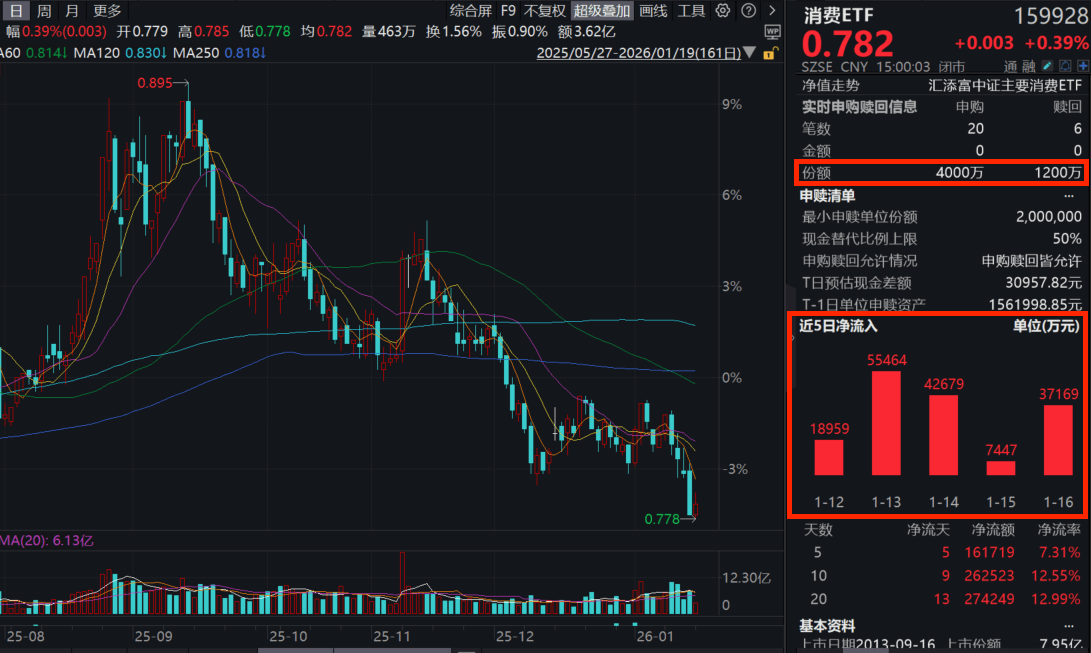
2025年社零同比增长3.7%!消费ETF(159928)收涨0.39%结束四连阴,近5日净流入超16亿元!政策加码下消费动能将持续释放!
Sou Hu Cai Jing· 2026-01-19 09:33
Group 1: Market Performance - A-shares experienced a slight increase with the consumer sector performing well, as evidenced by the leading consumer ETF (159928) rising by 0.39% and achieving a trading volume exceeding 360 million yuan [1] - The consumer ETF has seen a net subscription of 28 million units today, accumulating over 1.6 billion yuan in the past five days [1] Group 2: Economic Data - The National Bureau of Statistics reported that China's GDP for the year reached 14,018.79 billion yuan, reflecting a 5% growth year-on-year at constant prices [3] - In December 2025, the retail sales of consumer goods grew by 0.9% year-on-year, a decrease of 0.4 percentage points compared to November [3] - The per capita disposable income for residents in 2025 was 43,377 yuan, marking a nominal increase of 5% year-on-year, with a real growth of 5% after adjusting for price factors [3] Group 3: Consumer Trends and Policies - The focus on enhancing service consumption is evident, with a CAGR of approximately 9.6% in per capita service consumption from 2020 to 2024, expected to reach 46.1% of total consumption by 2024 [7] - The government aims to boost domestic demand and has outlined key tasks for 2026, emphasizing the importance of "domestic demand as the main driver" [3][7] - Policies are expected to support sectors such as elderly care, cultural tourism, and sports, with a focus on new consumption scenarios and enhancing service quality [4][8] Group 4: Investment Opportunities - The consumer ETF (159928) is noted for its resilience across economic cycles, with a TTM price-to-earnings ratio of 18.91, which is lower than 99% of the historical data over the past decade [4][9] - The top ten holdings in the consumer ETF account for over 68.55% of its weight, with significant representation from leading liquor brands and agricultural companies [9][10] - The Hong Kong Stock Connect Consumer 50 ETF (159268) is highlighted as an efficient investment vehicle for the consumer sector, particularly appealing to the younger generation [10]


五粮液:顶级“美酒+美食”融入世界餐桌 引领中国白酒全球化新进程
Feng Huang Wang Cai Jing· 2026-01-19 09:17
Core Insights - The collaboration between Wuliangye and the Michelin Guide marks a significant step in the internationalization of Chinese baijiu, positioning it as a high-end beverage that can complement global cuisine [2][3][7] - Wuliangye's presence in over 18 cities worldwide through Michelin events is reshaping perceptions of Chinese baijiu, transforming it from a cultural symbol to a recognized term in global culinary language [2][3][6] Group 1: Global Expansion and Brand Positioning - Wuliangye has become the only global partner of the Michelin Guide, initiating a journey that showcases Chinese baijiu in high-end dining settings across major cities like Tokyo, Singapore, and Paris [2][3] - The brand's strategy includes establishing "Wuliangye Grand Restaurants" in key markets, which serve as experiential hubs that integrate the brand into daily life and culture [3][4] - The Michelin series events have directly engaged approximately 25,000 high-end guests and industry leaders, creating a deep connection between sensory experiences and emotional engagement [7][8] Group 2: Culinary Innovation and Cultural Integration - Michelin chefs are increasingly incorporating Wuliangye into their dishes, highlighting its unique flavor profile that enhances the taste of various cuisines, thus elevating the beverage's status [2][3][6] - The introduction of innovative dishes, such as those created by Chef Yamamoto in Tokyo, showcases the versatility of Wuliangye, blending it with local ingredients to create harmonious flavor experiences [2][3] - Wuliangye's approach to integrating its products into diverse culinary contexts reflects a broader cultural dialogue, enhancing its appeal to both international and domestic consumers [7][8] Group 3: Experiential Marketing and Consumer Engagement - The establishment of "Wuliangye Trendy Drink Stores" and "Grand Restaurants" aims to create a multi-layered experiential network that caters to various consumer segments and preferences [4][6] - The Singapore Grand Restaurant, designed to be a cultural bridge, offers a unique dining experience that combines Chinese culinary heritage with local flavors, attracting a diverse clientele [5][6] - Feedback from consumers and industry professionals indicates a growing appreciation for the innovative pairing of Wuliangye with global cuisines, reinforcing the brand's market position [7][8] Group 4: Sustainable Value Creation - Wuliangye is building a sustainable value chain that connects tasting experiences, cultural recognition, and consumer conversion, ensuring long-term brand loyalty [7][8] - The brand's participation in global events, such as the upcoming Osaka Expo, emphasizes its commitment to cultural exchange and the promotion of Chinese heritage on the world stage [8][9] - The narrative of Wuliangye as a symbol of cultural confidence and innovation is becoming increasingly recognized, contributing to a positive perception of Chinese brands globally [9]
白酒板块1月19日跌0.51%,*ST岩石领跌,主力资金净流出8.5亿元
Zheng Xing Xing Ye Ri Bao· 2026-01-19 08:52
Core Viewpoint - The liquor sector experienced a decline of 0.51% on January 19, with *ST Rock leading the drop, while the Shanghai Composite Index rose by 0.29% and the Shenzhen Component Index increased by 0.09% [1]. Group 1: Market Performance - The liquor sector's main stocks showed mixed performance, with notable declines in major brands such as *ST Rock, Shanxi Fenjiu, and Gujing Gongjiu [2]. - The trading volume for the liquor sector was significant, with major stocks like Wuliangye and Kweichow Moutai recording high transaction amounts of 19.08 billion and 58.34 billion yuan respectively [2]. Group 2: Capital Flow - The liquor sector saw a net outflow of 850 million yuan from institutional investors, while retail investors contributed a net inflow of 221 million yuan [2]. - Individual stocks like Yingjia Gongjiu and Jianshe Liquor experienced varying levels of net inflow and outflow from different investor categories, indicating diverse investor sentiment [3].
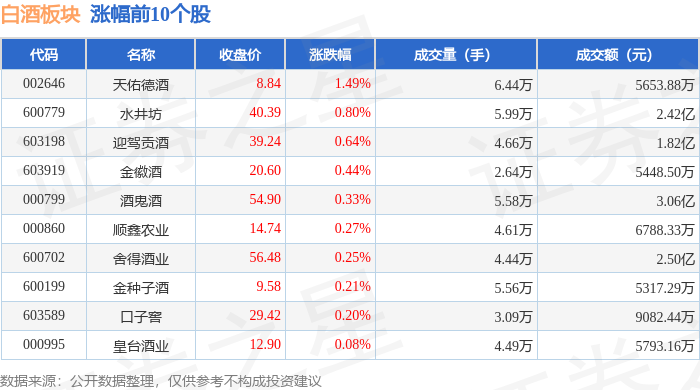
10只白酒股上涨 贵州茅台1376元/股收盘
Bei Jing Shang Bao· 2026-01-19 07:57
Core Viewpoint - The white liquor sector is showing signs of stabilization, with the current market conditions indicating that the industry fundamentals are nearing a bottom, despite recent price declines [1] Industry Summary - The Shanghai Composite Index closed at 4114.00 points, up 0.29%, while the white liquor sector index closed at 2214.03 points, up 0.74% [1] - Ten white liquor stocks experienced gains, but major players like Kweichow Moutai, Wuliangye, Shanxi Fenjiu, Luzhou Laojiao, and Yanghe all saw declines in their stock prices [1] - Kweichow Moutai closed at 1376.00 CNY per share, down 0.43%; Wuliangye at 104.55 CNY, down 0.58%; Shanxi Fenjiu at 169.36 CNY, down 1.75%; Luzhou Laojiao at 113.59 CNY, down 0.60%; and Yanghe at 61.99 CNY, down 0.02% [1] Company Insights - According to a report from Kaiyuan Securities, the white liquor industry is expected to see a recovery in sales during the 2026 Spring Festival, despite the current downward trend in prices [1] - The report emphasizes the importance of monitoring economic recovery, consumer confidence restoration, and the flexibility of brand policy adjustments in the medium to long term [1] - The current valuation of the white liquor sector is at a low point compared to recent years, with low market expectations and a favorable chip structure, indicating that the fundamentals are close to a bottom [1]
大变革时代的白酒行业如何发展?
Sou Hu Cai Jing· 2026-01-19 07:47
Core Insights - The Chinese liquor industry is facing both challenges and opportunities in the current transformative era, necessitating a reevaluation of its development strategies [1] Group 1: Consumer Trends - Consumers are increasingly prioritizing health, leading to a decline in the market share of high-alcohol, strong-flavored liquors. The market growth rate for low-alcohol and health-oriented liquors is rising annually [3] - Companies are encouraged to develop lower-alcohol and healthier liquor products to align with consumer preferences, as exemplified by Jiangxiaobai's introduction of a lower-alcohol product targeting younger consumers [3] Group 2: Marketing Strategies - Traditional marketing methods are becoming less effective; online shopping has emerged as a significant channel for liquor purchases. Companies should enhance their online marketing efforts through e-commerce platforms and social media [5] - Notable brands like Moutai and Wuliangye have established official flagship stores on e-commerce platforms and utilized live streaming and online promotions to attract consumers [5] Group 3: Cultural Integration - The liquor industry must balance the preservation of traditional culture with innovative integration. Companies can leverage historical stories and cultural references in product packaging and branding [7] - Collaborations with other cultural sectors, such as film, music, and art, can create unique liquor brands that resonate with modern consumers, as seen with Luzhou Laojiao's partnership with a fashion brand [7] Group 4: Industry Outlook - The liquor industry must adapt to changing consumer demands for health and youthfulness by developing new products, embracing online marketing, and merging traditional culture with contemporary elements [7] - Continuous adaptation to market changes is essential for the liquor industry to remain competitive and thrive in the future [7]