比亚迪

Search documents
刚刚,深圳上市公司达600家!
Shen Zhen Shang Bao· 2026-02-06 01:42
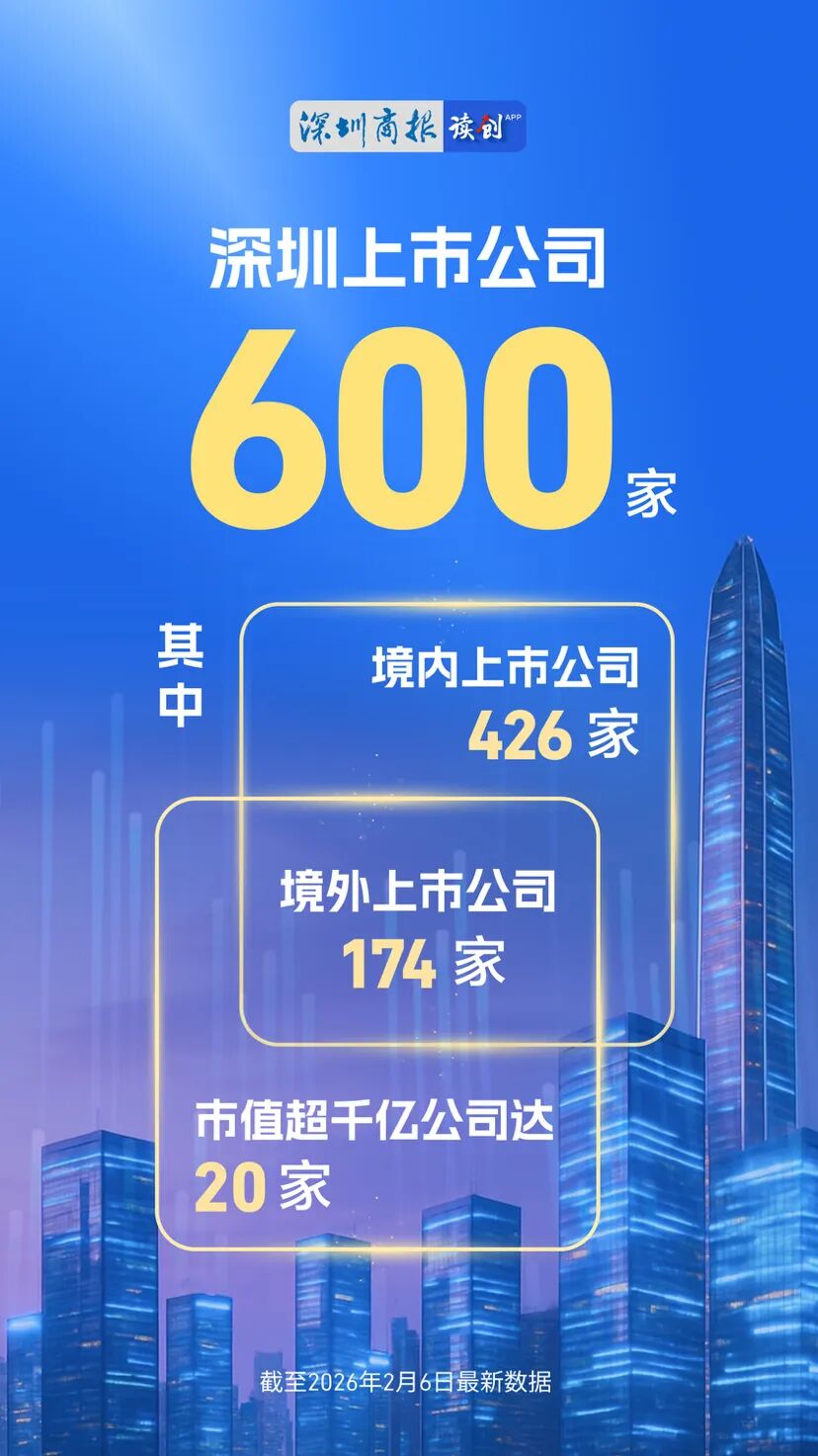
2月6日上午,随着卓正医疗,大族数控(301200)在港股敲钟上市,宣告深圳迎来了里程碑时刻:全市上市公司总量突破600家大关,其中,境内上市公 司426家,境外上市公司174家。 这不仅是一个数字的跨越,更是一座城市实体经济活力、创新动能与金融生态深度融合的生动映照,同时也是深圳在全球产业链中地位提升、新质生产力 加速形成、以及"科技-产业-金融"高效循环生态日臻成熟的集中体现。 600家上市公司,构成了一座城市经济无比生动的"基本盘"和"晴雨表"。截至2025年1月末,深圳上市公司总市值超19万亿元,稳居全国大中城市第二位。 600家上市公司的构成,清晰地映照出深圳经济结构的韧性与高度。境内上市公司在"十四五"期间增长超35%,龙头企业的牵引力与辐射力日益增强。 更为引人注目的是"新面孔"所蕴含的产业风向标意义。其中,北芯生命作为科创板医疗器械第五套上市标准重启后的"首例",大普微以未盈利之身闯关创 业板成功,惠科股份率先试水深市主板第二套上市标准……这些"首单""首家"不仅是企业的荣光,更是深圳积极拥抱资本市场改革、精准对接前沿科技创 新脉搏的缩影。从市值突破千亿的"智能影像第一股"的影石创新,到重新定 ...


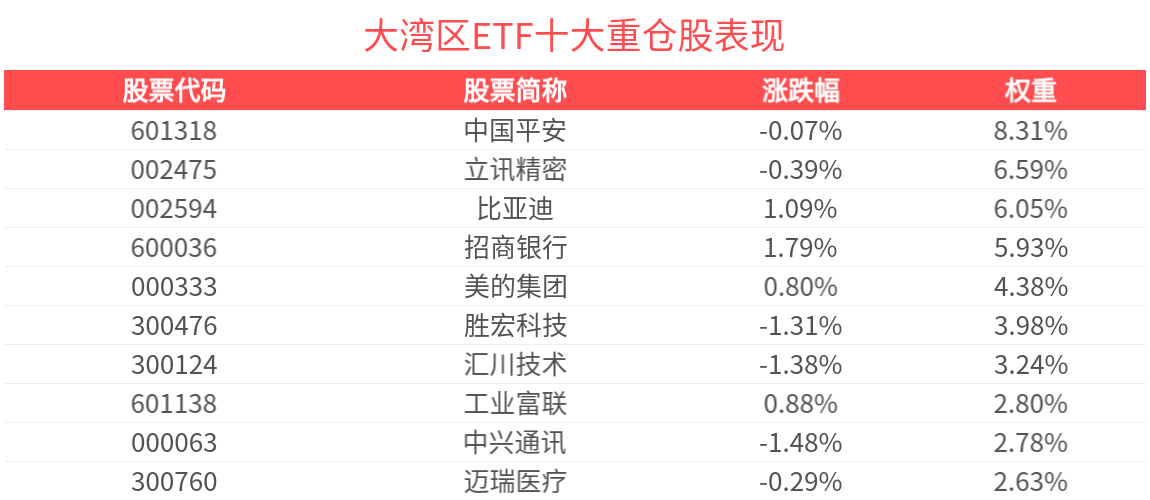
中证粤港澳大湾区发展主题指数下跌0.74%,大湾区ETF(512970)成立以来超越基准年化收益达3.32%
Xin Lang Cai Jing· 2026-02-06 01:40
Core Viewpoint - The performance of the China Securities Guangdong-Hong Kong-Macao Greater Bay Area Development Theme Index and its related ETF reflects the market dynamics and investment opportunities within the Greater Bay Area, with notable fluctuations in constituent stocks and overall index performance [1][2]. Group 1: Index Performance - As of February 5, 2026, the China Securities Guangdong-Hong Kong-Macao Greater Bay Area Development Theme Index (931000) decreased by 0.74% [1]. - The Greater Bay Area ETF (512970) also saw a decline of 0.47%, with the latest price at 1.5 yuan [1]. - Over the past six months, the Greater Bay Area ETF has accumulated a rise of 15.97% [1]. Group 2: Stock Performance - Among the constituent stocks, Huayin Securities led with a gain of 10.02%, while Jiejia Weichuang experienced the largest drop at 12.39% [1]. - The top ten weighted stocks in the index account for 44.55% of the total index weight, with China Ping An, Luxshare Precision, and BYD being the top three [2]. Group 3: Trading and Liquidity - The trading volume for the Greater Bay Area ETF was 57.35 million yuan, with an intraday turnover rate of 0.66% [1]. - The average daily trading volume over the past week was 99.55 million yuan [1]. Group 4: Risk and Return Metrics - The maximum drawdown for the Greater Bay Area ETF this year is 5.52%, with a relative benchmark drawdown of 0.02% [1]. - The ETF's Sharpe ratio over the past year is reported at 1.51 [1]. - The tracking error for the ETF over the last three months is 0.022% [1].
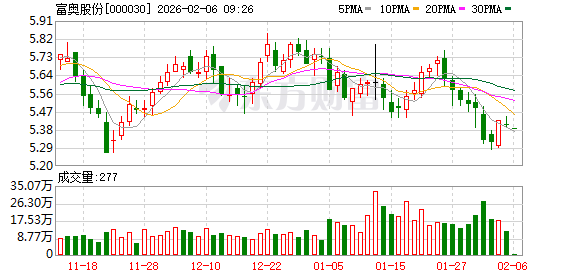
富奥股份:除一汽集团外,公司客户已覆盖奇瑞、吉利、长安等整车企业,以及赛力斯、蔚来等新能源车企
Mei Ri Jing Ji Xin Wen· 2026-02-06 01:25
Core Viewpoint - The company, Fu'ao Co., Ltd., emphasizes its independence as a publicly listed entity and its commitment to market-oriented operations, stating that it is not limited to supplying only to FAW Group and has a diverse customer base in the automotive industry [2]. Group 1: Customer Base and Orders - Fu'ao Co., Ltd. has established a customer base that includes major automotive manufacturers such as Chery, Geely, Changan, BYD, Great Wall, as well as new energy vehicle companies like Seres, NIO, Xpeng, and Leap Motor [2]. - In 2024, the company secured 307 new orders, with 142 of these from external markets, resulting in external order revenue accounting for 48% of total revenue, and over 80% of these orders being in the new energy sector [2]. - For the first half of 2025, the company obtained 141 new orders, with 62 from external markets, leading to external order revenue making up 44% of total revenue, and over 70% of these orders being in the new energy sector [2]. Group 2: Strategic Initiatives - The company has been progressively increasing its external market revenue share, indicating a continuous optimization of its revenue structure and diversification [2]. - Fu'ao Co., Ltd. is advancing its large chassis integration strategy, focusing on expanding its presence in the new energy sector and external markets through acquisitions of core assets, concentrating on its main business development, and laying out plans in forward-looking fields to enhance its core competitiveness in new energy [2]. - The company aims to further promote product structure upgrades and improve profitability while seizing opportunities in the electric and intelligent development of the automotive industry [2].


比亚迪1月份德国市场销量同比增超10倍 出口持续保持强势
Zheng Quan Ri Bao Wang· 2026-02-06 01:16
根据KBA(德国联邦汽车运输管理局)最新发布的数据,比亚迪2026年1月份在德国售出2629辆新车,远 高于2025年同期的235辆,同比增长10.18倍。在2025年,比亚迪在德国的乘用车注册数量达到23306 辆,相较于2024年的2891辆增长超7倍。 在英国,据SMMT(英国汽车制造商与贸易商协会)数据,比亚迪1月份新能源汽车注册量达4021辆,同 比增长149.13%。 这是比亚迪海外销量增长的一个缩影。目前比亚迪新能源车已遍布全球6大洲、110多个国家和地区,海 外市场全面开花,并推动欧洲、拉美、亚太等主要区域的新能源汽车渗透率提升,同时更高的盈利能力 使海外业务成为公司持续高速高质增长的新引擎。 比亚迪(002594)股份有限公司(以下简称"比亚迪")在海外市场保持攻势。 2025年,比亚迪海外年销量首次突破100万辆,同比增长超140%,推动中国汽车出海再创新高。进入 2026年,这一增速不减。根据比亚迪近日公布的2026年1月份产销快报,公司1月份出口新能源汽车合计 10.05万辆,相较于2025年1月份6.63万辆的海外销量,增长幅度超过50%。 "海外销量的增长将进一步巩固比亚迪在全球新 ...
锐新科技归母净利三连降拟重组突围 安徽国资7.25亿入主速推资产证券化
Chang Jiang Shang Bao· 2026-02-06 00:08
易主安徽国资半年后,锐新科技(300828)(300828.SZ)的资本运作来了。 2月4日晚,锐新科技发布公告称,公司正在筹划以发行股份及支付现金方式购买资产并募集配套资金事 项,预计本次交易可能构成重大资产重组。 2025年前三季度,锐新科技实现的归母净利润为0.28亿元,同比下降26.14%。公司同期归母净利润已经 三连降。 锐新科技经营业绩增长承压,亟待突围。 公开信息显示,锐新科技前身为天津锐新电子热传技术有限公司,系由天津市诺森工贸有限公司、北方 (天津)挤压模具制造有限公司和自然人王静共同出资设立。2020年4月,锐新科技通过闯关IPO方式登陆 A股市场。 截至目前,锐新科技专业从事工业精密铝合金部品及部件的研发、生产和销售,主要产品为电气自动化 设备元器件、汽车轻量化及汽车热管理系统部品及部件。 锐新科技的市场定位为,专注于服务全球领先的高端工业客户。在电气自动化领域,公司主要客户为 ABB、施耐德、西门子、丹佛斯、罗克韦尔等国际知名变频器制造商及风力发电设备龙头企业维斯塔 斯;在汽车轻量化及汽车热管理系统领域,锐新科技的主要客户包括丰田、本田、吉利、沃尔沃、奥 迪、宝马、比亚迪(002594 ...

多家车企官宣2026销量目标:冷静预期中仍有激进派,密集发新车支撑增量
Xin Lang Cai Jing· 2026-02-05 23:57
Core Viewpoint - The automotive industry is entering a slow growth phase, leading companies to set more conservative sales targets for 2026 compared to previous years' aggressive goals [1] Group 1: Sales Targets and Growth Expectations - Multiple automakers have announced their sales targets for 2026, with a general trend of more cautious expectations [1] - Leap Motor and Xiaomi Auto have higher growth expectations, but they do not project the aggressive "doubling" of sales seen in previous years [1] - Dongfeng Motor, which did not meet its 2025 sales target, has set an ambitious growth target of over 30% for 2026 [1] - Geely Auto aims for a sales target of 3.45 million units in 2026, representing a 14% increase from 2025 [2] - Changan Auto has set a target of 3.3 million units for 2026, a 13.3% increase, with a significant focus on electric vehicles [2] - Chery Group targets 3.2 million units, a 14.03% increase from 2025 [2] - Dongfeng Motor's 2026 target is 3.25 million units, with a 31.45% increase from its 2025 performance [3] - Great Wall Motors has lowered its target to 1.8 million units but still expects a 36% increase from 2025 [4] Group 2: New Energy Vehicle (NEV) Focus - Geely expects NEV sales to rise to 2.22 million units in 2026, accounting for 64% of total sales, a 32% increase from 2025 [2] - Changan anticipates NEV sales of 1.4 million units in 2026, a 26.2% increase [2] - Dongfeng aims for 1.7 million NEV sales in 2026 [3] Group 3: New Product Launches - Automakers are focusing on new product launches to stimulate market demand, with several companies planning multiple new models [5][7] - NIO plans to release five new models, while Leap Motor will introduce four new models [5] - Xiaomi Auto is set to launch several new vehicles, including the next-generation SU7 [5] - Traditional automakers like Changan and BYD are also planning numerous new product releases [7] Group 4: Industry Challenges - Experts warn that rapid product iteration may erode profit margins due to high R&D and production costs [8] - The automotive industry's sales profit margin was reported at 4.1% in 2025, the lowest in history, indicating increasing survival pressures for manufacturers [8]


X @Bloomberg
Bloomberg· 2026-02-05 23:52
A relentless selloff in BYD shares is laying bare investor anxiety over the profit outlook for China’s EV sector, as cooling demand at home and surging raw material costs trigger a brutal reset of expectations https://t.co/FRwt8ZDwTu ...
出口突破832万辆,究竟是谁在狂买中国车?
商业洞察· 2026-02-05 23:05
Core Viewpoint - In 2025, China's automobile exports reached 8.324 million units, a year-on-year increase of 29.9%, with export value at $142.46 billion, up 21.4%, indicating a significant global presence of Chinese automobiles [2][3]. Group 1: Who is Selling - The leading exporters are the "Big Three": Chery, SAIC, and BYD, with Chery exporting over 1.34 million units, SAIC's MG brand selling 1.07 million units, and BYD surpassing 1 million units for the first time [3]. - The second tier includes Great Wall, Changan, and Geely, with Great Wall establishing factories in Russia and Thailand, and Changan making strides in Mexico and Chile [6]. - The third tier consists of new energy vehicle manufacturers and commercial vehicle producers, with NIO and Xpeng targeting high-end markets in Germany and Norway, while Yutong and BYD dominate the global electric bus market [6]. Group 2: Market Trends - Chinese automakers are diversifying their export strategies, avoiding political entanglements with the West by establishing local production in countries like Mexico and Hungary [6]. - The exported vehicles are often tailored to local markets rather than being the most expensive models from China, with plug-in hybrid vehicles making up 13% of total exports, indicating a shift towards practical solutions [6][7]. - The popularity of plug-in hybrids is attributed to the lack of fast-charging infrastructure in 90% of countries, making them a suitable transitional technology [7]. Group 3: Export Destinations - The export market is diversified, with Asia, Europe, and Latin America as the main regions, and Mexico, Russia, and the UAE being the top three destinations for Chinese vehicle exports [7]. - The U.S. tariffs on Chinese electric vehicles have led companies to establish production in Mexico to circumvent these barriers, allowing vehicles to be exported to the U.S. duty-free [8]. - In Russia, the exit of Western automakers due to the Ukraine conflict has created a market gap that Chinese companies are rapidly filling, capturing over 51% of the new car market share [8]. Group 4: Defining Future Standards - The narrative around automotive standards is shifting from traditional German and Japanese benchmarks to a new "Chinese standard," focusing on innovative solutions to global challenges [9].


富士康为何重仓河南
He Nan Ri Bao· 2026-02-05 22:40
如今,研发中心的投用,不仅标志着其战略布局在河南的实质性推进,也更加明确了如今富士康与河南 的关系——早已超越简单的投资与设厂,演变成一场面向未来的深度协同与双向奔赴。 曾经,富士康作为全球电子代工龙头企业,凭借郑州基地撑起河南外贸"半壁江山"。但随着全球产业链 重构、人力成本上升及消费电子市场饱和,其传统代工模式面临挑战。 2月4日,富士康新能源汽车研发中心在郑州航空港正式投用。这一动作再次为"富士康要离开河南"画上 休止符:非但没有撤离,反而将代表未来的核心产业更深地扎根于中原腹地。 事实上,富士康与河南的联结正变得前所未有的紧密。2024年7月,富士康投资10亿元在郑州建设新事 业总部,加速布局其以新能源汽车、储能为代表的"3+3"战略产业,意在为河南再造一个"新富士康"。 然而,真正的故事并非"撤离",而是"升级"。在产业迭代的关键转型期,富士康为何会选择对河南"持 续加仓"? □郭晓霞 这源于双方发展的精准契合与共同需要。对富士康而言,开辟新能源汽车"第二曲线"是转型关键。河南 拥有国内领先的汽车产业链基础、"铁公机水"四位一体的运输体系、成熟的产业人才池以及有力的政策 支持,这些优势条件让河南成为 ...
“广货行天下”需瞄准三大市场
2 1 Shi Ji Jing Ji Bao Dao· 2026-02-05 22:23
Core Viewpoint - The development of service consumption is crucial for China's economic growth, with a significant gap compared to developed countries, indicating a vast potential for growth in this sector [2][3] Group 1: Service Consumption Trends - By 2025, the proportion of per capita service consumption expenditure in China is expected to reach 46.1%, while developed countries typically exceed 60%, with some even over 70% [2] - It is predicted that during the 14th Five-Year Plan period, service consumption will account for over 50% of total consumption, marking an irreversible trend [2] Group 2: Relationship Between Service and Goods Consumption - Both service and goods consumption are essential for expanding domestic demand, with service consumption focusing on growth and goods consumption on quality improvement [3] - The tourism sector exemplifies this relationship, with over 6.5 billion domestic tourist trips expected by 2025, highlighting the interconnectedness of service and goods consumption [3] Group 3: Market Opportunities for "Guangdong Goods" - The overseas market presents new opportunities for Guangdong goods, transitioning from low-margin exports to high-quality brand exports, particularly in emerging markets like Southeast Asia and Europe [4] - The Guangdong-Hong Kong-Macao Greater Bay Area, with over 80 million residents, serves as a significant market for both high-end and cost-effective products, providing a testing ground for product optimization [4] - The untapped potential in lower-tier markets, particularly in rural areas, offers significant opportunities for Guangdong goods, focusing on quality-price ratios rather than premium pricing [4] Group 4: Future Directions for Guangdong Goods - Future consumption trends are expected to lean towards intelligence, sustainability, differentiation, and emotional connection, where Guangdong has competitive advantages [5] - Guangdong's digital economy and advancements in AI and IoT are leading to innovative products, while the focus on green products aligns with global consumption trends [5] - The integration of local cultural elements into products enhances emotional value, appealing to younger consumers [5]