中国石油

Search documents
中东局势不确定性加大,油价短期震荡偏强
Ping An Securities· 2026-01-18 12:08
Investment Rating - The report maintains a "Strong Buy" rating for the oil and petrochemical sector [1]. Core Viewpoints - The uncertainty in the Middle East has increased, leading to a short-term strong fluctuation in oil prices. WTI crude futures closed up by 1.02% and Brent oil futures by 1.87% during the week of January 9 to January 16, 2026 [6]. - Geopolitical tensions, particularly involving Iran and the U.S., are significant factors affecting oil prices. Iran's oil inventory has reached record levels, equivalent to about 50 days of production, due to Western sanctions [6]. - The fluorochemical sector is expected to maintain high prosperity due to supply quota constraints and favorable demand driven by policy support. The production quota for HFCs in 2026 has increased by 5,963 tons year-on-year [6]. Summary by Sections Oil and Petrochemical - The report highlights the increased uncertainty in the Middle East, which is likely to impact oil prices in the short term. The geopolitical situation, including U.S. sanctions and military movements, is a critical factor [6][7]. - The report notes that domestic oil companies are diversifying their oil sources and integrating upstream and downstream operations to mitigate the impact of volatile international oil prices [7]. Fluorochemical - The fluorochemical sector is experiencing a favorable environment due to supply constraints and policy-driven demand. The production quotas for HFCs have been adjusted, with significant increases in specific categories [6][7]. - The report indicates that the demand for refrigerants is expected to grow, supported by national subsidy policies, with production of household air conditioners projected to increase by 11% year-on-year in January 2026 [6]. Semiconductor Materials - The semiconductor materials sector is on an upward cycle, with improving fundamentals and domestic substitution trends. The report suggests that there is potential for further price increases in this sector [7].





石油化工行业周报第 436 期(20260112—20260118):地缘局势动荡驱动油价上行,原油供给过剩预期有望改善-20260118
EBSCN· 2026-01-18 11:48
Investment Rating - The report maintains an "Overweight" rating for the oil and petrochemical industry [5] Core Views - Geopolitical tensions, particularly regarding Iran, have driven significant fluctuations in oil prices, providing a favorable backdrop for oil price recovery [1] - OPEC+ is expected to cautiously increase production in 2026, which may help alleviate the oversupply situation in the oil market [2] - Global oil demand is projected to improve, with the chemical raw material demand expected to dominate the growth in 2026 [3] - The report expresses a positive long-term outlook for major Chinese oil companies and the oil service sector, emphasizing their resilience during price fluctuations [4] Summary by Sections Oil Supply and Demand - OPEC forecasts a demand increase of 1.38 million barrels per day in 2026, with a cautious production increase expected to improve the supply-demand balance [2] - The IEA has raised its 2026 global oil demand growth forecast to 860,000 barrels per day, attributing this to improved macroeconomic conditions [3] Price Trends - As of January 16, 2026, Brent and WTI crude oil futures closed at $64.20 and $59.22 per barrel, reflecting increases of 1.9% and 0.7% respectively from the previous week [1] Investment Recommendations - The report recommends focusing on major Chinese oil companies, including China National Petroleum Corporation, Sinopec, and CNOOC, as well as their associated oil service engineering firms [4]
原油周报:伊朗供应忧虑支撑,国际油价震荡上涨-20260118
Soochow Securities· 2026-01-18 08:24
Report Overview - Report Title: Crude Oil Weekly Report: International Oil Prices Fluctuated and Rose Supported by Concerns over Iranian Supply - Report Date: January 18, 2026 - Chief Analyst: Chen Shuxian, CFA - Analyst: Zhou Shaowen 1. Report Industry Investment Rating No industry investment rating information is provided in the report. 2. Report Core View The report mainly presents the weekly data of crude oil and refined oil in the United States, including prices, inventories, production, demand, and import and export volumes. It also provides the performance and valuation of related listed companies, and recommends a number of oil - related companies [2][3]. 3. Summary by Directory 3.1 Crude Oil Weekly Data Briefing - **Upstream Key Company Performance**: The report shows the recent performance of upstream key companies such as CNOOC, PetroChina, and Sinopec, including stock price changes in the past week, month, quarter, year, and year - to - date. It also provides the valuation of these companies, including total market value, net profit attributable to the parent company, P/E ratio, and P/B ratio [8]. - **Crude Oil Market**: Brent and WTI crude oil futures had average weekly prices of $64.8 and $60.3 per barrel respectively, up $3.2 and $2.6 from the previous week. The total US crude oil inventory, commercial crude oil inventory, strategic crude oil inventory, and Cushing crude oil inventory were 8.4 billion, 4.2 billion, 4.1 billion, and 0.2 billion barrels respectively, with a week - on - week increase of 361, 339, 21, and 75 barrels. US crude oil production was 13.75 million barrels per day, down 60,000 barrels per day week - on - week. The number of active US crude oil rigs was 410, up 1 week - on - week, and the number of active fracturing fleets was 156, up 4 week - on - week. US refinery crude oil processing volume was 16.96 million barrels per day, up 50,000 barrels per day week - on - week, and the refinery operating rate was 95.3%, up 0.6 percentage points week - on - week. US crude oil imports, exports, and net imports were 7.09 million, 4.31 million, and 2.79 million barrels per day respectively, up 750,000, 40,000, and 710,000 barrels per day week - on - week [2][8]. - **Refined Oil Market**: The average weekly prices of US gasoline, diesel, and jet fuel were $76, $92, and $89 per barrel respectively, with a week - on - week change of +$3.0, +$3.5, and -$5.1. The inventory of US gasoline, diesel, and jet fuel was 250 million, 130 million, and 40 million barrels respectively, with a week - on - week change of +8.98 million, -30,000, and -890,000 barrels. The production of US gasoline, diesel, and jet fuel was 9.03 million, 5.3 million, and 1.85 million barrels per day respectively, with a week - on - week change of +30,000, -20,000, and -20,000 barrels. The consumption of US gasoline, diesel, and jet fuel was 8.3 million, 4.1 million, and 1.88 million barrels per day respectively, with a week - on - week change of +130,000, +900,000, and +180,000 barrels. The import, export, and net export of US gasoline were 130,000, 860,000, and 730,000 barrels per day respectively, with a week - on - week change of +30,000, -110,000, and -130,000 barrels. Similar data is also provided for diesel and jet fuel [2][9]. - **Oil Service Market**: The average weekly daily rates of self - elevating offshore drilling platforms and semi - submersible offshore drilling platforms remained unchanged week - on - week, month - on - month, and quarter - on - quarter [9]. 3.2 This Week's Petroleum and Petrochemical Sector Market Review - **Petroleum and Petrochemical Sector Performance**: The report presents the performance of the petroleum and petrochemical sector, including the sector's overall performance and the performance of its sub - industries. However, specific numerical data is not fully presented in the provided text [11]. - **Listed Company Performance in the Sector**: The report shows the stock price changes of upstream companies in the sector, including CNOOC, PetroChina, Sinopec, and other companies, in the past week, month, quarter, year, and year - to - date. It also provides the valuation of these companies, including total market value, net profit attributable to the parent company, P/E ratio, and P/B ratio [22][23]. 3.3 Crude Oil Sector Data Tracking - **Crude Oil Price**: The report shows the prices of various crude oils such as Brent, WTI, Russian Urals, and Russian ESPO, as well as their price differences. It also analyzes the relationship between the US dollar index, LME copper price, and WTI crude oil price [8][9]. - **Crude Oil Inventory**: It presents the inventory data of US crude oil, including total inventory, commercial inventory, strategic inventory, and Cushing inventory, and analyzes the relationship between US commercial crude oil inventory and oil prices [8][41]. - **Crude Oil Supply**: It shows the production data of US crude oil, including production volume, the number of drilling rigs, and the number of fracturing fleets, and analyzes the relationship between the number of drilling rigs, fracturing fleets, and oil prices [8][60]. - **Crude Oil Demand**: It presents the crude oil processing volume and operating rate of US refineries, as well as the operating rates of Chinese local and major refineries [8]. - **Crude Oil Import and Export**: It shows the import, export, and net import data of US crude oil and petroleum products [8]. 3.4 Refined Oil Sector Data Tracking - **Refined Oil Price**: It analyzes the relationship between international oil prices and domestic gasoline, diesel, and jet fuel prices, and presents the prices and price differences of refined oils in different regions such as the US, Europe, and Singapore [9][91]. - **Refined Oil Inventory**: It shows the inventory data of US and Singapore gasoline, diesel, and jet fuel [9]. - **Refined Oil Supply**: It presents the production data of US gasoline, diesel, and jet fuel [9]. - **Refined Oil Demand**: It shows the consumption data of US gasoline, diesel, and jet fuel, as well as the number of airport security checks of US passengers [9][150]. - **Refined Oil Import and Export**: It shows the import, export, and net export data of US gasoline, diesel, and jet fuel [9]. 3.5 Oil Service Sector Data Tracking The report presents the average daily rates of self - elevating and semi - submersible offshore drilling platforms [9]. 3.6 Related Listed Companies - **Recommended Companies**: CNOOC/China National Offshore Oil Corporation (600938.SH/0883.HK), PetroChina/PetroChina Company Limited (601857.SH/0857.HK), Sinopec/China Petroleum & Chemical Corporation (600028.SH/0386.HK), CNOOC Energy Technology & Services Limited (601808.SH), Offshore Oil Engineering Co., Ltd. (600583.SH), CNOOC Development Co., Ltd. (600968.SH) [3]. - **Companies to Watch**: Sinopec Oilfield Service Corporation (600871.SH/1033.HK), China Petroleum Engineering & Construction Corporation (600339.SH), Sinopec Machinery Co., Ltd. (000852.SZ) [3].
基础化工行业周报(20260112-20260116):“AI+“赋能化工研发制造,26 年小核酸药物迎快速增长期-20260117
EBSCN· 2026-01-17 14:34
Investment Rating - The report maintains an "Overweight" rating for the basic chemical industry [6] Core Insights - The integration of "AI+" in the chemical industry is being driven by national policies aimed at enhancing quality and efficiency through advanced technologies like large models and digital twins [1][2] - The global small nucleic acid drug market is experiencing rapid growth, with projections indicating a market size exceeding $15 billion by 2026, driven by technological breakthroughs and commercialization [3][33] - Key players like Bluestar Technology and Lianhua Technology are leading breakthroughs in small nucleic acid production and CDMO services, respectively [4][36] Summary by Sections AI Integration in Chemical Manufacturing - The chemical industry is advancing towards large-scale application of "AI+" through three main pathways: self-developed large models by leading companies, collaboration with third-party platforms, and investment in AI startups [2][27] - Major companies such as China National Petroleum, Sinopec, and China National Offshore Oil Corporation are embedding AI into core business processes to enhance operational efficiency [2][27] Small Nucleic Acid Drug Market - The small nucleic acid drug market has grown from $0.1 million in 2016 to $3.25 billion in 2021, with a compound annual growth rate (CAGR) of 217.8% [3][33] - The market is expected to continue its growth trajectory, with a forecasted CAGR of 35% from 2020 to 2025 [3][33] Key Players and Innovations - Bluestar Technology has established a comprehensive technology platform for the synthesis and purification of small nucleic acids, making it one of only two global suppliers with such capabilities [4][34] - Lianhua Technology is expanding its CDMO services for small nucleic acids, achieving significant progress in international market collaborations [4][36] Investment Recommendations - The report suggests focusing on leading companies in the chemical sector that leverage data for efficiency gains, such as China National Petroleum, Sinopec, and Wanhu Chemical [5][32] - In the small nucleic acid sector, attention is drawn to Bluestar Technology and Lianhua Technology for their strategic positions in the market [5][37]
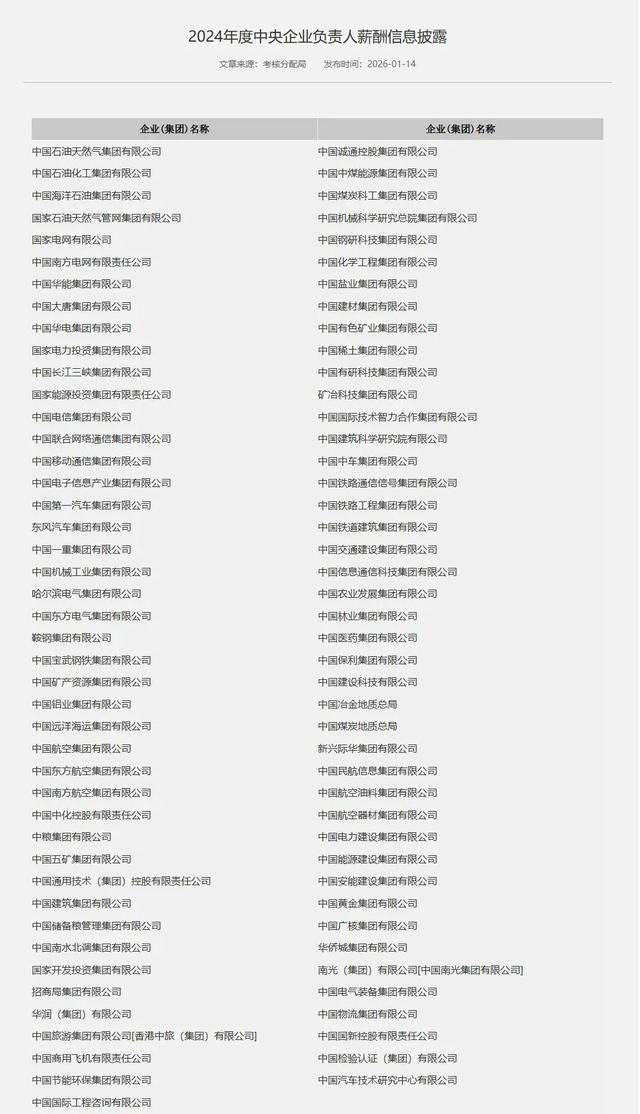
国资委公开80多家央企负责人薪酬
Sou Hu Cai Jing· 2026-01-17 13:14
Core Viewpoint - The State-owned Assets Supervision and Administration Commission (SASAC) disclosed the salary information of over 80 central enterprise leaders for the year 2024, indicating a stable salary range without extreme high salaries, showcasing significant industry differentiation [1][5]. Group 1: Salary Disclosure - The disclosure of salary information is part of SASAC's ongoing efforts to enhance transparency in key areas and respond to public concerns [2]. - The overall salary of central enterprise leaders in 2024 remains within a stable range, characterized by "top leaders leading, median concentration, and low compliance," with no extreme high salary phenomena observed [5]. Group 2: Salary Rankings - The top tier of salaries is dominated by leaders from telecommunications and energy central enterprises, with China Mobile's former chairman Yang Jie leading with a pre-tax salary of 1.2582 million yuan, followed by China Telecom and China Unicom chairmen with salaries of 1.2160 million yuan and 1.2101 million yuan respectively [6]. - In the energy sector, PetroChina's chairman Dai Houliang and general manager Hou Qijun both have an annual salary of 978,500 yuan, ranking first among energy central enterprises [7]. - Other notable salaries include China Huaneng Group's chairman Wen Shugang at 961,700 yuan and State Power Investment Corporation's chairman Yu Bing at 953,700 yuan, both of whom are also in the top tier [8]. Group 3: Salary Distribution - The second tier includes core central enterprises in electricity, construction, and automotive industries, with notable figures such as State Grid's chairman Zhang Zhigang earning 735,000 yuan and China National Nuclear Corporation's chairman Yang Changli earning 930,000 yuan [15]. - The third tier consists of central enterprises with strong public welfare attributes, such as China Forestry Group's chairman Shan Zhongli and Overseas Chinese Town Group's chairman Zhang Zhenggao, both earning 438,500 yuan, which is below the average level for central enterprises [16]. Group 4: Salary Variability - Within the same industry, the salary differences among central enterprise executives are manageable, with the highest annual salary for energy central enterprise chairmen (PetroChina at 978,500 yuan) and the lowest (National Pipeline Network at 872,900 yuan) showing a difference of about 100,000 yuan [20].


中国石油申请加氢脱烯烃催化剂及其制备方法专利,催化剂具有高比表面积
Sou Hu Cai Jing· 2026-01-17 09:40
Core Viewpoint - China National Petroleum Corporation (CNPC) has applied for a patent for a hydrogenation deolefination catalyst and its preparation method, indicating ongoing innovation in the oil and gas sector [1] Group 1: Patent Application - The patent application is titled "A Hydrogenation Deolefination Catalyst and Its Preparation Method" with publication number CN121314600A, filed on July 2024 [1] - The catalyst is designed for catalyzing the reforming of oil and consists of a carrier and active components, which include Ni, Zn, and W, with a specific surface area ranging from 70 to 220 m² [1] Group 2: Company Overview - CNPC was established in 1999 and is headquartered in Beijing, primarily engaged in oil and gas extraction [1] - The company has a registered capital of 18,302,097,000 RMB and has invested in 1,296 enterprises, participated in 443 bidding projects, and holds 5000 patent records [1] - Additionally, CNPC has 38 trademark records and 168 administrative licenses [1]
供应过剩担忧下,美伊局势发酵驱动油价窄幅震荡
Minsheng Securities· 2026-01-17 09:09
Investment Rating - The report maintains a "Buy" rating for the following companies: China National Petroleum Corporation (PetroChina), China National Offshore Oil Corporation (CNOOC), Sinopec Limited, Zhongman Petroleum, and New Natural Gas [2][3]. Core Insights - The report highlights that geopolitical tensions, particularly between the US and Iran, are driving oil prices to fluctuate within a narrow range, with a slight increase observed in the past week. The market is currently facing concerns over supply surplus, which is expected to dominate oil price movements in the short term [7][10]. - The report suggests three main investment themes: 1. Focus on industry leaders with stable performance and high dividends, specifically PetroChina and Sinopec. 2. CNOOC is recommended due to its low production costs and consistent output growth, which enhances earnings certainty. 3. New Natural Gas and Zhongman Petroleum are highlighted for their growth potential in production, supported by domestic policies encouraging oil and gas exploration [12][13]. Summary by Sections 1. Weekly Insights - The report discusses the impact of the US-Iran situation on oil prices, noting a slight increase in Brent crude prices to $64.13 per barrel, up 1.25% week-on-week, and WTI prices at $59.44 per barrel, up 0.54% [11][12]. 2. Market Performance - As of January 16, the oil and petrochemical sector saw a slight decline of 0.4%, while the broader market (CSI 300) fell by 0.6%. The report notes that the petrochemical sector outperformed the CSI 300 index [15][17]. 3. Industry Dynamics - The report outlines various geopolitical events affecting oil supply, including disruptions in Kazakhstan and developments in Venezuela's oil production. It also mentions the expected oil production figures from Azerbaijan for 2025 [24][25]. 4. Company Performance - The report lists the top-performing companies in the petrochemical sector, with Bohai Chemical leading with a 15.54% increase, while Shengtong Energy experienced the largest decline at 14.94% [21][22]. 5. Oil and Gas Price Tracking - The report provides detailed tracking of oil and gas prices, indicating fluctuations in both futures and spot prices. For instance, NYMEX natural gas futures closed at $3.11 per million British thermal units, down 1.02% week-on-week [50][51].


特朗普连环出击全球能源,中国石油路遭封锁,美国能源阴谋曝光
Sou Hu Cai Jing· 2026-01-17 08:41
Core Viewpoint - The article discusses how Trump's strategy of using oil as a weapon against China through Venezuela has not had the intended effect, revealing vulnerabilities in the U.S. approach while highlighting China's preparedness and diversified oil supply network [1][3]. Group 1: U.S. Strategy and Actions - The U.S. military intervention in Venezuela aimed to control the country's oil resources and limit China's energy supply, but the contradictory statements from the Trump administration exposed their true intentions [3]. - Trump's plan included pressuring various countries like Mexico, Colombia, Greenland, Cuba, and India to align with U.S. interests, but these nations did not comply with his demands [7]. Group 2: China's Response and Position - China has diversified its oil supply sources, relying on partnerships with Russia, the Middle East, and Africa, which mitigates the risk of being dependent on a single supplier like Venezuela [5]. - Even if Venezuela's oil supply were to be completely cut off, it would have a minimal impact on China's overall oil imports, as Venezuela accounts for less than 5% of China's total oil supply [3][5]. Group 3: Implications for U.S. and Global Dynamics - The U.S. energy companies are hesitant to invest in Venezuela due to the high risks associated with its oil fields, and the effectiveness of the U.S. blockade has been questioned as oil continues to flow [7]. - Trump's approach has not only failed to weaken China but has also led to discontent among U.S. capital and allies, indicating a potential miscalculation in U.S. foreign policy regarding resource control [7].
80多家央企负责人薪酬披露
Nan Fang Du Shi Bao· 2026-01-17 07:34
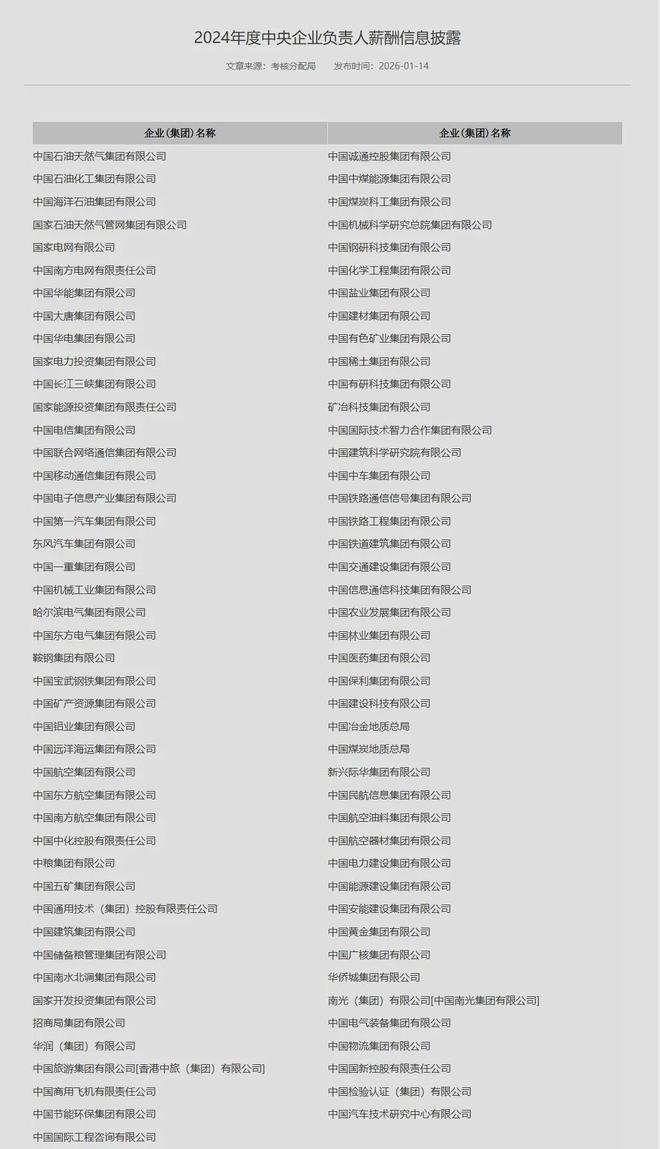
Core Insights - The State-owned Assets Supervision and Administration Commission (SASAC) disclosed the salary information of over 80 central enterprise leaders for the year 2024, indicating a stable salary range without extreme high salaries [1][2] Group 1: Salary Distribution - The overall salary of central enterprise leaders in 2024 remains stable, characterized by a "top-tier leading, median concentration, and low-tier compliance" pattern, with significant industry differentiation [5][16] - The top tier of salaries is dominated by telecommunications and energy central enterprises, with China Mobile's former chairman leading with a pre-tax salary of 1.2582 million yuan [5][6] - In the energy sector, the chairman of China National Petroleum Corporation (CNPC) and the general manager both received an annual salary of 978,500 yuan, ranking them first among energy central enterprises [6][7] Group 2: Salary Comparisons - The second tier includes core central enterprises in electricity, construction, and automotive industries, with notable figures such as the chairman of State Grid earning an annual salary of 735,000 yuan [12] - The salary range for the five major power generation group chairmen is concentrated between 880,000 and 960,000 yuan, indicating a relatively balanced distribution [16] - The third tier consists of central enterprises with strong public welfare attributes, such as the chairman of China Forestry Group earning 438,500 yuan, which is below the average level for central enterprises [13][15] Group 3: Specific Salary Figures - The chairman of China Merchants Group received an annual salary of 946,400 yuan, while the chairman of China Resources Group earned 951,200 yuan, both placing them in the top tier [8][11] - The chairman of China National Offshore Oil Corporation (CNOOC) received an annual salary of 966,900 yuan, ranking second in the energy sector [6][12] - The salary gap between the highest and lowest paid chairmen in the energy sector is approximately 100,000 yuan, indicating controlled salary differences within the same industry [16]
80多家央企“一把手”2024年年薪披露:最高近百万元, 能源通信行业居前
Hua Xia Shi Bao· 2026-01-17 05:17
Core Viewpoint - The recent disclosure of salary information for over 80 central enterprises by the State-owned Assets Supervision and Administration Commission (SASAC) highlights the structure, level, and distribution of executive compensation, reflecting a commitment to transparency and accountability in state-owned enterprises [2][3]. Salary Structure and Distribution - The highest annual salary for a central enterprise leader in 2024 is 978,500 yuan, held by the chairman of PetroChina, Dai Houliang, followed closely by the former chairman of China Mobile at 972,100 yuan and the former chairman of CNOOC at 966,900 yuan, all from the energy and communication sectors [3]. - Overall, the salary distribution among central enterprise leaders shows a clear stratification, closely related to the industry characteristics and operational challenges, with energy and communication sectors leading in compensation [4]. - Leaders of energy and power central enterprises, such as Huaneng Group and China Southern Power Grid, have salaries exceeding 950,000 yuan, while those in construction, manufacturing, and logistics typically earn between 600,000 and 950,000 yuan, and those in public service sectors earn between 400,000 and 600,000 yuan [3][4]. Industry Differences - There are significant salary disparities among central enterprises based on industry, with energy and communication sectors commanding higher salaries due to their monopolistic nature and substantial impact on the national economy, while sectors like forestry and pharmaceuticals, which focus on social welfare, tend to have lower compensation levels [4]. - Some central enterprises involved in overseas operations, such as China Resources Group, have additional overseas allowances that increase their overall compensation, with the highest total compensation reaching 1,351,200 yuan [4]. Salary Reform and Mechanism - The salary structure for central enterprise leaders consists of a basic salary, performance-based salary, and long-term incentive income, with performance evaluations directly influencing compensation [5][9]. - The 2024 salary determination aligns with the SASAC's performance reform direction, ensuring that compensation is closely tied to performance, with a significant portion of salaries being variable based on performance outcomes [9][10]. - The mechanism for salary determination includes comprehensive assessments of various factors, including safety, social responsibility, and innovation, with penalties for significant operational failures [10]. Transparency and Accountability - The recent salary disclosure is part of ongoing efforts to enhance transparency and accountability in central enterprises, with detailed public reporting of executive names, positions, salaries, and benefits [10]. - To improve public trust, it is suggested that the disclosure should also include the rationale behind salary structures and performance evaluations, not just the figures [10].