
小米汽车

Search documents
汽车行业周报:汽车两新补贴申请量突破1000万份,地平线发布L2城区辅助驾驶HSD
Southwest Securities· 2025-05-19 04:53
Investment Rating - The report maintains an "Outperform" rating for the automotive industry as of May 18, 2025 [1] Core Insights - The automotive industry is experiencing a positive retail trend, with passenger car retail sales reaching 574,000 units from May 1 to May 11, 2025, representing a year-on-year increase of 12% and a month-on-month increase of 34% [7][61] - The cumulative retail sales for the year have reached 7.446 million units, showing an 8% year-on-year growth [61] - The report highlights the significant impact of the "old-for-new" vehicle subsidy policy, with applications exceeding 10 million since its implementation in 2024, and 3.225 million applications recorded by May 11, 2025 [7][48] - The report emphasizes advancements in smart vehicles, particularly the launch of Horizon's L2 urban assisted driving system, which is expected to enhance vehicle computing platforms [7][64] Summary by Sections Passenger Vehicles - Retail sales for passenger vehicles from May 1 to May 11, 2025, were 574,000 units, up 12% year-on-year and 34% month-on-month [61][62] - Cumulative wholesale for the year reached 8.932 million units, with a 12% year-on-year increase [62] - Key companies to watch include BYD, Geely, Xpeng, SAIC, Changan, GAC, and Leap Motor [62] New Energy Vehicles - Retail sales of new energy passenger vehicles reached 294,000 units from May 1 to May 11, 2025, marking a 32% year-on-year increase [63] - The retail penetration rate for new energy vehicles is 51.3%, with cumulative sales of 3.618 million units for the year, reflecting a 35% year-on-year growth [63] - Recommended companies include BYD, Geely, Huayu Automotive, and others [63] Smart Vehicles - The report discusses the launch of Horizon's L2 urban assisted driving system, which will be mass-produced in September 2025 [64] - Companies with technological advancements in smart driving algorithms and sensors are highlighted, including BYD, Geely, and various component manufacturers [64] Heavy Trucks - In April, heavy truck sales were approximately 88,000 units, with a year-on-year increase of 6.5% [11][65] - The report notes a significant rise in new energy heavy truck sales, which reached 15,800 units, a 245% year-on-year increase [11][65] - Companies to monitor include Weichai Power, China National Heavy Duty Truck Group, and Tianrun Industrial [65] Robotics - The report mentions the "Digital China Construction 2025 Action Plan," which aims to enhance AI applications and develop intelligent manufacturing equipment [66] - Companies involved in humanoid robotics and AI technology are recommended, including Top Group, Sanhua Intelligent Controls, and others [66]




新势力4月成绩: 零跑交付超4万辆夺冠 小鹏理想均超3万辆
Cai Jing Wang· 2025-05-19 03:28
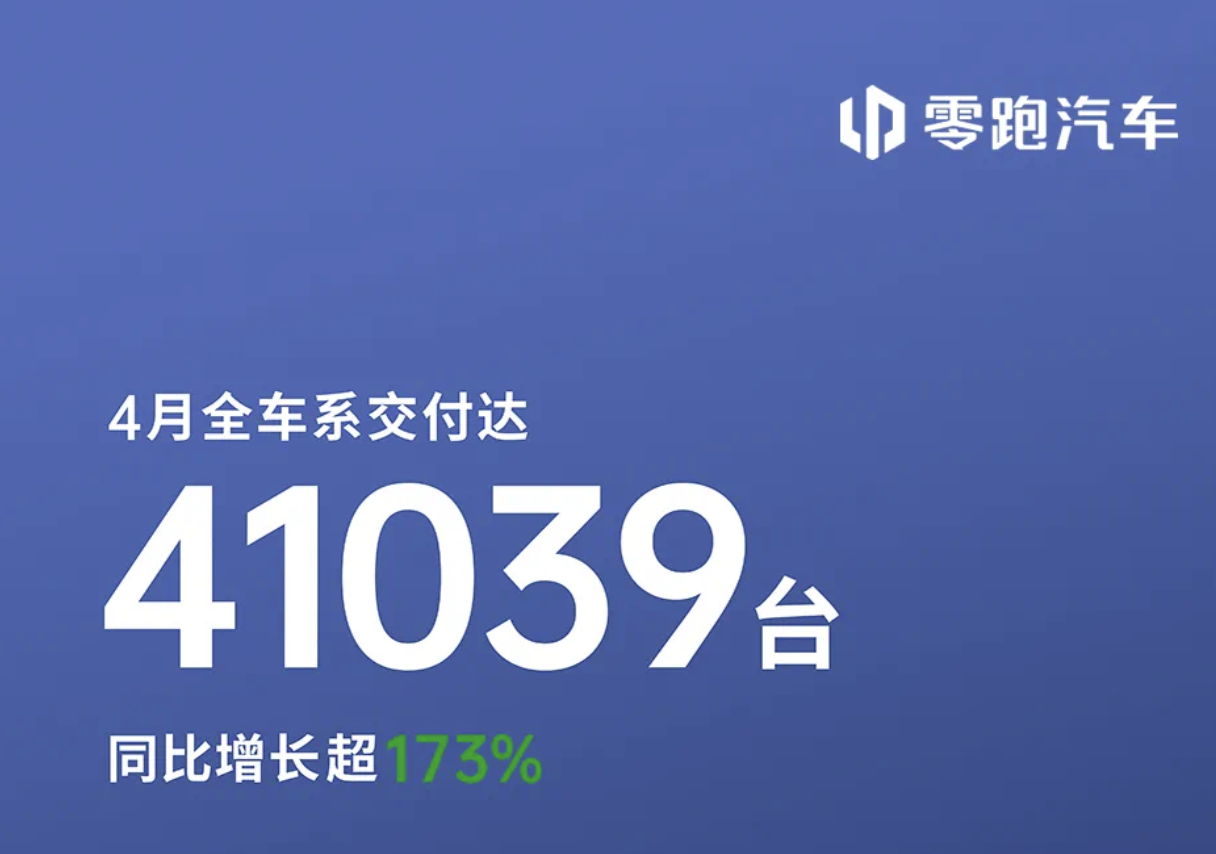
Core Viewpoint - The new energy vehicle market is experiencing significant growth, with "Zero, Xiaopeng, and Ideal" leading the sales rankings in April, indicating a competitive landscape among new energy vehicle manufacturers [1][4]. Group 1: Sales Performance - Leap Motor achieved the highest monthly sales in April with 41,039 units delivered, representing a year-on-year increase of 173% and a month-on-month increase of 10.6% [4]. - Xiaopeng's sales reached 35,045 units in April, showing a remarkable year-on-year growth of 273% and a month-on-month increase of 5.5% [4]. - Ideal maintained its position in the top tier with 33,939 units delivered, reflecting a year-on-year growth of 31.6% [4]. - NIO, Avita, and Lantu also reported significant growth, with Avita and Lantu achieving over 100% year-on-year growth [7]. Group 2: Market Trends - The overall automotive market maintained high activity levels in early April, supported by the Shanghai Auto Show and the launch of new models, which are expected to drive growth in the new energy vehicle sector [3]. - The "Zero, Xiaopeng, and Ideal" trio has consistently ranked in the top tier since the first quarter of this year, indicating a stable competitive landscape [4]. Group 3: Financial Performance - Zeekr reported a total revenue of 22.019 billion yuan in Q1, a slight year-on-year increase of 1.1%, but a significant quarter-on-quarter decline of 37.8%. The gross margin improved to 19.1%, while the net loss decreased by 60.2% year-on-year [8]. - Xiaopeng's Q1 deliveries exceeded guidance, with 94,008 units delivered, a year-on-year increase of 331%. The company expects to achieve profitability by Q4 of this year [11]. - NIO aims to achieve profitability in Q4 of this year, with a target of doubling sales this year and achieving quarterly profitability to pave the way for full-year profitability next year [11]. - Leap Motor plans to maintain a gross margin of 10% to 11% by 2025 and aims for a net profit margin to turn positive [12]. Group 4: Industry Insights - The performance differentiation among automotive companies reflects the resource endowment and strategic determination during the industry transition period. Long-term profitability depends on the ability to create differentiated value and maintain supply chain efficiency [13].


比亚迪欧洲总部落户匈牙利,宁德时代押注重卡换电 | 汽车早参
Mei Ri Jing Ji Xin Wen· 2025-05-18 22:27
Group 1 - CATL aims for a 50% penetration rate of new energy in heavy trucks within three years, introducing a standard battery and battery swap solution [1] - The battery swap solution is expected to address issues of short range and slow charging, potentially lowering costs in the commercial vehicle sector [1] - This strategic move signifies CATL's deepening involvement in the commercial vehicle market and may drive industry standards and electric vehicle adoption [1] Group 2 - Xiaomi responded to rumors regarding the SU7 model, clarifying that minor deformation issues are due to installation gaps and offering free repair services [2] - The company refuted claims of a sales collapse due to cancellations, attributing delivery limitations to production capacity issues [2] - Xiaomi's proactive communication reflects its commitment to consumer concerns and brand image maintenance [2] Group 3 - Changan Automobile's new electric vehicle factory in Thailand marks a significant step in its global strategy, enhancing competitiveness in Southeast Asia [3] - The factory, with an investment of approximately 2 billion RMB, showcases advanced manufacturing and supply chain management capabilities [3] - This development exemplifies the global influence of Chinese manufacturing and aligns with the Belt and Road Initiative [3] Group 4 - BYD announced the establishment of its European headquarters in Hungary to strengthen its market presence and service efficiency [4] - The new center will create 2,000 jobs and will serve as a hub for sales, after-sales, testing, and localized vehicle development [4] - This move reinforces BYD's strategic expansion in Europe amid increasing competition in the electric vehicle market [4] Group 5 - China FAW Group signed a strategic cooperation agreement with New Ziguang Group to enhance domestic chip applications and supply chain resources [5] - The collaboration aims to develop a comprehensive automotive-grade chip ecosystem, covering design, manufacturing, and application [5] - This partnership highlights the deep integration of the automotive and semiconductor industries, improving self-innovation capabilities [6]

对话禾赛科技CEO李一帆:禾赛没有一天选择过代工
2 1 Shi Ji Jing Ji Bao Dao· 2025-05-16 12:49
Group 1 - The trend of intelligent driving is leading to more advanced features being integrated into lower-priced vehicles, with safety becoming a critical focus [1] - The "LiDAR" technology is now available in vehicles priced around 120,000 yuan, exemplified by the Leapmotor B10, which utilizes Hesai's ATX [1] - Hesai Technology launched the "Thousand Eyes" perception solution for L2 to L4 level intelligent driving, offering three different combinations tailored for mainstream L2 level auxiliary driving systems [1] Group 2 - Hesai also introduced a series of automotive-grade LiDAR products, including ETX ultra-long-range LiDAR, AT1440 ultra-high-definition LiDAR, and FTX pure solid-state blind-spot LiDAR [1] - Hesai is recognized as the leading player in the domestic LiDAR industry, with major clients including Li Auto, Xiaomi Auto, and BYD, with Li Auto equipping all its models with Hesai's LiDAR this year [1] - On the international front, Hesai announced a significant long-term exclusive partnership with a top European OEM, marking the largest order in the overseas front-end production LiDAR sector to date [2]
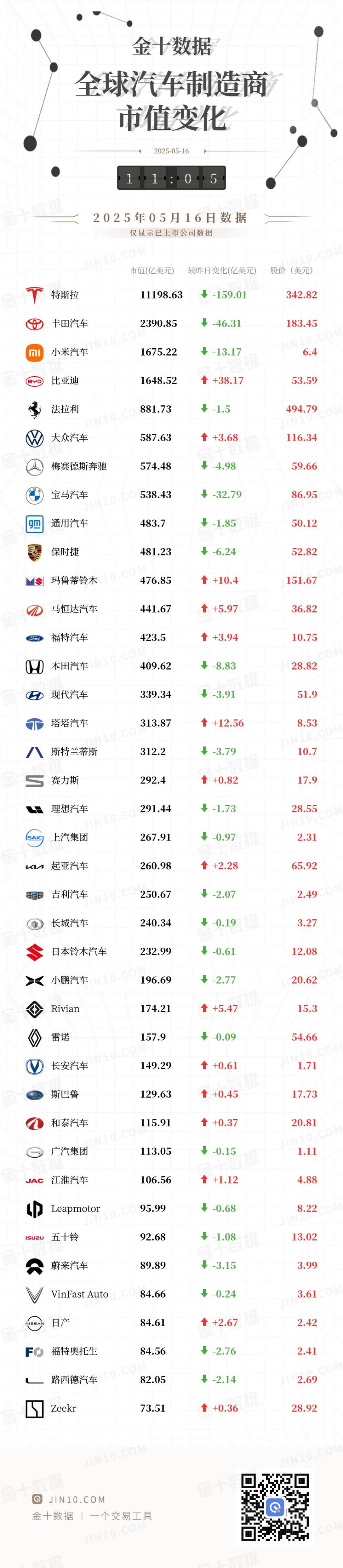
金十图示:2025年05月16日(周五)全球汽车制造商市值变化
news flash· 2025-05-16 03:11
| וש | 小米汽车 | 1675.22 | + -13.17 | 6.4 | | --- | --- | --- | --- | --- | | (BHD) | 比亚迪 | 1648.52 | ↑ +38.17 | 53.59 | | 法拉利 | | 881.73 | + -1.5 | 494.79 | | () 大众汽车 | | 587.63 | 1 +3.68 | 116.34 | | (1) | 梅赛德斯奔驰 | 574.48 | + -4.98 | 59.66 | | 宝马汽车 | 538.43 | V -32.79 | 86.95 | | --- | --- | --- | --- | | 通用汽车 | 483.7 | + -1.85 | 50.12 | | 保时捷 | 481.23 | + -6.24 | 52.82 | | MS 玛鲁蒂铃木 | 476.85 | 1 +10.4 | 151.67 | | 马恒达汽车 | 441.67 | 1 +5.97 | 36.82 | | 福特汽车 | 423.5 | 1 +3.94 | 10.75 | | 本田汽车 I | 409.62 | + -8. ...



沃特股份(002886) - 2025年5月15日投资者关系活动记录表
2025-05-15 10:20
Group 1: Company Vision and Strategy - The company aims to become a world-class provider of material solutions, focusing on high-tech special polymers and engineering polymers to meet customer needs in industries like 5G/6G communication, AI, and semiconductors [1] - The company adheres to the value of "being oneself and being needed," with a mission to "shape a better life for humanity" [1] Group 2: Revenue Growth and Market Opportunities - Future revenue growth is expected from special high polymer materials, engineering plastic alloys, and modified general plastics, targeting industries such as electronics, communications, and AI [2] - The rapid development of global technology in areas like 5G/6G and AI presents unprecedented opportunities for the special polymer materials industry [2] Group 3: Product Applications and Collaborations - The company has provided samples to multiple collaborative robot and humanoid robot supply chain companies [2] - Key materials used in the robotics industry include LCP, PPA, and PEEK, which meet various requirements such as lightweight and high-speed signal transmission [2][3] Group 4: Financial Health and Investment - The company reports normal cash flow and has no current plans for equity financing, ensuring compliance with legal disclosure obligations [4] - The company is actively exploring acquisition opportunities in the semiconductor materials sector to enhance its position in the global supply chain [5] Group 5: Talent and Production Capacity - The company has built a diverse and professional talent team, focusing on training and development to enhance competitiveness [4] - New production capacity for LCP is currently ramping up, with the company actively communicating with relevant authorities for necessary approvals [4]

2025中国汽车工业协会车用智能显示分会年会 暨“走进京东方·新产品/新技术”交流会成都召开
Zhong Guo Qi Che Bao Wang· 2025-05-15 03:15
Core Insights - The conference held by the China Automotive Industry Association focused on the latest technologies and future trends in the automotive smart display industry, showcasing advancements in OLED and Micro LED technologies by BOE [1][6] - The meeting emphasized the importance of collaboration within the industry to drive the smart transformation of the automotive sector [1][6] Group 1: Industry Trends and Challenges - The automotive smart display industry is experiencing significant growth, with electric vehicle penetration exceeding 35% and smart cockpit installation rates reaching 68%, alongside an annual compound growth rate of over 21% for automotive displays [6] - The industry is facing challenges such as price wars and the need for technological innovation, with a consensus among industry leaders to prioritize product quality and long-term strategies over short-term gains [5][9] Group 2: Strategic Initiatives and Collaborations - The conference highlighted the need for original technology incubation and the formation of industry alliances to share technological achievements and reduce R&D costs [7] - Companies are encouraged to embrace global markets and participate in national standard formulation to enhance competitiveness [7] Group 3: Technological Innovations - Discussions included advancements in display technologies such as Mini/Micro LED and AR HUD, with a focus on overcoming environmental light interference and achieving deep integration with autonomous driving systems [9][10] - The importance of high-end technology to break through price competition and the need for ecological collaboration to address cross-industry competition were emphasized [10] Group 4: Future Outlook - The automotive smart display industry is expected to continue its evolution towards a "China manufacturing" to "global intelligent manufacturing" transition, driven by technological advancements and collaborative efforts [10] - The conference concluded with a commitment to strengthen technology exchange and cooperation, accelerate standard formulation, and promote innovation and industrial upgrades for the prosperity of the Chinese automotive industry [15]


扬州又冲出一家IPO!两兄弟创业搞汽车HUD,干出全国第二
创业邦· 2025-05-14 03:22
Core Viewpoint - Jiangsu Zejing Automotive Electronics Co., Ltd. is preparing for an IPO on the Hong Kong Stock Exchange, positioning itself as the second-largest supplier of automotive HUD solutions in China, with significant backing from major automotive manufacturers [3][21]. Company Overview - Zejing Electronics is a leading player in the automotive HUD market, with a market share of approximately 16.2%, following a top competitor with a 23.3% share [20]. - The company has established partnerships with 22 automotive manufacturers, including NIO, Xiaomi, and BYD, and has supplied over 150,000 units across more than 90 vehicle models [21][22]. Founders and Background - The company was founded by two brothers, Zhang Bo and Zhang Tao, who have complementary skills in technology and industry management [6][7]. - Zhang Bo has a background in software and electronic products, while Zhang Tao has extensive experience in the automotive industry, having worked with major companies like SAIC Volkswagen [6][8]. Market Opportunity - The rise of smartphone usage while driving has led to increased demand for HUD technology, which enhances driving safety by projecting critical information onto the windshield [10][12]. - HUD technology, initially used in military aircraft, has become increasingly popular in mid to high-end vehicles in Europe and the U.S. since the 1990s [11]. Financial Performance - Zejing Electronics has shown significant revenue growth, with sales reaching 2.14 billion RMB in 2022 and projected to grow to 5.78 billion RMB in 2024, reflecting a compound annual growth rate of approximately 64.3% [40]. - The company's gross margin has improved from 22.6% to 27.3% over the same period, indicating better profitability [41]. Investment and Support - The company has completed eight rounds of financing, receiving substantial support from local government and industry capital, including investments from major automotive players [22][23]. - The latest funding round in 2024 valued the company at approximately 2.585 billion RMB [27]. Industry Context - The automotive industry in Jiangsu, particularly in Yangzhou, is rapidly developing, with plans to expand the automotive and parts industry to a scale of 300 billion RMB in the next 5 to 10 years [54][55]. - Yangzhou is positioning itself as a significant hub for new energy and intelligent connected vehicles, which aligns with Zejing's business focus [54].
欣锐科技(300745) - 2025年5月13日投资者关系活动记录表
2025-05-13 12:00
Industry Performance - In 2024, China's new energy vehicle (NEV) production and sales reached 12.888 million and 12.866 million units, respectively, with year-on-year growth of 34.4% and 35.5% [2][3] - NEV sales accounted for 40.9% of total new car sales, an increase of 9.3% from 2023 [2] - Plug-in hybrid vehicle sales made up 40% of NEV sales, up 10.4% year-on-year [2] Future Market Outlook - The NEV penetration rate is expected to exceed 50% in 2025, providing long-term growth opportunities for the company's vehicle power supply business [4][11] - The total automobile sales in China for 2025 are projected to be 32.9 million units, with NEV sales expected to reach 16 million units, a year-on-year increase of 24.4% [3] Company Financials - In 2024, the company achieved revenue of 223,675.59 million yuan, a year-on-year increase of 57.81% [8] - The net profit attributable to the parent company was -12,221.11 million yuan, a reduction in loss of 4,730.97 million yuan compared to the previous year [8] Inventory and Supply Chain Management - The company reported a significant inventory impairment of 21 million yuan in Q1 2025, attributed to rapid market changes and a cautious approach to inventory valuation [5][6] - Measures have been implemented to enhance supply chain management, including demand management and digital upgrades [5][6] Production Capacity and Utilization - The overall capacity utilization rate for 2024 was 94.34% [7] - The company plans to optimize production efficiency through automation and improved processes to meet future market demands [7][18] Strategic Initiatives - The company aims to enhance its product matrix by focusing on high-power density vehicle power supply products and expanding into new markets such as robotics and data centers [9][21] - Continuous investment in R&D and technology innovation is emphasized to maintain competitiveness and meet customer needs [9][25] Challenges and Responses - The company faces challenges from industry competition and pricing pressures, with strategies in place to improve profitability and operational efficiency [12][25] - The management acknowledges the need for a balance between market share and profitability, with ongoing efforts to enhance financial performance [25][26]

关税调整对汽车的影响及受益标的
2025-05-12 15:16
Summary of Conference Call Records Industry Overview - The conference call discusses the impact of tariff adjustments on the automotive industry, particularly focusing on the effects of U.S. tariffs on Chinese goods, including automobiles and parts. The overall impact on Chinese parts manufacturers is relatively small due to their strategic production placements in North America and Mexico [1][3][6]. Key Companies and Recommendations - **Preferred Stocks in Hong Kong**: - Xpeng Motors, Li Auto, and Xiaomi Motors are highlighted, with Xpeng Motors being the top pick [1][4]. - **Preferred Stocks in A-shares**: - Desay SV and Boteli are recommended [1][5]. - **Fuyao Glass**: - Projected revenue for 2025 is approximately 8.835 billion yuan, with a price-to-earnings ratio of 17 times, maintaining a growth rate of 15-21% due to increased global market share and automotive glass upgrades [1][7]. - **New Spring Co.**: - Expected profit for 2025 is between 1.3 to 1.35 billion yuan, with a current valuation of about 16 times, benefiting from localized production in Mexico to avoid tariff risks [1][8]. Tariff Impact and Market Sentiment - The tariff situation has improved for the automotive parts sector, with Tesla and Huawei entering a phase of increased orders and production in Q2, which is expected to enhance market sentiment and lead to technological upgrades [1][9]. - The easing of U.S.-China trade tensions is seen as beneficial for the automotive industry, alleviating previous negative sentiments and fears of price wars [2]. Robotics Industry Outlook - 2025 is identified as a pivotal year for the robotics industry, with expectations for technological recovery and the introduction of autonomous taxi services driving growth. Key companies to watch include Top Group, Sanhua, and Beite [1][9][11]. - The development of smart robotics is being accelerated through collaborations, such as Huawei's partnership with UBTECH, and Xiaomi's advancements in robotics [9][10]. Future Trends and Innovations - The Tesla supply chain is anticipated to experience a rebound, while Huawei and Xiaomi's supply chains are noted for their smart advantages. Key technological focuses include dexterous hands and lightweight materials, with companies like Zhaoming and Xingyu benefiting from these trends [1][10]. - The robotics sector is expected to see a significant increase in production rates, particularly in smart connected vehicles, with potential breakthroughs in domestic production [11]. Conclusion - The automotive and robotics industries are poised for growth in 2025, driven by strategic adaptations to tariff challenges, technological advancements, and improved market sentiment. Key players and recommended stocks are positioned to capitalize on these trends.