
景顺长城

Search documents
首批北交所主题基金成立四周年,累计收益率最高达138%
Bei Jing Shang Bao· 2025-11-23 12:07
Core Insights - The first batch of North Exchange thematic funds has shown impressive performance since its establishment on November 23, 2021, with some products achieving cumulative returns of over 100%, the highest being 138% [1][4] - The North Exchange 50 Index has reached new highs, with a year-to-date increase of 32.72% as of November 21, 2025, contributing to the strong performance of the thematic funds [3] - The average year-to-date return for the first batch of thematic funds is 46.56%, with leading funds like Huaxia North Exchange Innovation Small and Medium Enterprises Fund achieving 77.53% [3][4] Thematic Fund Performance - As of November 23, 2025, all but one of the first batch of thematic funds have positive cumulative returns, with an average return of 60.13% [4] - The cumulative return of the Huaxia North Exchange Innovation Small and Medium Enterprises Fund is 138.62%, while other funds like Huatai North Exchange Innovation Fund are close to doubling their returns at 92.68% and 89.62% [4] - Newer funds established in August 2022 and April 2023 have also performed well, with cumulative returns exceeding 100% for all three funds [5] Market Dynamics - The North Exchange thematic funds are considered more flexible compared to other fund products, primarily focusing on core assets of the North Exchange, which enhances their competitiveness in a bull market [5][6] - The liquidity issues that previously affected these funds have been gradually resolved, with turnover rates now comparable to other growth sectors in the Shanghai and Shenzhen markets [6] - The performance of North Exchange thematic funds is expected to continue benefiting from favorable market conditions, with adjustments needed based on market environment and investment styles [6]


16只硬科技主题基金同日获批;中国旅游集团牵头组建新央企
2 1 Shi Ji Jing Ji Bao Dao· 2025-11-23 09:33
Group 1 - The Chinese Ministry of Foreign Affairs and the embassy in the Democratic Republic of the Congo have urged Chinese citizens and businesses in the eastern region, particularly South Kivu, to evacuate immediately and report their information to the embassy [1] - The National Internet Information Office and the Ministry of Public Security have drafted regulations for personal information protection on large online platforms, requiring that personal information collected within China be stored domestically [2] - China Tourism Group is leading the establishment of a new central enterprise for cruise operations, following a signing ceremony involving 17 units across key sectors such as new materials and artificial intelligence [3] Group 2 - The Chinese government has announced that electronic savings bonds will be included in the personal pension product range to support the development of a multi-tiered pension insurance system [6] - Sixteen new hard technology-themed funds have been approved, focusing on sectors like AI and chips, indicating a positive signal from regulators for strategic emerging industries [7] - The price of white duck down has increased by approximately 20% over the past two months, benefiting companies in the industry as demand for down jackets rises [8][9] Group 3 - The first large-capacity all-solid-state battery production line in China has been completed and is currently undergoing small-batch testing [10] - The lithium iron phosphate industry is experiencing cautious expansion among companies despite a recovery in industrial demand, as prices have not significantly increased [11] - Guangku Technology plans to acquire 99.97% of Suzhou Anjie Xun Optoelectronics for 1.64 billion yuan, enhancing its position in the optical communication sector [12] Group 4 - Huawei has introduced a breakthrough AI technology called Flex:ai, which significantly improves the utilization rate of computing resources by allowing a single GPU/NPU to handle multiple AI workloads [13] - Zhaoyi Innovation announced plans for several executives to reduce their holdings in the company, citing personal financial needs [14] - The U.S. is preparing to initiate new actions regarding Venezuela, with military presence in the Caribbean region, indicating potential geopolitical implications for the region [15] Group 5 - The Nasdaq index has seen a cumulative decline of nearly 3% this week, with Nvidia's stock dropping approximately 6% [17] - Upcoming significant events include the 2025 China Automotive Supply Chain Conference and the release of financial reports from major companies like Alibaba and NIO [18][24]
首批科创创业人工智能ETF 等16只硬科技基金获批 即将启动募集
Sou Hu Cai Jing· 2025-11-23 03:10
Core Viewpoint - The approval of 16 new hard technology investment products signals increased funding and support for the hard technology sector, indicating a positive regulatory stance towards strategic emerging industries [1] Group 1: Product Approval - 16 hard technology products have been rapidly approved, including ETFs focused on artificial intelligence and semiconductor sectors [1] - The approved products consist of 7 AI ETFs, 3 semiconductor ETFs, 4 semiconductor design theme ETFs, and 2 actively managed technology equity funds [1] - The approval process was notably swift, with some products receiving approval on the same day they were submitted for review [1] Group 2: Market Impact - The new products are expected to attract significant new capital focused on technology investments, enhancing the overall market for hard technology [1] - Industry insiders view the rapid approval as a strong signal of regulatory support for strategic emerging industries [1]

麦高视野:ETF观察日志(2025-11-20)
Mai Gao Zheng Quan· 2025-11-21 06:01
- The report introduces the **RSI (Relative Strength Index)** as a quantitative factor. The construction idea is to measure the relative strength of price movements over a specific period to identify overbought or oversold market conditions. The formula is: $ RSI = 100 - \frac{100}{1 + RS} $, where $ RS $ is the ratio of the average gain to the average loss over a 12-day period. An RSI > 70 indicates an overbought market, while RSI < 30 indicates an oversold market[2] - Another quantitative factor mentioned is **Net Purchase (NETBUY)**, which measures the net inflow or outflow of funds for ETFs. The formula is: $ NETBUY(T) = NAV(T) - NAV(T-1) \times (1 + R(T)) $, where $ NAV(T) $ is the net asset value on day $ T $, $ NAV(T-1) $ is the net asset value on the previous day, and $ R(T) $ is the return on day $ T $[2] - The report also tracks **Institutional Holdings** as a factor, which is derived from the latest annual or semi-annual reports of ETFs, excluding holdings by linked funds. This factor provides an estimate of institutional participation in the ETF[3] - The report includes **T+0 Trading** as a feature for certain ETFs, indicating whether same-day buy-and-sell transactions are allowed[2] - The report provides a detailed breakdown of ETF performance across various indices, including **broad-based indices** (e.g., CSI 300, CSI 500, CSI 1000) and **thematic indices** (e.g., semiconductor, renewable energy, artificial intelligence). Performance metrics include RSI, net purchase, and institutional holdings[4] - The **RSI values** for ETFs tracking broad-based indices range from 35.83 to 52.12, with thematic ETFs showing a wider range, such as 30.25 for robotics and 63.73 for banking[4] - **Net purchase values** vary significantly, with some ETFs showing large outflows (e.g., -10.82 billion for Nasdaq 100 ETFs) and others showing inflows (e.g., 10.01 billion for Hang Seng Technology ETFs)[4] - **Institutional holdings** also vary widely, with some ETFs having over 90% institutional participation (e.g., CSI 800 ETFs) and others below 20% (e.g., certain thematic ETFs like robotics)[4]
越跌越买,抄底来了
Zhong Guo Ji Jin Bao· 2025-11-21 05:51
Core Insights - The overall net inflow of stock ETFs reached 9 billion yuan on November 20, with a total inflow of nearly 28.5 billion yuan for the week from November 17 to November 20 [1][3]. Fund Inflows - The top five sectors for net inflow included Hang Seng Technology (2.35 billion yuan), Semiconductors (1.15 billion yuan), Sci-Tech 50 Index (1.08 billion yuan), Hong Kong Internet (890 million yuan), and Gold (870 million yuan) [3]. - The leading fund company, E Fund, reported a total ETF size of 810.53 billion yuan, with a net inflow of 1.57 billion yuan on November 20, and an increase of 209.88 billion yuan since 2025 [3]. Fund Outflows - The top five sectors for net outflow included the CSI 300 Index (1.2 billion yuan), New Energy (910 million yuan), Banks (600 million yuan), Computers (250 million yuan), and Media (250 million yuan) [3][8]. - The Securities ETF, Bank ETF, and Battery ETF were among the largest outflow products, with the CSI 300 ETFs experiencing significant net outflows [8]. Market Trends - The current A-share market is experiencing a technology-led structural market, with a strong long-term outlook for sectors such as semiconductors, innovative technology products, and innovative pharmaceuticals [8][9]. - The market is expected to focus more on the 2026 economic outlook as year-end approaches, with technology sectors showing clearer investment opportunities [9].
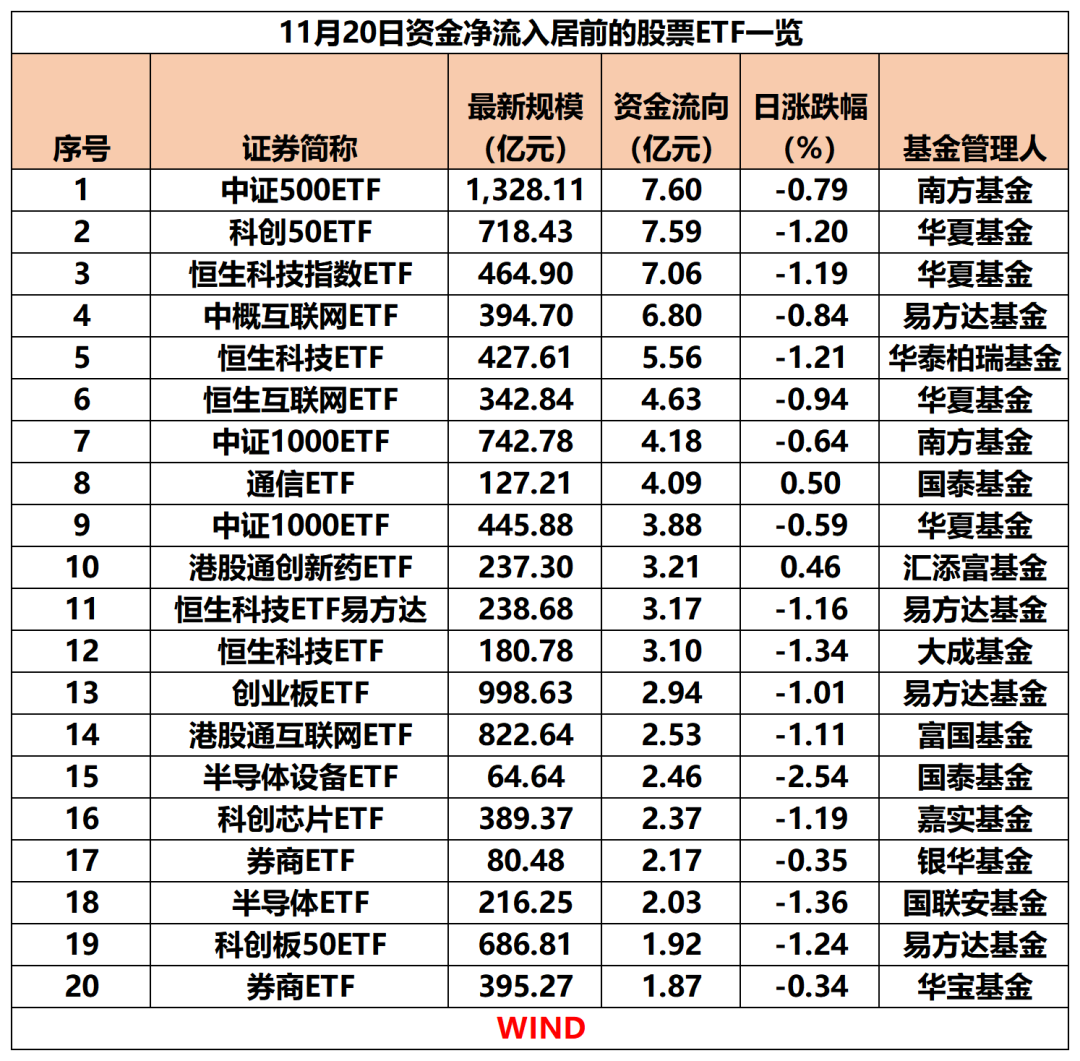
越跌越买!抄底来了
Zhong Guo Ji Jin Bao· 2025-11-21 05:40
Group 1 - On November 20, the overall net inflow of stock ETFs reached 9 billion yuan, with a total inflow of nearly 28.5 billion yuan since November 17 [1][2] - The top five sectors for inflow included Hang Seng Technology (2.35 billion yuan), Semiconductors (1.15 billion yuan), and the Sci-Tech 50 Index (1.08 billion yuan) [2] - The top five sectors for outflow were the CSI 300 Index (1.2 billion yuan), New Energy (910 million yuan), and Banking (600 million yuan) [2] Group 2 - As of November 20, the latest scale of E Fund's ETF reached 810.53 billion yuan, with a net inflow of 1.57 billion yuan on the previous day [2] - The net inflow for E Fund's China Concept Internet ETF was 680 million yuan, while the Hang Seng Technology ETF saw a net inflow of 320 million yuan [2] - Huaxia Fund's Sci-Tech 50 ETF and Hang Seng Technology Index ETF had the highest net inflows of 759 million yuan and 706 million yuan, respectively [3] Group 3 - The leading ETFs for net inflow included the CSI 500 ETF, Sci-Tech 50 ETF, and CSI 1000 ETF, while popular thematic ETFs like Securities ETF and Banking ETF experienced significant outflows [4][6] - The net outflow from the Securities ETF was 505 million yuan, and the Banking ETF saw a net outflow of 433 million yuan [6] - Market analysts suggest that the current A-share market is experiencing a technology-led structural market, with a strong long-term outlook for sectors like semiconductors and innovative technologies [6][7]
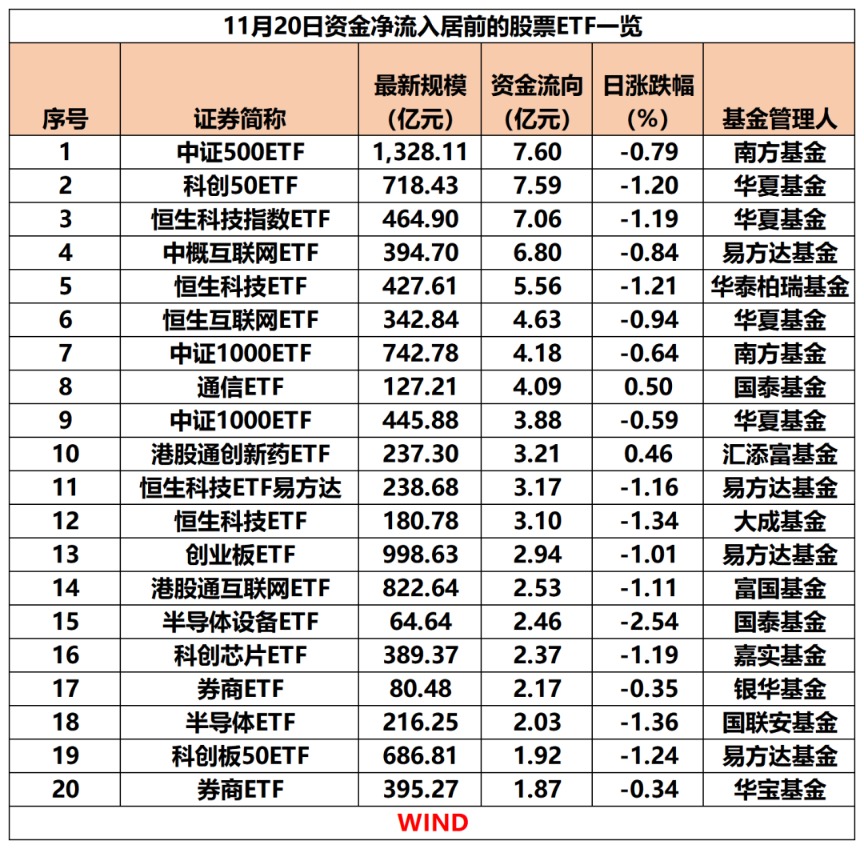
越跌越买!抄底来了
中国基金报· 2025-11-21 05:34
Core Viewpoint - The stock ETF market in China has seen significant inflows, with a total of 90 billion yuan on November 20, and nearly 285 billion yuan since November 17, indicating a trend of "buying on dips" in the market [2][3][4]. Fund Inflows - On November 20, the overall net inflow for stock ETFs (including cross-border ETFs) reached 90 billion yuan, bringing the total scale to 4.57 trillion yuan [5]. - The top five sectors for inflows included Hang Seng Technology (23.5 billion yuan), Semiconductors (11.5 billion yuan), Sci-Tech 50 Index (10.8 billion yuan), Hong Kong Internet (8.9 billion yuan), and Gold (8.7 billion yuan) [5]. - The leading fund companies included E Fund, with a total ETF scale of 810.53 billion yuan and a net inflow of 15.7 billion yuan on November 20 [5]. Fund Outflows - The top five sectors for outflows were the CSI 300 Index (-12.0 billion yuan), New Energy (-9.1 billion yuan), Banks (-6.0 billion yuan), Computers (-2.5 billion yuan), and Media (-2.5 billion yuan) [5]. - Popular theme ETFs such as Securities ETFs, Bank ETFs, and Battery ETFs experienced significant outflows, with multiple CSI 300 ETFs leading the outflow rankings [10]. Investment Trends - The current A-share market is undergoing a technology-led structural market, with a strong long-term outlook for sectors like semiconductors, innovative technology products, and innovative pharmaceuticals [12]. - The "anti-involution" trend is creating structural opportunities in sectors like new energy and is expected to reshape the overall manufacturing ecosystem, with a focus on semiconductors, new energy smart vehicles, and biopharmaceuticals [12]. - As the year-end approaches, institutional funds are expected to focus more on the 2026 economic outlook, with a clearer investment direction in the technology sector and traditional manufacturing with improving profit expectations [12].

深圳金博会巨头云集 “科技+服务”创新纷呈
Zhong Guo Jing Ji Wang· 2025-11-21 01:31
转自:深圳特区报 深圳特区报记者 张程 "我行已构建覆盖科技企业全生命周期的综合金融服务体系,制造业贷款与战略性新兴产业贷款余额双 双突破2000亿元,精准赋能深圳'20+8'产业集群发展,推动传统产业转型升级、战略性新兴产业和未来 产业前瞻布局。"展台有关负责人介绍。 作为国内规模最大、参展机构最多、覆盖金融领域最广的重要展会之一,深圳国际金融博览会(以下简 称金博会)自创办以来,已从地方性展会成长为全球展览业协会(UFI)认证的国际性专业展会。正在 火热开展的第十九届金博会,自然也成了金融机构大秀创新产品和服务的重要舞台。 福田展区,"金融专业楼宇投壶""品牌打卡点"等互动环节轻松有趣,吸引众多市民参与。招商证券、景 顺长城等多家金融机构开展主题投教活动,通过知识问答、现场咨询等形式,以"大白话"传递金融反 诈、个人养老金等知识,有效提升公众参与感。 走进展会现场,处处充满金融创新动能。中国信保在金博会上发布了全新外经贸全球资信数据服务产 品"全球查",以数字化创新赋能外贸高质量发展。 "展区重点展示了中国平安、财富趋势、华锐技术、豆沙包、海云安等企业形象,立体呈现出金融科技 生态全景。同时展厅也将数字A ...
福田区携多项全国首创金融成果亮相第十九届金博会
Zhong Zheng Wang· 2025-11-20 10:43
Core Insights - The 19th Shenzhen International Financial Expo, themed "New Heights of Industrial Finance, Empowering the Future with Science and Technology," was held from November 19 to 21, showcasing 288 global institutions and enterprises [1] Group 1: Financial Innovation in Futian District - Futian District has achieved seven national firsts in the field of technology finance, including the first private venture capital enterprise tech innovation bond and the first digital RMB "talent insurance" [2] - A total of 25 tech innovation bonds have been issued in Futian, accounting for 45% of Shenzhen's total, with a total issuance scale of 37.9 billion yuan, representing 50% of the city's total [2] Group 2: Digital Finance Developments - Futian has realized 11 national firsts in digital finance, including the establishment of the first financial technology space after the release of the Guangdong-Hong Kong-Macao Greater Bay Area Development Plan [2] - The district has attracted 70% of Shenzhen's financial technology enterprises, supporting Shenzhen's rise to second place globally in the Global Financial Centers Index (GFCI) for financial technology [2] Group 3: Ecosystem Empowerment - Futian has facilitated financing for over 10,000 enterprises, successfully securing nearly 110 billion yuan in funding [3] - The district has provided support for nearly 3,000 enterprises in listing services, with a reserve of 2,908 "star enterprises" for future growth [3] Group 4: Expo Highlights - Key financial technology companies, including Ping An Technology and Wealth Trend, showcased their core technologies and products at the expo [4] - The expo featured educational activities by financial institutions to enhance public engagement and awareness [4]
麦高视野:ETF观察日志(2025-11-19)
Mai Gao Zheng Quan· 2025-11-20 05:45
- The report includes the construction of the RSI (Relative Strength Index) factor, which is calculated using the formula: $ RSI = 100 - 100 / (1 + RS) $, where RS represents the ratio of average gains to average losses over a 12-day period. RSI values above 70 indicate an overbought market, while values below 30 suggest an oversold market [2] - The report also introduces the calculation of net subscription (NETBUY), defined as $ NETBUY(T) = NAV(T) - NAV(T-1) * (1 + R(T)) $, where NETBUY(T) represents the net subscription amount, NAV(T) is the ETF's net asset value on day T, and R(T) is the return on day T [2] - The report tracks various ETFs categorized into "Broad-based" and "Thematic" indices, such as CSI 300, CSI 500, and industry-specific indices like non-bank financials, dividends, and China internet sectors. It provides daily performance metrics, including RSI values, net subscription amounts, and institutional holding percentages [2][4][7] - The RSI factor is evaluated as a useful indicator for identifying market conditions, such as overbought or oversold states, aiding in short-term trading decisions [2] - The net subscription metric is assessed as a valuable measure for understanding fund flows and investor sentiment towards specific ETFs [2] - RSI values for various ETFs range from 11.05 to 77.25, reflecting diverse market conditions across different indices and sectors [4][7] - Net subscription values vary significantly, with some ETFs showing positive inflows while others exhibit outflows, indicating mixed investor sentiment across different funds [4][7]