
浪潮信息

Search documents
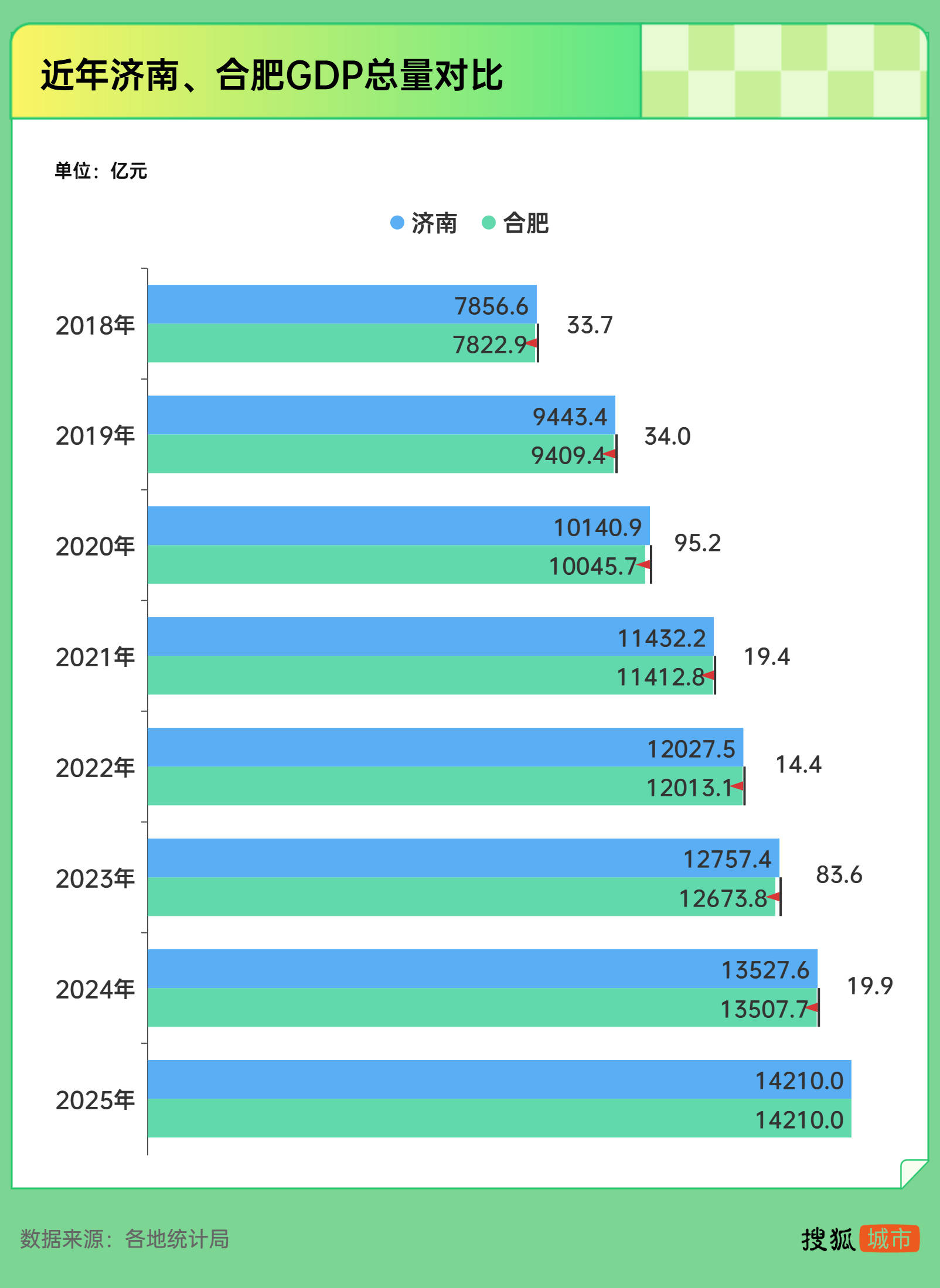
“缠斗”8年,合肥GDP总量追平济南
Sou Hu Cai Jing· 2026-02-06 12:48
Core Insights - In 2025, both Jinan and Hefei achieved a GDP of 1.421 trillion yuan, ranking them 18th nationally, marking a significant milestone for Hefei [1][3] - Hefei aims to surpass a GDP of 2 trillion yuan in the next five years, while Jinan has not specified a concrete target [14] Group 1: Economic Growth and Performance - Hefei's GDP growth rate is projected at 6.1% for 2025, surpassing Jinan's 5.4%, making it the second highest among trillion-yuan cities [5] - From 2012 to 2021, Hefei's GDP increased by 2.7 times, ranking it 19th nationally, a rise of 13 positions over ten years [5] - Hefei's industrial output is expected to exceed 1.4 trillion yuan by 2025, with strategic emerging industries accounting for over 60% of this output [5] Group 2: Industrial and Sectoral Contributions - Hefei leads in the production of new energy vehicles, with an output of 1.371 million units in 2025, representing 8.3% of the national total [6] - Jinan's secondary industry growth is slower, with a projected increase of 4.4% in 2025, which is below its overall GDP growth [6] - Jinan has strong foundations in steel, electronics, and equipment manufacturing, but is still transitioning to new growth drivers [6] Group 3: Service Sector Dynamics - Jinan's tertiary industry is expected to generate 916.26 billion yuan in 2025, growing at 6.0%, which is higher than Hefei's 864.97 billion yuan and 4.4% growth [8] - Jinan's service sector revenues are over 35% higher than Hefei's, with significant advantages in transportation, culture, education, and real estate [9][12] - Despite a larger population, Hefei's consumer spending is lower than Jinan's, indicating potential weaknesses in its service sector [12] Group 4: Future Strategies and Goals - Hefei's "14th Five-Year Plan" emphasizes the development of strategic emerging industries while addressing service sector shortcomings [14] - Jinan's "14th Five-Year Plan" focuses on strengthening its manufacturing base and developing high-end industries without specific GDP targets [14] - Both cities are expected to continue competing closely, with Hefei aiming for higher economic rankings and Jinan focusing on manufacturing excellence [15]

东兴证券晨报-20260206
Dongxing Securities· 2026-02-06 09:09
Economic News - The Ministry of Finance, General Administration of Customs, and State Taxation Administration announced a "zero tariff" policy for imported goods purchased by residents of Hainan Free Trade Port, allowing an annual exemption limit of 10,000 yuan per person [1] - The Shanghai Futures Exchange will adjust the price fluctuation limits and trading margin ratios for gold and silver futures starting February 9, 2026, with gold futures' fluctuation limit increasing from 16% to 17% [2] - The Ministry of Industry and Information Technology and other departments released a plan for the high-quality development of traditional Chinese medicine, aiming to cultivate 60 high-standard raw material production bases by 2030 [3] - The Ministry of Commerce reported a 7.4% year-on-year growth in service trade in 2025, with knowledge-intensive service trade growing by 6.6% [4] - The National Internet Information Office and 11 other departments issued opinions to enhance digital services for foreign personnel entering China, aiming for a more interconnected digital service system by 2030 [5] Key Company Information - Meituan announced the acquisition of Dingdong Maicai's China business for approximately $717 million (about 5 billion yuan) [6] - Guoxuan High-Tech plans to raise 5 billion yuan through a private placement to expand its new energy battery production capacity [7] - Nanjing Mining Group intends to acquire a 10% stake in Eagle Valley Gold through a cash investment of $30 million [8] - Muyuan Foods reported a 2.73% year-on-year increase in the sale of live pigs in January 2026, with sales revenue declining by 11.93% [9] - Baidu announced a new stock repurchase plan of up to $5 billion, effective until December 31, 2028, to enhance long-term shareholder value [10] Industry Insights - The rubidium and cesium market is expected to enter a new structural expansion cycle driven by the penetration of perovskite solar cells and the development of space photovoltaics [11] - Perovskite solar cells are projected to have a market penetration rate of 30% by 2030, significantly increasing from 1.3% in 2025 [12] - The flexible structure of perovskite solar cells allows for applications in various fields, including building-integrated photovoltaics (BIPV), wearable devices, and vehicle power generation [13] - The global BIPV market is expected to grow from $16.66 billion to $47.02 billion between 2026 and 2031, with a CAGR of 23.06% [14] - The demand for rubidium is projected to grow at a CAGR of 115% from 2025 to 2030, driven by the increasing production of perovskite solar cells [15]
计算机行业GenAI系列(二十五):从谷歌和微软业绩看AI叙事分化与再定价
GF SECURITIES· 2026-02-06 02:28
Investment Rating - The industry investment rating is "Buy" [2] Core Insights - The latest financial reports from major tech giants indicate that the AI narrative is entering a new phase, where the market is systematically evaluating the actual contributions of AI to revenue structure, profitability, and cash flow, rather than just technological advancement or user scale [6][19] - Google has successfully integrated AI into its core businesses, enhancing profitability and operational efficiency, while Microsoft is focusing on building a new productivity ecosystem through AI, which may take longer to reflect in financial statements [6][21] - The differentiation in AI narratives is leading to a revaluation of companies based on their ability to demonstrate sustainable profitability from AI investments [21] Summary by Sections Google - Google reported a strong performance in Q4 2025, with revenue of $113.83 billion, up 18% year-on-year, and net profit of $34.46 billion, up 29.8% [9] - The cloud business saw a significant revenue increase of 48% year-on-year, driven by strong enterprise AI demand, with operating profit reaching $5.3 billion, reflecting a profit margin increase from 17.5% to 30.1% [11] - Capital expenditures for Google are projected to rise significantly, with $27.9 billion in Q4 2025 and an annual total of $91.4 billion, primarily focused on technology infrastructure [12] Microsoft - Microsoft achieved revenue of $81.3 billion in FY2026 Q2, a 17% increase year-on-year, with net profit rising 60% to $38.5 billion, influenced by OpenAI investment returns [15] - The Microsoft Cloud segment generated $51.5 billion in revenue, up 26%, indicating strong growth in enterprise AI and cloud services [15] - Azure's growth remains robust at nearly 40%, but there are signs of a slight slowdown in growth rate, with capital expenditures reaching $37.5 billion, focused on AI infrastructure [16][17]


数字经济ETF工银(561220)开盘跌0.47%,重仓股中芯国际跌1.48%,海光信息跌1.00%
Xin Lang Cai Jing· 2026-02-06 01:41
Group 1 - The Digital Economy ETF (工银561220) opened at 1.480 yuan, experiencing a decline of 0.47% [1] - Major holdings in the ETF include companies like SMIC, which fell by 1.48%, and Haiguang Information, which dropped by 1.00% [1] - The ETF's performance benchmark is the China Securities Index for State-Owned Enterprises in the Digital Economy, managed by ICBC Credit Suisse Asset Management [1] Group 2 - Since its inception on May 21, 2025, the ETF has achieved a return of 48.72%, with a monthly return of 0.79% [1]






科技巨头加速抢占超节点高地
Zheng Quan Ri Bao· 2026-02-05 16:45
Core Insights - The evolution of AI large models from single-modal to multi-modal is driving an exponential increase in computing power demand, with supernodes becoming a key foundation to overcome computing bottlenecks [1] - Huawei aims to provide scalable and effective computing power for the global AI industry through innovations in "clusters + supernodes," marking supernode deployment as a significant focus for its AI infrastructure strategy by 2026 [1] - Huawei's self-developed AI computing cluster, Atlas900 supernode, has been deployed over 300 sets since its launch, serving more than 20 clients across various industries, indicating a new phase of large-scale application [1] - The demand for computing power and communication efficiency is growing exponentially as model parameters evolve from hundreds of billions to trillions, making supernodes essential for supporting complex computing needs [1] Industry Developments - Supernodes are seen as the ecological foundation for transitioning computing power from "usable" to "usable effectively," pushing the industry from "single-point performance competition" to "system-level efficiency competition" [2] - Major Chinese tech giants are rapidly occupying the supernode landscape, with companies like Alibaba Cloud and Tencent Cloud releasing their own supernode solutions, while infrastructure firms focus on hardware breakthroughs [3] - Huawei's supernode technology has achieved breakthroughs in three key areas: ultra-large bandwidth, ultra-low latency, and unified memory addressing, enabling "computation without waiting for communication" and eliminating traditional cluster data exchange issues [3] - The supernode architecture is becoming the mainstream form of future intelligent computing centers, with leading domestic companies establishing a clear first-mover advantage in this field [3] Collaborative Efforts - Wuhan Yangtze Computing Technology Co., a subsidiary of FiberHome Technologies, has partnered with Ascend to release the Ascend Intelligent Manufacturing series solutions, while StarRing Information Technology has announced collaboration with Huawei in intelligent computing products [4] - The development of supernode technology is recognized as a crucial direction for AI advancement, with two main paths emerging: single vendor solutions for extreme computing efficiency and collaborative ecosystems to leverage multiple capabilities [4] - Domestic leading enterprises' focus on supernode technology is gradually altering the international computing power competition landscape, emphasizing the importance of ecosystem collaboration for optimizing computing efficiency and fostering sustainable innovation [4]
济南市2026年国家试点持续发力,做“活”数字乡村建设大文章
Feng Huang Wang Cai Jing· 2026-02-05 07:44
自济南市获批第二批国家数字乡村试点地区以来,市委网信办坚决扛起济南数字乡村建设统筹协调政治 责任,坚持"一盘棋"谋划、"一体化"推进,明确"不仅要在技术上守正创新,更要推进国家治理体系和 治理能力现代化深刻变革"。为此,全市网信系统紧扣"活"字做文章,充分发挥统筹、协调、督导、服 务等职能,从搞活思想、用活政策、盘活资源、做活形势、激活动能五个方面持续发力,努力将济南打 造成为数字乡村建设的先行区、示范区。 搞活有作为好思想:强化统筹引领,凝聚发展共识 市委网信办始终关注国家顶层设计,紧紧抓住试点政策机遇,将中央的"大写意"转化为济南的"工笔 画"。 高点谋划,绘就"施工图"。牵头编制《第二批国家数字乡村试点济南市实施方案》,确立"114N"的数字 乡村战略体系。通过明确时间表、路线图和任务书,将党中央的宏观要求细化为可操作、可量化、可考 核的具体任务,确保试点工作有章可循、有序推进。 "走出去"取经,拓宽工作视野。为避免闭门造车,组织骨干力量和部分专家赴淄博市、铜陵市考察学 习。通过实地观摩和交流,开阔眼界、启迪思维,学习借鉴兄弟城市在数字乡村治理、智慧农业发展等 方面的先进经验,进一步增强数字建设和美乡村 ...
东兴证券:全球超节点竞争格局尚未确立 建议关注发布国产超节点云厂商等
智通财经网· 2026-02-05 06:20
Core Viewpoint - Starting from 2025, supernodes will become a significant technological innovation direction in the AI computing network, with increasing competition among AI chip manufacturers in both chip performance and Scale up network [1][5]. Group 1: Supernode Development - Nvidia has launched mature supernode solutions, with plans to release GH200 NVL72, GB200/GB300 NVL72, and VR200 NVL72 from 2024 to 2026 [1][3]. - The Blackwell architecture standardizes Scale up with GB200 NVL72 stabilizing the scale at 72 GPUs per cabinet, consisting of 18 Compute Trays and 9 Switch Trays [2]. - The Rubin architecture will enhance bandwidth, with the NVLink 6 Switch increasing single GPU interconnect bandwidth to 3.6 TB/s, up from 1.8 TB/s [2]. Group 2: Nvidia's Competitive Advantage - Nvidia maintains a leading position in the supernode market, with a projected shipment of approximately 2,800 units of GB200/300 NVL72 by 2025 [3]. - Future plans include the introduction of Vera Rubin NVL144 and Rubin Ultra NVL576, expanding interconnected GPUs from 72 to 576 [3]. - Innovations such as NVLink and NVLink Switch are crucial for achieving high bandwidth and low latency in AI training clusters, with NVLink 5 Switch supporting a total bandwidth of 130 TB/s for 72 GPUs [4]. Group 3: Industry Landscape and Investment Strategy - The global supernode competition landscape is still being established, with Nvidia currently in a leading position [6]. - The report suggests monitoring Nvidia's supernode supply chain, including components like PCB backplanes, high-speed copper cables, optical modules, and cooling systems [6]. - Chinese manufacturers are actively participating in the supernode and Scale up network sectors, with potential for domestic firms to gain a competitive edge [6].


浪潮信息:公司始终坚持以市场为导向、以效益为中心,立足长远制定产品和营销方案
Zheng Quan Ri Bao Wang· 2026-02-04 13:49
Core Viewpoint - The company emphasizes a market-oriented approach and focuses on efficiency to ensure sustainable and stable development in the long term [1] Group 1 - The company is committed to developing products and marketing strategies based on market demands [1] - The company aims for continuous and stable growth through long-term planning [1]

AI存储成市场风口,巨头环伺下的星辰天合能否突围?
Zhi Tong Cai Jing· 2026-02-04 08:19
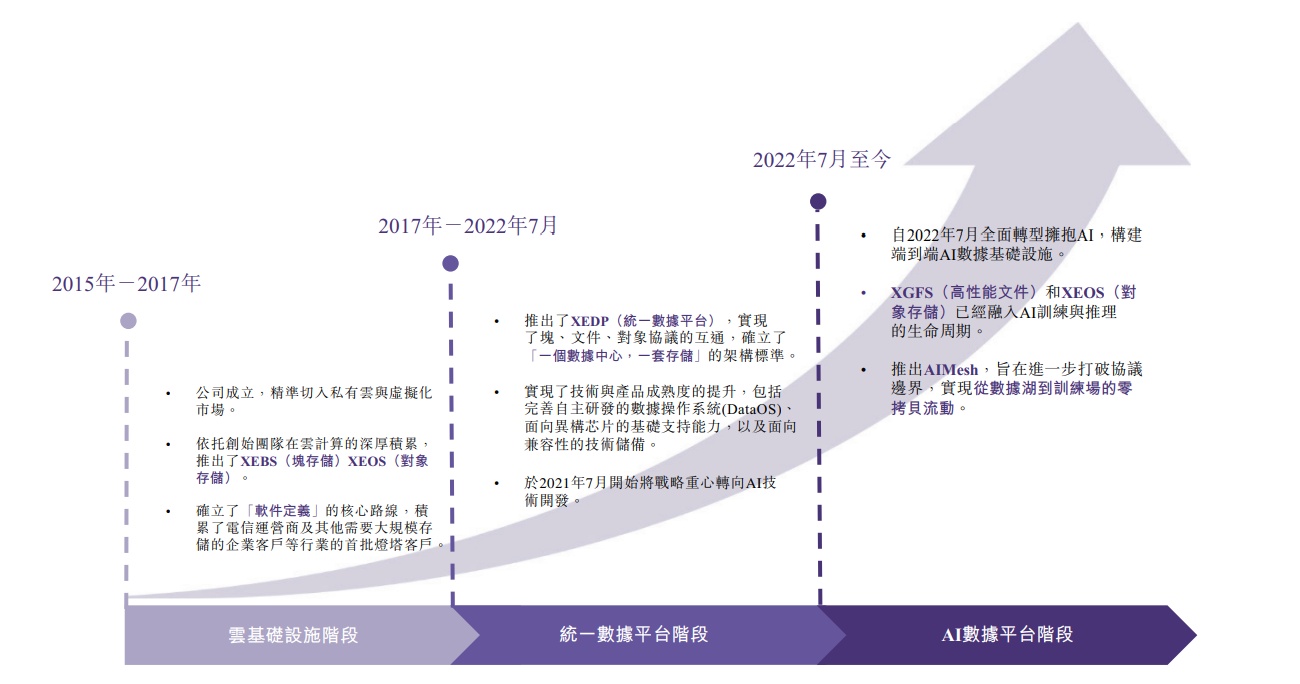
Core Viewpoint - The global storage chip market is experiencing a "bull market" driven by a supply-demand imbalance, with significant growth in high-end storage chip demand due to the explosion of AI computing power. Companies in the storage industry are leveraging capital markets to expand, including Beijing Starry Sky Technology Co., Ltd. (Starry Sky), which has submitted an IPO application to the Hong Kong Stock Exchange [1][2]. Company Overview - Starry Sky has become the second-largest provider of distributed AI storage solutions in China, holding a 10.4% market share as of 2024, and is the largest independent provider in this sector [1][2]. - The company has undergone three development phases since its establishment in 2015, evolving from a storage technology provider to a leader in the distributed AI storage solutions market [3][5]. Financial Performance - Starry Sky's revenue for 2023 and 2024 is projected to be 167 million and 172 million RMB, respectively, with losses of 181 million and 84 million RMB during the same periods. However, in the first three quarters of 2025, revenue is expected to reach 195 million RMB, reflecting a 65.4% year-on-year growth, with a net profit of 811,000 RMB [2][11][12]. - The company's gross margin improved significantly, reaching 63.7% in 2024, up from 55.4% in 2023, driven by product structure optimization and economies of scale in AI storage services [12][13]. Business Model and Services - Starry Sky primarily offers two core services: AI storage solutions and associated AI storage services, with the former contributing 80% of revenue in 2024. The AI data lake storage and AI training and inference storage solutions account for 40.7% and 39.3% of revenue, respectively [9][11]. - The company provides AI storage services that ensure the long-term stability of customer systems post-deployment, contributing to overall revenue growth [11]. Market Dynamics - The storage chip market is experiencing a price surge, with predictions of continued price increases into 2026, driven by supply shortages. Starry Sky stands to benefit from this trend as it offers software-defined solutions that optimize existing storage infrastructure [18][19]. - The competitive landscape includes major players like Huawei and Inspur, which provide comprehensive hardware and software solutions, posing challenges for Starry Sky as an independent software vendor [20][21]. Shareholder Structure - Starry Sky has undergone eight rounds of financing, with its latest valuation at 4.58 billion RMB. The shareholder structure includes a mix of founders, professional investment institutions, and state-owned enterprises, reflecting strong confidence in the company's future [6][8].
新股前瞻|AI存储成市场风口,巨头环伺下的星辰天合能否突围?
Zhi Tong Cai Jing· 2026-02-04 08:13
Core Viewpoint - The global storage chip market is experiencing a bull market driven by a supply-demand imbalance, with significant growth in high-end storage chip demand due to the explosion of AI computing power. Companies in the storage industry, including Beijing Starry Sky Technology Co., Ltd. (Starry Sky), are leveraging capital markets for growth opportunities amid this favorable industry environment [1][10]. Company Overview - Starry Sky has submitted its IPO application to the Hong Kong Stock Exchange, focusing on enterprise-level AI storage solutions. It holds a 10.4% market share in China's distributed AI storage solutions market, making it the second-largest provider in this sector [1][2]. - The company has undergone three developmental phases since its establishment in 2015, evolving from a storage technology provider to a leader in the distributed AI storage solutions market [3][4]. Financial Performance - Starry Sky's revenue for 2023 and 2024 is projected to be 167 million and 172 million RMB, respectively, with losses of 181 million and 84.18 million RMB. However, in the first three quarters of 2025, the company reported revenue of 195 million RMB, a 65.4% year-on-year increase, and a net profit of 8.11 million RMB, marking a turnaround from a loss of 65.51 million RMB in the previous year [2][7]. - The company's revenue growth is attributed to increased demand for AI storage solutions, with significant order increases for both AI data lake storage and AI training and inference storage solutions [8][9]. Market Position and Competition - Starry Sky ranks second in the Chinese distributed AI storage solutions market, with a market share of 10.4%, trailing behind Huawei, which holds 14.7%. The company faces competition from major tech giants like Huawei, Inspur, and H3C, which offer comprehensive hardware and software solutions [10][12]. - The ongoing bull market for storage chips is expected to benefit Starry Sky, as its software-defined solutions help clients optimize existing storage infrastructure amid rising hardware costs [11]. Shareholder Structure - Starry Sky has completed eight rounds of financing since its inception, with the latest round in December 2022 valuing the company at 4.58 billion RMB. The shareholder structure includes a mix of founders, professional investment institutions, and state-owned enterprises, reflecting strong confidence in the company's future [4][5]. Revenue Model - The company primarily generates revenue from two core services: AI storage solutions and associated AI storage services, with the former contributing 80% of total revenue in 2024. The AI data lake storage and AI training and inference storage segments are crucial components of this revenue model [6][9].
