
陶氏公司

Search documents
行业聚焦:全球聚乙烯行业头部生产商市场份额及排名调查
QYResearch· 2026-01-19 04:50
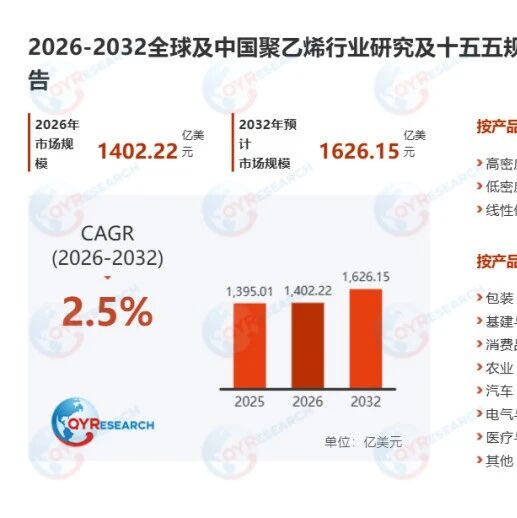
Core Viewpoint - Polyethylene (PE) is a widely used thermoplastic resin with a stable global consumption of approximately 120 million tons, growing at an annual rate of about 3% [4][5]. Market Overview - Polyethylene is a fundamental component of the petrochemical industry, with China being the largest consumer, accounting for about one-third of global consumption [4]. - The industry is transitioning from rapid expansion to a phase of supply-demand rebalancing, characterized by cyclical fluctuations in market conditions [4]. - Production is concentrated in regions with cost advantages, such as the Middle East and North America, while Asia-Pacific, particularly China, is a key center for demand and new capacity [4][7]. Application Structure - The primary applications of polyethylene are in various types of films and flexible packaging, which account for nearly half of total consumption [5]. - Other significant applications include pipes, containers, electrical insulation, and automotive parts, with different polyethylene types serving specific roles [5]. Cost Structure and Equipment Characteristics - The main cost driver for polyethylene production is the upstream ethylene monomer, which can be derived from various sources [6]. - Raw material and energy costs typically account for 60% to 70% of total costs, while the remaining costs include depreciation, labor, and environmental compliance [6]. - New world-class facilities often utilize integrated refining and petrochemical processes, achieving production capacities of 300,000 to 700,000 tons per year [6]. Industry Chain and Competitive Landscape - Polyethylene serves as a crucial link between upstream resources and downstream industries such as packaging, construction, and automotive [7]. - The industry is characterized by high concentration, with major players including Sinopec, ExxonMobil, and Dow, among others [10][7]. - Future capacity is expected to concentrate in regions with resource advantages, and competition will intensify as companies shift towards high-performance materials and sustainable practices [7]. Market Competition and Scale - The top 10 polyethylene producers globally hold approximately 46% of the market share [10]. - High-density polyethylene (HDPE) is the leading product type, accounting for 43.80% of the market [11][13]. Future Outlook - The report anticipates that during the 14th Five-Year Plan, China will focus on high-quality development and technological innovation, which will influence the polyethylene market dynamics [23]. - The analysis includes projections for supply and demand, competitive landscape, and potential opportunities along the Belt and Road Initiative [23].

ICIS“2026年全球最具影响力化工领袖40强”榜单出炉
Quan Jing Wang· 2026-01-16 01:42
Core Viewpoint - The ICIS "Top 40 Most Influential Chemical Leaders Globally by 2026" list recognizes CEOs and senior executives who have made significant positive impacts on their companies and the chemical industry [1] Group 1: Rankings and Notable Leaders - Dr. Sultan Ahmed Al Jaber, CEO of Abu Dhabi National Oil Company (ADNOC), ranks first on the list [1] - Abdulrahman Al-Fageeh, CEO of Saudi Basic Industries Corporation (SABIC), is in second place [1] - Jim Fitterling, CEO of Dow, holds the third position [1] - Chinese chemical leaders include Xiang Jiong Jiong, General Manager of Rongsheng Petrochemical, ranked 16th; Liao Zengtai, Chairman of Wanhua Chemical, ranked 17th; and Dai Houliang, Chairman of China National Petroleum Corporation, ranked 18th [1] Group 2: Evaluation Criteria - The selection criteria for the rankings include five dimensions: project management capability, profitability and shareholder value creation, industry advocacy, mergers and acquisitions and portfolio management, as well as innovation and ESG (Environmental, Social, and Governance) performance [1]



全球涂料研发哪家强?PPG/阿克苏/宣伟/立邦/艾仕得等上榜
Xin Lang Cai Jing· 2026-01-13 11:27
Group 1 - The report by the European Commission reveals significant changes in the global innovation landscape, highlighting that 25 Chinese chemical companies are among the top 2000 global industrial R&D investors for 2025 [2][7] - Among the 2000 companies, there are 98 chemical firms, with a total R&D investment of 26 billion euros in 2024, averaging 1.32 million euros per chemical company [2][7] - Major international paint companies such as PPG, AkzoNobel, Sherwin-Williams, Nippon Paint, RPM, and Axalta are included in the list, while Asian Paints from India did not make the cut [2][7] Group 2 - PPG Industries ranks 515th with an R&D investment of 415.82 million euros in 2024, showing a slight decrease of 0.23% year-on-year [4][9] - AkzoNobel ranks 755th with an R&D investment of 276 million euros, reflecting a year-on-year increase of 9.96% [4][9] - Sherwin-Williams ranks 917th with an R&D investment of 209.2 million euros, marking a year-on-year growth of 10.53% [4][9] Group 3 - The total R&D investment of the top 2000 companies is 144.6 billion euros, accounting for over 90% of global corporate R&D investments [5][10] - The distribution of companies includes 674 from the United States, 581 from China, 318 from the European Union, and 192 from Japan [5][10] - The top ten companies by R&D investment include Amazon, Alphabet, Meta, Microsoft, Apple, Huawei, Samsung, Volkswagen, Johnson & Johnson, and Intel [5][10]
Elastomers Applications and Global Markets, 2024-2025 and 2029, Profiles of Leading Companies - BASF SE, Dow, LG Chem, Covestro AG and Arkema
Globenewswire· 2026-01-13 09:02
Core Insights - The global elastomers market was valued at $112.7 billion in 2024 and is projected to grow to $177.7 billion by 2030, with a compound annual growth rate (CAGR) of 8.1% from 2025 to 2030 [1][7]. Market Dynamics and Growth Factors - Increased production of lightweight automotive components, electric vehicles (EVs), medical devices, and consumer electronics is creating new opportunities for elastomer manufacturing [2]. - Advanced medical treatments and the demand for biocompatible elastomers are driving global demand, with applications in various medical devices such as ECG sensors and disposable medical devices [3]. - The demand for EVs and lightweight vehicles positively impacts the elastomers market, as they can replace some metal and ceramic compounds, aiding manufacturers in reducing their carbon footprint [4]. Report Scope - The report covers various types, processes, and end uses of elastomers, with estimated values based on manufacturers' total revenue, projected in constant U.S. dollars [5]. - It includes a comprehensive analysis of global market trends, historical revenue data, and forecasts for the elastomers market [10]. Key Attributes - The report consists of 153 pages, covering a forecast period from 2025 to 2030, with an estimated market value of $120.4 billion in 2025 and a forecasted value of $177.7 billion by 2030 [7]. Emerging Technologies and Developments - The report highlights the evolution of vitrimer polymers technology, development of polyolefin catalysts, and the use of AI systems for TPPU production as key technological advancements [11]. Market Segmentation - The elastomers market is segmented by type (thermosets and thermoplastics), process (injection molding, extrusion, adhesive, coating, and others), end use (automotive, industrial, medical, consumer goods, building and construction, and others), and region (North America, Europe, Asia-Pacific, South America, and the Middle East and Africa) [15]. Companies Featured - Leading companies in the elastomers industry include BASF, Dow, LG Chem, Covestro AG, and Arkema, among others [12][15].



跨越边界的认知:QYResearch 如何通过研究连接不同行业?
QYResearch· 2026-01-12 09:00
Core Viewpoint - The article emphasizes the importance of breaking down information silos in various industries to foster collaboration and innovation, highlighting QYResearch's role as a catalyst in connecting different sectors through comprehensive data analysis and research [2][4]. Group 1: Company Background and Development - QYResearch has been dedicated to building a cross-industry research ecosystem for 18 years, starting from its establishment in 2007, focusing on providing detailed data analysis for enterprises [4]. - The company has expanded its research capabilities across 36 industry research centers since 2015, keeping pace with global industrial transformations [4]. - QYResearch has established research centers in 10 countries, including China, the USA, Japan, South Korea, and Germany, creating a unique advantage of "global vision + local insight" [4]. Group 2: Resource System and Research Capabilities - The company boasts a comprehensive resource system with over 90 million database entries, integrating more than 200 customs databases and 300 third-party databases, covering the entire industry chain from raw material supply to market consumption [5]. - QYResearch has a team of over 180 full-time professional analysts who possess industry expertise and interdisciplinary research capabilities, enabling them to interpret the intrinsic connections between different industries [5]. - The establishment of a unique 30-angle interview confirmation system ensures data authenticity and accuracy, laying a solid foundation for cross-industry analysis [5]. Group 3: Industry Coverage and Research Focus - QYResearch has developed a "comprehensive yet precise" industry coverage, serving over 30 major categories and more than 300 sub-industries, allowing it to capture key intersections and overlapping market demands across various fields [6]. - The research extends to critical areas such as semiconductor materials, eco-friendly packaging films, and brain-computer interface applications, demonstrating the company's extensive reach in global industries [6]. Group 4: Technology-Driven Research and Global Network - The company employs a technology-driven research system that integrates data collection, analysis, and application, utilizing its proprietary QYR Data database with over 80 million product information entries [7]. - QYResearch's global presence enhances its ability to connect industries, with localized research teams understanding regional industrial characteristics and market demands [8]. Group 5: Customized Services and Client Solutions - QYResearch offers customized research reports and consulting services tailored to the specific needs of different industry clients, facilitating precise resource integration [9]. - The company has successfully assisted clients like Dow Chemical and Three Squirrels by providing comprehensive market analysis that combines insights from various sectors, enabling effective product development and market entry strategies [9][11]. Group 6: Case Studies and Practical Applications - The article presents case studies demonstrating how QYResearch's research has facilitated cross-industry collaboration, such as Caregen's expansion into the cosmetic market through tailored market analysis [10]. - Other examples include Three Squirrels optimizing its plant protein beverage strategy and Stryker Medical leveraging QYResearch's reports for technological collaboration in the medical field [11][12]. Group 7: Future Outlook and Strategic Focus - QYResearch aims to enhance its cross-industry research capabilities by focusing on emerging industries like renewable energy, semiconductors, and biotechnology, aligning with global trends [13]. - The company plans to transition from a "report delivery" model to a "long-term partnership" approach, providing ongoing updates and strategic consulting to clients [14]. - QYResearch is committed to expanding its global footprint and local service network to eliminate information barriers across regions and industries [14].

MMA及丙烯酸酯市场继续承压
Zhong Guo Hua Gong Bao· 2026-01-12 03:37
Group 1 - The global MMA and acrylate market will face uneven demand, changing trade flows, and cautious procurement attitudes in 2026, despite signs of tightening supply in some regions [1] - In Europe, MMA demand is weak in Q1 2026, but the market is expected to tighten due to the closure of arbitrage opportunities from Asia, with local producers competing for contracts [1] - The average CIF price of MMA in Northwest Europe was €1297.18/ton in November 2025, nearing the offshore price from Asia, leading to a halt in imports [1] Group 2 - Middle Eastern low-cost MMA supplies are pressuring the European market, contributing to price declines, while the LiMA facility in Texas is ramping up production, potentially increasing U.S. exports to Europe [2] - The MMA export volume from the U.S. is expected to grow at a CAGR of 3.46% over the next five years, positioning the U.S. as a net exporter [2] - In the acrylate market, buyers in Europe are securing attractive contract discounts, with a preference for long-term contracts to ensure stable supply [2] Group 3 - The U.S. MMA market's performance will heavily depend on the Federal Reserve's interest rate policy, as real estate demand constitutes 85% to 90% of MMA's end-use [3] - Despite maintenance at key facilities, U.S. MMA spot prices remained between 87 to 91 cents/lb in Q4 2025, with a modest demand increase of 1% to 2% expected in 2026 [3] - The U.S. acrylate market faces challenges, with weak downstream demand and complex trade flows due to tariff policies, leading to a shift towards Latin American sources [3] Group 4 - In Asia, MMA prices are expected to decline in 2026 due to weak demand and high inventories, with Chinese and Southeast Asian offshore prices continuing to fall [4] - India's BA market is undergoing structural changes with new domestic production capabilities, reducing reliance on imports and leading to the lowest prices since the pandemic [4] - The total BA production capacity in India is projected to reach 280,000 tons/year, meeting 70% to 75% of domestic demand, fundamentally altering market dynamics [4]
欧洲塑协牵头构建塑料循环体系
Zhong Guo Hua Gong Bao· 2026-01-12 03:34
Core Viewpoint - The European Plastics Association has announced that Rob Ingram, CEO of INEOS Olefins & Polymers Europe, will take over as the association's president starting January 1, 2026, focusing on promoting the circular economy within the industry [1] Group 1: Leadership Changes - Rob Ingram will succeed Benny Malmsten, Vice President and Head of Sustainability at Chevron Phillips Chemical [1] - The association has elected three vice presidents from Dow Chemical, Borealis, and Evonik Industries [1] Group 2: Industry Challenges - The European plastics industry is at a critical turning point, with unprecedented pressure on its competitiveness [1] - The market share of European plastic production has significantly declined from 22% in 2006 to an expected 12% by 2024, indicating a rapid and ongoing loss of competitiveness [1] Group 3: Strategic Goals - Ingram emphasizes the need for coordinated action across the entire value chain and urgent policy measures to support this key European strategic industry [1] - The association aims to achieve 65% circularity in plastic products and climate neutrality by 2050 under Ingram's leadership [1] - The member companies of the association account for 90% of the polymer production in the EU27, Norway, Switzerland, and the UK [1]
涨价!涨价!化工悄悄新高了...
Xin Lang Cai Jing· 2026-01-07 01:21
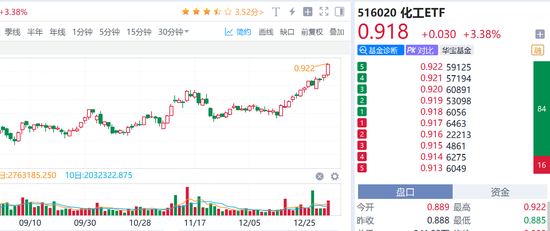
Core Viewpoint - The chemical sector is experiencing a price increase driven by supply constraints and emerging demand, with significant contributions from policy guidance and industry self-discipline [6][7]. Group 1: Market Performance - The chemical ETF surged over 3.3% on January 6, reaching a new high not seen in 22 years [3]. - The chemical ETF's total size has increased to 3.893 billion yuan, marking a historical peak since its inception in August 2025 [4]. Group 2: Price Dynamics - Wanhua Chemical plans to continuously raise global prices for core products like MDI/TDI starting December 2025, aligning with international giants such as BASF and Dow [6]. - The price of lithium hexafluorophosphate and electrolytes saw significant quarterly increases of 185.71% and 92.41%, respectively, in Q4 2025, leading to a sharp recovery in profitability for related companies [7]. Group 3: Industry Fundamentals - After approximately three and a half years of a downturn, the chemical industry is witnessing a peak in capital expenditure, with supply expansion slowing down [6]. - Policies aimed at reducing overcapacity and stabilizing prices are accelerating profit recovery in the sector [6]. Group 4: Demand Factors - Expectations of a global interest rate cut are boosting traditional demand, while emerging fields such as new energy, energy storage, and AI are providing new growth momentum [6]. Group 5: Company Performance - Tianqi Materials, a major component of the chemical ETF, forecasts a net profit of 1.1 to 1.6 billion yuan for 2025, representing a year-on-year increase of 127.31% to 230.63% [6]. - The company's Q4 performance is expected to be particularly strong, with a projected net profit of approximately 929 million yuan, a 508% increase compared to Q3 [6].

化工行业景气回升,化工ETF嘉实(159129)把握行业复苏机遇
Xin Lang Cai Jing· 2026-01-06 05:32
Group 1 - The core viewpoint is that the chemical industry is experiencing a recovery phase from a cyclical bottom, with chemical product price indices expected to stabilize and improve profitability as downstream companies replenish inventory [2] - The China Chemical Industry Association and the Phosphate Fertilizer Association held a meeting to ensure the supply of sulfuric acid resources for phosphate fertilizer production, stabilizing agricultural supply for the spring farming season [1] - Wanhua Chemical has continuously raised global prices for core products such as MDI and TDI since December 2025, in line with international giants like BASF and Dow, driven by industry-wide maintenance and rising raw material costs [1] Group 2 - The top ten weighted stocks in the CSI Sub-Industry Chemical Theme Index account for 45.31% of the index, with major companies including Wanhua Chemical, Salt Lake Industry, and Hengli Petrochemical [2] - The chemical industry is seeing new growth engines from emerging applications in AI, OLED, and robotics, with semiconductor materials expanding due to demand from computing power [2] - The chemical ETF managed by Harvest (159129) closely tracks the CSI Sub-Industry Chemical Theme Index, focusing on the new economic cycle amid the "anti-involution" backdrop [2][3]


烧碱市场要闻与数据:需求季节性下滑,关注宏观动态
Hua Tai Qi Huo· 2026-01-04 11:53
1. Report Industry Investment Rating No relevant content provided. 2. Core Views of the Report - The current spot price of caustic soda is stable with a slight decline. The supply side is operating at a high level, and the demand side shows weakening trends. The overall supply - demand situation is weak. The future focus is on changes in liquid chlorine prices, device dynamics, and the implementation of macro anti - involution details [3]. - The PVC market was weak in the early part of the month, rebounded due to macro - sentiment, and then the macro - sentiment faded, with the overall supply - demand situation remaining weak. It is expected to fluctuate in the near future, and attention should be paid to subsequent device maintenance and macro - side policies [6]. 3. Summary According to the Directory 3.1 Basis Strategy Analysis - **Caustic Soda**: The basis of caustic soda maintains a C - structure. The spot price first fell, then rose, and then fell again. The inventory is at a high level, and the basis is expected to continue to weaken. A reverse cash - and - carry strategy is recommended [12]. - **PVC**: The basis of PVC also shows a C - structure. After the price hit a new low, the supply - demand situation improved marginally, and the basis strengthened slightly. However, it is expected to weaken again in the future, and a reverse cash - and - carry strategy is recommended [12]. 3.2 Caustic Soda Price & Spread - In December, the spot price of caustic soda first fell, then rose, and then fell again. The high - level operation of production led to an oversupply situation and inventory accumulation. The demand from alumina is relatively stable, but the procurement price has been adjusted downward. Non - aluminum downstream demand enters the off - season in January [13]. 3.3 PVC Price & Spread - In December, the PVC price first fell and then rose. The high inventory led to a continuous decline in price, and the low price improved the supply - demand situation marginally. Macro - sentiment boosted the long - term demand expectation, but the overall supply - demand situation remained weak after the macro - sentiment faded [35]. 3.4 Cost and Profit - The comprehensive profit of chlor - alkali has been significantly reduced and is at a low level compared to the same period. The profit of PVC upstream raw materials is extremely compressed. The price of ethylene is expected to remain weak in January [52]. 3.5 Caustic Soda Supply - In December, new caustic soda production capacity was put into operation, and the overall supply remained at a high level. There are few planned maintenance enterprises in January, and the supply is expected to remain high due to the good market conditions of liquid chlorine [70]. 3.6 Liquid Chlorine Price and Its Downstream Products - In December, the price of liquid chlorine increased. The downstream demand supported the price, but in January, the terminal demand of some downstream products entered the off - season, and the price is expected to fluctuate slightly [82]. 3.7 PVC Supply - The overall PVC output remained high in December. All new production capacity has been put into operation, and the supply is still abundant. There is no new domestic production capacity in 2026, and the overseas supply contraction in December 2025 provided a small support to the market sentiment [98]. 3.8 Caustic Soda Downstream Demand - The demand from alumina is expected to weaken in the long - term. The non - aluminum downstream demand enters the off - season in January, and the demand of various industries is expected to decline seasonally [110]. 3.9 Caustic Soda Import and Export - The main import sources of domestic liquid caustic soda in November were Singapore, Norway, and Germany, and the main export destinations were Indonesia, Australia, and Canada. The export orders remain normal [132]. 3.10 PVC Downstream Demand - The downstream demand for PVC is weakening. The demand for pipes and profiles is affected by the sluggish real - estate market, while the film industry performs relatively well. The downstream demand is expected to decline further in January [145]. 3.11 PVC Import and Export - The BIS certification and anti - dumping duties of PVC in India have been cancelled, and the export expectation for 2026 is improving. The current PVC export maintains its resilience through price - for - volume strategy [156]. 3.12 Caustic Soda and PVC Inventory Data - The inventory of caustic soda increased in December due to factors such as production increase and weakening downstream demand. The PVC social inventory continued to increase, and the high - level futures warehouse receipts continued to suppress the PVC futures price [160].