鹏华

Search documents
麦高视野:ETF观察日志(2025-11-19)
Mai Gao Zheng Quan· 2025-11-20 05:45
- The report includes the construction of the RSI (Relative Strength Index) factor, which is calculated using the formula: $ RSI = 100 - 100 / (1 + RS) $, where RS represents the ratio of average gains to average losses over a 12-day period. RSI values above 70 indicate an overbought market, while values below 30 suggest an oversold market [2] - The report also introduces the calculation of net subscription (NETBUY), defined as $ NETBUY(T) = NAV(T) - NAV(T-1) * (1 + R(T)) $, where NETBUY(T) represents the net subscription amount, NAV(T) is the ETF's net asset value on day T, and R(T) is the return on day T [2] - The report tracks various ETFs categorized into "Broad-based" and "Thematic" indices, such as CSI 300, CSI 500, and industry-specific indices like non-bank financials, dividends, and China internet sectors. It provides daily performance metrics, including RSI values, net subscription amounts, and institutional holding percentages [2][4][7] - The RSI factor is evaluated as a useful indicator for identifying market conditions, such as overbought or oversold states, aiding in short-term trading decisions [2] - The net subscription metric is assessed as a valuable measure for understanding fund flows and investor sentiment towards specific ETFs [2] - RSI values for various ETFs range from 11.05 to 77.25, reflecting diverse market conditions across different indices and sectors [4][7] - Net subscription values vary significantly, with some ETFs showing positive inflows while others exhibit outflows, indicating mixed investor sentiment across different funds [4][7]
持有期基金成清盘主力 流动性风险不可不防
Zhong Guo Zheng Quan Bao· 2025-11-18 22:26
Core Insights - The number of public fund products (excluding asset management plans) that have been liquidated this year is approaching 200, with periodic open and holding period funds being the main contributors, accounting for over 40% of the total liquidated funds [1][3][4] - The survival space for actively managed equity funds continues to be squeezed due to the rapid development of index investing in recent years, with over 70 actively managed equity funds liquidated this year, representing nearly 40% of the total [2][3] - The design of holding period funds aims to reduce friction costs from investor behavior, but many investors have sacrificed liquidity without achieving satisfactory returns, leading to a poor investment experience [1][6][7] Fund Liquidation Trends - As of November 18, nearly 200 public funds have been liquidated this year, a decrease compared to the same period last year [2] - Among the liquidated funds, over 70 are actively managed equity funds, including various types such as mixed equity, flexible allocation, and balanced funds [2][3] - Notable liquidated thematic funds include those focused on carbon neutrality, advanced manufacturing, and healthcare, many of which were launched in 2022 and have net assets below 200 million yuan, triggering contract termination [2] Holding Period Fund Performance - Holding period funds, particularly those with fixed opening periods, have been the primary contributors to fund liquidations, with over 30 FOF products being affected [3] - Many fixed income products, including pure bond and "fixed income plus" funds, have also faced liquidation, with various terms ranging from 30 days to 30 months [3] - In the third quarter, the total number of holding period fund shares decreased by nearly 800 billion, with significant reductions in mixed equity and pure bond funds [4] Market Dynamics - Despite the overall decline, some categories of holding period funds, such as "fixed income plus" and FOFs, have seen growth, indicating a mixed market response [5] - The design of holding period funds is intended to limit frequent trading and enhance returns, but the actual investment outcomes are influenced by market conditions and fund management capabilities [6][7] - Investors are advised to carefully consider liquidity risks and the overall market environment when investing in holding period funds, as these factors can significantly impact their investment experience [6][7]
债券ETF规模突破7000亿元!年内吸金超百亿的债券型ETF达20只
Ge Long Hui· 2025-11-17 08:28
Core Insights - The bond ETF market has reached a new high with a total scale exceeding 700 billion yuan, marking significant growth in 2023 [1] - There has been a net inflow of over 427 billion yuan into bond ETFs this year, with 20 ETFs attracting more than 10 billion yuan each [1] - Institutional investors dominate the bond ETF market, accounting for 92% of the total investors [1] Group 1: Market Overview - As of November 14, 2023, the total scale of bond ETFs is 706.29 billion yuan, a record high [1] - The bond ETF market has seen a notable expansion this year, with 53 bond ETFs contributing to the total scale [1] - The short-term bond ETF has attracted nearly 40 billion yuan, while the 30-year government bond ETF has seen over 29 billion yuan in net inflows [1] Group 2: Types of Bond ETFs - The main categories of bond ETFs include interest rate bond ETFs, credit bond ETFs, and convertible bond ETFs, each with distinct risk-return characteristics [2][3][4] - Interest rate bond ETFs are based on government bonds and policy financial bonds, while credit bond ETFs focus on corporate bonds [2][3] - Convertible bond ETFs serve as a hybrid between bonds and stocks, providing unique investment opportunities [4] Group 3: Factors Driving Growth - The growth of bond ETFs is driven by increased demand from investors in a low-interest environment, leading to heightened sensitivity to fund fees [5] - Regulatory support and product innovation have contributed to the introduction of 32 new bond ETFs this year [6] - Enhanced liquidity from market makers and broker-dealers has significantly improved the trading environment for bond ETFs, creating a positive feedback loop [6] Group 4: Future Outlook - The bond ETF market is expected to face challenges in 2025, with diminishing correlations between long-term bonds and both fundamental and liquidity factors [6] - Institutional behavior is increasingly influencing the bond market, with a shift towards equity-bond rebalancing due to declining risk-return ratios [6] - The asset management sector is anticipated to focus on multi-asset and multi-strategy developments in response to changing market conditions [6]
同比增长132%!主动权益基金发行回暖 募集规模同比翻倍
Zhong Guo Ji Jin Bao· 2025-11-16 17:24
Group 1 - The core viewpoint of the article highlights a significant recovery in the issuance of active equity funds, with a total of 276 new funds established this year, raising a total of 1410.68 billion yuan, representing a year-on-year increase of 132.25% [1][2][3] Group 2 - A notable indicator of the recovery in active equity fund issuance is the early closure of fundraising for many funds, with 73 funds closing early this year, including several "daylight funds" [3] - The reasons for the recovery in active equity fund issuance include a rebound in the A-share market since last year's fourth quarter, improvements in corporate earnings, and the introduction of policies encouraging long-term investment in equity markets [3][4] - The issuance of passive index products has also surged, with over 760 new index funds established this year, raising more than 5500 billion yuan, marking a year-on-year growth of 89.36% in number and 24% in scale [4] - The market is currently experiencing a phase where both active equity and passive index products are growing, with a shift towards more diverse investment tools [4]

发行,同比增长132%!
Zhong Guo Ji Jin Bao· 2025-11-16 12:00
Core Insights - The issuance of equity funds in China has significantly increased this year, with 276 active equity funds established and a total issuance scale of 141.068 billion yuan, representing a year-on-year growth of 132.25% [1][3][4] Fund Issuance Trends - A total of 276 active equity funds were established by November 14, with a combined issuance scale of 141.068 billion yuan, marking a 132.25% increase compared to the previous year [3][4] - Notably, 11 funds raised over 2 billion yuan, with the highest approaching 5 billion yuan, while the highest fundraising amount in the same period last year was less than 1.4 billion yuan [3][4] Early Closure of Fundraising - The early closure of fundraising for many active equity funds indicates a recovery in the market, with 73 funds closing early this year, including several "sunshine funds" [4] - Examples include the E Fund Technology Pioneer, which announced early closure with a fundraising cap of 2 billion yuan, and the China Universal XinYue Return fund, which sold out in one day with a cap of 1.5 billion yuan [4] Market Recovery Factors - The recovery in active equity fund issuance is attributed to the rebound of the A-share market since the fourth quarter of last year, driven by breakthroughs in sectors like AI, robotics, and innovative pharmaceuticals, leading to improved corporate earnings and market sentiment [4] - Policy initiatives such as the "Implementation Plan for Promoting Long-term Capital into the Market" and "Action Plan for Promoting High-Quality Development of Public Funds" have encouraged long-term investment in equity markets [4] Growth of Index Products - The issuance of passive index products has also surged, with over 760 new index funds established this year, totaling over 550 billion yuan, reflecting year-on-year growth of 89.36% in number and 24% in scale [6] - The market is entering a phase where both active equity and passive index products are growing together, with a wider variety of investment tools available [6] Future Outlook - The future performance of active equity funds will depend on their ability to consistently generate returns that exceed market performance and their differentiation from passive products [6] - Active equity products have shown good excess returns this year, particularly in a market environment favoring growth styles and emerging industries, suggesting a potential for continued strong performance in active management [6]
新能源车电池ETF领涨丨ETF基金日报
2 1 Shi Ji Jing Ji Bao Dao· 2025-11-14 03:05
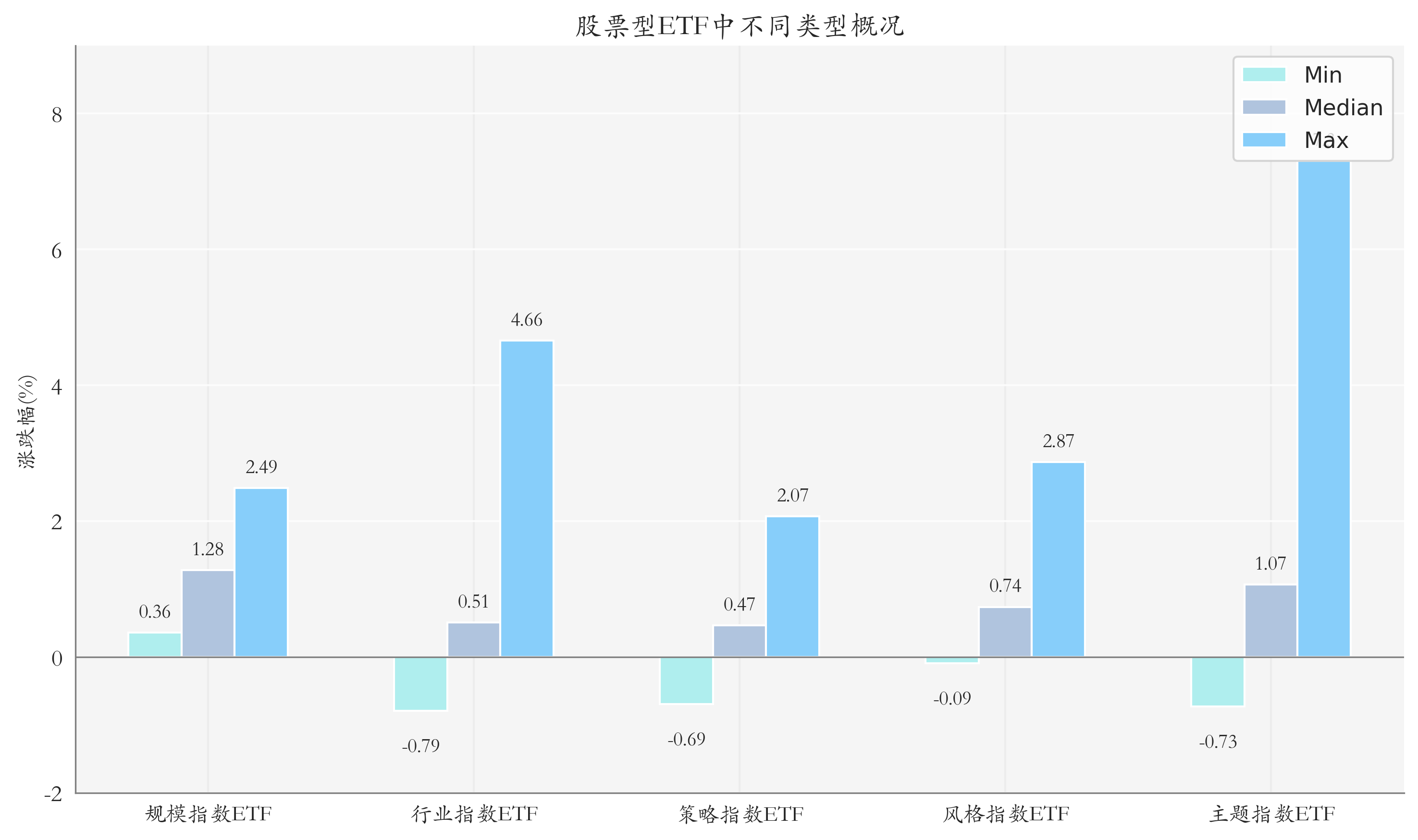
Market Overview - The Shanghai Composite Index rose by 0.73% to close at 4029.5 points, with a daily high of 4030.4 points [1] - The Shenzhen Component Index increased by 1.78% to close at 13476.52 points, reaching a high of 13488.63 points [1] - The ChiNext Index saw a rise of 2.55%, closing at 3201.75 points, with a peak of 3209.7 points [1] ETF Market Performance - The median return for stock ETFs was 1.08%, with the highest return from the Huaxia ChiNext ETF at 2.49% [2] - The Southern CSI New Energy ETF led the industry index ETFs with a return of 4.66% [2] - The top-performing thematic ETF was the Invesco CSI New Energy Vehicle Battery ETF, achieving a return of 7.3% [2] ETF Gains and Losses - The top three ETFs by gain were: Invesco CSI New Energy Vehicle Battery ETF (7.3%), GF CSI New Energy Vehicle Battery ETF (7.14%), and ICBC Credit Suisse CSI New Energy Vehicle Battery ETF (6.94%) [5] - The ETFs with the largest declines included: Huaxia CSI All-Share Utilities ETF (-0.79%), Harvest CSI Green Power ETF (-0.78%), and Penghua CSI Telecom Theme ETF (-0.73%) [6] ETF Fund Flows - The top three ETFs by inflow were: Southern ChiNext AI ETF (inflow of 545 million), Southern CSI 1000 ETF (inflow of 324 million), and Huaxia SSE 50 ETF (inflow of 321 million) [8] - The ETFs with the largest outflows were: Southern CSI Shenwan Nonferrous Metals ETF (outflow of 582 million), Guotai CSI A500 ETF (outflow of 421 million), and Huatai-PB CSI 300 ETF (outflow of 406 million) [9] ETF Margin Trading Overview - The highest margin buy amounts were for: Huaxia SSE Sci-Tech 50 ETF (580 million), Guotai CSI All-Share Securities Company ETF (391 million), and E Fund ChiNext ETF (388 million) [11] - The ETFs with the highest margin sell amounts included: Huatai-PB CSI 300 ETF (53.61 million), Southern CSI 500 ETF (22.02 million), and Huaxia SSE 50 ETF (12.57 million) [12] Institutional Insights - Xinda Securities anticipates a new upward cycle for lithium batteries driven by energy transition and domestic storage policies, predicting a 50% growth in storage demand by 2026 [13] - Kaiyuan Securities notes positive developments in the photovoltaic industry, with significant reductions in losses in upstream segments, and a robust demand in the storage sector, leading to sustained price increases for batteries [14]
晨会报告:哪些二级债基适配高波环境?-20251112
Shenwan Hongyuan Securities· 2025-11-12 01:01
Core Insights - The report discusses the adaptability of secondary bond funds in high volatility environments, emphasizing diverse strategies for selecting aggressive products [3][12]. - It highlights the importance of high allocation and growth styles in secondary bond funds, suggesting that funds with a weighted average stock PE above 30 times are classified as growth style funds [4][12]. - The report also notes the increasing investment in Hong Kong stocks by secondary bond funds, with a stock market value ratio reaching 11.21% in Q3 2025 [12]. Summary by Sections High Allocation Strategy - High allocation secondary bond funds typically maintain high positions, with an average convertible bond allocation exceeding 30% across 64 funds, including both conservative and aggressive styles [3][12]. - A three-dimensional selection system is recommended, focusing on high elasticity, favorable holding experience, and cost-effectiveness, evaluated through three core indicators and five sub-indicators [12]. Growth Style - Growth style funds are identified by their holding stocks with a PE ratio above 30, with evaluations based on holding experience and risk-return ratios, particularly the Sharpe ratio [4][12]. - The report emphasizes the need to consider industry rotation, portfolio construction methods, and the balance between growth and quality [4][12]. Hong Kong Stock Strategy - The report indicates a continuous increase in the proportion of Hong Kong stock investments within secondary bond funds, with specific funds maintaining stable positions in this market [12]. - It mentions that the investment limit for Hong Kong stocks is capped at 50% of the stock assets for products that can invest in Hong Kong stocks [12]. Tool-based Products - Tool-based products within secondary bond funds include strategies focused on innovation and micro-cap stocks, with specific funds targeting these areas [12]. - The report identifies representative products for micro-cap strategies and highlights the unique index-enhanced strategy products focused on innovation [12].
申万宏源证券晨会报告-20251112
Shenwan Hongyuan Securities· 2025-11-12 00:44
Core Insights - The report emphasizes the diverse strategies of secondary bond funds and the significant differences in their risk-return profiles, suggesting a focus on high-positioning and growth-oriented funds to capitalize on high-growth sectors [3][12] - It highlights the increasing investment in Hong Kong stocks by secondary bond funds, with the proportion reaching 11.21% of stock market value in Q3 2025, indicating a trend towards technology-driven assets [12] - The report outlines a three-dimensional selection system for high-elasticity products, focusing on high performance, good holding experience, and cost-effectiveness [12] Summary by Sections Secondary Bond Fund Strategies - The report identifies four main strategies for selecting secondary bond funds suitable for high volatility environments: high positioning, growth style, Hong Kong stock strategy, and tool-type products [3][12] - High-positioning funds typically have an average convertible bond position exceeding 30%, with 64 funds identified, ranging from conservative to aggressive styles [12] - Growth style funds are characterized by a weighted average PE ratio above 30, with evaluations based on holding experience and risk-return ratios [4][12] Hong Kong Stock Strategy - The report notes a continuous increase in the investment ratio of secondary bond funds in Hong Kong stocks, with specific funds maintaining stable positions [12] - It mentions that the investment limit for products that can invest in Hong Kong stocks is capped at 50% of their stock assets [12] Tool-Type Products - The report discusses the emergence of tool-type products within secondary bond funds, including strategies focused on innovation and micro-cap stocks [12] - It highlights specific funds that target dual innovation strategies and micro-cap stocks, indicating a growing trend in specialized investment approaches [12]
单周募集265亿元!基金发行回暖,创新与多元化趋势显现
Zheng Quan Shi Bao Wang· 2025-11-10 02:00
Core Insights - The public fund issuance market has shown a strong recovery trend, with a total fundraising scale of 26.5 billion yuan during the week of November 3 to November 9, indicating a warming market sentiment [1][4] - Active equity products have become the dominant force in the issuance market, with stock and mixed funds raising a total of 21.8 billion yuan, accounting for 82.4% of the total issuance [1][2] - There is a notable increase in enthusiasm for overseas investments, highlighted by the establishment of two QDII funds focused on the Brazilian market, which collectively raised over 5.1 billion yuan [1][3] Fundraising Details - A total of 41 new funds were established during the week, with an average fundraising scale of 646 million yuan [1] - Among active equity funds, 21 stock funds raised 9.4 billion yuan (35.6%), while 9 mixed funds raised 12.4 billion yuan (46.8%), together exceeding 80% of the total issuance [1][2] - Bond funds raised 4.1 billion yuan (15.3%), while QDII funds raised 600 million yuan (2.3%) [1] Market Trends - The surge in active equity funds is attributed to improved market sentiment and increased risk appetite among investors, as well as proactive positioning by fund companies [2][4] - Leading institutions such as E Fund, Fortune, and Penghua have launched representative products, showcasing a variety of strategies including quantitative stock selection and industry themes [2] - The issuance of QDII funds targeting emerging markets like Brazil reflects a growing interest in international asset allocation opportunities [3]
单周募集265亿元!基金发行回暖,创新与多元化趋势显现
券商中国· 2025-11-10 01:54
Core Viewpoint - The public fund issuance market is experiencing a significant recovery, with a total fundraising scale of 26.5 billion yuan last week, indicating a strong growth momentum and increasing investor confidence in equity assets [1][4]. Fundraising Overview - A total of 41 new funds were established last week, with an average fundraising scale of 646 million yuan. Among these, actively managed equity funds dominated the market, raising a total of 21.4 billion yuan from stock funds and 12.4 billion yuan from mixed funds, together accounting for 82.4% of the total fundraising [1][2]. - Bond funds raised 4.1 billion yuan, accounting for 15.3%, while QDII funds raised 600 million yuan, making up 2.3% of the total [1]. Active Equity Funds - The active equity funds are benefiting from recent market stabilization and increased investor risk appetite. Major institutions like E Fund, Fortune, and Penghua have launched representative products, with strategies including quantitative stock selection and industry themes [2]. - Notable products include E Fund's Industrial Selection A, which raised over 3.16 billion yuan, and other funds like Fortune Xinghe A and Penghua Qihang Quantitative Stock Selection, which raised 3 billion yuan and 2.98 billion yuan respectively, all completing subscriptions within a day [2]. International Investment Trends - There is a notable increase in enthusiasm for overseas investments, highlighted by the establishment of two QDII funds focused on the Brazilian market, which collectively raised over 5.1 billion yuan. This reflects a strong interest in emerging market opportunities [3]. - The fundraising for these QDII funds was rapid, with E Fund's ETF attracting over 2.5 billion yuan in subscriptions on the first day, indicating high investor demand for international asset allocation [3]. Market Outlook - The recent trends in the public fund issuance market suggest a phase of recovery, with active equity funds leading the way. If this trend continues, it could bring more incremental capital into the A-share market, further boosting investor confidence [4].