
Rokid

Search documents
2025年的智能眼镜,一个能打的都没有?
投中网· 2025-12-19 04:36
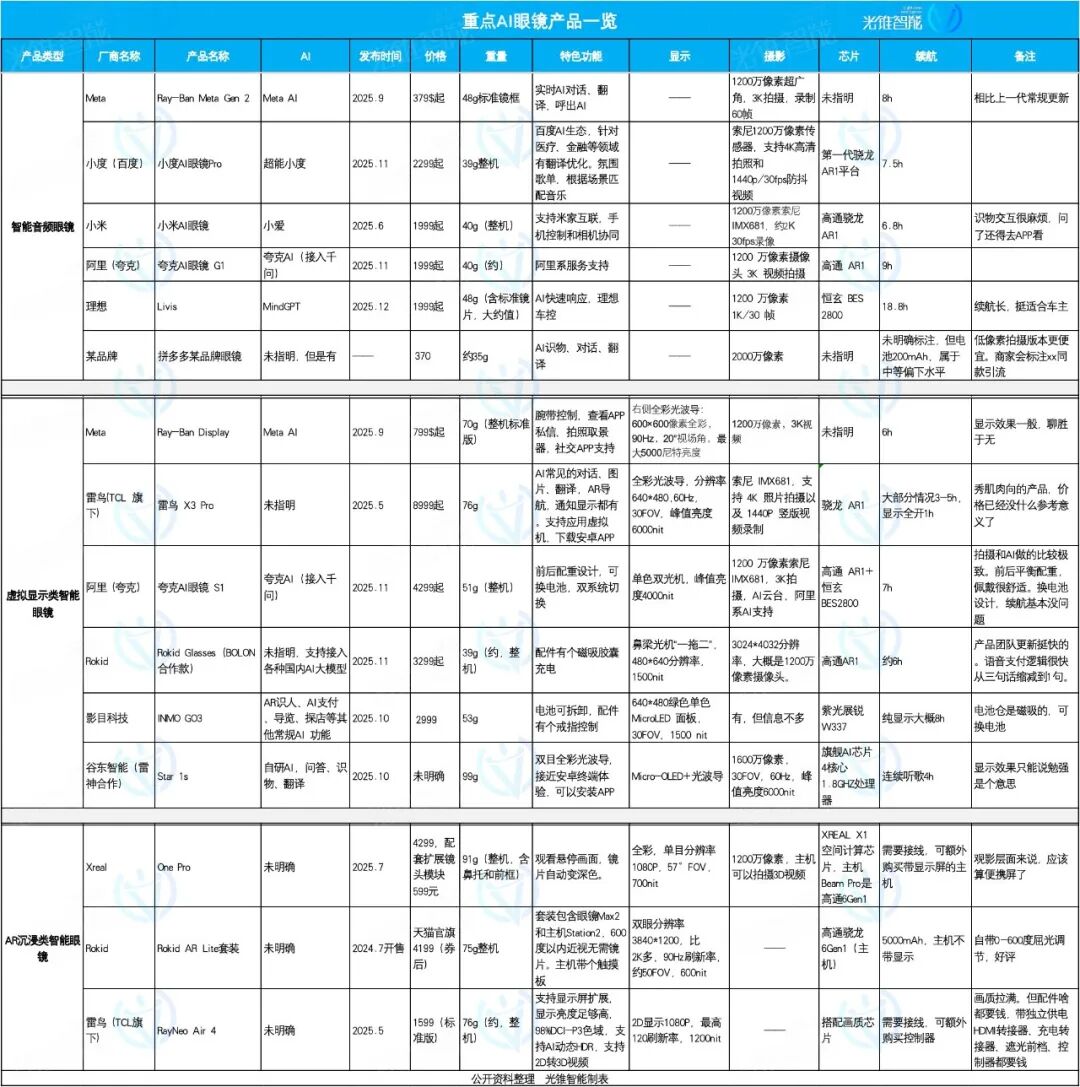
Core Viewpoint - The article discusses the rapid growth and competitive landscape of the AI smart glasses market, highlighting the diverse range of products and the lack of standardization in the industry [5][6]. Group 1: Market Overview - By 2025, it is estimated that around 30-40 companies will release AI smart glasses, with some institutions reporting over a hundred [5]. - The sales of smart glasses are increasing rapidly, with a 2500% year-on-year growth in transaction volume during the 2025 Double Eleven shopping festival, making it one of the fastest-growing categories in the 3C digital industry [5]. Group 2: Product Classification - Smart glasses can be classified into five levels based on their intelligence: - L1: Non-interactive, video playback only - L2: Interactive via headphones, no object recognition - L3: Can capture video and recognize objects with AI interaction - L4: Includes AR functionality for real-time display of information - L5: Full-color display with advanced interaction capabilities [8][11]. Group 3: Current Product Landscape - Nearly half of the smart glasses from major manufacturers fall into L2 and L3 categories, priced generally under 2000 yuan, resembling smart headphones more than traditional smart glasses [11]. - Products priced above 3000 yuan typically target tech-savvy consumers, with limited offerings in the L4 category, such as the Thunderbird Innovation X3 Pro, which struggles with battery life and weight issues [12][13]. Group 4: Sales Data and Trends - In Q3 2025, the Chinese smart glasses market shipped 623,000 units, a 62.3% year-on-year increase, with audio-video capturing glasses accounting for 454,000 units and AR/VR glasses for 169,000 units [18]. - The market for consumer-grade AR/VR glasses saw a similar trend, with 169,000 units sold, but the exact sales figures for AR-enabled smart glasses remain unclear due to combined reporting with VR devices [19]. Group 5: Future Outlook - IDC predicts that by 2025, smart glasses shipments in China will exceed 2.9 million units, with a year-on-year growth rate of over 121% [22]. - Despite the optimistic projections, the industry is still maturing, and the actual demand for smart glasses has yet to be established, with many products still seen as luxury items rather than necessities [22][23]. Group 6: Target Markets and Strategies - Brands are advised to focus on specific user groups, such as car owners or content creators, to create more defined use cases for smart glasses [25]. - The current wave of smart glasses development is closely tied to the AI trend, with many companies seeking to leverage their AI capabilities through wearable technology [26].



当眼镜成为科技圈的年抛型风口,AI眼镜能打破魔咒吗?
3 6 Ke· 2025-12-17 09:58
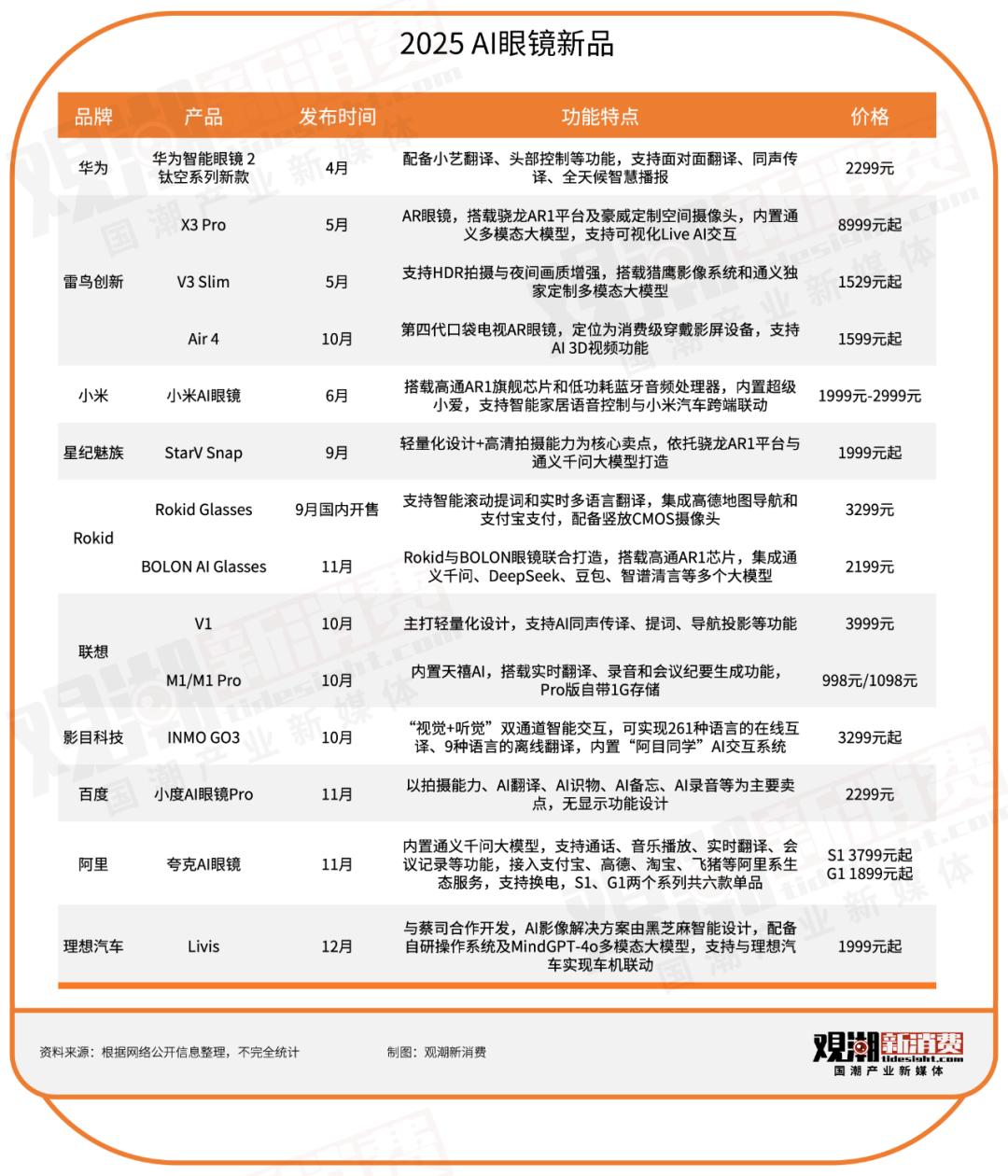
巨头的入局往往是一条赛道成熟的标志,而Rokid、雷鸟创新、影目科技等创业公司是这条赛道的铺路者,如今他们相逢于"AI眼镜元年"。 近日,2025微博年度关键词出炉,是一个古早又新鲜的词汇:赛博。 这个词诞生已近百年,在互联网语境中更是历经多轮传播与演变,其核心含义早已无需过多解释,还衍生出了层出不穷的网络新梗;说它新鲜,则源于其 承载的独特内核——永远锚定着对未来天马行空的想象。 曾经承载"赛博"之名的科幻畅想,一旦从虚幻照进现实,便会褪去"赛博"的标签,而更前沿、更具未来感的构想,又会迅速接过"赛博"的话语权,让这个 词始终保持着对未知的探索与浪漫。 产品功能设计与产业链生产能力的成熟,让智能眼镜迅速进入销量增长的通道。IDC报告显示,2025年上半年全球智能眼镜市场出货量达406.5万台,同比 增长64.2%;2025年全球智能眼镜出货量将达到1205万台,同比增长18.3%;其中中国市场将突破275万台,同比增长107%,居全球第一。 2025年11月至今,联想、百度、阿里、理想接连推出了AI眼镜,加上此前就已入局的华为、小米,以及曾从腾讯手中抢下PICO的字节跳动,AI眼镜赛道 上已经聚集了互联网大 ...
数码家电行业周度市场观察-20251217
Ai Rui Zi Xun· 2025-12-17 08:38
Investment Rating - The report does not explicitly provide an investment rating for the industry Core Insights - The digital home appliance industry is experiencing a transformation driven by AI technology, with significant developments in various sectors including education, retail, and robotics [1][2][3][4][6][9][10] Industry Trends - The education sector is leveraging generative AI to enhance personalized services, with companies like Fenbi exploring AI-driven products despite facing competition and the need for continuous investment [1] - New retail is shifting from supply-driven to demand-driven management through AI, addressing issues like inventory backlog and customer loyalty [2] - The "human-vehicle-home" ecosystem is evolving with 5G, AI, and IoT technologies, enhancing user experience and creating new business models [3] - AI video content is becoming longer and more sophisticated, democratizing the creative process in the film industry [4] - The AI terminal ecosystem is developing rapidly, with significant growth in AI smartphones and smart wearables, driven by advancements in domestic computing chips [4] - The humanoid robot market is projected to grow significantly, driven by labor shortages and technological advancements, although challenges remain [4][6] - AI entrepreneurship is transitioning from model competition to scenario-based applications, as showcased at the World Internet Conference [6] - The home appliance market is shifting towards quality and innovation, with air conditioners performing well despite price wars, while the black appliance sector faces challenges [9] - The coffee machine market is experiencing growth due to consumer demand for high-quality coffee experiences, reflecting a shift towards premium products [9] - The "Double 11" shopping festival highlighted the significant role of AI in driving sales and transforming consumer decision-making in the home appliance sector [10] Top Brand News - Soul App is preparing for an IPO, focusing on AI-driven emotional value services, with a strong user base among Generation Z [13] - Alibaba is launching new AI products aimed at the consumer market, seeking to enhance its ecosystem and address internal strategic challenges [14] - Yushun Technology is on the verge of going public, having established itself as a leader in the humanoid robot sector [14] - Rokid is gaining traction in the smart glasses market, collaborating with various partners to enhance product functionality and user experience [16] - Kuaishou reported strong revenue growth, attributing part of its success to AI technology that enhances online marketing [17] - Black Sesame Intelligence is addressing challenges in robot mass production with a new intelligent computing platform [18]
AI眼镜大决战已到?对话9位操盘手和专家真相:蛋糕分得心慌慌
3 6 Ke· 2025-12-16 12:21
Core Viewpoint - The entry of major companies into the AI glasses market is seen as a double-edged sword, potentially benefiting both startups and established players by expanding the market rather than creating direct competition [1][4][15]. Group 1: Market Dynamics - Major companies like Xiaomi, Baidu, and Alibaba have entered the AI glasses market, with significant sales reported, indicating a growing interest and demand [3][11]. - The sales of lightweight, screenless AI glasses in China surged by 463% in the first half of 2025, marking a historical high [11][14]. - The overall market for AI glasses is expected to grow rapidly, with projections indicating that China's market could exceed 1 billion yuan within three years [14][15]. Group 2: Competitive Landscape - The competition is characterized by both major companies and startups coexisting, with startups like Rokid and Thunderbird also achieving significant sales milestones [3][8]. - Analysts suggest that the entry of large firms will accelerate market growth and user education, benefiting startups in the long run [15][18]. - The market is still in its early stages, and there is a consensus that it is not yet time for intense competition, as the focus remains on expanding the market [15][19]. Group 3: Financial Viability - Despite the surge in sales, many companies, including major players, are struggling to achieve profitability due to high R&D costs and competitive pricing strategies [19][20]. - Companies like Xiaomi and Alibaba have indicated that they do not rely on selling glasses for profit, highlighting the industry's current financial challenges [19][20]. Group 4: Supply Chain and Innovation - The supply chain is a critical factor, with major companies leveraging their negotiating power to drive down costs and improve product offerings [22][36]. - Startups are focusing on technological innovation and differentiation to carve out their niche in the market, often achieving breakthroughs that larger companies have not [29][33]. Group 5: Future Outlook - The AI glasses market is anticipated to reach a tipping point similar to the "iPhone moment" by 2025, with significant advancements expected in technology and user adoption [4][51]. - The industry is currently focused on enhancing user experience and integrating AI glasses into daily life, which is seen as essential for widespread acceptance [54][55].





复盘2025AI眼镜:百款产品的聚焦和分化
3 6 Ke· 2025-12-16 12:14
AI眼镜的玩家快要把行业"挤爆了"。 在过去的11月里,就有小度、夸克、Rokid等多家公司发布了AI眼镜新品。整个行业在大厂的扎堆涌入下,打得难舍难分。2026年,追觅也将 加入战场。 就连造车的理想,也按捺不住进来分一杯羹。 12月3日,理想AI眼镜Livis正式发布,起售价为1999元,当晚就被抢购一空。不少消费者抱怨称,"标准版以上的版本,根本抢不到货"。 理想Livis是一款整合了理想自家MindGPT大模型和用于自家车控的智能音频类眼镜。比起一个"替代"手机的智能终端,理想对AI眼镜的看法更像是智能 汽车的周边产品。以买一个驾驶场景的墨镜看待理想Livis,价格还算合理,毕竟线下配一个蔡司镜片的墨镜也要上千。 理想AI眼镜的出现,意味着,AI眼镜行业出现了一个定位更明确的玩家。 回顾2025这一年的AI眼镜新品,不难发现寻找定位是各大AI眼镜厂商推出新品的一大主题。 在AI、续航、硬件参数、软件落地、显示等AI眼镜的基础能力下,我们看到了夸克想要聚焦拍摄、雷鸟主打显示效果、Rokid擅长软件迭代的特征。厂商 的能力和偏好,为AI眼镜行业注入了更多差异化。但也为消费者选购AI眼镜,带来了一定的困难。 ...
2025年第49周:数码家电行业周度市场观察
艾瑞咨询· 2025-12-16 00:05
Group 1 - The education industry is undergoing transformation driven by generative AI technology, with companies like Fenbi exploring AI products to enhance personalized services in public examination training, although facing competition and the need for continuous investment [2] - New retail is not merely about digital transformation but involves a shift from supply-driven to demand-driven management through AI, addressing issues like inventory backlog and customer loyalty [3] - The "human-vehicle-home" ecosystem is being reshaped by 5G, AI, and IoT technologies, enhancing user experience and creating new business models, while traditional companies face challenges in standardization and data security [4] Group 2 - AI video technology has made significant advancements, allowing for longer and more complex narratives, thus democratizing content creation in the film industry [5] - The domestic AI terminal market is rapidly evolving, with significant growth in AI smartphones and smart wearables, driven by breakthroughs in domestic computing chips [6] - Humanoid robots are seeing increased commercial viability, with market projections indicating substantial growth, although challenges such as high costs and reliance on imported components remain [7] Group 3 - The AI entrepreneurship landscape is shifting towards scenario-based applications, as showcased by the "Six Little Dragons" at the World Internet Conference, indicating a transition in AI from data to cognitive construction [8] - In the AI era, traditional five-year strategic planning is becoming obsolete, necessitating a shift towards strategic agility to adapt to rapid market changes [9][10] - The Chinese home appliance market is transitioning from quantity to quality, with significant sales fluctuations in white and black goods, indicating a competitive shift towards high-end products [11] Group 4 - The smart glasses industry is facing challenges in user experience and technology, with high return rates and a lack of killer applications hindering widespread adoption [12] - The home coffee machine market is experiencing significant growth driven by consumer demand for higher quality coffee experiences, reflecting a trend towards premiumization [13][14] - The recent "Double 11" shopping festival saw a surge in smart home appliance sales, with AI technology playing a crucial role in reshaping consumer decision-making and product functionality [15] Group 5 - The AI sector is witnessing a surge in IPOs, with a focus on practical applications in healthcare, logistics, and autonomous driving, as capital flows towards areas with clear commercialization potential [16] - AI in healthcare is advancing towards a stage of efficiency revolution and commercialization, with significant applications in medical imaging and drug development [17][18] - Soul App is preparing for an IPO, leveraging its unique position as a virtual identity AI social platform, with strong user engagement metrics and revenue growth [19] Group 6 - Alibaba is actively developing AI products for the consumer market, aiming to create a cohesive ecosystem despite internal challenges related to resource allocation and talent retention [20] - Yushutech is on the verge of going public, having established itself as a leader in the humanoid robot sector with a focus on low-cost, high-performance technology [21][22] - Haier Robotics is collaborating with INDEMIND to advance the development of home robots, integrating AI technology with household applications [23] Group 7 - Rokid is gaining traction in the smart glasses market, successfully integrating fashion and technology while expanding its user base across various professional fields [24] - Zoom's upcoming financial report is expected to highlight the impact of AI on its growth, with a focus on enhancing user experience through AI tools [25][26] - Kuaishou's third-quarter results show significant revenue growth driven by AI technology, indicating a successful commercialization strategy [27] Group 8 - Black Sesame Intelligence is addressing the challenges of robot mass production with its new intelligent computing platform, aiming to enhance reliability and performance in the robotics sector [28] - Investment in AI glasses is characterized by high uncertainty, with a focus on long-term technological breakthroughs rather than short-term speculation [29] - Xiaopeng Motors is aggressively pursuing the humanoid robot market, projecting significant sales growth despite industry skepticism regarding market potential [31] Group 9 - Apple is preparing for a leadership transition, with a focus on hardware-driven AI strategies, amidst challenges in the saturated smartphone market and increasing regulatory pressures [32] - Baidu is developing its own AI chips to address the unsustainable value distribution in the AI industry, aiming to enhance computational efficiency and scalability [33][34]

AI时代下 新支付方式造出更多新消费场景
Mei Ri Shang Bao· 2025-12-15 23:16
Core Insights - The emergence of AI payment systems is revolutionizing the payment landscape, allowing users to place orders and make payments through voice commands, significantly enhancing convenience and efficiency [3][4][5] Group 1: AI Payment Innovations - Alipay launched the first "AI payment" service in China in September, integrating voice-activated ordering and payment through the "Lucky AI" assistant at Luckin Coffee, creating a seamless user experience [4] - Meituan's AI Agent product "Xiao Mei" was also launched for public testing, offering services such as food delivery and restaurant reservations, indicating a growing trend in AI-driven local services [4] - Rokid, a tech company specializing in smart glasses, announced the transition of "AI payment" from mobile devices to smart glasses, showcasing the potential for hands-free ordering through voice commands [4] Group 2: Impact on Consumer Experience - The shift towards "zero presence" payment methods enhances consumer enjoyment and convenience, particularly in cities like Hangzhou, which is known for its rapid adoption of new technologies [5] - The "tap-to-pay" feature, launched in July 2024, has become widespread in Hangzhou, allowing users to place orders without needing to interact with their phones, reflecting a significant change in consumer behavior [5] - The evolution of payment methods is redefining the relationship between consumers and spending, with a focus on creating a more natural and intuitive interaction [6] Group 3: Future of Payment Systems - The trend towards "invisible technology" in payment systems is expected to continue, moving from tangible forms of currency to more seamless interactions [6] - "AI payment" is seen as a starting point for reshaping new consumption scenarios, pushing the industry towards smarter, more efficient, and user-friendly solutions [6] - As technology evolves, payment systems are anticipated to transform from mere transactional tools into intelligent hubs connecting consumers with a broader ecosystem [6]



风语筑董事长李晖:文旅拥抱科技 重塑线下空间价值
Zhong Guo Zheng Quan Bao· 2025-12-15 22:27
Core Insights - The company has launched the "Intangible Cultural Heritage Millet Youth Art Support Program" in collaboration with art schools, utilizing AI technology to explore new value in intangible cultural heritage [2][3] - The integration of AI technology into the company's operations is a key focus for business development this year, with initiatives including the establishment of the "Embodied Intelligence Research Institute" [2][4] AI Technology Utilization - In November, the company announced a partnership with ByteDance's AI content creation platform, aiming to apply AI-generated content in cultural tourism practices [3] - The "Millet Youth Art Support Program" will serve as a practical example of this initiative, focusing on IP development and content creation through AI [3] - The company is implementing a model of "AI intelligent production + professional human verification" to achieve precise digital preservation of intangible cultural skills [3] Smart Devices Empowering Cultural Tourism - The company is integrating embodied intelligent robots and smart glasses into cultural tourism scenarios, enhancing visitor experiences [4][5] - The "Embodied Intelligence Research Institute" was established to promote the fusion of AI technology with practical applications in cultural tourism [4] - The company has deployed interactive service robots in various venues, enhancing visitor engagement and cultural interpretation [4][5] Revenue Growth and Business Strategy - In the first three quarters of the year, the company achieved revenue of 1.331 billion yuan, a year-on-year increase of 38.88%, and a net profit of 52.7 million yuan, up 116.78% [6] - The company is focusing on finding new growth avenues and optimizing management to improve cash flow [6] - The strategy emphasizes revitalizing existing spaces rather than large-scale redevelopment, aligning with national "expanding domestic demand" initiatives [6] Cultural Value Re-creation - The company aims to leverage local cultural values through digital technology and marketing to create unique competitive advantages in cultural tourism [7] - By utilizing big data analysis, the company tailors content design and interaction methods to align with public preferences, creating replicable practical experiences [7]


风语筑董事长李晖: 文旅拥抱科技 重塑线下空间价值
Zhong Guo Zheng Quan Bao· 2025-12-15 22:01
Core Viewpoint - The company, Fengyuzhu, is leveraging AI technology to enhance cultural heritage and tourism experiences through innovative projects and collaborations, aiming to create new market opportunities and improve operational efficiency. Group 1: AI Technology Utilization - Fengyuzhu announced a partnership with ByteDance's AI platform to utilize AI-generated content in cultural tourism practices, with the "Intangible Heritage Millet Youth Art Support Program" serving as a key example [2] - The company aims to identify potential IP developers and use AI for content creation, focusing on three core areas: intelligent digital archives, AI-driven content creation, and immersive AI-generated scenes [2] - AI is helping the company reduce costs and expand into new markets by enhancing digital media technology [2] Group 2: Smart Devices Empowering Cultural Tourism - Fengyuzhu is integrating embodied intelligent robots and smart glasses into cultural tourism settings, having established the "Embodied Intelligence Research Institute" to promote AI technology in practical applications [3] - The company has deployed interactive service robots in various venues, enhancing visitor engagement and providing cultural explanations [3] - A collaboration with Rokid aims to develop an AI smart guide system using smart glasses, allowing visitors to receive real-time information and personalized experiences during museum visits [4] Group 3: Business Growth and Financial Performance - In the first three quarters of the year, Fengyuzhu achieved revenue of 1.331 billion yuan, a year-on-year increase of 38.88%, and a net profit of 52.7 million yuan, up 116.78% [6] - The company is focusing on finding new growth avenues and optimizing management to improve cash flow [6] - Fengyuzhu is committed to the national strategy of expanding domestic demand, emphasizing the importance of revitalizing existing spaces rather than large-scale redevelopment [6] Group 4: Cultural Value Re-creation - The company aims to transform latent cultural resources into visible IPs through creative design and technology, enhancing the attractiveness of traditional sites [6] - By leveraging digital technology and data analysis, Fengyuzhu seeks to build unique competitive advantages in cultural tourism [7] - The focus is on making local cultural values come alive and creating a replicable model for cultural tourism development [7]
文旅拥抱科技 重塑线下空间价值
Zhong Guo Zheng Quan Bao· 2025-12-15 20:19
Core Insights - The company is leveraging AI technology to enhance its business model and integrate traditional cultural heritage into modern applications through initiatives like the "Non-material Cultural Heritage Youth Art Support Program" [1] - The focus on AI-driven content creation and immersive experiences is aimed at revitalizing offline cultural tourism spaces and creating new market opportunities [2] Group 1: AI Technology Integration - The company has partnered with ByteDance's AI creation platform to utilize AI-generated content in cultural tourism practices, with a specific focus on the "Non-material Cultural Heritage Youth Art Support Program" [1] - AI technology is being applied in various aspects of the business, including the rebranding of the film production department to an AI film production department, indicating a strategic shift towards AI applications [2] Group 2: Smart Devices in Cultural Tourism - The company is incorporating embodied intelligent robots and smart glasses into cultural tourism settings, enhancing visitor engagement and interaction [2][3] - Collaborations with companies like Rokid aim to develop AI smart guide systems that provide immersive experiences through real-time visual recognition and personalized visitor interactions [3] Group 3: Revenue Growth and Business Strategy - In the first three quarters of the year, the company reported revenue of 1.331 billion yuan, a year-on-year increase of 38.88%, and a net profit of 52.7 million yuan, up 116.78% [4] - The company is focusing on finding new growth avenues while optimizing costs and management to improve cash flow, aligning with national strategies to expand domestic demand [4] Group 4: Cultural Value Rejuvenation - The company aims to revitalize existing cultural spaces by transforming latent cultural resources into tangible intellectual properties, enhancing their appeal through creative design and technology [4] - Emphasizing local cultural values and utilizing digital technologies for value reconstruction, the company seeks to build a unique competitive edge in the cultural tourism sector [5]