
网易

Search documents
AI开始替游戏厂商赚钱:腾讯的算盘、网易的执念、中腰部的生死局
3 6 Ke· 2026-01-08 12:21
Core Insights - The article highlights a silent revolution in the Chinese gaming industry, where companies like Tencent and NetEase have effectively integrated AI into their business models, leading to significant financial gains while other sectors are still exploring AI's potential [1][2]. Tencent's AI Monetization - Tencent has emerged as a leader in AI monetization, with its marketing services revenue reaching 36.2 billion yuan in Q3 2025, a 21% year-on-year increase, despite a challenging advertising market [3]. - The success of Tencent's AI in gaming is primarily seen in the selling of games rather than game development, showcasing a unique approach to AI integration [2][4]. - The "Hunyuan + Advertising" system has transformed Tencent's advertising strategy, reducing the operational steps required for advertisers by 80% while increasing eCPM and CTR, thus enhancing revenue without increasing ad placements [5][8]. Cost Efficiency and Profitability - Tencent's capital expenditure growth is significantly lower than its revenue growth, indicating a strategic focus on optimizing existing resources rather than excessive hardware investment [6][8]. - The company's gross profit increased by 22% year-on-year, with an operating profit margin rising to 38%, reflecting the successful implementation of AI in driving revenue while controlling costs [8][9]. NetEase's AI Integration - NetEase has deeply integrated AI into its products, exemplified by the success of the mobile game "Nirvana in Fire," which features AI NPCs that enhance player engagement and retention [10][11]. - The use of AI in user-generated content (UGC) has allowed NetEase to reduce content production costs while increasing user engagement, creating a sustainable competitive advantage [12]. Mid-Tier Companies' Adaptation - For mid-tier companies like Perfect World and Giant Network, AI has become essential for survival, with Perfect World turning a profit in 2025 after implementing AI tools to reduce development costs [13][15]. - Giant Network has developed a specialized AI model, "GiantGPT," to optimize game development, achieving significant cost savings and maintaining profitability [16]. Industry Challenges and Compliance - The article notes the "Jevons Paradox," where increased efficiency from AI leads to higher overall resource consumption in the gaming industry, creating a competitive environment that favors larger companies [20]. - The shift in talent structure towards AI engineers and data scientists poses challenges for traditional creative roles within gaming companies [21]. - New compliance regulations for AI-generated content are expected to create barriers for smaller companies, further consolidating resources among larger firms [22][23]. Future Outlook - The article anticipates a shift towards "AI-native games" in 2026, where games will be generated in real-time by AI, marking a significant evolution in the gaming industry [24].


港股科网股普跌,智谱收涨超13%
Di Yi Cai Jing Zi Xun· 2026-01-08 08:59
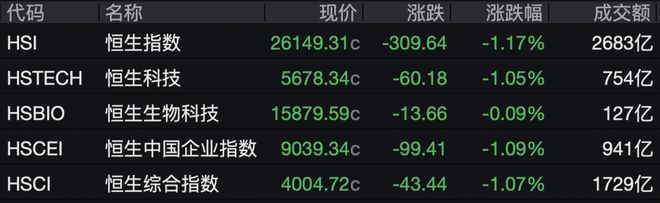
1月8日,港股恒生指数收跌1.17%,恒生科技指数跌1.05%。 | 代码 | 名称 | 现价 | 涨跌 | 涨跌幅 | 成交额 | | --- | --- | --- | --- | --- | --- | | HSI | 恒生指数 | 26149.31c | -309.64 | -1.17% | 2683亿 | | HSTECH | 恒生科技 | 5678.34c | -60.18 | -1.05% | 754亿 | | HSBIO | 恒生生物科技 | 15879.59c | -13.66 | -0.09% | 127亿 | | HSCEI | 恒生中国企业指数 | 9039.34c | -99.41 | -1.09% | 941亿 | | HSCI | 恒生综合指数 | 4004.72c | -43.44 | -1.07% | 1729亿 | 科网股普跌,联想集团跌逾5%,百度集团、美团跌超3%, 阿里巴巴、 快手、京东、腾讯控股均走 低。 | 名称 | 现价 | 涨跌幅 ◆ | | --- | --- | --- | | 联想集团 | 8.780 | -5.59% | | 0992.HK | | | ...

高盛:中国股票今年还有20%涨幅空间
3 6 Ke· 2026-01-08 08:10
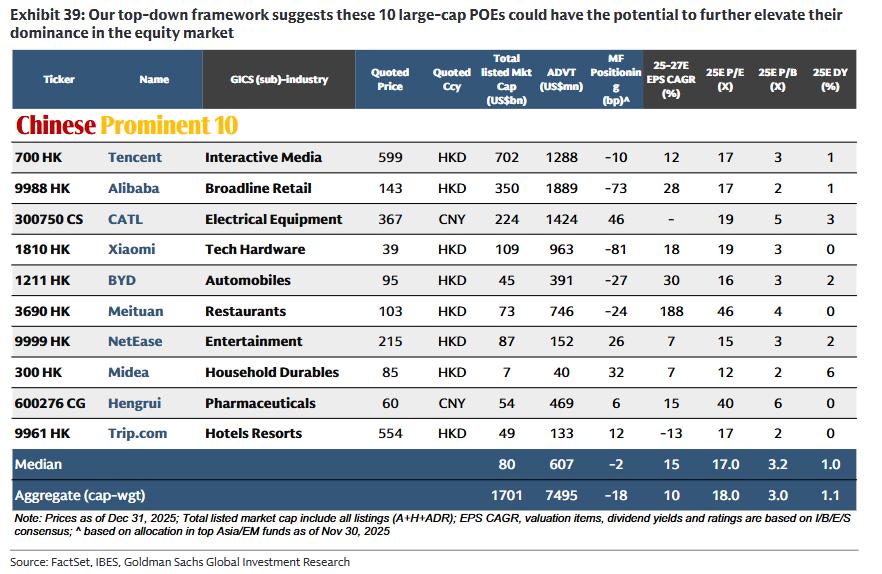
Group 1: Market Outlook - Goldman Sachs predicts that Chinese stocks will be supported by artificial intelligence and policy measures, with the MSCI China Index expected to rise by 20% by the end of 2026, and the CSI 300 Index projected to increase by 12% to 5200 points [1] - As of the first trading day of 2026, the CSI 300 Index has already risen by 3.5%, reaching a four-year high, while the MSCI China Index has increased by approximately 3.6%, outperforming the S&P 500 [1] Group 2: Earnings-Driven Growth - The core argument of Goldman Sachs' report is that returns in 2026 will be primarily driven by earnings growth, supported by artificial intelligence, "going global" strategies, and anti-involution policies [2] - Five major capital flows are expected to support the market: net southbound capital inflows potentially reaching a record $200 billion; domestic asset reallocation bringing about 3 trillion RMB into the stock market; total dividends and buybacks nearing 4 trillion RMB; global active funds possibly increasing their allocation to Chinese stocks; and IPO financing exceeding $100 billion [2] Group 3: Investment Logic - On a macro level, Goldman Sachs has raised its forecast for China's real GDP growth in 2026, citing resilient exports as a key driver, with a trend towards diversification and quality improvement in export destinations [4] - The report indicates that the valuation of the MSCI China Index and CSI 300 has recovered to mid-cycle levels, with forward P/E ratios of 12.4x and 14.5x, respectively, around or slightly above the 10-year average [4] Group 4: Sector and Company Insights - Goldman Sachs expects the TMT sector (technology, media, and telecommunications) to have the highest earnings growth forecast at approximately 20%, driven by AI-related revenue growth and increased capital expenditures [5] - The firm holds an "overweight" view on several sectors, including technology hardware, media/entertainment, internet retail, materials, and insurance, benefiting from various supportive factors [5] - A list of ten leading Chinese companies comparable to the "Big Seven" in the U.S. stock market includes Tencent, Alibaba, CATL, Xiaomi, BYD, Meituan, NetEase, Hengrui Medicine, and Trip.com, with a total market capitalization of $1.7 trillion, accounting for 40% of the MSCI China Index [6]


【投资】如何积极把握港股投资机遇
中国建设银行· 2026-01-08 07:52
Core Viewpoint - The article emphasizes the potential of the Hong Kong stock market, particularly in the technology sector, as a significant option for global asset allocation by 2025, highlighting its strong performance and attractiveness to investors [1]. Group 1: Investment Opportunities in Hong Kong Technology - The Hong Kong stock market is expected to attract more overseas funds, especially in the technology sector, due to the Federal Reserve's decision to resume interest rate cuts [3]. - In 2025, southbound funds are projected to have a cumulative net purchase of HKD 1,393.55 billion in Hong Kong stocks, marking a historical annual high, with technology being a key focus area [3]. - The Hang Seng Technology Index, which includes major tech companies like Alibaba, Tencent, and Xiaomi, is seen as a representative index for the Hong Kong tech market, indicating significant growth potential amid the AI wave [6][7]. Group 2: Performance and Valuation - The Hang Seng Technology Index has shown a cumulative increase of 30.85% since the beginning of 2023, outperforming the Hang Seng Index, which rose by 27.57% during the same period [15]. - The current Price-to-Earnings (P/E) ratio of the Hang Seng Technology Index is 22.74, which is considered reasonable compared to its historical average and other major technology indices like the Nasdaq 100 [19][21]. - The article provides a comparison of the Hang Seng Technology Index's P/E ratio with other indices, indicating its investment value [19][21]. Group 3: Sector Distribution and Growth Potential - The Hang Seng Technology Index covers a balanced distribution across various sectors, including software services, semiconductor, and media and entertainment, indicating a diverse investment landscape [9][12]. - The technology sector is characterized by high growth attributes and performance elasticity, making it an attractive investment option in the current market environment [14].

网易互娱梦幻事业部林云枫离职 此前已卸任负责人
Cai Jing Wang· 2026-01-08 06:05
Core Insights - Lin Yunfeng, a key figure in NetEase's DreamWorks division, officially left the company on January 7 [1] - Lin previously served as the head of the DreamWorks division and was reassigned to lead the online gaming division's project "Fenghua Battle" [1] - The internal restructuring of the DreamWorks division is expected to be completed by October 2025, with Wu Weicong taking over as the new head [1] Company Changes - Lin Yunfeng was involved in the development of "Fantasy Westward Journey" since 2003 and became the second chief planner of the game [1] - In 2015, Lin was promoted to producer of "Fantasy Westward Journey" and head of the DreamWorks division [1] - The restructuring will see mobile projects move to the Sea God division, led by Chen Junxiong, while PC projects remain under the DreamWorks division [1]
网易梦幻事业部负责人林云枫离职,《漫威争锋》制作人接任 | 最前线
3 6 Ke· 2026-01-08 05:14
Group 1 - Lin Yunfeng, the former head of NetEase's DreamWorks division, has officially left the company after 22 years of service [1][3] - His departure follows a series of personnel adjustments within NetEase's interactive entertainment division, which included the restructuring of the DreamWorks division and the reassignment of key projects [3] - Lin was previously moved to oversee the self-operating chess game "Fenghua Duel" based on the "Yin Yang Master" IP, indicating that he was still involved in significant projects within the company [3] Group 2 - The restructuring at NetEase has led to the reassignment of the "Dream of Dreams" online game project to Wu Weicong, the producer of "Marvel Showdown," while the mobile team was integrated into the Sea God division [3] - The ongoing personnel changes at NetEase, including the departure of other key figures, suggest a potential shift in the company's market strategy and performance in the coming year [3]
网易梦幻事业部负责人林云枫已离职
Xin Lang Cai Jing· 2026-01-08 04:45
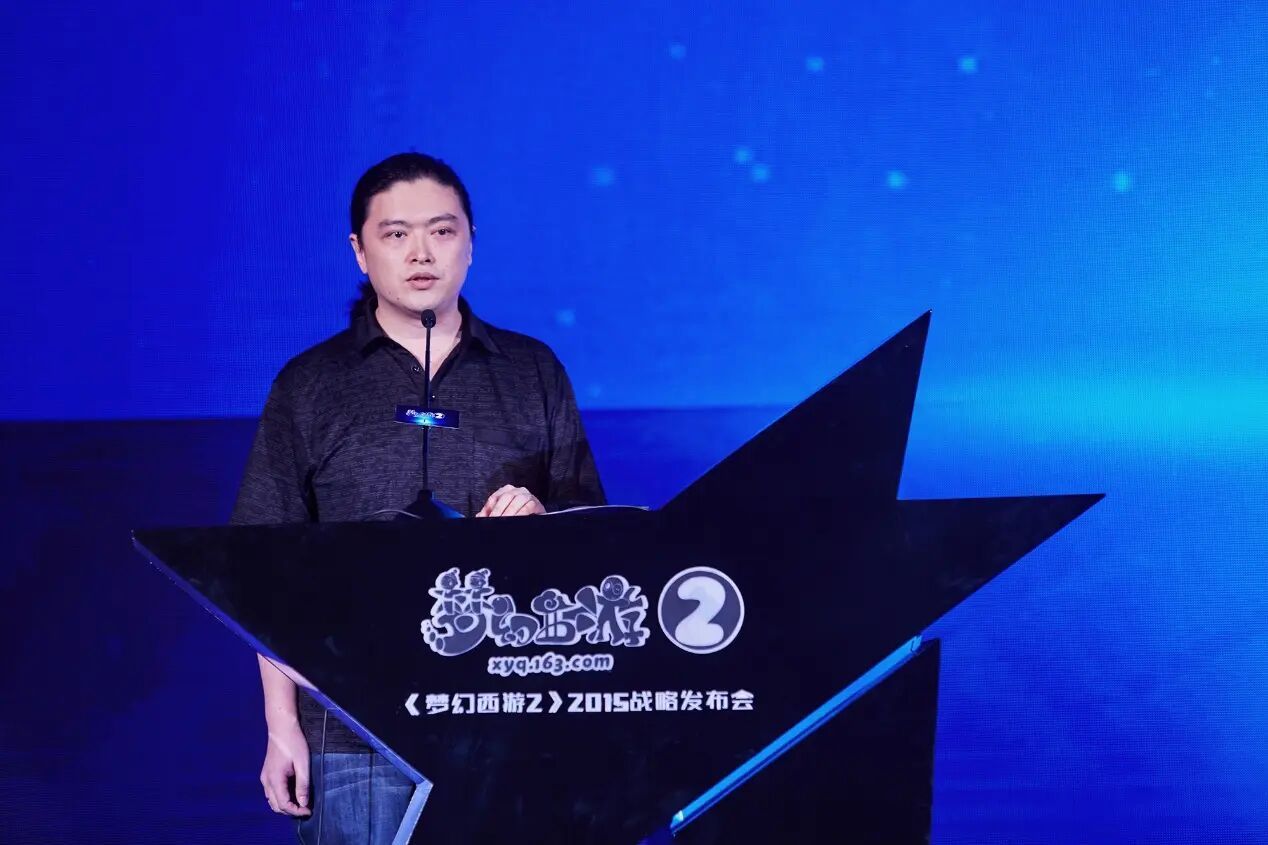
Core Insights - Lin Yunfeng, the former head of NetEase's DreamWorks division, has left the company [1][2] - Following his departure, the mobile game team of "Dream of the West" has been integrated into the Sea God division [1][2] - Chen Junxiong, the head of the Sea God division, is also the producer of the "Dream of the West" mobile game [1][2] Company Background - Lin Yunfeng participated as a core planner in the development of "Dream of the West" in 2003 and later became the game's second chief planner [1][2] - In 2015, Lin was promoted to producer of "Dream of the West" and head of the DreamWorks division [1][2] - He was also responsible for the auto-chess game "Fenghua Duel" based on the "Onmyoji" IP [1][2]
港股午评:恒指跌1.22%、科指跌1.13%,科网股及大金融股走低,军工及半导体概念股拉升
Jin Rong Jie· 2026-01-08 04:13
Market Overview - The Hong Kong stock market opened lower and continued to decline, with the Hang Seng Index down 1.22% at 26,136.49 points, the Hang Seng Tech Index down 1.13% at 5,673.84 points, and the National Enterprises Index down 1.14% at 9,034.76 points [1] - Major technology stocks experienced declines, including Alibaba down 1.51%, Tencent down 1.68%, JD.com down 1.58%, Xiaomi down 1.78%, NetEase down 0.99%, Meituan down 2.78%, and Kuaishou down 2.51% [1] - The military industry stocks rose, with Aerospace Holdings increasing by over 5%, while the semiconductor sector showed strength with Meijiayin Holdings rising by over 8% [1] - Financial stocks collectively dragged the market down, with Apple concept stocks, gambling stocks, automotive stocks, and home appliance stocks all declining [1] - Three new stocks were listed today, with Jingfeng Medical-B rising over 29%, Tianshu Zhixin rising over 11%, and Zhipu rising over 11% [1] Company News - Xinyi International (00732.HK) reported a cumulative net operating revenue of approximately HKD 16.534 billion for 2025, a year-on-year decrease of about 7.3% [2] - China Overseas Development (00688.HK) reported a cumulative contract property sales amount of approximately RMB 251.231 billion for 2025, down 19.1% year-on-year [2] - Greentown China (03900.HK) reported a total contract sales amount of approximately RMB 251.9 billion for 2025, a decrease of 9% year-on-year [2] - China Overseas Hongyang Group (00081.HK) achieved a contract sales amount of RMB 2.57 billion in December 2025, down 43.9% year-on-year [3] - Qinhuangdao Port Co., Ltd. (03369.HK) reported a total throughput of 433 million tons for the year ending December 31, 2025, an increase of 4.48% year-on-year [4] - China Carbon Neutrality (01372.HK) signed a tripartite strategic cooperation agreement with China Tower and China Recycled Resources to jointly create a lithium battery circular economy ecosystem [4] - Guofu Hydrogen Energy (02582.HK) entered into a pre-purchase order agreement for the hydrogen energy project in Tasmania, Australia, including electrolyzer hydrogen production equipment and hydrogen refueling station equipment [4] - Lijun Pharmaceutical (01513.HK) had its Lecanemab injection included in the priority review and approval process [5] - Kinko Services (09666.HK) received acceptance from independent shareholders for 218.6 million shares without interests [6] - CICC (03908.HK) plans to issue no more than HKD 3 billion in perpetual subordinated bonds [7] - Agricultural Bank of China (01288.HK) saw Ping An Life increase its stake in its H-shares [8] - Alibaba (09988.HK) announced an upgrade to its Gaode Map with a new "Street View" feature [8] - Agile Group (03383.HK) reported a total pre-sale amount of approximately RMB 8.57 billion as of December 31, 2025 [8] - CIMC Group (02039.HK) announced that the sale of a property project will reduce the group's net profit attributable to shareholders by approximately RMB 1.08 billion for 2025 [9] - Xiaomi Group-W (01810.HK) repurchased 3.9 million shares for HKD 149 million at prices between HKD 38.12 and HKD 38.20 [10] - Tencent Holdings (00700.HK) repurchased 1.023 million shares for HKD 636 million at prices between HKD 615.5 and HKD 628 [10] - Geely Automobile (00175.HK) repurchased 3.388 million shares for HKD 59.156 million at prices between HKD 17.38 and HKD 17.65 [11] - Youjia Innovation (02431.HK) saw its chairman Liu Guoqing increase his stake by a total of 50,000 H-shares [12] Institutional Insights - Guoxin Securities believes that the Hong Kong stock market's recovery has begun, driven by a weaker US dollar and improved domestic liquidity, suggesting a focus on AI and PPI [13] - Galaxy Securities anticipates continued active trading in the Hong Kong market due to multiple positive factors, predicting an overall upward trend [14] - Everbright Securities shares a similar view, noting that domestic policy support and a weaker dollar may lead to further upward movement in the Hong Kong market [14] - Dongwu Securities suggests that the Hong Kong market is entering a period of upward fluctuation, emphasizing the importance of dividends as a base and capitalizing on the technology growth trend in the first half of the year [14] - Industrial Securities recommends a proactive approach to investing, indicating that the Hong Kong market may start a spring offensive led by the Hang Seng Tech Index [14]

网易梦幻事业部林云枫离职,《漫威争锋》制作人接管
3 6 Ke· 2026-01-08 03:48
Core Viewpoint - The departure of Lin Yunfeng, head of NetEase Interactive Entertainment's Dreamland Division, marks a significant change in leadership, with implications for ongoing projects and the future direction of the division [1]. Group 1: Leadership Changes - Lin Yunfeng has left his position, with no immediate plans for entrepreneurship, after being reassigned to the online gaming division a few months prior [1]. - He has been with NetEase for over 20 years, playing key roles in the development of the "Dream of the West" series and overseeing the Dreamland Division [1][2]. - The Dreamland Division has been a cornerstone of NetEase's gaming business, with Lin Yunfeng's leadership contributing to its success [3]. Group 2: Product Performance - The "Dream of the West" online game has been a major revenue driver for NetEase, achieving a peak concurrent user count of 358 million after the launch of a new server in July [2]. - The mobile adaptation of "Dream of the West" has also been successful, consistently ranking in the top ten of the iOS sales charts since its release in 2015 [3]. - Despite the success of the "Dream of the West" series, the Dreamland Division has faced challenges in expanding into new genres and developing new hit products [6]. Group 3: Project Developments - The division is currently focused on the development of "Fenghua Battle," a key project that has shown promising data performance during its iOS testing phase [1]. - Other projects, such as "Destiny: Stars," have experienced significant revenue declines after initial success, indicating volatility in the gaming market [6]. - The division has attempted to diversify its portfolio with various game types, but has struggled to produce long-lasting hits outside of the "Dream of the West" series [6].
市场获利回吐,恒指短线调整
Guodu Securities Hongkong· 2026-01-08 03:18
Group 1: Market Overview - The Hang Seng Index experienced a decline of 251 points or 0.94%, closing at 26,458 points after a strong start to the year with a cumulative rise of over 1,000 points in the first three trading days [3][4] - The market faced profit-taking pressure, particularly in e-commerce, technology, and automotive sectors, leading to significant sell-offs in major stocks like Alibaba, Tencent, and Meituan [3][4] Group 2: Economic and Industry Insights - Citigroup maintains its year-end target for the Hang Seng Index at 28,800 points, indicating a potential upside of approximately 9% from current levels, with a mid-year target of 27,500 points [7] - The outlook for Chinese stocks is cautious, with earnings performance being a key factor for future growth, particularly influenced by consumer confidence and property prices in mainland China [7] - Citigroup is optimistic about sectors such as technology, internet, insurance, healthcare, and consumer stocks, anticipating benefits from national policies and earnings growth [7] Group 3: Company-Specific Developments - Kuaishou is reportedly considering its first issuance of offshore bonds, joining the trend of Chinese tech companies raising funds in the global debt market [11] - GF Securities plans to raise approximately 6.125 billion HKD through a combination of new H-share placements and zero-coupon convertible bonds, aimed at supporting its international business development [12] - Busy Ming, a Chinese snack retail chain, has passed the listing hearing for an IPO on the Hong Kong Stock Exchange, showing significant growth with a GMV of 66.1 billion RMB, a 74.5% increase year-on-year [13]
