
中国资源循环集团

Search documents
滨海新区与京冀协同发展成果喜人
Bei Jing Ri Bao Ke Hu Duan· 2026-02-22 20:44
Group 1 - The core viewpoint of the article highlights the establishment of significant projects and institutions in the Beijing-Tianjin-Hebei region, with a total investment exceeding 48 billion yuan [1] Group 2 - The China Resource Recycling Group has set up five secondary enterprises and a national pipeline scientific testing base, taking on 99 major projects from Beijing and establishing 389 new institutions [1] Group 3 - In transportation development, the Tang-Cheng Expressway and the Jin-Shi Expressway have been completed and opened to traffic; the Tianjin Port Xiong'an New Area Service Center has seen its first batch of entries into the Xiong'an Comprehensive Protection Zone, and new sea-rail intermodal trains have been launched from Tianjin Port to Pinggu, Beijing [1] Group 4 - In government services, there are 1,586 items under the "regional handling" initiative between Beijing and Hebei, with 231 online self-service projects under "Beijing-Tianjin-Hebei + Xiong'an" and 727 items under "Bin-Xiong handling"; the free trade pilot zone has 230 items for "non-discriminatory acceptance and uniform processing" [1]
“津关24条”新版发布 支持在京津冀开展保税展示交易
Zhong Guo Jing Ying Bao· 2026-02-07 12:53
Core Viewpoint - The Tianjin Customs is set to implement the "Tianjin Customs 24 Measures (2026 Version)" to enhance the city's high-level opening-up and support foreign trade development, following the successful implementation of the previous version [1][2]. Group 1: Policy Implementation - The "Tianjin Customs 24 Measures" will be officially released in early 2024, serving as a key driver for high-quality foreign trade development in Tianjin [1]. - In 2025, Tianjin's total import and export value reached 835.87 billion, with a year-on-year growth of 2.8%, and exports exceeded 400 billion for the first time, reaching 430.94 billion, a 10.1% increase [1]. Group 2: Focus Areas of the New Measures - The new measures will focus on five key areas, including the implementation of national strategies, development of new productive forces, construction of a pioneering reform and opening-up zone, building a modern socialist metropolis, and safeguarding national security [2][3][4]. Group 3: Specific Initiatives - The measures include support for technological innovation tax incentives, expansion of customs clearance for high-tech equipment, and facilitation of cross-border e-commerce [2][3]. - Initiatives to enhance the import and export processes for agricultural products, medical health industries, and high-end manufacturing sectors are also outlined [2][3]. - The establishment of a green channel for the Shanghai Cooperation Organization countries and the promotion of the Belt and Road Initiative are part of the strategic focus [1][2]. Group 4: Security and Safety Measures - The measures emphasize strengthening border security, enhancing the ability to manage public health emergencies, and ensuring food safety at entry points [4].
纺织业多元革新促节能降碳
Jing Ji Ri Bao· 2026-01-29 22:11
中央经济工作会议明确提出"坚持'双碳'引领,推动全面绿色转型",将重点行业节能降碳改造推向纵 深。 "这为纺织行业高质量发展指明了方向。"中国纺织工业联合会副会长、社会责任办公室主任阎岩接受本 报记者专访时表示,纺织行业绿色转型目前已形成"头部引领、分层追赶"的良性格局,从理念倡导进入 规模化实践阶段,正通过技术革新、价值链协同与产业生态支撑的多元发力,释放高质量发展新动能。 技术引领效应持续显现 在工业和信息化部近期公布的"2025年度重点行业能效'领跑者'企业名单"中,江苏恒科新材料有限公司 成功入选,成为聚酯涤纶细分行业全国唯一的"领跑者"企业。 "作为恒力集团全资子公司,恒科新材已构建全流程中水回用系统,废水回用率超90%,年节约水资源 250万吨以上。"恒科新材副总经理陆佳颖介绍,在能源结构优化方面,建成总容量106.5兆瓦的光伏发 电项目及60兆瓦/120兆瓦时储能系统,打造"光储充"一体化模式,热媒炉全面采用生物质颗粒燃料,可 再生能源利用占比超40%。同时,回收利用聚酯工艺塔塔顶蒸汽及空压机余热,用于制冷与物料加热。 近3年,共完成79项节能技改项目,创造效益超7000万元。 "恒力是纺织行业 ...
四大增长极经济与产业洞察报告(2025)
GUOTAI HAITONG SECURITIES· 2026-01-29 08:17
产业观察 [table_Header]2026.01.29 四大增长极经济与产业洞察报告(2025) 产业研究中心 摘要:聚焦四大战略区域 2025 年协同发展,解构要素配置与产业生态新格局 期 2026.01.18 [Table_Summary] 核心观点:区域协同、产业升级与统一大市场建设的联动是高质量发展的 关键支撑。四大增长极通过制度协同破除行政壁垒,要素市场化改革畅通 资源流动,形成"顶层引领+地方创新"的协同格局。产业层面呈现梯度分 工与集群化演进,长三角技术密集型产业领跑,粤港澳大湾区聚焦跨境融 合,京津冀疏解赋能并重,川渝强化双核联动。通过"要素流动—产业协 同 —市场统一"联动路径,推动区域从"集群化"迈向"链群化",既发挥比 较优势实现差异化发展,又通过跨域平台与规则衔接强化协同,为全国构 建优势互补、高质量发展的区域经济布局提供实践支撑。 筑基与引领:2025 年四大区域聚焦制度协同、规则衔接与跨域合作,以顶 层规划与专项政策为支撑,形成"顶层引领+地方创新"的协同格局,筑牢 区域高质量发展制度根基。 破壁与赋能:要素市场化改革正推动资源配置逻辑从"区域内优化"向"跨 区域重组"转化。人 ...
中国资环废旧手机回收平台服务网络拓展至63座城市
Ren Min Ri Bao· 2026-01-27 22:28
Core Viewpoint - The "Chip Shatter Worry-Free" platform by China Resource Recycling Group has expanded its service network significantly and aims to enhance electronic waste recycling and environmental protection [1] Group 1: Service Expansion - The service network of the "Chip Shatter Worry-Free" platform has grown from 4 pilot cities (Beijing, Tianjin, Shanghai, and Shenzhen in Guangdong) to 63 cities within one year [1] - The platform plans to continue expanding its service range and explore the inclusion of more electronic and electrical products for recycling [1] Group 2: Environmental Impact - The project is projected to achieve a carbon reduction of approximately 320 tons and a harmless treatment of electronic waste amounting to about 39 tons by 2025 [1] - The initiative aims to prevent environmental pollution from harmful substances such as lead and mercury [1] Group 3: Resource Recovery - The platform is expected to extract around 2.4 kilograms of gold, 13 kilograms of silver, and 1.8 tons of copper from the recycling process [1]
广东浙江均设置区间目标——图观2026地方两会第三期
一瑜中的· 2026-01-26 15:35
文 : 华创证券首席经济学家 张瑜(执业证号:S0360518090001) 联系人: 陆银波(15210860866) 袁玲玲(微信 Yuen43) 往期重点内容 1月13日《地方两会的"信息点"》 1月15日《浙江率先开局》 1月26日《北京GDP目标维持在5%左右》 | સ્ત્રેફ્ર | | ફ્તિસ્ટે | 今年目标 | 去年目标 | 去年实际 | | --- | --- | --- | --- | --- | --- | | 调整为区间目标, 下调约0.5个点 | | 广东 | 4.5%-5%,在实际工作 中全力争取更好结果 | 5%左右 | 3.9% | | | | 浙江 | 5%-5.5%,在实际工作 中努力争取更好结果 | 5.5%左右 | 5.5% | | 下调0.5 | | 河南 | 5%左右,在实际工作 中努力争取更好结果 | 5.5%左右 | 5.6% | | 仍为点 | 个点 | 天津 | 4.5%,在实际工作中努 力争取更好结果 | 5%左右 | 4.8% | | 位目标 | 基本不变 | 河北 | 2%以下 | 5%以上 | 5.6% | | | | 北京 | 5%左右 ...

瞭望|天津高质量发展“九字诀”
Xin Lang Cai Jing· 2026-01-24 13:25
Core Viewpoint - The article emphasizes the strategic importance of "Beijing-Tianjin-Hebei," "Port-Industry-City," and "Education-Science-Talent" as key components for Tianjin's high-quality development during the "14th Five-Year Plan" period, aiming to enhance collaboration and innovation across these sectors [1][2]. Group 1: Beijing-Tianjin-Hebei Collaboration - The Beijing-Tianjin-Hebei collaboration has opened new opportunities for Tianjin, enhancing its role in alleviating non-capital functions from Beijing and promoting technological innovation [3][4]. - The region has seen significant industrial integration, with Tianjin leading initiatives in high-end equipment and new information technology, contributing to the national industrial landscape [4][5]. - Infrastructure improvements, such as the completion of intercity rail lines, have facilitated better connectivity and economic integration within the region [6]. Group 2: Port-Industry-City Integration - Tianjin's port has become a critical asset, with container throughput increasing from 21.02 million TEUs in 2022 to 23.29 million TEUs by 2024, reflecting its growing role as a comprehensive economic hub [8]. - The port's operational efficiency has improved significantly, reducing vessel turnaround times and enhancing service capabilities, which supports industrial growth [7][8]. - The integration of port services with high-end industries has led to the establishment of multiple industrial clusters, attracting significant investments and fostering economic development [9][10]. Group 3: Education, Science, and Talent Development - Tianjin is enhancing its innovation ecosystem by leveraging its educational resources, with 29 national key laboratories and 56 universities contributing to a robust talent pool [11][12]. - The city has implemented policies to promote industry-education integration, resulting in a high alignment of vocational education with local industry needs, achieving over 90% alignment in program offerings [12][13]. - Initiatives to attract and retain talent, such as the "Haihe Talent" program, have successfully brought in over 520,800 individuals, with a focus on young and highly educated professionals [14][15].
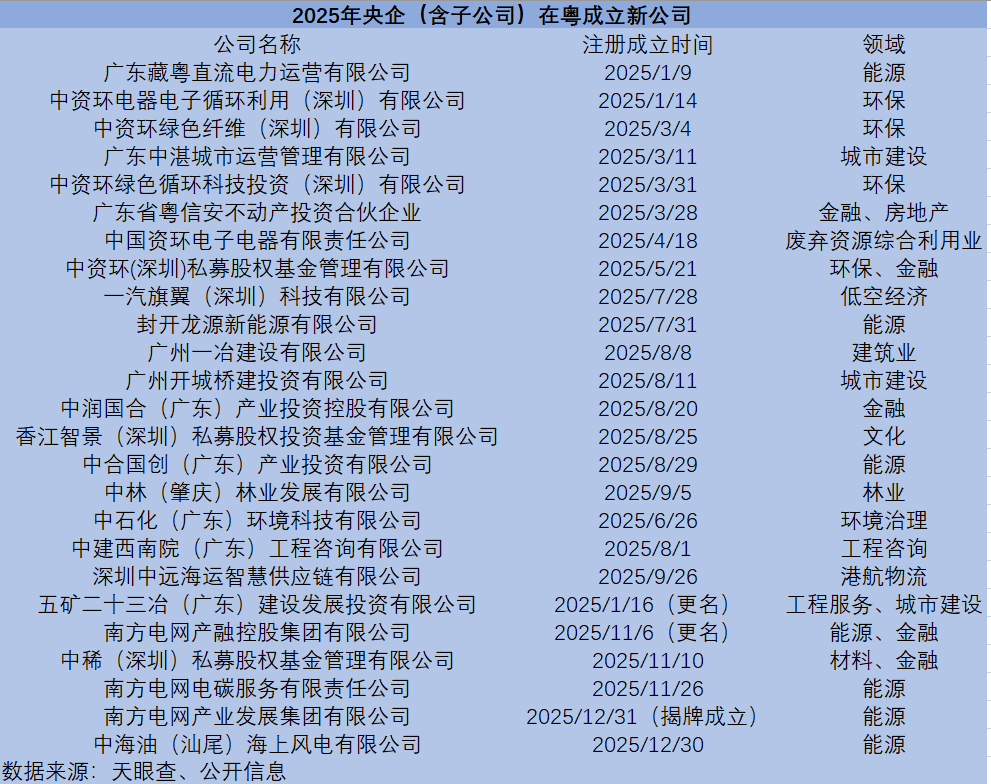
央企重仓广东,一年内至少25家新公司落地
2 1 Shi Ji Jing Ji Bao Dao· 2026-01-24 09:04
Core Viewpoint - Central enterprises are increasingly establishing new companies in Guangdong, reflecting a strong commitment to long-term investment and collaboration with local economies, particularly in strategic emerging industries and green technologies [1][5][6]. Group 1: Central Enterprises' Activities - In 2025, at least 25 central enterprises (including subsidiaries) established new companies in Guangdong, with ongoing activities into 2026 [3][4]. - Southern Power Grid established three wholly-owned subsidiaries in Guangzhou in late 2025, with a planned investment of 180 billion yuan for fixed assets in 2026, focusing on new power systems and emerging industries [2][6]. - China Resources Recycling Group and China Rare Earth Group are among the new entrants, setting up multiple subsidiaries in various cities, including Shenzhen [3][4]. Group 2: Investment Focus - Central enterprises are prioritizing strategic emerging industries, with an average annual investment growth rate exceeding 20% [6][8]. - The establishment of companies like China Rare Earth Group's subsidiaries in Shenzhen aims to align with local industry needs, particularly in artificial intelligence and new energy vehicles [6][7]. - The focus on green and low-carbon technologies is evident, with companies like China Resources Recycling and South Power Carbon Company working on carbon management and recycling initiatives [8][9]. Group 3: Regional Development - Guangzhou and Shenzhen are the primary cities attracting central enterprises for new business expansions and headquarters [4][5]. - The collaboration between central enterprises and local governments is enhancing the business environment and market potential in Guangdong [5][9]. - Various sectors are being targeted, including construction, energy, environmental protection, and digital technology, showcasing the depth and breadth of central-local cooperation [4][5].


央企重仓广东:一年落地超20家 偏好创新业务
2 1 Shi Ji Jing Ji Bao Dao· 2026-01-23 15:52
Core Viewpoint - Central enterprises are increasingly establishing new companies in Guangdong, reflecting a strategic focus on long-term development and collaboration with local economies, particularly in the Greater Bay Area [1][5]. Group 1: Central Enterprises' Activities - In 2025, at least 25 new companies were established by central enterprises (including subsidiaries) in Guangdong, indicating a robust trend of investment and collaboration [5]. - The establishment of physical companies by central enterprises signifies a commitment to long-term growth and resource integration in the region [1][5]. - Notable companies established include Guangdong Cangyue Direct Current Power Operation Co., Ltd. and China Resources Recycling Group, which focus on energy and environmental sectors [2][3]. Group 2: Investment Trends - Southern Power Grid announced an investment of 180 billion yuan for fixed asset investments in 2026, marking a record high for five consecutive years, focusing on new power systems and quality service improvements [3]. - Central enterprises are increasingly investing in strategic emerging industries, with an average annual investment growth rate exceeding 20% [6][8]. - The focus on green and low-carbon initiatives is evident, with companies like China Resources Recycling and Zhonglin (Zhaoqing) Forestry Development Co., Ltd. engaging in carbon management and environmental technologies [8]. Group 3: Regional Economic Impact - The influx of central enterprises into Guangdong is a recognition of the region's business environment, market potential, and strategic importance [6]. - Cities like Guangzhou and Shenzhen are becoming key hubs for central enterprise activities, attracting new business developments and innovation headquarters [5][6]. - The collaboration between central enterprises and local governments is fostering a diverse industrial ecosystem, enhancing the depth and breadth of cooperation [5][6]. Group 4: Innovation and Technology - Central enterprises are leveraging Guangdong's rich application scenarios and innovative regulatory frameworks to test new technologies and products [6][7]. - Companies like China First Automobile Works are focusing on low-altitude economy initiatives, with significant advancements in electric vertical takeoff and landing (eVTOL) aircraft technology [6]. - The establishment of platforms for high-tech applications, such as rare earth materials, is crucial for advancing Shenzhen's high-tech and green energy sectors [7][8].
中国资环电池公司进口锂离子电池用再生黑粉原料 一单海外业务背后的资源循环(美丽中国)
Ren Min Ri Bao· 2026-01-05 22:31
Core Viewpoint - In 2025, China will no longer classify qualified recycled black powder for lithium-ion batteries as solid waste, allowing for its importation, marking a significant step in the lithium battery recycling industry [1][3]. Group 1: Import and Recycling Process - China Resources Recycling Group's subsidiary, China Resources Environmental Battery Company, successfully completed its first overseas transaction by importing 47 tons of recycled black powder, which passed customs in Tianjin [1]. - The recycled black powder contains strategic metals such as cobalt, nickel, manganese, and lithium, which are essential for battery production [2]. - The value of recycled black powder is significantly higher than that of natural minerals, with each ton of imported recycled black powder reducing the need for approximately 3 tons of primary mineral extraction and lowering carbon emissions by 2.5 tons [2]. Group 2: Policy Changes and Market Demand - Prior to the policy change, recycled black powder was considered solid waste, limiting its importation due to both regulatory and market constraints [3]. - The announcement by six government departments in June 2025 allowed for the import of qualified recycled black powder, addressing the rising demand for resources driven by the rapid growth of the electric vehicle industry [3]. Group 3: Quality and Logistics Challenges - Ensuring the quality of imported black powder is critical, as many overseas sources do not meet China's import standards due to excessive impurities [3][5]. - The logistics of transporting powdered black powder across borders posed challenges, leading to the adoption of sealed containers with moisture and shock protection [5]. Group 4: Future Prospects and Industry Development - The successful import of recycled black powder has led to the establishment of a closed-loop resource recycling system, with further processing to produce battery-grade lithium carbonate and iron phosphate for domestic battery manufacturers [6]. - China Resources Recycling Group aims to expand its operations by establishing more pre-treatment bases for recycled black powder, promoting large-scale imports and enhancing the resource recycling chain [6].