King

Search documents
Meet Sweden, the unicorn factory chasing America in the AI race
Fortune· 2026-01-03 11:00
Core Insights - The article discusses the potential existence of an AI 'bubble' and the impact of media narratives on investor sentiment, particularly regarding the NASDAQ [1] - It emphasizes the importance of integrating technology into everyday life to mitigate market volatility and prevent disconnection between real-world experiences and market excitement [2] Group 1: Sweden's Technological Progress - Sweden's Home-PC reform in the 1990s aimed to place a computer in every household, which is credited with initiating significant technological advancements in the country [3] - Stockholm now boasts the highest number of unicorns per capita outside Silicon Valley, with notable AI startups like Legora valued at $1.8 billion and Einride raising $100 million [4] - The success of Swedish tech companies like Skype, Spotify, and Klarna has created liquidity moments that benefit the local ecosystem, fostering a culture of reinvestment among millionaires [7] Group 2: Factors Contributing to Sweden's Success - A digitally literate generation emerged from the Home-PC reform, leading to the establishment of globally competitive technology companies [6] - Sweden invests 3.57% of its GDP in Research & Development, the highest in Europe, and offers supportive policies for entrepreneurs, such as a six-month leave to start a business [9] - Cultural aspects, including a focus on aesthetics in software design and a high-trust environment, contribute to the success of Swedish companies [10][11] Group 3: Challenges and Global Implications - Despite its successes, Sweden faces challenges, including reliance on American investors for later-stage capital [12] - The Swedish approach to technology, characterized by broad acceptance and integration into daily life, serves as a model for other countries concerned about the rapid valuation of AI companies [13]



游戏行业的品牌战略:如何让产品从爆款进化为文化符号
3 6 Ke· 2025-12-03 03:33
Core Insights - The gaming industry is experiencing explosive content growth by 2025, making brand recognition a crucial factor for success beyond mere innovation [1][5] - Strong brand strategies create immersive experiences and emotional connections, transforming individual games into cultural phenomena with long-term commercial value [1][10] - Game naming and logo design are essential starting points for brand development, serving as the first touchpoints for players and conveying the game's world and tone [1][12][26] Brand Consistency - Maintaining brand consistency is key for successful game brands, ensuring that every aspect from pre-launch to post-launch aligns with the core game universe [2][29] - A strong brand strategy not only focuses on emotional engagement but also integrates gameplay mechanics, art style, narrative techniques, and character design to create a lasting appeal [9][35] Long-term Brand Operations - The core of long-term brand operations revolves around continuously delivering value centered on player experience and emotional recognition [3][35] - Top-tier game brands extend beyond the games themselves, creating cross-dimensional ecosystems through esports, film, and merchandise, becoming cultural symbols in daily life [4][38] Naming and Logo Design - A compelling game name is not just a label but an invitation that ignites player curiosity and defines the future of the IP [12][21] - Effective naming should consider three core dimensions: alignment with the game world, uniqueness, and the ability to spark curiosity [13][17][19] - A powerful logo serves as the first visual symbol of the brand, accurately conveying the game's world and tone [26][28] Marketing and Community Engagement - Pre-launch marketing should strategically build anticipation, deepening emotional investment from players even before the game is released [30] - Post-launch, brands must shift focus to long-term operations, fostering emotional connections and maintaining engagement through community interaction and social media [32][36] Cultural Integration - Successful game brands integrate into culture and daily life, expanding their reach through esports, film adaptations, and merchandise, thus enhancing emotional ties with players [41][42] - The most successful brands evolve beyond gaming, becoming cultural symbols that reshape the entertainment landscape and continuously attract user engagement [42]
游戏行业的品牌战略:如何让产品从爆款进化为文化符号 | 红杉汇内参
红杉汇· 2025-12-03 00:03
Core Insights - The gaming industry will experience explosive content growth by 2025, making brand recognition a crucial factor for success, surpassing mere innovation [3][4] - Strong brand strategies can create a cohesive gaming universe, supporting sequels, spin-offs, and cultural expansion, transforming individual games into cultural forces with long-term commercial value [3][6] - Game naming and logo design are essential for brand creation, serving as the first touchpoints for players and conveying the game's worldview and tone [3][9] Brand Strategy and Player Experience - A successful game brand is not just an accessory but the core of the gaming experience, creating emotional connections and immersion for players [6][7] - The brand strategy shapes the game's core identity, influencing gameplay mechanics, art style, narrative, and character design, ensuring long-term appeal [7][8] - A powerful brand transcends the game itself, creating a cultural symbol that integrates into daily life through esports, film, and merchandise collaborations [31][32] Naming and Logo Design - A compelling game name serves as an invitation, igniting player curiosity and establishing emotional connections [9][17] - Effective naming should align with the game's universe, be unique and memorable, and spark curiosity [10][12][15] - Logos act as the first visual symbol of the brand, conveying the game's worldview and differentiating characteristics [19][22] Brand Consistency and Marketing - Maintaining brand consistency across all player interactions is vital for creating a lasting cultural impact [24][30] - Pre-launch marketing should strategically build anticipation and deepen emotional investment in the brand [25][26] - Post-launch, brands must focus on long-term engagement, fostering emotional connections and community involvement [27][28] Community and Cultural Integration - Successful brands empower communities, transforming passive audiences into active participants in discussions and experiences [29][30] - Top brands continuously evolve with players, embedding themselves in culture and dialogue [30][31] - The most powerful brands extend beyond gaming, integrating into various cultural dimensions, including esports and media [31][33] Conclusion - Leading game brands have become cultural symbols, reshaping the entertainment landscape and continuously engaging users beyond the gaming experience [35]

中国游戏出海启示录:从 “把游戏带出去” 到 “把能力带出去”
晚点LatePost· 2025-10-23 10:21
Core Insights - The article discusses the transformation of the global gaming industry, particularly focusing on the challenges and opportunities for Chinese gaming companies in the international market. It emphasizes the need for long-term operational capabilities and innovative marketing strategies to succeed in a competitive landscape [3][4][5]. Industry Overview - The global gaming industry experienced rapid growth from 2011 to 2021, with a compound annual growth rate (CAGR) exceeding 9.7%, and the mobile gaming market in China growing nearly 145% during the same period [5][6]. - However, post-pandemic, the industry has entered a downturn, with global market growth projected to drop to 2% in 2024 and 3% in 2025 [6][9]. Market Dynamics - The competition in the gaming market has intensified, with players increasingly gravitating towards established service-based games, which accounted for over 60% of user engagement time in 2022 [7]. - Emerging markets, particularly in the Middle East, Africa, and Latin America, are showing significant growth potential, with mobile gaming revenue in Latin America reaching 48% of total gaming revenue [9][10]. Successful Strategies - Successful examples include Supercell's Brawl Stars, which achieved over $400 million in monthly revenue five years post-launch through effective long-term operations [3]. - Chinese gaming companies are adapting by utilizing advanced marketing tools, such as Google Ads and YouTube, to enhance user acquisition and retention [4][11]. Marketing Evolution - The traditional approach to user acquisition through low-cost downloads is becoming less effective, with a shift towards more sophisticated marketing strategies that focus on user value and engagement [13][14]. - Companies are increasingly integrating brand advertising into their marketing strategies to reach broader audiences and enhance user recognition [15][16]. Technological Advancements - The article highlights the role of AI and advanced advertising platforms, such as Google's Gemini, in reshaping the gaming landscape, enabling companies to better understand and target their audiences [17][18]. - The integration of AI in game development is expected to democratize the creation process, allowing more individuals to participate in game design [18]. Conclusion - The future of gaming globalization for Chinese companies lies in leveraging new marketing capabilities and technological advancements to create and sustain high-quality gaming experiences in emerging markets [10][18].


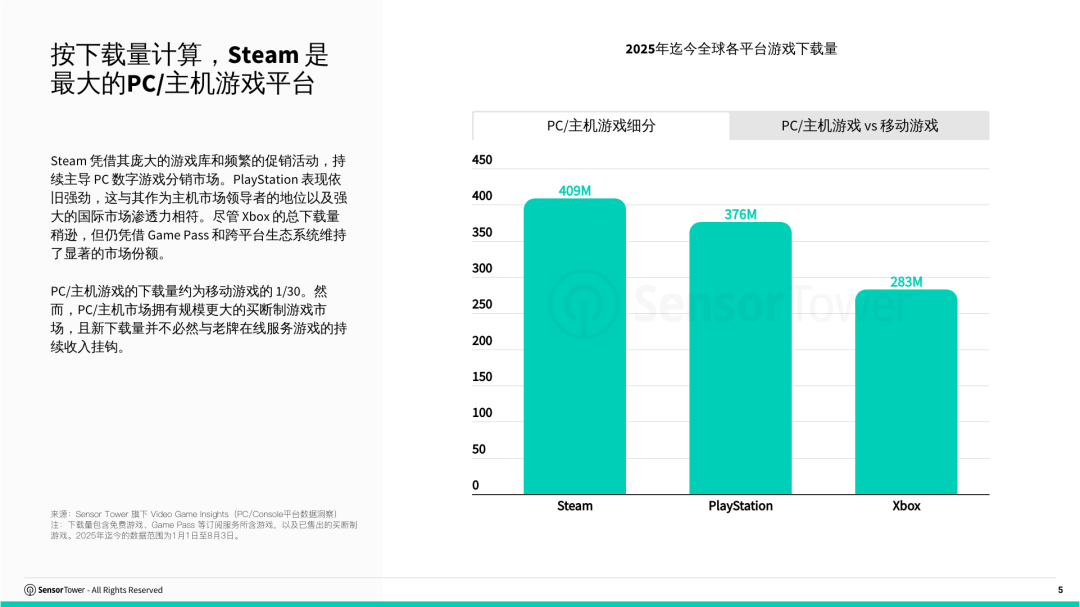
SensorTower:2025年迄今PC/主机游戏下载量已超10亿次 Steam平台全年收入有望突破120亿美元
智通财经网· 2025-09-17 02:53
Group 1 - In 2025, PC/console game downloads are expected to exceed 1 billion, with Steam holding the largest market share due to its dominance on the PC platform [1] - Steam's game purchase revenue is projected to grow by 15% compared to the same period in 2024, potentially surpassing $12 billion by the end of the year [3] - Action games (262 million downloads), shooting games (189 million downloads), and role-playing games (131 million downloads) are the most popular genres among PC/console players in 2025 [5] Group 2 - Electronic Arts (EA) is currently the highest download publisher, benefiting from sports and IP game series, as well as collaborations like "Split Fiction" and "It Takes Two" [8] - Microsoft and Sony rank second and third respectively, with Sony's content performing better on PlayStation and Microsoft's content being more popular on Xbox, largely due to the integration with Game Pass [8] - Notable games include "Marvel Rivals" by NetEase, which is the most downloaded PC/console game this year, and Kepler Interactive's "Clair Obscur: Expedition 33" and "REMATCH" gaining significant traction [11] Group 3 - In the AAA game sector, sports games like "EA SPORTS FC 25" and "NBA 2K25" continue to dominate, while the action RPG "Monster Hunter Wilds" also performs strongly [14] - The AA game "Clair Obscur: Expedition 33" has received critical acclaim and surpassed "NBA 2K25" in downloads [14] - The independent game "R.E.P.O." has the highest sales, reflecting its popularity in content creation circles, while the second-ranked independent game "Schedule I" achieved comparable download performance at double the price [14]


员工爆料:King暴力裁员200人,背后资本推动AI取代员工
Tai Mei Ti A P P· 2025-08-29 07:57
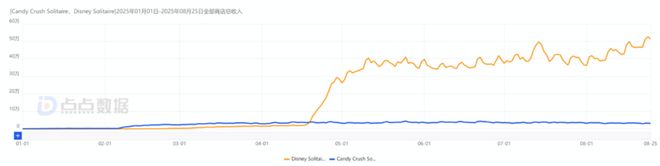
Core Insights - King, a veteran in the casual gaming industry, is facing significant internal turmoil following its acquisition by Microsoft, leading to management changes and employee dissatisfaction [1][10]. Group 1: Management Changes - Todd Green has replaced Tjodolf Sommestad as the new president of King after Sommestad's 14-year tenure, which included three years as president [1]. - The company has launched a new game, "Candy Crush Solitaire," which has not met expectations, generating revenue significantly lower than competitors like "Disney Solitaire" [1]. Group 2: Layoffs and Employee Feedback - King announced layoffs of 200 employees, which has been met with criticism regarding the rationale behind the cuts, with claims that performance evaluations did not influence the decisions [3][4]. - Employees reported that the layoff process was opaque, with some long-term contributors being let go without clear justification [4][10]. - The feedback mechanism within the company has deteriorated, with employees feeling unable to voice concerns anonymously, leading to a decline in morale [6][9]. Group 3: AI Implementation and Protests - The layoffs included many positions in middle management and user experience teams, with protests organized by the CSVI union in response to the job cuts [10][12]. - Employees who had previously developed AI tools to enhance productivity are now being replaced by those very tools, raising concerns about the future of their roles [12][14]. - King is pushing for increased AI integration in daily tasks, aiming for 100% usage, although the effectiveness of this initiative remains questionable [14].
在欧盟服软、美国硬气,苹果面对的问题并不相同
3 6 Ke· 2025-08-08 11:53
Core Viewpoint - Apple is facing significant challenges in both the US and European markets regarding its App Store policies, particularly the so-called "Apple tax" on in-app purchases, leading to different strategic responses in each region [1][3][10]. Group 1: Legal Challenges and Responses - Two months ago, Apple lost a lawsuit against Epic Games, resulting in a forced adjustment of its App Store policies in the US, including a 27% commission on external purchases and restrictions on developers directing users to alternative payment methods [1][3]. - Apple is now targeting the court that issued the ruling, arguing that the decision overstepped its jurisdiction by affecting all US developers, not just those involved in the case [1][3]. - In contrast, Apple has accepted the European antitrust ruling and is making significant adjustments to its App Store rules in the EU to avoid potential fines of up to €50 million per day for violating the Digital Markets Act (DMA) [1][3]. Group 2: Market Dynamics and Strategic Differences - The EU's determination to assert digital sovereignty has led to a more stringent regulatory environment, compelling Apple to comply with new rules, while the US market remains more lucrative for Apple, prompting a more defensive stance [5][7][8]. - Apple's market share in Europe is 26%, compared to 12% in China, but the revenue generated from the App Store in Europe is significantly lower, at $148 billion, compared to $539 billion in China and $406 billion in the US [5][7]. - The difference in revenue potential between the US and Europe is stark, with the US being the largest consumer market, which influences Apple's reluctance to concede on its "Apple tax" in the US [8][10]. Group 3: Financial Implications - If the US court's injunction is not overturned, Apple's App Store revenue could face catastrophic declines, as the company currently earns approximately $12.18 billion from the US App Store's commission structure [10]. - The disparity in penalties between the US and EU is notable; while Apple retains a 15% commission for external purchases in Europe, it would receive no revenue if developers bypass the in-app purchase system in the US [10][12]. - Major game developers, such as King and Zynga, have strong incentives to direct users to external payment methods, potentially increasing their profit margins by 5-8%, which could lead to significant revenue growth for US mobile game companies [12].

出海指南-英国篇:出海第五大游戏市场,超六成英国用户是中轻度游戏玩家
3 6 Ke· 2025-08-05 02:13
Core Insights - The report titled "2025 China Game Overseas Guide - UK Edition" was jointly developed by Gamma Data and the China Audio-Video and Digital Publishing Association's Game Working Committee, providing a comprehensive analysis of the UK gaming market for Chinese game companies looking to expand overseas [1][2]. Group 1: UK Gaming Market Overview - The UK gaming industry is a key pillar of the digital entertainment sector, contributing significantly to the country's cultural soft power [2]. - The market size peaked at £4.9 billion (approximately ¥46 billion) during the COVID-19 pandemic in 2020, reflecting a 29% year-on-year growth compared to 2019, and accounted for about 50% of the digital entertainment industry [2][6]. - In 2024, the UK gaming industry is projected to be worth £4.6 billion, making it the second-largest gaming market in Europe [6]. Group 2: Market Segmentation and Trends - The console gaming segment remains the largest in the UK, holding a 51% market share, while mobile gaming is steadily increasing, accounting for 34% [11][13]. - The mobile gaming market has shown consistent growth over the past five years, with a market size of £1.58 billion in 2024, driven by a high willingness to pay among younger players [17][25]. - Casual gaming genres such as puzzle, gambling, and strategy dominate the mobile gaming market, collectively accounting for 53% of revenue [19][21]. Group 3: Tax Incentives and Compliance - The UK has implemented a video game tax relief policy, allowing companies to claim a 34% tax deduction on qualifying expenditures, with over £5 billion in tax relief provided since its inception [7][8]. - Compliance with regulations such as the General Data Protection Regulation (GDPR) and the Online Safety Act (OSA) is essential for game developers operating in the UK [45][46]. Group 4: Player Behavior and Preferences - Over 62% of UK gamers identify as casual or light gamers, indicating a preference for simple and accessible gaming experiences [31]. - The smartphone is the most popular gaming platform among UK players, with a 36.2% preference, highlighting a shift towards mobile gaming [33]. - Female players tend to favor casual genres like puzzle and life simulation, while male players are more inclined towards competitive and strategy games [35]. Group 5: Marketing and Localization Strategies - UK players prefer "cold humor" in game narratives, contrasting with the more exaggerated "hot humor" typical in American media, suggesting a need for culturally sensitive storytelling [37][38]. - Recommendations for new games primarily come from friends and gaming influencers, emphasizing the importance of community engagement and local marketing strategies [40]. - Social media platforms like TikTok are gaining traction, especially among female users, indicating potential for targeted marketing campaigns [41].
Top1被颠覆之后,单人纸牌又有新品跑出800万月流水
3 6 Ke· 2025-07-23 00:18
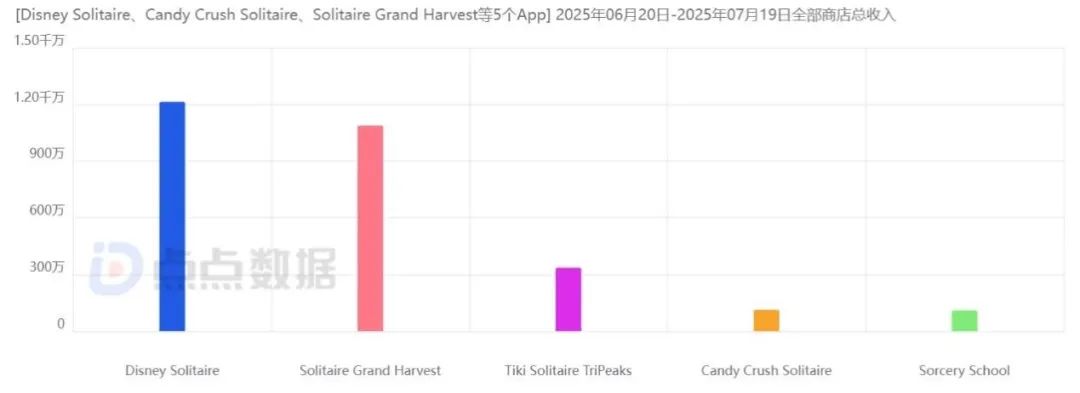
Core Insights - The mobile solitaire game market has seen a shift with the launch of "Disney Solitaire," which has surpassed "Solitaire Grand Harvest" in revenue, achieving $12.13 million in the last 30 days compared to $10.87 million for "Solitaire Grand Harvest" [1][3] - "Disney Solitaire" differentiates itself through its vibrant scenes and beloved cartoon characters, targeting Disney fans, while other IP-based games like "Candy Crush Solitaire" have not performed as well [3] - "Sorcery School," a new entry in the solitaire genre, is gaining traction with a unique fantasy setting and RPG elements, generating nearly $1.1 million in revenue over the last 30 days [5][12] Market Dynamics - "Disney Solitaire" has become the highest-grossing solitaire game in the last 30 days, indicating a competitive shift in the market [3] - Other IP-driven games like "Candy Crush Solitaire" and "Fishdom Solitaire" have struggled to maintain strong revenue, highlighting the challenges of relying solely on established brands [3][19] - The introduction of "Sorcery School" demonstrates a trend towards innovative gameplay in the solitaire genre, combining traditional card mechanics with RPG elements to enhance player engagement [5][19] Company Strategies - Pretty Simple, the developer of "Sorcery School," leverages its experience in narrative-driven games to create a compelling fantasy backdrop, which is less common in the solitaire genre [6][10] - The RPG system in "Sorcery School" allows for a more dynamic gameplay experience, encouraging in-app purchases through a structured economy involving magical items and upgrades [12][17] - The success of "Disney Solitaire" and the emergence of "Sorcery School" suggest that companies are increasingly looking to diversify gameplay mechanics and integrate popular themes to attract players [19]
18亿美元,瑞典AI独角兽让OpenAI、Meta慌了
3 6 Ke· 2025-07-22 09:37
Core Insights - Lovable, a Swedish AI startup, has completed a $200 million Series A funding round, achieving a valuation of $1.8 billion, marking the largest Series A financing in Sweden's history [3][4] - The company aims to democratize coding by targeting non-programmers, leveraging AI tools to convert simple text prompts into functional websites and applications [3][4] - Lovable joins the ranks of other Swedish unicorns like Klarna and Spotify, indicating a growing trend of successful tech startups in Europe [3][4] Company Overview - Founded two years ago, Lovable has quickly become the largest AI startup in Stockholm, surpassing its American competitors in funding [6][7] - The company has raised a total of $225 million, significantly more than competitors like Replit and StackBlitz, which raised $97 million and $80 million respectively [6][7] - Lovable's CEO, Anton Osika, emphasizes the importance of making digital product creation accessible to the 99% of the population who have never had the ability to build digital products [4][6] Market Context - The interest in AI programming startups has surged, particularly following high-profile acquisitions and funding rounds in the sector [3][4] - Competitors like Figma and Squarespace are developing their own coding tools, indicating a competitive landscape [4] - Despite advancements, Europe lags behind the US and China in developing large language models, but Osika believes that local talent and ambition can drive innovation [8] Funding and Investment - The recent funding round was led by Accel, with participation from several notable investors, including early supporters and European tech billionaires [4][7] - Lovable plans to use the new capital to expand its team from 45 employees and enhance its product offerings [4][6] - The company has also established partnerships with major firms like Klarna and Hubspot, indicating a strategic approach to growth [4][7] Security and Challenges - Lovable has faced scrutiny regarding the security of applications created by its AI, leading to improvements in safety measures [5][6] - The company aims to ensure that users cannot create unsafe applications if they follow the platform's guidelines [5]